Haryana Board Class 7 Maths Solutions For Chapter 4 Simple Equations

Haryana Board Class 7 Maths Solutions For Chapter 4 Simple Equations

  • Equation: An open sentence containing the sign of equality is called an “equation. “
  • Linear equation: An equation involving one variable with highest power T, is called a “Linear equation” or ‘Simple equation’.
  • Solution: The value which when substituted for the variable in an equation makes LHS = RHS is called ti “solution” or “root of the given equation”.
  • Properties of equality:
    1. Reflexive property: Every number is equal to itself.
      Eg: 6 = 6, x = x etc.
    2. Symmetric property: If a, b are two numbers and a = b, then b = a
      Eg: (6 + 3) = (8 + 1) hence (8+1) = (6+3)
    3. Transitive property: Ifa = b and b = c then a = c for any three numbers a, b, c.
      Eg: 10 + 5 = 15, 15 = 3×5
      10 + 5 = 3 x 5
      If x = a and x = b, then a = b, for any three numbers x, a, b.
      Eg: 12 = 8 + 4, 12 = 7 + 5 .-.8 + 4 = 7 + 5
    4. Addition Property: If a = b, then a + c = b + c where a, b, c are any three numbers.
    5. Subtraction Property: If a = b, then a-c =b-c where a, b, c are any three numbers.
    6. Multiplicative Property: Ifa = b, then ab = be, where a, b, c are any three numbers.
    7. Division Property:Ifa = b, then = \( \frac{a}{c}=\frac{b}{c} \) where a,b,c are any three numbers and c=0.
  • We can add the same number to both sides ofan equation.
  • We can subtract the same number from both sides of an equation.
  • We can multiply both sides of an equation by the same non-zero number.
  • We can divide both sides of an equation by the same non-zero number.
  • In transforming terms from L.H.S. to R.H.S.
    ‘+ quantity’ becomes ‘- quantity’
    ‘- quantity’ becomes ‘+ quantity’
    ‘x quantity’ becomes ‘÷quantity’
    ‘÷ quantity’ becomes ‘x quantity’
  • Transposition: We can drop any term from one side of an equation and take it to the otherside with its sign changed. This process is called “Transposition”.
  • Simple equation: An equation in one variable with highest power 1 is known as Simple equation.
    Eg: y – 7 = 11; 2m- 5 = m + 7
  • Bhaskara – II: Bhaskara-II is a famous mathematician of an ancient India. He wrote ‘Siddhanta Shiromani’.
  • Variables: The word variable means something that can vary i e. change. A vanable takes on different numerical values; its value is not fined Variables ore denoted usually by letters of the alphabets such as x, y, z, l, m, n, p. etc.
  • Expressions: Expressions ore formed by performing operations like addition, subtraction, multiplication and division on the variables.
    Example: 4x + 5
  • Equations: An equation is a kind of condition on a vanable. An expression equated to some value is called an equation.
    Example: 4i + 5 – 9
  • Value of an expression:
    The value of an expression depends upon the value of the variable from which the expression is formed.
    Example: 4x + 5
    At x-0; 4×0+ 5= 0 + 5=5
    At x=l; 4×1+ 5=4 + 5=9
    At x=2; 4×2+ 5=8 + 5=13
    At x=5; 4×5+ 5=20 + 5=25

Haryana Board Class 7 Maths Solutions For Chapter 4 Exercise – 4.1 :

1. Complete the last column of the table
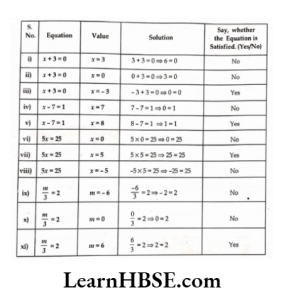
Complete the last column of the table

Haryana Board Class 7 Maths Simple Equations solutions

2. Check whether the value given in the brackets is a solution to the given equation or not:

1) n + 5 = 19 (n = 1)

Solution: 11 + 5 = 19

n =1;

LHS =1+5=6

RHS =19

LHS ≠ RHS

n =1 is not a solution.

HBSE Class 7 Simple Equations Solutions

2) 7n + 5 = 19 (n = -2)

Solution: 7H + 5 = 19

n= -2;

LHS = 7n + 5

= 7 (-2) + 5 = -14 + 5 = -9

RHS = 19

LHS ≠ RHS

n = – 2 is not a solution.

3) 7n + 5 =19 (n=2)

Solution: 7n + 5 = 19

n = 2

LHS = 7n + 5

= 7 x 2 + 5 = 14 + 5-19

RHS = 19

LHS = RHS

n = 2 is a solution

How to solve linear equations Class 7 HBSE

4) 4p – 3 = 13 (p = 1)

Solution:

4p-3 = 13

p-1 ;

LHS = 4p -3

=4 x 1- 3 = 4 – 3 = 1

RHS = 13

LHS ≠ RHS

p =1 is not a solution.

5) 4p – 3 = 13 (p = – 4)

Solution:

4p – 3=13

p = -4;

LHS = 4p – 3

4(- 4) – 3 = – 16 – 3 = -19

RHS = 13

LHS ≠ RHS

p = – 4 is not a solution.

6) 4p-3 = 13 (p = 0)

Solution:

4p – 3 = 13

p = 0;

LHS =4p-3

= 4(0) – 3 = 0- 3 = -3

RHS = 13

LHS ≠ RHS

p = 0 is not a solution

3. Solve the following equations by trial and error method:

1) 5p + 2 = 17
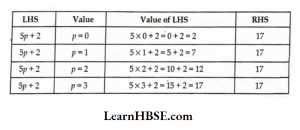
5p + 2 = 17

p = 3 is the solution.

2) 3m- 14 = 4
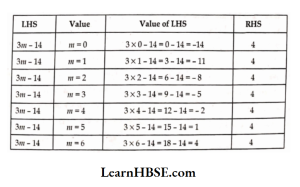
3m - 14 = 4

Solution:

m= 6 is the solution.

Key Questions in Simple Equations for Class 7 HBSE

4. Write equations for the following statements:

1) The sum of numbers x and 4 is 9.

Solution: 1 + 4-9

2) 2 subtracted from y is 8.

Solution: y- 2 = 8

3) Ten times a is 70.

Solution: 10a = 70

Transposition method in algebra Class 7 Haryana Board

4) The number h divided by 5 gives 6.

Solution: \( \frac{b}{5} \)

5) Three-fourth of t is 15

Solution: \( \frac{3}{4} t=15 \)

6) Seven times m plus 7 gets you 77.

Solution: 7m + 7 = 77

7) One – fourth of a number ‘x’ minus 4 gives 4.

Solution: \( \frac{1}{4} x-4=4 \)

8) If you take away 6 from 6 times y, you get 60.

Solution: 6y- 6 60

9) If you add 3 to one – third of z, you get 30.

Solution: \( \frac{1}{3} z+3=30 \)

5. Write the following equations in statement forms :

1) p + 4 = 15

Solution: Sum of p and 4 is 15.

2) m – 7- 3

Solution: The difference between m and 7 is 3.

3) 2m = 7

Solution: Two times m is 7

4) \( \frac{m}{5}=3 \)

Solution: One-fifth of m is 3

5. \( \frac{3 m}{5}=6 \)

Solution: Three-fifth of m is 6.

6) 3p + 4 = 25

Solution:

If we add 4 to three times of p we get 25.

Sample Problems Simple Equations Haryana Board Class 7

7) 4p – 2 =18

Solution: 2 subtracted from four times of p gives 18

8) \( \frac{p}{2}+2=8 \)

Solution: Adding 2 to half of p gives 8

Haryana Board Class 7 Maths Solutions For Chapter 4

1) Irfan says that he has 7 marbles more than five times the marbles Parmit has. Irfan has 37 marbles. (Take m to be the number of Parmit’s marbles.)

Solution:

Let Parmit have ’m’ marbles

Five times of m is 5m

7 more than five times of m – 5m + 7

i.e. Irfan has 5m + 7 marbles.

But it is given that Irfan has 37 marbles

5m + 7 = 37 is the requirrd equation.

2) Laxmi’s father is 49 years old. He is 4 years older than three times Laxmi’s age. (Take Laxmi’s age to be ‘y’ years.)

Solution:

Let the age of Laxmi be ‘y’ years

Three times Laxmi’s age = 3y yearss

Laxmi’s father is 4 years older than three times Laxmi’s age.

Age of Lnxmi’s father = 3y + 4 years.

It is given that Laxmi’s father is 40 years old.

3y + 4 = 49 is the required equation.

Solving simple equations step by step Class 7 HBSE

3) The teacher tells the class that the highest marks obtained by a student in her class is twice the lowest marks plus 7. The highest score is 87. (Take the lowest score to be T.)

Solution:

Let the lowest score be l.

Twice the lowest marks = 2l.

Highest score obtained by a student in her class is twice the lowestmarks plus 7.

i.e., Highest score =2l+ 7

Given that the highest score is 87.

2l+ 7 = 87 is the required equation.

4) In an isosceles triangle, the vertex angle is twice either base angle. (Let the base angle be ‘b’in degrees. Remember that the sum of angles of a triangle is 180 degrees.)

Solution:

Let the base angle be ‘b’ degrees

Vertical angle = Twice the base angle = 2b degrees

Sum of the angles of triangle = 180° b + b + 2b = 180°

4b = 180° or b = 45° is the required equation.

Haryana Board Class 7 Maths Solutions For Chapter 4

1) When you multiply anumber by 6 and subtract 5 from the product you get 7. Can you tell what the number is?

Solution:

Let the number be x

Multiplying by 6it becomes 6x

Subtract 5 from the product it becomes 6x-5

Given its value is 7

6x- 5 = 7

Transposing- 5 from LHS to RHS

6x = 7 + 5

6x = 12

(or)

\( x=\frac{12}{6}=2 \)

The required numberis 2.

2) What is that number one-thirdofwhich added to 5 gives 8?

Solution:

Let the number be x

One – third of that number is \( \frac{1}{3} \times x=\frac{x}{3} \)

Add 5 to it

\( \frac{x}{3}+5 \)

Given its value is 8

\( \frac{x}{3}+5=8 \)

Transposing 5 from LHS to RHS

\( \begin{aligned}
\frac{x}{3} & =8-5 \\
& \Rightarrow \frac{x}{3}=3
\end{aligned} \)

Multiplying both sides by 3 we get

\( \frac{x}{3} \times 3=3 \times 3 \text { or } \mathrm{x}=9 \)

The required number is 9.

Haryana Board Class 7 Maths Solutions For Chapter 4

1. There are two types of boxes containing mangoes. Each box of the larger type contains 4 more mangoes than the number of mangoes contained in 8 boxes of the smaller type. Each larger box contains 100 mangoes. Find the number of mangoes contained in the smaller box.

Solution:

Let the number of mangoesin the small box be x.

Number of mangoesin larger type box are 4 more than the number of mangoes contained in 8 boxes of the smaller type.

Equation is 8x + 4 = 100

Transposing 4 froms LHS to RHS

8x = 100 – 4

8x = 96

Dividing both sides by 8 we get

\( \frac{8 x}{8}=\frac{96}{8} \Rightarrow 64 x=768 \) \( x=\frac{768}{64} \)

x= 12

The number of mangoes contained in the smaller box are 12

Solving Equations Class 7 Haryana Board

Haryana Board Class 7 Maths Solutions For Chapter 4 Exercise-4.3

1. Setup equations and solve them to find the unknown numbers in the following cases:

(1) Add 4 to eight times a number; you get 60.

Solution: Let the number be x

Eight times the number is 8x

Add 4 to this product it becomes 8x + 4

Given its value is 60

8x + 4 = 60

Transposing 4 from LHS to RHS

8x = 60- 4

=> 8x = 56

Dividing both sides by 8 we get

\( \begin{aligned}
& \frac{8 x}{8}=\frac{56}{8} \Rightarrow 64 x=448 \\
& x=\frac{448}{64}
\end{aligned} \)

⇒ x = 7

The required number is 7.

2) One-fifth of a number minus 4 gives 3.

Solution:

Let the number be x

One -fifth of this number is \( x \times \frac{1}{5}=\frac{x}{5} \)

Subtracting 4 from it we get

\( \frac{x}{5}-4 \)

Given its value is 3

\( \frac{x}{5}-4=3 \)

Transposing – 4 from LHS to RHS

\( \begin{aligned}
& \frac{x}{5}=3+4 \\
& \Rightarrow \frac{x}{5}=7
\end{aligned} \)

Multiplying both sides by 5 we get

\( \frac{x}{5} \times 5=7 \times 5 \)

=> x = 35

The required number is 35.

3) If I take three-fourths of a number and add 3 to it,I get 21.

Solution:

Let the number be x

Three-fourth of this number is

\( x \times \frac{3}{4}=\frac{3 x}{4} \)

Adding 3 to this value we get

\( \frac{3 x}{4}+3 \)

Given its value is 21

\( \frac{3 x}{4}+3=21 \)

Transposing 3 from LHS to RHS

\( \begin{aligned}
& \frac{3 x}{4}=21-3 \\
& \Rightarrow \frac{3 x}{4}=18
\end{aligned} \)

Multiplying both sides by 4 we get

\( \begin{aligned}
& \frac{3 x}{4} \times 4=18 \times 4 \\
& \Rightarrow 3 x=72
\end{aligned} \)

Dividing both sides by 3 we get

\( \begin{aligned}
& \frac{3 x}{4}=\frac{72}{3} \Rightarrow 9 x=216 \\
& \Rightarrow x=24
\end{aligned} \)

=> x = 24

The required number is 24.

4) When I subtracted 11 from twice a number, the result was 15.

Solution:

Let the number be x

Twice of that number is 2x

Subtracting 11 from this product, we get 2x-11

Given its value is 15

2x-11 = 15

Transposing – 11 from LHS to RHS

2x = 15 + 11

=> 2x = 26

Dividing both sides by 2 we get

\( \begin{aligned}
& \frac{2 x}{2}=\frac{26}{2} \Rightarrow 4 x=52 \\
& x=\frac{52}{4}
\end{aligned} \)

=>x= 13

The required number is 13

5) Munna subtracts thrice the number of notebooks he has from 50, he finds the result to be 8.

Solution:

Let the number be x

Thrice of the number is 3x

On subtracting thrice the number of notebooks from 50, it becomes 50 – 3x

The result is 8

50 -3x = 8

On transposing 50 from LHS to RHS

– 3x = 8 – 50

– 3x =- 42

Dividing both sides by -3 we get

\( \begin{aligned}
& \frac{-3 x}{-3}=\frac{-42}{-3} \Rightarrow 9 x=126 \\
& \Rightarrow x=\frac{126}{9} \Rightarrow x=14
\end{aligned} \)

The required number is 14.

HBSE Class 7 Maths Chapter 4 Guide

6) Ibenhal thinks a number. If she adds 19 to it and divides the sum by 5 she will get 8.

Solution:

Let the number be x

Adding 19 to it, we get x + 19

Dividing the sum by 5 we get \( \frac{x+19}{5} \)

The result is 8

\( \frac{x+19}{5}=8 \)

Multiplying both sides by 5 we get

\( \frac{x+19}{5} \times 5=8 . \times 5 \)

=> x+ 19 = 40

Transposing 19 from LHS to RHS

x= 40 – 19

x= 21

The required number is 21

7) Anwar thinks of a number. If he takes away 7 from \( \frac{5}{2} \) of the number, the result is 23.

Solution:

Let the number be x

\( \frac{5}{2} \text { of the number is } \frac{5 x}{2} \)

Take away 7 from it we get

\( \frac{5 x}{2}-7 \)

The result is 23

\( \frac{5 x}{2}-7=23 \)

Transposing -7 from LHS to RHS

\( \frac{5 x}{2}=23+7 \Rightarrow \frac{5 x}{2}=30 \)

Multiplying both sides by 2 we get

\( \frac{5 x}{2} \times 2=30 \times 2 \Rightarrow 5 x=60 \)

Dividing both sides by 5 we get

\( \frac{5 x}{2}=\frac{60}{5} \Rightarrow 25 x=300 \)

=> x = 12

The required number is 12

2. Solve the following:

1) The teacher tells the class that the highest marks obtained by a student in her class is twice the lowest marks plus 7. The highest score is 87. What is the lowest score?

Solution: Let the lowest score be x

Twice the lowest marks plus 7 is 87

2x + 7 = 87

Transposing 7 from LHS to RHS

2x = 87-7

=> 2x = 80

Dividing both sides by 2 we get

\( \begin{aligned}
& \frac{2 x}{2}=\frac{80}{2} \Rightarrow 4 x=160 \\
& \Rightarrow x=40
\end{aligned} \)

The lowest score in the class is 40.

2) In an isosceles triangle, the base angles are equal. The vertex angle is 40°. What are the base angles of the triangle? (Remember, the sum of three angles of a triangle is 180°)

Solution:

ABC is an isosceles triangle.

The base angles are equal.

Let one of its measure be x.

Given: Vertex angle is 40°
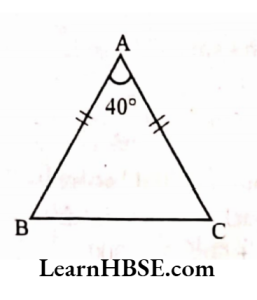
ABC is an isosceles triangle

Sum of the three angles of a triangle is 180°.

i.e. ∠A+∠B+∠C = 180°

=> 40° + x + x = 180°

=> 40° + 2.V = 180°

Transposing 40° from LHS to RHS we get

2x = 180° – 40°

=> 2x = 140°

Dividing both sides by 2 we get

\( \begin{aligned}
&\frac{2 x}{2}=\frac{140^{\circ}}{2} \Rightarrow 4 x=280^{\circ}\\
&\Rightarrow x=\frac{280^{\circ}}{4}
\end{aligned} \)

=> x= 70°

The base angle is 70° each

Important Concepts Simple Equations Class 7 HBSE

3) Sachin scored twice as many runs as Rahul. Together, their runs fell two short of a double century. How many runs did each one score?

Solution: Let runs scored by Rahul be x

Then runs scored by Sachin = 2x

The sum of their runs is two short of a double century.

x + 2.x + 2 = 200

=> 3x + 2 = 200

Transposing 2 froms LHS to RHS

3x = 200 -2

=> 3x = 198

Dividing both sides by 3 we get

\( \begin{aligned}
& \frac{3 x}{3}=\frac{198}{3} \Rightarrow 9 x=594 \\
& \Rightarrow x=\frac{594}{9}
\end{aligned} \)

=> X = 66

Runs scored by Rahul = 66

Runs scored by Sachin = 132

3. Solve the following:

1) Irfan says that he has 7 marbles more than five times the marbles Parmithas. Irfan has 37 marbles. How many marbles does Parmit have?

Solution:

Let the number of marbles with Parmit be

If five times the number is added to 7 we get 37 marbles.

5x + 7 = 37

Transposing 7 from LHS to RHS

5x = 37-7 => 5x = 30

Dividing both sides by 5 we get

\( \begin{aligned}
& \frac{5 x}{5}=\frac{30}{5} \Rightarrow 25 x=150 \\
& \Rightarrow x=\frac{150}{25} \\
& \Rightarrow x=6
\end{aligned} \)

Parmit has 6 marbles.

2) Laxmi’s father is 49 years old. He is 4 years older than three times Laxmi’s age. What is Laxmi’s age?

Solution:

Let Laxmi’s age be x years

Laxmi’s father is 49 years old and is 4 years older than three times Laxmi’s age.

3x + 4 = 49

Transposing 4 from LHS to RHS

3x = 49- 4

=> 3x = 45

Dividing both sides by 3 we get

\( \begin{aligned}
& \frac{3 x}{3}=\frac{45}{3} \Rightarrow 9 x=135 \\
& \Rightarrow x=\frac{135}{9} \Rightarrow \mathrm{x}=15
\end{aligned} \)

Laxmi’s age is 15 years.

Word problems on simple equations Class 7 HBSE

3) People of Sundargram planted trees in the village garden. Some of the trees were fruit trees. The number of non fruit trees were two more than three times the number of fruit trees. What was the number of fruit trees planted if the number of non – fruit trees planted was 77?

Solution:

Let the number of fruit trees planted be x

Number of non – fruit trees = 3x + 2

Given non – fruit trees = 77

3x + 2 = 77

Transposing 2 from LHS to RHS

3x = 77- 2

=> 3x = 75

Dividing both sides by 3 we get

\( \begin{aligned}
& \frac{3 x}{3}=\frac{75}{3} \Rightarrow 9 x=225 \\
& x=\frac{225}{9}
\end{aligned} \)

x = 25

The number of fruit trees planted are 25.

4. Solve the following riddle:

I am a number,

Tell my identity!

Take me seven times over

And add a fifty !

To reach a triple century

You still need forty !

Solution:

Let the number be x

Seven times of this number is 7 x x = 7x

On adding 50 it becomes 7x + 50

To reach a triple century we need forty

7x + 50 + 40 = 300

=> 7x + 90- 300

Transposing 90 bom LHS to RHS

7x-300-90

=> 7x- 210

Dividing both sides by 7 we get

\( \begin{aligned}
& \frac{7 x}{7}=\frac{210}{7} \Rightarrow 49 x=1470 \\
& x=\frac{1470}{49} \Rightarrow x=30
\end{aligned} \)

The required number is 30.

Haryana Board Class 7 Maths Chapter 4 Very Short Answer Questions

1. What is meant by simple equation?

Solution: An equation is a condition on a variable such that two expressionsin the variable should have equal value.

2. What is meant by solution of an equation ?

Solution:

The value of the variable for which the equation is satisfied is called the solution of the equation.

3. Find the value of the expression 4x + 5 at x = 1, 2, 3

Solution:

Given expression is 4x + 5

At x =1 its value is4(l) + 5- 4 + 5- 9

x = 2 its value is 4 (2) + 5 – 8 + 5 – 13

x- 3 its value is 4 (3) + 5 = 12 + 5-17

4. “If you subtract 5 from 6 times a number you get 7” write this statement in the form of an equation.

Solution:

Let the number be x; x multiplied by 6 is 6x. Subtracting 5 from 6x, we get 6x-5.

The obtained result is 7.

6x – 5- 7

5. Solve 4 (m + 3) – 18

Solution:

4(m + 3)-18

Divide both sides by 4

m + 3 = \( \frac{18}{4} \)

=> m + 3 = \( \frac{9}{2} \)

m = \( \frac{9}{2} \) – 3

\( m=\frac{9}{2}-\frac{6}{2}=\frac{3}{2} \)

Practice Problems Simple Equations Class 7 Haryana Board

6. The sum of three times a number and 11 is 32. Find the number.

Solution:

Let the number be x

3x + 11 = 32

3x = 32 – 11

3x- 21

x = \( \frac{21}{3} \) = 7

The required number is 7.

7. The sum of twice a number and 4 is 80, find the number.

Solution:

Let the number be ‘x’

Twice a number = 2x

The sum of twice a number and 4 is 80

=> 2x + 4 = 80

=> 2x = 80 – 4

=> 2x – 76

x= \( \frac{76}{2} \)

=> x = 38

The number = 38

8. Find the value of x from the adjacent diagram.

Solution: From the figure
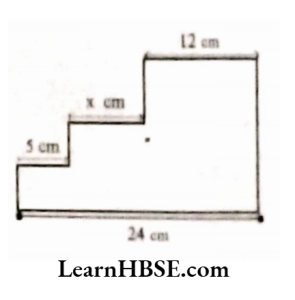
Adjacent diagram

12 + x + 5 – 24

17 + x – 24

x – 24 – 17

x – 7 cm

9. To convert temperature from Fahrenheit to Centigrade, we use the formula (F-32) = \( \frac{9}{5} \) x C.If C = -40° C then find F.

Solution:

F-32 = \( \frac{9}{5} \) x C

If C = – 40°C then F – 32 = \( \frac{9}{5} \) x -40

F – 32 = 9 x 8

F – 32 = -72

F = -72+32

F = -40°

10. Write the equations of the following mathematical statements.

1) A number A decreased by 5 is 14.

Solution: A – 5 = 14

2) Eight times of y plus 3 is -5.

Solution: Eight times of

y = 8 X y = 8y

Eight times of y plus 3 is – 5

8y + 3 = -5

3) If you add one fourth of z to 3 you get 7.

Solution:

One fourth of z = \( \frac{z}{4} \)

If we add one fourth of z to \( 3=\frac{z}{4}+3 \)

\( \frac{z}{4}+3=7 \)

4) If you take away 5 from 3 times of m, you get 11.

Solution:

3 times of m = 3 x m = 3m

If we take away 5 from 3 times of m

= 3m – 5

3m- 5 = 11

5) Sum of angles 2x (x – 30) is a right angle.

Solution: The sum of angles 2x (x – 30)

= 2x + x – 30

= 3x – 30

Right angle = 90°

3x -30 = 90″

3x = 120°

6) The perimeter of a square of side ‘a’ is 14 m

Solution:

The side of a square is ‘a’ m

Perimeter of a square = 4 x side

= 4 x a = 4a m.

The result is => 4a = 14 m.

11. Write the following equations in statement form.

1) m – 5 =12

Solution: ‘m’ is decreased by 5 is 12.

2) \( \frac{a}{3}=4 \)

Solution: One third of number ‘a’ is 4.

3) 4x + 7 = 15

Solution: 4 times of ‘x’ and 7 is 15

4) 2 – 3y = 11

Solution: 2 is decreased bv 3 time ‘y’ is 11

12. Write any three equivalent equations having the solution a = -5

Solution:
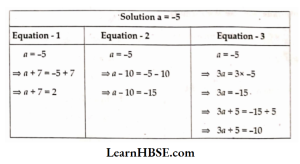
Write any three equivalent equations having the solution a = -5

Here a + 7 = 2; a-10 = -15 and 3a + 5 = -10 are equivalent equations because they have the same solution a = – 5

13. The difference between two numbers is 7. Six times the smallerplus the larger is 77. Find the numbers.

Solution:

Let the smaller number be ‘x’

The differencebetween two numbers =7

Larger number = x +7

Six times of smaller plus the largeris 77

=> 6x + x + 7 = 77

=> 7x +7 = 77

=> 7x = 77 -7

=> 7x = 70

\( \frac{70}{7} \)

=>x = 10

The smaller number = 10

Larger number = x + 7

= 10 + 7 = 17

14. In a class of 48 students, the number of girls is one third the number of boys. Find the number of girls and boys in the class.

Solution:

Let the number of boys be ‘x

then number of girls = \( \frac{x}{3} \)

Total students in the class is 48

\( \begin{aligned}
& \Rightarrow \quad x+\frac{x}{3}=48 \\
& \Rightarrow \quad \frac{3 x+x}{3}=48 \\
& \Rightarrow \quad \frac{4 x}{3}=48 \\
& \Rightarrow 4 x=48 \times 3 \\
& \Rightarrow 4 x=144 \\
& \Rightarrow x=\frac{144}{4} \\
& \Rightarrow x=36
\end{aligned} \)

Number of boys = 36

\( \begin{aligned}
\text { Number of girls } & =\frac{x}{3}=\frac{36}{3} \\
& =12
\end{aligned} \)

15. A sum of 500 is in the form of notes of denominations of 5 and 10. If the total number of notes is 90 then find the number of notes of each type.

Solution:

Total number of notes

Let the 5 notes be x then the 10 notes = 90 -x

5 denomination amount = 5x

10 denomination amount = 10 (90-x)

= 900 – 10x

Total amount = 500

=> 5x + 900 – 10 x =500

=> 900 – 5x = 500

=>-5x = 500-900

=>-5x = -400

=> 5x= 400

=> \( x=\frac{400}{5} \)

=> x = 80

Number of notes of 5 = 80

Number of notes of 10 = 90 – x

= 90 – 80 = 10

16. Suhana said, “multiplying my number by 5 and adding 8 to it gives the same answer as subtracting my number from 20. Find Suhana’s number.

Solution:

Let Suhana’s number be ‘x’

From the problem, we have

5x x + 8 = 20-x

5x + 8 = 20 – x

By transposing variables and constants,

5x + x = 20- 8

6x= 12

\( x=\frac{12}{6} \)

[Transposing 6 to R.H.S]

Suhana’s number is 2

Haryana Board Class 7 Maths Chapter 4 Long Answer Questions

17. Check whether the value given in the brackets is a solution to the given equation or not.

1) 5n – 7 = 23 (n = 6)

Solution:

When n = 6

LHS = 5n -7

= 5(6) – 7 = 30- 7

= 23

RHS = 23

LHS = RHS

So n = 6 is a solution.

2) \( \frac{p}{4}-7 \) = 5 (p = 8)

Solution: When p = 8

LHS = \( \frac{p}{4}-7 \) = \( \frac{8}{4} \) -7

= 2- 7 = -5

RHS = 5

LHS = RHS

So ‘p’ = 8 is not a solution

3) 5 – 2x = 19 (x = -7)

Solution: When x = -7

LHS = 5 – 2x = 5 – 2(-7)

= 5 + 14 = 19

RHS = 19

LHS = RHS

So, x = -7 is a solution

4) 2 + 3 (m – 1) = 5 (m = -2)

Solution:

When m = -2

LHS = 2 + 3 (m – 1)

= 2 + 3 (-2- 1) = 2 + 3(-3)

= 2-9 = -7

RHS = 5

LHS = RHS

m = -2

So, ‘m’ = -2 is not a solution
Haryana Board Solutions For Class 7 Maths Chapter 3 Data Handling

Haryana Board Solutions For Class 7 Maths Chapter 3  Data Handling

Key Concepts

  • Data:
    A data is a collection of numbers gathered to give some information.
  • We collect data by several ways. They are through newspapers, magazines, television and through various sources. All the data collected give us some sort ofinformation.
  • Collection of Data:
    Any set of data can give us some inferences butifwe want tofind a specific information,we need to collect data which can tell us about that. Some of these data are easy to collect and some are difficult.
    Below are given a few situations:
    Performance of your class in Mathematics.
    Performance of India in football or in cricket.
    Female literacy rate in a given area.
    Number of children below the age of 5 years in the families around the area.
  • Organization of Data:
    After collecting the data we have to record and organize it.
    Different kinds of data we come across in our daily life are put in a tabular form. Our school rolls, progress report, indexin the text books, temperature record and many other are recorded in a tabular form.
    If we record them in a proper table it becomes easy to understand and interpret.
  • The information eitherin theform ofpictures,numbers or words is called ‘Data’.
  • Based on method of collecting information the data is divided into two different types namely, ‘Primary data’ and ‘Secondary data’.
  • Primary Data: The data collected directly through personal experiences, interviews, direct observations etc., is called ‘Primary data’.It is also called ‘raw data’ or firsthand’ information.
  • Secondary Data: The information which has been collected in the past by someone else but used by the investigator is called ‘Secondary Data’.
  • Range of the data: The difference between maximum and minimum values of data is called ‘Range’ of the data.
  • Measures of Central Tendency:  Arithmetic mean, mode, and median.
  • Arithmetic mean (or) Average:  The sum of observations ofdata is divided by number of observations of a data is called Arithmetic mean (or) Average (or) Mean.
    \( \text { Arithmetic mean }=\frac{\text { Sum of observations }}{\text { Number of observations }} \)
  • ‘Arithmetic Mean’ is a number or value that represents or shows the central tendency of a group of observations of data.
  • ‘Arithmetic Mean’ of given data always lies between the highest and lowest observations of the data.
  • The most common representative (or) central tendency value of a grouped data is average or Arithmetic mean.
  • Mode: The observation which occurs most frequently in the given data is called ‘Mode’ of the data.
  • Data having only one mode, is known as ‘Unimodal data’.
  • Data having two modes is known as ‘Bimodal data’.
  • Median: The middle most value of the data, when the observations are arranged in either ascending or descending order is called ‘median’.
  • If the number of observations is odd then median is \( \left(\frac{(n+1)}{2}\right)^{\text {th }} observation. \)
  • If the number of observations is even then the median is average of \( \left(\frac{\mathrm{n}}{2}\right)^{\mathrm{th}} \) and \( \left(\frac{n}{2}+1\right)^{t h} \) observation.
  • Bargraph: Representation o fnumerical data by using bars of uniform width is called ‘Bar graph’.
  • In bar graphs the width of all rectangles (bars) is equal and height (lengths) of each bar is proportional to the data that it represents.
  • Double bar graph: Representation of two sets ofnumerical data on the same graph by using bits of uniform width is called double
    bar graph.
  • Pie charts: A pie chart is the representation ofthe numerical data by sectors ofthe circle such that angle ofeach sector(area ofsector) is proportional to value of the given data.
  • The parts ofcircles are called ‘sectors’
  • Angle of sector
    \( =\frac{\text { Value of the item }}{\text { Sum of the values of all items }} \times 360^{\circ} \)
  • It You will find that when all the values of data set are increased or decreased by a certain number, the mean also increases or decreases by the same number.
  • Note: If each observation in a data set is repeated an equal number of times or if no score is repeated then the data set has no mode.

1. How would you find the average of your study hours for the whole week?

Solution: First,I will find the study hours of all the 7 days of the week separately.

Then find the sum of all these study hours and divide by 7.

1. Find the mean of your sleeping hours during one week.

Solution: Students can arrange the data with the help of their parents and then solve with the help of teacher.

2. Find at least 5 numbers between \( \frac{1}{2} \) and \( \frac{1}{3} \)

Solution: 1st number

\( =\frac{\frac{1}{2}+\frac{1}{3}}{2}=\frac{\frac{3+2}{6}}{2}=\frac{5}{6 \times 2}=\frac{5}{12} \)

2nd number

\( =\frac{\frac{1}{2}+\frac{5}{12}}{2}=\frac{\frac{6+5}{12}}{2}=\frac{11}{12 \times 2}=\frac{11}{24} \)

3rd number

\( =\frac{\frac{5}{12}+\frac{1}{3}}{2}=\frac{\frac{5+4}{12}}{2}=\frac{9}{12 \times 2}=\frac{9}{24} \)

4th number

\(
=\frac{\frac{5}{12}+\frac{11}{24}}{2}=\frac{\frac{10+11}{24}}{2}=\frac{21}{24 \times 2}=\frac{21}{48} \)

5th number

\( =\frac{\frac{11}{24}+\frac{9}{24}}{2}=\frac{\frac{11+9}{24}}{2}=\frac{20}{24 \times 2}=\frac{20}{48} \)

The required five numbers are:

\( \frac{5}{12}, \frac{11}{24}, \frac{9}{24}, \frac{21}{48}, \frac{20}{48} \)

Haryana Board Solutions For Class 7 Maths Chapter 3  Data Handling Exercise-3.1

1. Find the range of heights of any ten students of your class.

Solution:

Let’s assume we have the following heights (in cm) for ten students

145, 150, 142, 155, 148, 160,135, 155, 140,165

Range = 165 cm- 135 cm

= 30 cm

HBSE Class 7 Data Handling Solutions

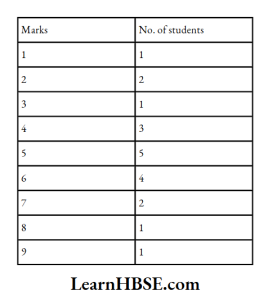
2. Organise the following marks in a class assessment, in a tabular form.

4, 6, 7, 5, 3, 5, 4, 5, 2, 6, 2, 5,1, 9, 6, 5, 8, 4, 6, 7

The frequency table:

The, frequency table

1) Which number is the highest?

Solution: 9

2) Which number is the lowest?

Solution: 1

3) What is the range of the data?

Solution: Range = Highest observation.

Lowest observation = 9-1=8

Haryana Board Class 7 Maths Data Handling Solutions

4) Find the arithmetic mean.

Solution: Arithmetic mean

\( =\frac{\text { Sum of all observations }}{\text { Number of observations }} \) \( \begin{gathered}
=\frac{4+6+7+5+3+5+4+5+2+6+2+5+1+9+6+5+8+4+6+7}{20} \\
=\frac{100}{20}=5
\end{gathered} \)

3. Find the mean of the first five whole numbers.
Solution: First five whole numbers are 0, 1, 2, 3, 4

\( \begin{aligned}
\text { Mean }= & \frac{\text { Sum of all observations }}{\text { Number of observations }} \\
& =\frac{0+1+2+3+4}{5}=\frac{10}{5}=2
\end{aligned} \)

4. A cricketer scores the following runs in eight innings: 58,76,40,35, 46,45,0,100. Find the mean score.

Solution: Given observations: 58, 76, 40, 35, 46, 45, 0, 100

\( \begin{aligned}
& \text { Mean }=\frac{\text { Sum of all observations }}{\text { Number of observations }} \\
& =\frac{58+76+40+35+46+45+0+100}{8} \\
& =\frac{400}{8}=50
\end{aligned} \)

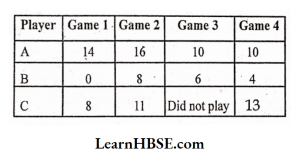
5. Following table shows the points of each player scoredin four games.

Solution:

Following table shows the points of each player scoredin four games

Now answer the following questions:

1) Find the mean to determine A’s average number of points scored per game.

Solution: Points of A in all the four games’are 14, 16, 10, 10

\( \begin{aligned}
\text { Mean } & =\frac{\text { Sum of all the observations }}{\text { Number of observations }} \\
& =\frac{14+16+10+10}{4}=\frac{50}{4}=12.5
\end{aligned} \)

2) To find the mean number of points per game for C, would you divide the total points by 3 or by 4 ? Why ?

Solution: To find the mean number of points per game for C we divide the total points by 3 because the number of games under consideration is 4 but ‘C’ did not play the 3rd game.

Key Questions in Data Handling for Class 7 HBSE

3) B played in all the four games. How would you find the mean ?

Solution: Points of B in all the four games are 0, 8, 6, 4

\( \begin{aligned}
\text { Mean } & =\frac{\text { Sum of all the observations }}{\text { Number of observations }} \\
& =\frac{0+8+6+4}{4}=\frac{18}{4}=4.5
\end{aligned} \)

4) Who is the best performer?

Solution:

A’s average =12.5

B’s average =4.5

C’s average = \( \frac{8+11+13}{3}=\frac{32}{3}=10.67 \)

A is the best performer.

Class 7 Maths Chapter 3 Data Handling Haryana Board

6. The marks (out of 100) obtained by a group of students in a science test are 85, 76, 90, 85, 39, 48, 56, 95, 81 and 75.

Find the:

1) Highest and the lowest marks obtained by the students.

Solution:

Highest marks obtained by the students = 95

Lowest marks obtained by the students = 39

2) Range of the marks obtained.

Solution:

Range = Highest marks- Lowest marks = 95 – 39 = 56

3) Mean marks obtained by the group

Solution:

\( \begin{aligned}
& \text { Mean }=\frac{\text { Sum of all observations }}{\text { Number of observations }} \\
& =\frac{85+76+90+85+39+48+56+95+81+75}{10} \\
& =\frac{730}{10}=73
\end{aligned} \)

7. The enrolment in a school during six consecutive years was as follows: 1555, 1670, 1750, 2013, 2540, 2820. Find the mean enrollment of the school for this period.

Solution:

\( \begin{aligned}
& \text { Mean }=\frac{\text { Sum of all observations }}{\text { Number of observations }} \\
& =\frac{1555+1670+1750+2013+2540+2820}{6} \\
& =\frac{12348}{6}=2058
\end{aligned} \)

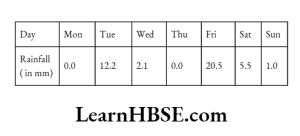
8. The rainfall (in mm) in a city on 7 days of a certain week was recorded as follows:


The rainfall (in mm) in a city on 7 days of a certain week was recorded as follows

1) Find the range of the rainfall in the above data.

Solution:

Range of the rainfall

Highest rainfall – Lowest rainfall

= 20.5 – 0.0- 20.5 mm

2) Find the mean rainfall for the week.

Solution: Mean rainfall for the week

\( \begin{aligned}
& =\frac{\text { Sum of all observations }}{\text { Number of observations }} \\
& =\frac{0.0+12.2+2.1+0.0+20.5+5.5+1.0}{7} \\
& =\frac{41.3}{7}=5.9
\end{aligned} \)

Sample Problems Data Handling Haryana Board Class 7

3) On how many days was the rainfall less than the mean rainfall?

Solution:

On 5 days the rainfall is less than the mean rainfall.

The heights of 10 girls were measured in cm and the results are as follows: 135, 150, 139’ 128, 151, 132, 146, 149, 143,141.

1) What is the height of the tallest girl?

Solution: Height of the tallest girl – 151 cm

2) What is the height of the shortest girl?

Solution. Height of the shortest girl = 128

3) What is the range of the data?

Solution: Range of the data = Highest observation – Lowest observation=151-128 = 23 cm

Haryana Board 7th Class Maths Data Handling Questions and Answers

4) What is the mean height of the girls?

Solution: Mean height of the girls

\( \begin{aligned}
& =\frac{\text { Sum of all observations }}{\text { Number of observations }} \\
& =\frac{135+150+139+128+151+132+146+149+143+141}{10} \\
& =\frac{1414}{10}=141.4 \mathrm{~cm}
\end{aligned} \)

5. How many girls have height more than the mean height ?

Solution: 5 girls have heights more than the mean height

Solutions To Try These

Find the mode of

1) 2, 6, 5, 3, 0,3, 4, 3, 2, 4, 5, 2, 4.

Solution: Arranging the numbers with same values together, we get 0,2, 2, 2, 3, 3, 3, 4, 4, 4, 5, 5, 6.

Mode of this data are 2, 3, 4 because they occur most often.

2) 2, 14, 16, 12, 14, 14, 16, 14, 10, 14, 18, 14.

Solution: Arranging the numbers with same values together we get 2, 10, 12, 14, 14, 14, 14, 14, 14, 16, 16, 18

Mode of this data is 14

Solutions To Try These

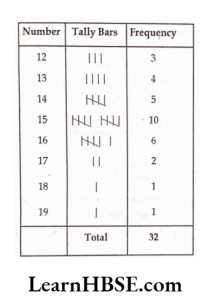
1. Find the mode of the following data: 12, 14, 12,16, 15, 13,14, 18, 19, 12, 14, 15, 16, 15, 16,16, 15,17, 13, 16, 16, 15, 15, 13, 15,17,15, 14, 15,13, 15, 14.

Solution: Let us put the data in a tabular form:

Let us put the data in a tabular form

Mode of this data is 15.

2. Heights (in cm) of 25 children are given below: 168, 165, 163, 160, 163, 161, 162, 164, 163, 162, 164, 163, 160, 163, 160, 165, 163, 162, 163, 164, 163, 160, 165, 163, 162. What is the mode of their heights? What do we understand by mode here?

Solution: Arranging the data in ascending order :

160, 160, 160, 160, 161, 162, 162, 162, 162, 163, 163, 163, 163,163, 163, 163, 163, 163, 164, 164, 164, 165, 165, 165, 168.

Here 163 cm occurred the highest number of times.

Mode = 163

We understand that most of the students have height of 163 cm.

Solutions To Try These

Discuss with your friends and give

1) Two situations where mean would be an appropriate representative value to use, and

2) Two situations where mode would be an appropriate representative value to use.

Solution:

1) Two situations where mean would be appropriate:

1. Average grades

2. Age distribution
2) Two situations where mode would be appropriate:

1. Preferred mode of transportation
2. Clothing sizes

In these situations, the mean is suitable for calculating the average or overall value, while the m useful for identifying tire most frequently occurring value in the dataset.

Solutions To Try These

Your friend found the median and the mode of a given data. Describe and correct your friends error if any : 35, 32, 35, 42, 38, 32, 34 Median 42, Mode  32

Solution: Arranging the data in ascending order :

32, 32, 34, 35, 35, 38, 42

Median is the middle observation

Median =35

Here 32, 35 occurred two times

Mode – 32, 35

Haryana Board Class 7 Data Collection and Organization

Haryana Board Solutions For Class 7 Maths Chapter 3  Data Handling Exercise-3.2

1, The scores in Mathematics test (out of 25) of 15 students is as follows: 19, 25, 23, 20, 9, 20, 15, 10, 5, 16, 25, 20, 24, 12, 20. Find the mode and median of this data Are they same?

Solution: Given scores: 19, 25, 23, 20, 9, 20,15, 10, 5, 16, 25, 20, 24, 12, 20

Median: Arranging the data in ascending order: 5, 9, 10, 12, 15, 16,19, 20, 20, 20, 20, 23, 24, 25, 25

Median is the middle observation.

Median = 20

Mode: 20 occurred more frequently

A Mode =20

Yes, median and mode of the given scores are same.

2. The rims scored in a cricket match by 11 players is as follows: 6, 15, 120, 50, 100, 80, 10, 15, 8, 10, 15 Find the mean, mode and median of this data. Are the three same ?

Solution:

Given: Runs scored in a cricket match by 11 players 6, 15, 120, 50, 100, 80, 10, 15,8,10,15.

1) Mean:

\( \begin{aligned}
& \quad \text { Mean }=\frac{\text { Sum of all observations }}{\text { Number of observations }} \\
& =\frac{6+15+120+50+100+80+10+15+8+10+15}{11} \\
& =\frac{429}{11}=39
\end{aligned} \)

∴ Mean = 39

2) Median:

Arranging the datain ascending order : 6, 8, 10, 10, 15, 15, 15, 50, 80, 100, 120

Median is the middle observation.

Median = 15

3) Mode:

Mode is the observation with highest frequency.

Mode = 15

Here mean, mode and median are not same

Chapter 3 Data Handling Class 7 Solutions in Hindi Haryana Board

3. The weights (in kg.) of15 students of a class are: 38, 42/ 35, 37, 45, 50, 32, 43, 43, 40, 36, 38, 43, 38, 47

1) Find the mode and median of this data.

2) Is there more than one mode?

Solution:

1) The weights (in kg.) of 15 students of a class. 38, 42, 35, 37, 45, 50, 32, 43, 43, 40, 36, 38, 43, 38, 47

Median:

Arranging the grades in ascending order: 32, 35, 36, 37, 38, 38, 38, 40, 42, 43, 43, 43, 45, 47, 50

∴ Median = 40

Mode: It is the observation with highest frequency

Mode = 38 ;43

2) Yes there are two modes. i.e. 38 and 43.

4. Find the mode andmedian of the data: 13, 16,12,14, 19, 12, 14, 13, 14

Solution:

Given data:13,16,12,14,19,12,14,13,14 Median:

Arranging the data in ascending order: 12,12,13,13,14,14,14,16,19

Median = 14

Mode: It is the observation with highest frequency.

Mode = 14

5. Tell whether the statement is true or false:

1) The mode is always one of the                                                                         – True

2) The mean is one of the numbers in a data.                                                      – False

3) The median is always one of the numbers in a data.                                           -True

4) The data 6, 4, 3, 8, 9, 12, 13, 9 has mean 9.                                                  – False

Solutions To Try These

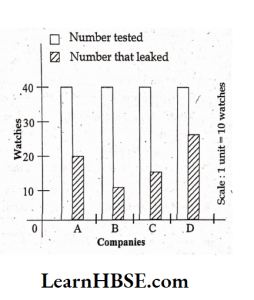
1. The bar graph shows the result of a survey to test water-resistant watches made by different companies. Each of these companies claimed that their watches were water-resistant. After a test the above results were revealed.

The bar graph shows the result of a survey to test water resistant watches made by different companies

1) Can you work out a fraction of the number of watches that leaked to the number tested for each company?

Solution: In scale:1 unit = 10 watches

For company A: Required ratio

\( =\frac{200}{400}=\frac{1}{2} \)

For company B: Required ratio

\( =\frac{100}{400}=\frac{1}{4} \)

For company C: Required ratio

\( =\frac{150}{400}=\frac{15}{40}=\frac{15 \div 5}{40 \div 5}=\frac{3}{8} \)

For company D: Required ratio

\( =\frac{250}{400}=\frac{25}{40}=\frac{25 \div 5}{40 \div 5}=\frac{5}{8} \)

2) Could you tell on this basis which company has better watches?

Solution: Company B has better watches.

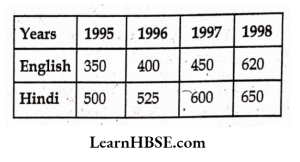
2. Sale of English and Hindi books in the years 1995,1996,1997 and 1998 are given below:

Sale of English and Hindi books in the years 1995,1996,1997and1998 are given below

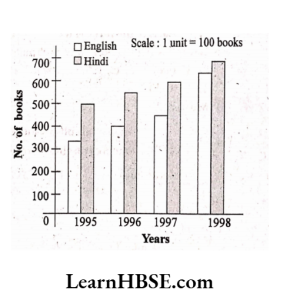
Draw a double bar graph and answer the following questions

Draw a double bar graph and answer the following questions

1) In which year was the difference in the sale of the two language books least?

Solution:

Difference

In 1995 —> 500-350 = 150

In1996 —> 525 – 400 = 125

In 1997 —> 600- 450 = 150

In 1998 —> 650-620 = 30

In the year 1998 the difference in the sale of two language books is least

2) Can you say that the demand for the English books rose faster? Justify.

Solution: Yes, we can say that the demand for English books rose faster.

Haryana Board Solutions For Class 7 Maths Chapter 3  Data Handling Exercise-3.3:

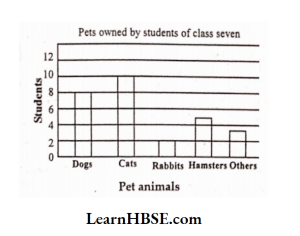
1. Use the bar graph to answer the following questions.

Use the bar graph to answer the following questions

1) Which is the most popular pet?

Solution: ‘Cat’ is the most popular pet.

2) How many students have dog as a pet?

Solution: 8 students have a dog as a pet.

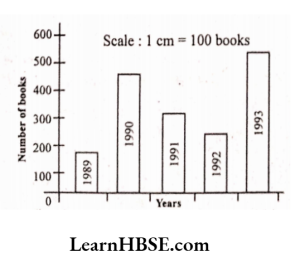
2. Read the bar graph which shows the number of books sold by a bookstore during five consecutive years and answer the following questions:

Read the bar graph which shows the number of books sold by a bookstore during five consecutive years

Haryana Board Class 7 Maths Exercise 3.1 Solutions

1) About how many books were sold in 1989? 1990? 1992?

Solution: Number of books sold in 1989 = 175 (approx)

Number of books sold in 1990 = 475 (approx)

Number of books sold in 1992 = 225 (approx)

2) In which year were about 475 books sold? About 225 books sold?

Solution:

About 475 books were sold in 1990.

About 225 books were sold in 1992.

3) In which years were fewer than 250 books sold ?

Solution: In the years 1989 and 1992 fewer than 250 books were sold.

4) Can you explain how you would estimate the number of books sold in 1989?

Solution: From the bar graph reading it is clear that the number of books in 1989 is 175.

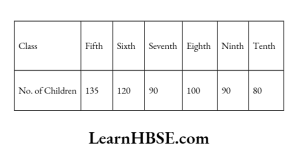
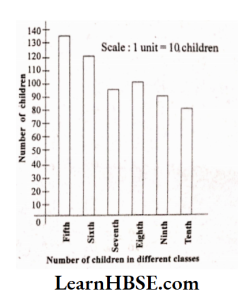
3. Number of children in six different classes are given below. Represent the data on a bar graph.

Number of children in six different classes are given below

Number of children in six different classes are given below. Represent the data on a bar graph

1) How would you choose a scale?

Solution: Start the scale at ‘O’.

The greatest value in the given data is 135. So mark the scale at the value greater than 135 such as 140. Use equal division along axes such as an increment of 10. Take 1 unit for 10 children.

2) Answer the following questions:

1) Which class has the maximum number of children ? And the minimum ?

Solution:

Fifth class has the maximum number of children.

Tenth class has the minimum number of children.

2) Find the ratio of students of class sixth to the students of class eight.

Solution: Ratio of students of class sixth to eighth = 120 : 100

\( =\frac{120}{100}=\frac{6}{5}=6: 5 \)

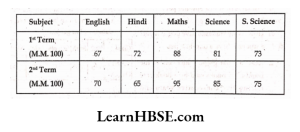
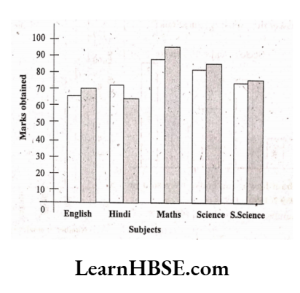
4. The performance of a studentin l9t term and 2nd term is given. Draw a double bar graph choosing appropriate scale and answer the following:

The performance of a studentin l st term and 2nd termis given bargraph

Solution:

The performance of a studentin lst term and 2nd termis given bargraph

1) In which subject, has the child improved his performance the most ?

Solution: In Maths the child has improved his performance the most.

2) In which subject is the improvement the least ?

Solution: HisScience the child’s improvement is the least.

3) Has the performance gone downin any subject ?

Solution: Yes, his performance has gone downin Hindi.

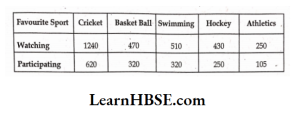
5. Consider this data collected from a survey of a colony.

Consider this data collected from a survey of a colony

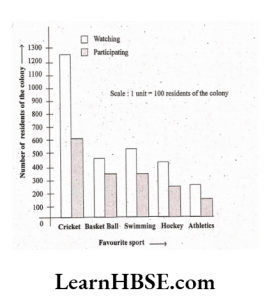
1) Draw a double bar graph choosing an appropriate scale. What do you infer from the bar graph?

Solution:

Draw a double bar graph choosing an appropriate scale

Inference: The residents of the colony like cricket the most and athletics tire least

2) Which sport is most popular?

Solution: Cricket is most popular watching as well as participating.

3) Which is more preferred, watching or participating in sports?

Solution: Watching sports is more preferred than participating in sports.

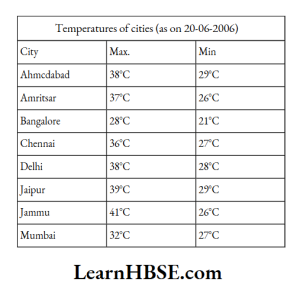
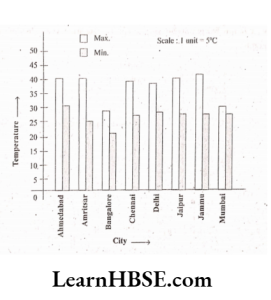
6. Take the data giving the minimum and the maximum temperature of various cities given in the beginning of this chapter. Plot a double bar graph using the data and answer the following:

Take the data giving the minimum and the maximum temperature of various cities given in the beginning of this chaper

Take the data giving the minimum and the maximum temperature of various cities given in the beginning of this chaper bar graph

HBSE Class 7 Maths Chapter 3 Guide

1) Which city has the largest difference in the minimum and maximum temperature on the given data?

Solution:

Ahmedabad → 38°- 29° = 9°C;

Bangalore → 28°- 21° = 7°C;

Delhi → 38°-28° =10°C ;

Jammu → 41°- 26° = 15°C;

Amritsar → 37°- 26°= 11°C

Chennai → 36°- 27° = 9°C

Jaipur → 39°- 29° = 10°C

Mumbai → 32°- 27° = 5°C

Jammu has the largest difference in the minimum and maximum temperatures on the given data.

2) Which is the hottest city and which is the coldest city?

Solution: Jammu is the hottest city and Bangalore is the coldest city.

3) Name two cities where maximum temperature of one was less than the minimum temperature of the other.

Solution: Bangalore and Ahmedabad orBangalore and Jaipur.

4) Name the city which has the least difference between its minimum and the maximum temperature.

Solution: Mumbai.

Additional Questions

Haryana Board Solutions For Class 7 Maths Chapter 3  Data Handling Very Short Answer Questions

1. What is meant by a data?

Solution:

A data is a collection of numbers gathered to give some information.

2. Define ‘Range’ of a data.

Solution:

The difference between the highest and the lowest observations of a data is called range

3. Find the arithmetic mean of 17, 31, 12,27,15,19,23

Solution:

\( \text { Mean }=\frac{\text { Sum of all observations }}{\text { Number of observations }} \) \( \begin{aligned}
& =\frac{17+31+12+27+15+19+23}{7} \\
& =\frac{144}{7}=20.57
\end{aligned} \)

4. Find the range of the scores 18, 26, 23,16, 32, 18

Solution:

Range = Highest observation- Lowest observation

32-16 = 16.

Important Questions for Class 7 Maths Chapter 3 Haryana Board

5. Find the mode of the numbers 10, 8, 4,6, 10, 3, 10.

Solution:

Here 10 occurs 3 times

Mode = 10

6. Define ‘Median’.

Solution:

The data is arranged in the order of increasing or decreasing magnitude then the middle most value in this arrange ment is called median.

7. Find the median of 10, 20, 15, 29, 35,42, 14.

Solution: The values are arranged in increasing order 10,14,15, 20, 29,35, 42 Then the middle most value 20 is the median.

8. Find the arithmetic mean of first three multiples of 5.

Solution:

First three multiples of 5 are = 5, 10, 15

Arithmetic mean

\( =\frac{\text { Sum of observations }}{\text { Number of observations }} \) \( =\frac{5+10+15}{3}=\frac{30}{3}=10 . \)

9. What is the range of first ten whole numbers ?

Solution: First ten whole numbers are 0,l, 2, 3, 4,5, 6, 7, 8 and 9

Range

= Maximum value – minimum value

=9-0=9

10. Find the mean of the first five prime numbers.

Solution:

The numbers are 2, 3, 5, 7, 11

Sum ofnumbers = 2 +.3 + 5 + 7+11 = 28

\( \text { Mean }=\frac{28}{5}=5.6 \)

11. Amounts donated by eight students to ‘NIVAR’ cyclone effected people are 300, 450, 700, 650, 400, 900, 850. Find the Arithmetic Mean of amounts donated.

Solution: The amounts donatedby eight students are 300, 450,700, 650, 400, 750, 900,850.

Number of students = 8

Arithmetic mean of amounts donated

\( =\frac{\text { Sum of observations }}{\text { Number of observations }} \) \( =\frac{300+450+700+650+400+750+900+850}{8} \)

\( =\frac{5000}{8} \) = 625.

12. 20 students were participated in “SWATCH BHARAT ABHIYAN” campaign. The number of days each student participated were 5,1, 2, 4,1, 2, 3, 2,1, 2, 3, 2, 5, 3, 4, 2,1, 3, 4 and 5. Find mode of the data.

Solution: The number of days each student participated were 5,1, 2, 4,1, 2, 3, 2,1, 2,3, 2, 5, 3, 4, 2, 1,3, 4 and 5.

By arranging the numbers of saipe values together.

1,1, 1,1, 2, 2, 2, 2, 2, 2, 3, 3, 3, 3, 4, 4; 4, 5,5,5.

‘2’ occcurs most frequentlyin the data.

Mode = 2.

13. The number of pages in textbooks of different subjects are 421,175, 128>117, 150, 145, 147 and 113 find median of given data.

Solution: The number of pages in textbooks of different subjects are 421, 175, 128, 117,150, 145, 147 and 113.

Arrange the observations in ascending order113,117,128,145,147,150,175, 421.

In ‘8’ observations the 4th and 5th observations are middle most values

\( \text { Median }=\frac{145+147}{2}=\frac{292}{2}=146 .\)

14. In a set of four integers, the average of the two smallestintegers is 102, the average of the three smallest integers is 103, the average ofallfouris104. Which is the greatest of these integers ?

Solution:

Average of all four = 104

Total of four integers = 4 x 104 = 416

Total of three integers = 3 x 103 = 309

4th No = 416 -309 = 107

Total of two integers = 2 x 102 = 204

3rd No = 309- 204 = 105

Similarly 2nd is 103 & 1st is 101

The numbers are 101, 103, 105 & 107

Greatest = 107

15,. The monthly income (in rupees) of 7 households in a village are 1200, 1500, 1400,1000,1000,1600,10000. (1) Find the median income of the house holds, (2) If one more household with monthly income 1500is added, what will the median income be?

Solution: Monthly income (in rupees) are 1200, 1500, 1400, 1000, 1000, 1600, 10000

Rearrangingin ascending order, the income 1000, 1000, 1200, 1400, 1500, 1600 and 10,000

It can be seen 1400 is the median. By inclusion of one more item of 1500 and rearranging the incomes are 1000, 1000, 1200, 1400, 1500, 1500, 1600 & 10,000

From which we find both 1400 & 1500 are in the middle of the values.

The median, therefore is calculated by the average of the two middle values. i.e

\( =\frac{1400+1500}{2}=\frac{2900}{2}=1450\)

The median income = 1450

16. How many distinct sets of three positive integers have a mean of 6, a median of 7, and no mode ?

Solution: Let the integers be x, y & z

such that mean, 6 = \( \frac{x+y+z}{3} \)

ie x + y + z = 18
given median = 7
x + z = 11
x & z may be
1, 10
2,9
3,8
4,7
&5,6

such that sets of three positive integers satisfying the data are

1, 7, 10 fulfilling the condition

2, 7, 9 of mean = 6

3, 7, 8 median = 7

Haryana Board Solutions For Class 7 Maths Chapter 3  Data Handling Long Answer Questions

17. Find arithmetic mean of

1) 4,5,11,8

2) 10, 15, 21, 12, 17

3) \( \frac{1}{4}, \frac{1}{2}, \frac{3}{4}, \frac{3}{2}, \frac{5}{4} \)

1) 4,5,11,8

Solution: Arithmetic mean

\( \begin{aligned}
& =\frac{\text { Sum of observations }}{\text { Number of observations }} \\
& =\frac{4+5+11+8}{4}=\frac{28}{4}=7
\end{aligned} \)

2) 10, 15, 21, 12, 17

Solution: Arithmetic mean

\( \begin{aligned}
& =\frac{\text { Sum of observations }}{\text { Number of observations }} \\
& =\frac{10+15+21+12+17}{5} \\
& =\frac{75}{5}=15
\end{aligned} \)

3.\( \frac{1}{4}, \frac{1}{2}, \frac{3}{4}, \frac{3}{2}, \frac{5}{4} \)

Solution: Arithmetic mean

\( \begin{aligned}
& =\frac{\text { Sum of observations }}{\text { Number of observations }} \\
& =\frac{\frac{1}{4}+\frac{1}{2}+\frac{3}{4}+\frac{3}{2}+\frac{5}{4}}{5} \\
& =\frac{1+2+3+6+5}{4} \\
& =\frac{17}{4} \times \frac{1}{5}=\frac{17}{20}
\end{aligned} \)

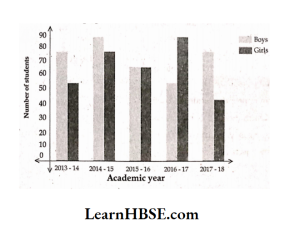
18. In the adjacent double bar graph, number of students of a class are shown according to academic year.

In the adjacent double bar graph, number of students of a class are shown according to academic year

Answer the following questions on the basis of this double bar graph.

1) In which academic year, number of girls were more than number of boys in the school ?

Solution. In 2016-17 academic year,number of girls weremore thannumber of boys in the school.

2) In which academic year, number of both girls and boys in the school were equal?

Solution: In 2015-16 academic year, number of both girlsand boysin the school were equal.

3) What was the total number of students in the school in the academic year 2013-14?

Solution. Total number of students in the academic year 2013-14 was =70 + 50 = 120.

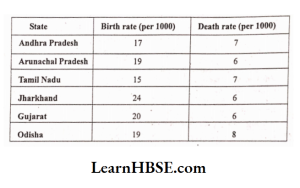
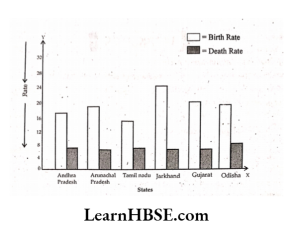
19. Birth and death rates of different states in 2015 are given below. Draw a double bar graph for the given data.

Birth and death rates of different states in 2015 are given below. Draw a double bar graph for the given data

Solution:

Steps in drawing a double bar graph:

1. Draw X-axis (horizontal line) and Y-axis (vertical line) on the graph paper and mark their intersecting point as ‘O’.

2. Take ‘States’ on X-axis

3. Take ‘Birth rate’ and ‘Death rate’ on Y-axis.

4. Take an appropriate scale on Y-axis so that birth rate and death rate can be shown easily. Let us take 1 cm = 2 units on Y-axis.

5. Find the lengths of each bar by dividing the value by 2

Example: Length of bar represents 17 birth

rate = \( \frac{17}{2} \) = 8.5 cm

Length of bar represents 7 death rate = \( \frac{7}{2} \) = 8.5 cm

=3.5 cm.

a double bar for the given data

Important Concepts Data Handling Class 7 HBSE

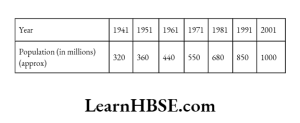
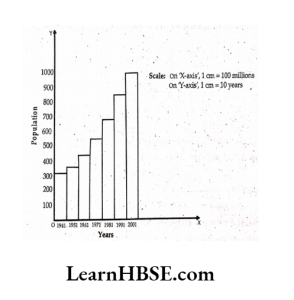
20. Draw a bar graph for the following data.

Population of India in successive census years.

Population of India in successive census years

Source Data from census ofIndia 1991 and 2001

Source: Data from census of India 1991 and 2001

Solution:

Draw X- axis (horizontalline) and Y- axis (verticalline) on the graph paper and mark their intersection as O.

Take years on X – axis

Take population on Y – axis with1 cm as 100 millions so that maximum population fits on the graph sheet.

Graph is drawn against the given values.

Haryana Board Solutions For Class 7 Maths Chapter 3  Data Handling Multiple Choice Question And Answers

1. Which of the following is not a measure of central tendency?

  1. Mean
  2. Median.
  3. Mode
  4. Range

Answer: 4

2. Range of 3, 50, 6, 19, 5, 43, 2 is 

  1. 52
  2. 48
  3. 53
  4. 46

Answer: 2

3. Mean of first 5 prime numbers is

  1. 6.5
  2. 5.2
  3. 5.6
  4. 6.2

Answer: 3

4. Mode of the data 14, 6, 12, 6, 13, 6, 14, 6

  1. 6
  2. 12
  3. 13
  4. 14

Answer: 1

5. Median of x, \(\frac{x}{2}, \frac{x}{3}, \frac{x}{4}, \frac{x}{5} \) is 5. Then x =

  1. 3
  2. 9
  3. 12
  4. 15

Answer: 4

6. Mean of three observations a, b, c is…………

  1. \( \frac{a+b+c}{3} \)
  2. \( \frac{\mathrm{a} \times \mathrm{b} \times \mathrm{c}}{3} \)
  3. \(\frac{a-b-c}{3} \)
  4. \(\frac{a \times b+c}{3} \)

Answer: 1

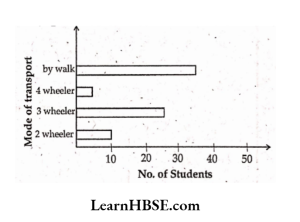
7. The bar graph shows mode of transport to a school. Here, the total no. of students is……………

The bar graph shows mode of transport to a school

  1. 50
  2. 80
  3. 75
  4. 100

Answer: 3

Step-by-Step Solutions for Data Handling Class 7 Haryana Board

8. Given below are heights of10 boys of class 7in cm138,128,140,142,129,142,154,144,146, 152. Then the median height is ………….cm

  1. 142
  2. 140
  3. 144
  4. 146

Answer: 1

9. The bar graph consists of………..

  1. triangles
  2. squares
  3. circles
  4. rectangles

Answer: 4

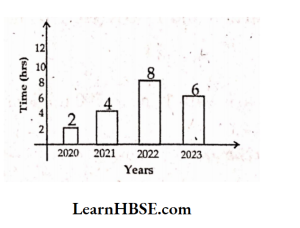
10. The bar graph shows, the number of hours studied by Arjun everyday during last 4 years. The mode of the given data belongs to………. year

The bar graph shows, the number of hours studied by Arjun everyday during last 4 years

  1. 2021
  2. 2022
  3. 2023
  4. 2020

Answer: 2

11. The mean of first 5 multiples of 6 is

  1. 12
  2. 18
  3. 24
  4. 30

Answer: 2

12. Match the following for the given data: -2, 0, 1, 2, 9, 2, 5, 2, -6, -1

a) Mean       ( )    1)2

b) Median   ( )    2)15

c) Mode      ( )     3)1.2

d) Range    ( )    4)1.5

  1. a-1,b-2, c-3, d-4
  2. a – 2,b – 3, c – 4, d -1
  3. a-4,b-1, c-2, d-3
  4. a-3,b-4,c-1, d-2

Answer: 4

13. Which of the following has the same mean, median and mode ?

  1. 2, 3, 7, 3, 8, 2, 3
  2. 4, 3, 4, 3, 4, 6, 4
  3. 4, 2, 2,1,3, 2, 3
  4. 6, 2, 5, 4, 3, 4,1

Answer: 2

14. If the arithmetic mean of 5, 6, 2, x, 12 is 8, then x =………..

  1. 10
  2. 12
  3. 8
  4. 15

Answer: 4

15. The range of the data 6, 3, 0, -5,12, -4 if 2 was subtracted from each of the observations becomes….

  1. increases
  2. decreases
  3. does not change
  4. zero

Answer: 3

16. Given graph shows the marks of a student in Sumniative Assessment. The average marks of the student is…………

Given graph shows the marks of a student in Sumniative Assessment

  1. 76.6
  2. 75.6
  3. 77.6
  4. 76

Answer: 1

17. The median of the data 5, 9, 0, -6, x, 6,1 if their mean is 2 is…………

  1. 0
  2. 1
  3. 2
  4. 3

Answer: 2

18. The mean offirst two numbers is 2.5, the mean of other three numbers is 9, then mean of all numbers is

  1. 6.4
  2. 6.5
  3. 5.9
  4. 5.2

Answer: 1

19. For the given data: 3, 5, 6, 3, 4, 3, 2, 6, the mean of its median and mode is

  1. 3.2
  2. 3.5
  3. 3.25
  4. 4

Answer: 3

20. In bar graphs………of bars remains some

  1. length
  2. width
  3. value
  4. none

Answer: 2

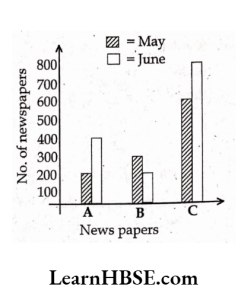
21. Study the bar graph. The average circulation of newspapers B and C in the month of June is………..

Study the bar graph

  1. 450
  2. 500
  3. 550
  4. 475

Answer: 2

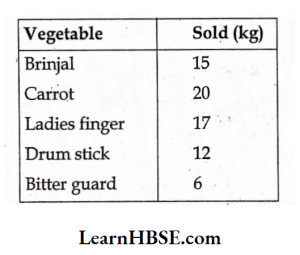
22. A vegetable seller collects the following data of vegetables sold in his shopin a day. The mode (most sold vegetable) of the data is ……..

A vegetable seller collects the following data of vegetables sold in his shopin a day

  1. Drumstick
  2. Brinjal
  3. Ladies Finger
  4. Carrot

Answer: 4

23. The weights of 6 people is given as 38, 42,18, 35, 35, 39, then the mean weight of them is

  1. 35.4
  2. 39
  3. 35
  4. 34.5

Answer: 4

24. Range of first 10 whole numbers

  1. 0
  2. 11
  3. 9
  4. 10

Answer: 3

25. The median of observations 8, 10, 12, x + 1, x+3, 25, 29, 35 is 18, then x =

  1. 15
  2. 16
  3. 17
  4. 18

Answer: 2

26. What is the arithmetic mean of first 10 natural numbers?

  1. 3.5
  2. 7.5
  3. 55
  4. 5.5

Answer: 4

27. The mean of 2, x, 5, y and 14 is 6 then which of the following is true?

  1. x + y = 13
  2. x + y = 9
  3. x- y = 12
  4. 2x + y = 13

Answer: 2

28. Find the arithmetic mean of first 6 prime numbers.

  1. 5.83
  2. 8.63
  3. 6.83
  4. 9.63

Answer: 3

29. Find the mean of first five whole numbers.

  1. 1
  2. 2
  3. 3
  4. 4

Answer: 2

30. Find the mean of first 6 natural numbers.

  1. 5.5
  2. 6.5
  3. 3.5
  4. 4.5

Answer: 3

31. The median of first 16 whole numbers is

  1. 6.5
  2. 7.5
  3. 9.5
  4. 8.5

Answer: 2

32. What is the shape of each partin pie chart ?

  1. Sector
  2. Chart
  3. Cone
  4. Cylinder

Answer: 1

33. The median of the data 24, 29, 34, 38, x is 29, then value of x is

  1. more than 38
  2. less than 29
  3. between 29,34
  4. none of these

Answer: 2

34. Total data is represented as relative size of components in a

  1. Pie diagram
  2. Pictograph,
  3. Bar graph
  4. Sector

Answer: 1

35. The most frequently occurring value for a set of observations is called

  1. Arithmetic mean
  2. Median
  3. Mode
  4. Range

Answer: 3

36. The median of first 5 even natural numbers

  1. 6
  2. 8
  3. 10
  4. 30

Answer: 1

Practice MCQ’s Handling Class 7 Haryana Board

37. The sum of four observations is 44. What is the mean ?

  1. 10
  2. 9
  3. 8
  4. 11

Answer: 4

38. The mean of 11 observations is 12. What is the sum of observations?

  1. 122
  2. 132
  3. 142
  4. 152

Answer: 2

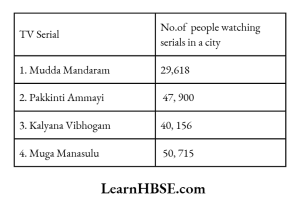
In a survey finding, number of people watching TV serials aregiven below. Answer the following questions (39 – 40)

In a survey finding, number of people watching TV serials aregiven below

39. Which is the “most popular show” from the above table?

  1. Mudda Mandaram
  2. Pakkinti Ammay
  3. Kalyana Vibhogam
  4. Muga Manasulu

Answer: 4

40. Which concept is used to know “most popular show” ?

  1. Mean
  2. Median
  3. Mode
  4. None

Answer: 3

State which representative has to be taken to decide in the folloivittg situations (41-43).

41. Aninvigilator wants to bring sufficient number of additional papers to the examination hall.

  1. mean
  2. mode
  3. median
  4. none

Answer: 1

42. Preparation of number of laddus for a marriage

  1. mean
  2. mode
  3. median
  4. none

Answer: 1

43. For finding the favourite cricketer in a class

  1. mean
  2. mode
  3. median
  4. None

Answer: 2

44. Find the median of first five odd natural numbers.

  1. 5
  2. 4
  3. 2
  4. 8

Answer: 1

45. What is the mode ofunit digits that are presentin the numbers between 50 to 60 ?

  1. 1
  2. 5
  3. 2
  4. Nil

Answer: 4

46. When there is no mode for a particular data we can say the mode is

  1. 1
  2. 0
  3. 2
  4. None

Answer: 4

47. What is the mean of factors of 12 ?

  1. 5.66
  2. 3.76
  3. 4.66
  4. 8.66

Answer: 3

48. What is median of first 5 multiples of 11?

  1. 32
  2. 33
  3. 34
  4. 35

Answer: 2

49. The mean of x+2, x+7, x+6 is 15. Then find the observations.

  1. 11,12,16
  2. 12, 17, 16
  3. 13,16,17
  4. 15, 16, 17

Answer: 2

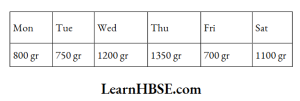
Weight of food that Raj ate each day is given in the table

Weight of food that Raj ate each day is given in the table

50. How much weight of food per day does he eat on an average?

  1. 783.13
  2. 873.3
  3. 983.3
  4. 784.3

Answer: 3

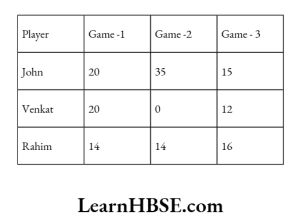
The following table shows the scores of player in each game. Observe it and answer the following questions. (51 – 52)

Thefollowing table shows the scores ofplayerin eachgame

51. Who is the best player?

  1. John
  2. Venkat
  3. Rahim
  4. All

Answer: 1

52. Which mathematical concept is used to know the best player?

  1. Mean
  2. Median
  3. Mode
  4. All

Answer: 1

53. Identify the one which is not affected by maximum and minimum value of the data.

  1. Mean
  2. Mode
  3. Median
  4. None

Answer: 3

54. Find the difference between mean and median of the following data 3, 16, 24, 13

  1. 1.5
  2. 2.5
  3. 0.5
  4. 3.0

Answer: 3

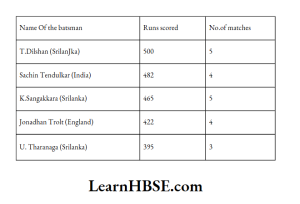
Observe the table and answer 55, 56 questions based on this table.

Observe the table and answer 55, 56 questions based on this table

55. Who is the best batsman from the table?

  1. T.Dilshan
  2. Sachin Tendulkar
  3. K.Sangakkara
  4. Tharanga

Answer: 4

56. Who is average batsman?

  1. Sachin Tendulkar
  2. Jonadhan ,
  3. K. Sangakkara
  4. T. Dilshan

Answer: 2

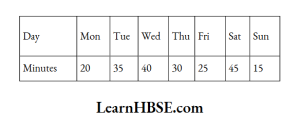
57. Nani Practices Yoga regularly for a week as follows.

Nani Practices Yoga regularly for a week as follows

The average time spent per day by Nani is ….

  1. 25 min
  2. 32 min
  3. 24 min
  4. 30 min

Answer: 4

NaniPractices Yoga regularly for a week asfollows 1

58. From this what can you conclude? ( )

  1. Mean is nothing but average
  2. Mean always lies between the highest and lowest observations of the data
  3. Mean is representative of data
  4. None

Answer: 2

59. A data of 10 observations has a minimum value 15 and maximum value 25. What is the mean of the data?

  1. 12
  2. 15
  3. 21
  4. 27

Answer: 3

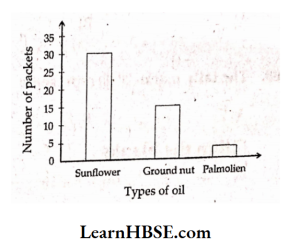
60. From the graph what is the mode here?

  1. Sunflower
  2. Groundnut
  3. Palmolien
  4. All

Answer: 1

61. The presentation of data can be of ………

The presentation of data can be of

  1. Bar graph
  2. Double bar graph
  3. Pie chart
  4. Above all

Answer: 4

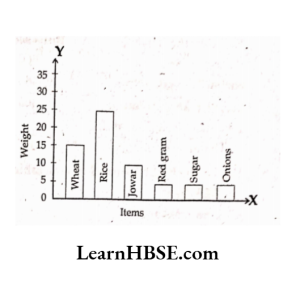
Observe the graph and answer the following questions. (62- 63)

62. Find the ratio between sale of Jowar and sale of Sugar ?

  1. 10: 5
  2. 2:1
  3. 2:3
  4. A and B

Answer: 4

63. How much is the sale of Rice more over Wheat?

How much is the sale of Rice more over wheat

  1. 5
  2. 10
  3. 15
  4. 20

Answer: 2

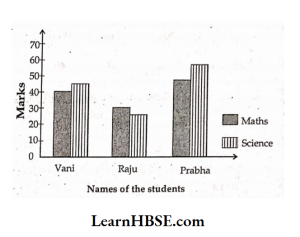
Observe the adjacentfigure and answer thefollowing questions. (64- 65)

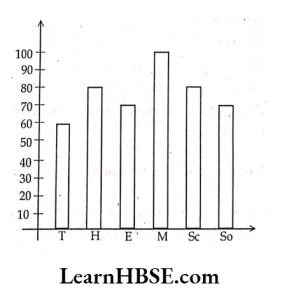
64. What are the total marks of Vani in both Mathematics and Science?

  1. 85
  2. 70
  3. 110
  4. 100

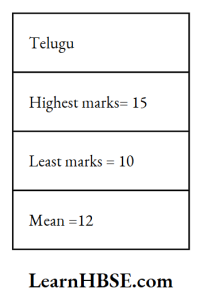
Answer: 1

65. In which subject Raju is well

In which subject Raju is well

  1. Maths
  2. Science
  3. Social
  4. Telugu

Answer: 1

66. Mode of the given set of numbers 1,1, 1, 2, 2, 2, 2, 3, 3, 4, 4, is

  1. 1
  2. 2
  3. 3
  4. 4

Answer: 2

67. The most common representative value of a group of a data is

  1. Arithmetic mean
  2. Range
  3. Mode
  4. Median

Answer: 1

68. The average of \( \) and \( \frac{1}{2} \)

  1. \( \frac{1}{8} \)
  2. \( \frac{1}{2} \)
  3. \( \frac{3}{8} \)
  4. \( \frac{3}{4} \)

Answer: 3

69. The tally marks ||||.||| represents

  1. 7
  2. 8
  3. 9
  4. 6

Answer: 2

Fill in the blanks:

70. We use…… for recording and organisation of data

Answer: Tally marks

71. In a bar graph …… of all the bars is same

Answer: Width

72. ……. help to compare two collections of data at a glance

Answer: Double graph

73…….. represents data in the form of pictures.

Answer: Pictograph

74. Representing the data with the help of bars is known as…………..

Answer: bar graph

Match the following:

75.

1. Mean of 5 and 11 is ( ) A) 20

2. Range of 23, 26, 28, 32, 54, 41 is ( ) B) 12

3. Median of 19, 25, 23, 20, 9, is ( ) C) 8

4. Mode of 12, 14, 12, 16, 12 is ( ) D) 10

5. The tally marks |||| |||| represents ( ) E) 31

Answer: 1. C 2. E 3. A 4. B 5. D