HBSE Class 11 Physics Simple Harmonic Motion Long Answer Type Questions

Oscillation And Waves Simple Harmonic Motion Long Answer Type Questions

Question 21. Show that the equation x = Acos(ωt- α) is a mathematical representation of simple harmonic motion. Find the time period and the maximum speed of the motion.
Asnwer:

Given equation

x = Acos(ωt-α)

∴ Velocity, v = \(\frac{d x}{d t}=-A \omega \sin (\omega t-\alpha)\)

The magnitude of sin (ωt-α) is maximum when it is ±1. This corresponds to the maximum velocity, or simply, the maximum speed.

∴ Maximum speed = ±Aω.

Again, cos (ωt-α) = cos(ωt- α + 2π) .

So, a particle executing SHM returns to its initial phase when the phase angle changes by 2π. The time elapsed between them is the time period (T) of the SHM.

∴ ω(t + T)-α = ωt-α + 2π

or, ωT = 2π or, T = \(\frac{2 \pi}{\omega}\)

Now, acceleration, a = \(\frac{d v}{d t}=-A \omega^2 \cos (\omega t-\alpha)\),

i.e., a = -ω²x

This relation signifies that the given equation is a mathematical representation of SHM.

Viscosity And Surface Tension Class 11 HBSE Notes

Question 22. If the frequency of a simple harmonic motion is n then find the frequency of its kinetic energy.
Answer:

Given that the frequency of a simple harmonic motion is n

If the particle executes the simple harmonic motion, then displacement, x = Asin(ωt+θ)

x = \(A \sin (\omega t+\theta)\)

= \(A \sin (2 \pi n t+\theta)\) (because \(n=\frac{\omega}{2 \pi}\))

∴ Velocity, v = \(\frac{dx}{dt}\) = Aω cos(ωt+θ)

So, the kinetic energy, if the particle has a mass m, is

K = \(\frac{1}{2} m v^2=\frac{1}{2} m A^2 \omega^2 \cos ^2(\omega t+\theta)\)

= \(\frac{1}{4} m A^2 \omega^2[1+\cos 2(\omega t+\theta)]\)

= \(\frac{1}{4} m A^2 \omega^2+\frac{1}{4} m A^2 \omega^2 \cos (2 \omega t+2 \theta)\)

On the right-hand side, the first term is a constant it ensures that the kinetic energy K is never negative. The cosine factor in the second term actually signifies that K is an oscillating quantity. The frequency of the oscillation is \(n^{\prime}=\frac{2 \omega}{2 \pi}=2 \cdot \frac{\omega}{2 \pi}=2 n .\)

The potential energy of an oscillating particle also oscillates with a frequency 2n.

Viscosity And Surface Tension Definition Class 11 Physics

Question 23. The kinetic energy of a particle is 1/2 mω²(A² -x²), where m, ω and A are constants. Prove that the motion of the particle is simple harmonic.
Answer:

Given

The kinetic energy of a particle is 1/2 mω²(A² -x²), where m, ω and A are constants.

Kinetic energy, K = \(\frac{1}{2} m v^2=\frac{1}{2} m \omega^2\left(A^2-x^2\right)\)

So, the velocity of the particle is,

v = \(\pm \omega \sqrt{A^2-x^2}= \pm \omega\left(A^2-x^2\right)^{1 / 2}\)

∴ \(\frac{d v}{d x}= \pm \omega \cdot \frac{1}{2}\left(A^2-x^2\right)^{-\frac{1}{2}} \cdot(-2 x)=\mp \frac{\omega x}{\sqrt{A^2-x^2}} .\)

Now, acceleration,

a = \(\frac{d v}{d t}=\frac{d x}{d t} \frac{d v}{d x}=v \frac{d v}{d x}\)

= \(\pm \omega \sqrt{A^2-x^2} \cdot \text { (Ғ) } \frac{\omega x}{\sqrt{A^2-x^2}}=-\omega^2 x .\)

So. a = -ω²xt which signifies that the motion is simple harmonic.

Numerical Problems On Viscosity And Surface Tension Class 11

Question 24. The speed of a body of mass m, when it is at a distance x from the origin, is v. Its total energy is \(\frac{1}{2} m v^2+\frac{1}{2} k x^2\), where k is constant. Prove that the body executes a simple harmonic motion.
Answer:

Given

The speed of a body of mass m, when it is at a distance x from the origin, is v. Its total energy is \(\frac{1}{2} m v^2+\frac{1}{2} k x^2\), where k is constant.

Total energy, E = \(\frac{1}{2} m v^2+\frac{1}{2} k x^2\)

∴ \(\frac{d E}{d t}=\frac{1}{2} m \frac{d}{d t}\left(v^2\right)+\frac{1}{2} k \frac{d}{d t}\left(x^2\right)\)

= \(\frac{1}{2} m \frac{d}{d v}\left(v^2\right) \frac{d v}{d t}+\frac{1}{2} k \frac{d}{d x}\left(x^2\right) \frac{d x}{d t}\)

= \(\frac{1}{2} m \cdot 2 v \cdot a+\frac{1}{2} k \cdot 2 x \cdot v\)

= \(m v a+k x v \quad[a=\text { acceleration }]\)

If E = constant, \(\frac{d E}{d t}=0\).

∴ \(m v a+k x v=0 \text { or, } a=-\frac{k}{m} x=-\omega^2 x\left[\omega= \pm \sqrt{\frac{k}{m}}\right]\)

This is the equation of a simple harmonic motion.

Viscosity And Surface Tension Derivation Class 11 HBSE

Question 25. The mass and radius of a satellite is twice that of the Earth. If a second pendulum is taken to that satellite, what will be Its time period?
Answer:

Given

The mass and radius of a satellite is twice that of the Earth. If a second pendulum is taken to that satellite

Acceleration due to gravity on the earth’s surface,  g = \(\frac{GM}{R^2}\)

Acceleration due to gravity on the surface of the satellite in question,  \(g^{\prime}=\frac{G \cdot 2 M}{(2 R)^2}=\frac{1}{2} \frac{G M}{R^2}\)

∴ \(\frac{g}{g^{\prime}}=2\)

Time period on the surface of the earth T = \(2 \pi \sqrt{\frac{L}{g}}\)

The time period on the surface of that satellite \(T^{\prime}=2 \pi \sqrt{\frac{L}{g^{\prime}}}\)

Hence, \(\frac{T}{T^{\prime}}=\sqrt{\frac{g}{g}}\)

or, \(T^{\prime}=T \times \sqrt{\frac{g}{g^{\prime}}}=2 \sqrt{2}=2.828 \mathrm{~s} \quad(because T=2 \mathrm{~s}) .\)

Factors Affecting Viscosity And Surface Tension Class 11

Question 26. A lift is moving vertically upwards with an acceleration a. What will be the changed time period of a simple pendulum suspended from the roof of the lift? If the lift becomes free and starts falling down with the acceleration due to gravity, what will be the change in the time period?
Answer:

Given

A lift is moving vertically upwards with an acceleration a.

Acceleration due to gravity (downwards) = g

Acceleration of the lift (upwards) = -a

Hence, the effective acceleration due to gravity with respect to the lift, g’ = g- (-a) = g + a

Therefore, the time period of the pendulum in the lift, \(T^{\prime}=2 \pi \sqrt{\frac{L}{g+a}}\)

We compare it with the time period inside the lift with no acceleration: \(T=2 \pi \sqrt{\frac{L}{g}}\)

∴ \(\frac{T}{T^{\prime}}=\sqrt{\frac{g+a}{g}} \text { or, } T^{\prime}=T \sqrt{\frac{g}{g+a}}\)

As g< (g+ a), T’ <T; hence, in this case, the time period will decrease. When the lift is falling freely downwards, its acceleration a = g.

Hence, the acceleration due to gravity with respect to the lift, g’ = g- a = g- g = 0.

Hence, the time period, in this case, T’ = \(2 \pi \sqrt{\frac{L}{g^{\prime}}}\) = infinity.

An infinite time period signifies that the pendulum will not oscillate at all.

Difference Between Viscosity And Surface Tension Class 11

Question 27. The bob of a simple pendulum is hollow. If half of it is filled with water, what will be the effect on Its time period?
Answer:

Given

The bob of a simple pendulum is hollow. If half of it is filled with water

The center of gravity of the hollow bob is at its center. Thus, the distance from the point of suspension to the center of the bob is the effective length (L) of the pendulum. When the bob is half filled with water, the center of gravity of the bob is lowered. Thus, the effective length of the pendulum increases. Hence, the time period (T) of oscillator of the pendulum also increases as T ∝ √L.

Question 28. A hollow sphere is filled up with water and is suspended using a long string. As water trickles out slowly through an orifice at the lower part of the sphere, it is observed that the time period of the pendulum first increases and. later continues to decrease. Explain these observations.
Answer:

Given

A hollow sphere is filled up with water and is suspended using a long string. As water trickles out slowly through an orifice at the lower part of the sphere, it is observed that the time period of the pendulum first increases and. later continues to decrease.

  • Time period of a simple pendulum at a fixed place is directly proportional to the square root of the effective length of the pendulum. The distance between the point of suspension and the center of gravity of the bob is the effective length. The time period of oscillation increases or decreases with the increase or decrease of its effective length.
  • The Centre of gravity of the spherical bob, completely filled with water, lies at the center of the sphere. As water trickles out through the orifice, the upper part of the sphere starts getting emptied making the lower half heavier than the upper half.
  • As a result, the center of gravity of the bob starts going down from the center of the sphere and the effective length begins to increase. The time period also starts increasing.
  • When more water trickles out, the center of gravity of the bob again starts shifting towards the center of the sphere resulting in a decrease in the effective length, and consequently, a lowering of the time period.

When the hollow sphere becomes completely empty, the center of gravity shifts back to the center of the sphere and the effective length regains its initial value. As a result, the final value of the time period equals its initial value.

Viscosity And Surface Tension Formula Class 11 HBSE

Question 29. The bob of a simple pendulum is made of iron. Exactly below the equilibrium position of the pendulum, the pole of a strong magnet is placed. What will be the change in the time period of the pendulum?
Answer:

Given

The bob of a simple pendulum is made of iron. Exactly below the equilibrium position of the pendulum, the pole of a strong magnet is placed.

In addition to the gravitational force, the magnetic force of attraction of the magnet acts on the pendulum bob. If acceleration produced by the magnetic field on the bob is a, the total acceleration of the pendulum bob g’ = g+a

∴ Time period of the simple pendulum T = \(x2 \pi \sqrt{\frac{L}{g+a}}\)…(1)

It is understood from equation (1) that the time period decreases due to the increase in acceleration of the pendulum bob.

Question 30. If the point of suspension of a simple pendulum is in a horizontal motion, with constant acceleration, what will be the effect on the time period?
Answer:

Given

The point of suspension of a simple pendulum is in a horizontal motion, with constant acceleration

When the point of suspension moves horizontally with a constant acceleration a, the effective acceleration due to gravity with respect to the point of suspension, \(g^{\prime}=\sqrt{g^2+a^2}\)

∴ Time period, T = \(2 \pi \sqrt{\frac{L}{\left(g^2+a^2\right)^{1 / 2}}}\)…(1)

From equation (1), it is understood that the time period decreases due to the increase in the value of the acceleration of the bob.

Question 31. A simple pendulum, suspended from the roof of a car, is oscillating. What will be the time period of the pendulum when the car moves in a circular path at a constant speed?
Answer:

Given

A simple pendulum, suspended from the roof of a car, is oscillating.

Two forces act on the pendulum bob when the car moves in a circular path at constant speed:

  1. Weight of the bob mg vertically downwards,
  2. Centrifugal force in the bob mω²r horizontally. (M=mass of bob, ω angular velocity of bob, r=radius of the circular path)

∴ Resultant effective force on the bob, F = \(\sqrt{m^2 g^2+m^2 \omega^4 r^2}=m \sqrt{g^2+\omega^4 r^2}\)

Hence, acceleration of the bob a = \(\frac{F}{m}=\sqrt{g^2+\omega^4 r^2}\)

∴ Time period T = \(2 \pi \sqrt{\frac{L}{a}}=2 \pi \sqrt{\frac{L}{\left(g^2+\omega^4 r^2\right)^{1 / 2}}}\)

Applications Of Viscosity And Surface Tension Class 11

Alternative Method: When the car along with the point of suspension of the pen¬dulum moves on a circular path horizontally, a freely falling body (along the vertical line through the point of suspension) is subjected to centripetal acceleration horizontally and acceleration clue to gravity vertically. The centripetal acceleration is ω²r (ω= angular velocity of point of suspension, r = radius of the circular path).

∴ Acceleration of the body falling freely with respect point of suspension = \(\sqrt{g^2+\omega^4 r^2}\)

Hence, time period of oscillation of the pendulum T = \(2 \pi \sqrt{\frac{L}{\left(g^2+\omega^4 r^2\right)^{1 / 2}}}\)

Experiment On Viscosity And Surface Tension Class 11 HBSE

Question 32. State the changes in the time period of a pendulum, when

  1. The pendulum is taken to a mountaintop from the earth’s surface
  2. The pendulum is set on the floor of a mine
  3. The diameter of the bob of the pendulum is increased
  4. Keeping the radius of the bob unchanged, its mass is increased. Give reasons for your answer

Answer:

Time period of a simple pendulum T = \(2 \pi \sqrt{\frac{L}{g}}\)

  1. Taking the pendulum from the earth’s surface or a mountain top, the value of g decreases. Hence, the time period increases.
  2. On the floor of a mine, the value of g decreases. Hence, the time period of a pendulum increases.
  3. On increasing the diameter of the bob, its effective length increases. Hence, the time period increases
  4. Time period is independent of the mass of the pendulum bob. Hence, even if mass is increased, keeping the diameter the same, the time period remains unchanged.

HBSE Class 11 Physics First And Second Law Of Thermodynamics Question and Answers

Question 21. Three samples, A, B, and C of gas initially have the same volume. The volume of each sample is doubled by the following processes:

  1. An isothermal process on a,
  2. Adiabatic process on b, and
  3. Isobaric process on c. In which process will the work done be highest?

Answer:

The processes on the three samples are shown on a pV diagram. Two vertical lines X and Y denote the volumes V and 2V. In this diagram, the area under a curve represents the work done.

Class 11 Physics Thermodynamics First And Second Law Of Thermodynamics In Graph Three Samples A B C Of A Gas Intially Have The Same Volume

Clearly, this area is the largest for the isobaric process on sample C. So the work done in this process will be the highest.

First Law Of Thermodynamics Class 11 Derivation HBSE

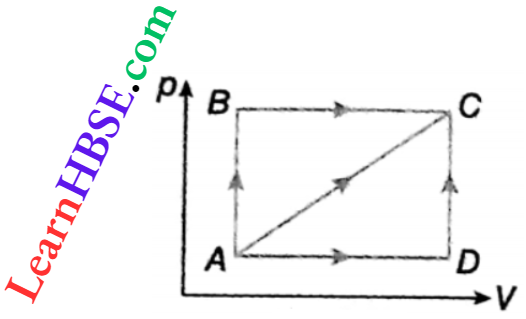
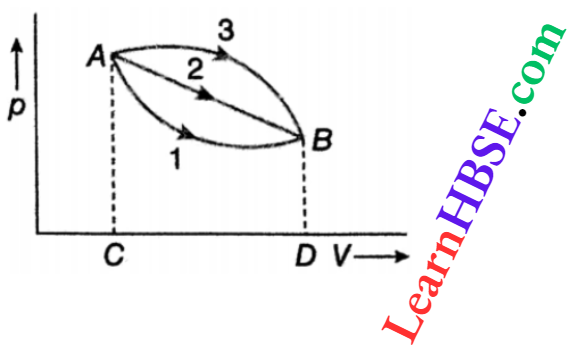
Question 22. An ideal gas of mass is mistaken from state A to state B in three different processes 1,2 and 3. If the work done in the three processes are W1, W2, and W3, arrange them in descending order.

Class 11 Physics Thermodynamics First And Second Law Of Thermodynamics pV Diagram Represents The Work Done Corresponding Process

Answer:

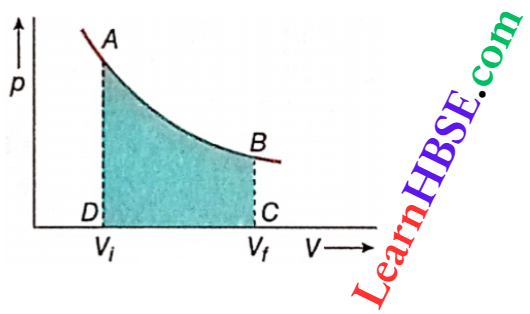
The area under a curve on a pV diagram represents the work done in the corresponding process.

Area A3BDCA > area A2BDCA > area AIBDCA.

So, W3 >W2>W1.

First And Second Law Of Thermodynamics Class 11 HBSE Notes

Question 24. In a process on an ideal gas, dW = 0 and dQ< 0. Show that the temperature of the gas will fall.
Answer:

Given

In a process on an ideal gas, dW = 0 and dQ< 0

In an adiabatic process, Q = 0

From the first law of thermodynamics, \(U_f-U_i=Q-W=0-W=-W \text { or, } W=U_{i^{-}}-U_f \text {. }\)

In a compression, W is negative.

So, Ui – Uf <0 or, Ui < Uf. This means that the internal energy increases. The temperature of an ideal gas will also increase with the increase in internal energy.

Relation Between First And Second Law Of Thermodynamics Class 11

Question 25. When the tyre of a bicycle or motor car bursts suddenly, cool air comes out from the tube. Explain why.
Answer:

When a tube bursts, the air in it expands very rapidly. A very rapid process is essentially an adiabatic process. We know that the temperature of the gas falls in such an adiabatic expansion. So, cool air comes out from a burst tube.

Second Law Of Thermodynamics Class 11 Physics HBSE

Question 26. The molar specific heats Cp and Cv of an ideal gas are expressed in the unit of cal • mol-1 • °C-1. But R is expressed in J • mol-1 • °C-1. Write down the relation between Cp and Cv.
Answer:

Given

The molar specific heats Cp and Cv of an ideal gas are expressed in the unit of cal • mol-1 • °C-1. But R is expressed in J • mol-1 • °C-1.

R J · mol-1 · °C-1 = R/J ca l · mol-1 · °C-1.

So the relation Cp – Cv = R is to be written as Cp – Cv = R/J, where J = Joule’s equivalent.

Question 27. Cp – Cv = a for hydrogen gas and Cp – Cv= b for oxygen gas. What is the relation between a and h?
Answer:

Given

Cp – Cv = a for hydrogen gas and Cp – Cv= b for oxygen gas

The relation between a and h

Cp and Cv are molar-specific heats. As hydrogen and oxygen gases satisfy the properties of an ideal gas, Cp -Cv= R for both the gasses. So, a = b.

Question 28. An ideal gas undergoes four processes: isochoric, isobaric, isothermal, and adiabatic. In which process is

  1. The change in internal energy is zero,
  2. The work done zero and
  3. Is the heat exchange zero?

Answer:

  1. Internal energy of an ideal gas does not change when the temperature is constant. So the corresponding process is an isothermal process.
  2. Work done is zero when the volume remains constant. So the corresponding process is an isochoric process.
  3. Heat exchange with the surroundings is zero in an adiabatic process.

First And Second Law Of Thermodynamics Examples Class 11

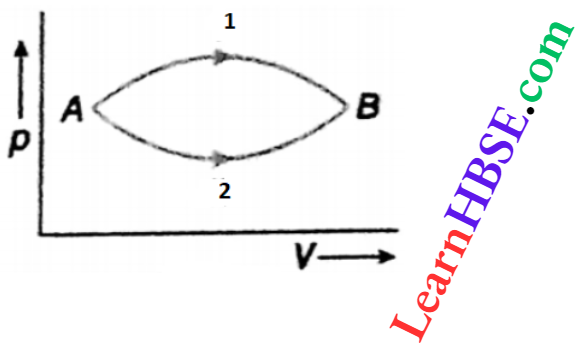
Question 29. A system goes from state A to state B in two different processes 1 and 2. What is the relation between the respective changes \(\Delta U_{\mathrm{1}} \text { and } \Delta U_{\mathrm{2}}\) of internal energy?

Class 11 Physics Thermodynamics First And Second Law Of Thermodynamics A System Goes From State A To State B In Two Different Process

Answer:

The initial and the final states are the same for both processes. Internal energy is a function of state. The value of ΔU is not path-dependent

So, ΔU = UB – UA and ΔU= UB – UA

∴ ΔU1 = ΔU2

Question 30. One should not try to cool a kitchen by leaving the refrigerator door open. Explain why.
Answer:

  • The refrigerator releases heat by absorbing it from the food kept inside it. If the door of a refrigerator is kept open, the refrigerator absorbs heat from the kitchen and releases it in the kitchen itself.
  • For that, no temperature change should occur. But during this process, the compressor of the refrigerator converts some electric energy supplied to it into heat energy. As a result, the kitchen temperature tends to increase slightly.

Question 31. The volume, pressure, and temperature of some amount of gas are V, p, and T, respectively. A partition divides the gas into two equal parts. What will be the values of the quantities in each part?
Answer:

Given

The volume, pressure, and temperature of some amount of gas are V, p, and T, respectively. A partition divides the gas into two equal parts.

The volume V is an extensive property. So the volume of each half would be But the pressure p and the temperature T are intensive properties. So they remain unaltered, i.e., the values of these quantities in each half of the gas will be p and T.

First And Second Law Of Thermodynamics Formula Class 11

Question 32. Show that the adiabatic bulk modulus of an ideal gas is equal to the product of the pressure of the gas and the ratio of its two specific heats (γ).
Answer:

In case of adiabatic change of some fixed mass of ideal gas, pVγ = constant,

where, \(\gamma=\frac{\text { specific heat of the gas at constant pressure }}{\text { specific heat of the gas at constant volume }}\)

Differentiating the above relation we get, \(V^\gamma d p+p \gamma V^{\gamma-1} d V=0\)

or, \(V^\gamma d p+\gamma p \frac{V \gamma}{V} d V=0\)

or, \(\frac{d p}{p}=-\gamma \frac{d V}{V}\)

∴ \(K_s=\frac{d p}{-\frac{d V}{V}}=\gamma p\)

[where Ks is the adiabatic bulk modulus of the gas]

So, the adiabatic bulk modulus of an ideal gas is equal to the product of the pressure of the gas and the ratio of its two specific heats (γ).

First And Second Law Of Thermodynamics Conclusion

A body or a part of a body or a combination of a number of bodies whose properties are being studied is usually called a thermodynamic system. In general, such a system exchanges energy and mass with its surroundings.

Thermodynamic properties are of two types:

  1. Extensive properties (examples: mass, volume, internal energy, entropy, etc.) and
  2. Intensive properties (examples: pressure, temperature, density, specific heat, coefficient of expansion, modulus of elasticity, etc.)

Joules Law In Thermodynamics: If some amount of work is entirely converted into heat, the work done and the heat produced are proportional to each other.

The amount of work done to produce unit amount of heat is called the mechanical equivalent of heat or Joule’s equivalent (J).

The first law of thermodynamics: When a system absorbs some amount of heat from the surroundings,

  1. A part of it increases the internal energy of the system and
  2. The remaining part is converted into some external work done by the system.

The internal energy of a particular amount of ideal gas depends on its temperature only. This property is approximately true for real gases also.

Applications Of First And Second Law Of Thermodynamics Class 11

Heat absorbed by unit mass of a substance to raise the temperature by one degree, when

  1. The volume is kept constant and
  2. The pressure is kept constant, are called the specific heat at constant volume (cv) and the specific heat at constant pressure (cp) respectively.
  • When 1 mol of a substance is taken, instead of unit mass, the corresponding quantities are called the molar specific heat at constant volume (Cv) and the molar specific heat at constant pressure (Cp).
  • A process in which the temperature of a system remains constant is called an isothermal process. The changes in volume and pressure in an isothermal process are called isothermal changes.
  • A process in which no heat is exchanged between a system and its surroundings is called an adiabatic process. The changes in volume, pressure, and temperature in an adiabatic process are called adiabatic changes.

The second law of thermodynamics:

  • Clausius’s statement: No self-acting machine can transfer heat from a lower to a higher temperature.
  • Kelvin-Planck statement: No self-acting machine can convert some amount of heat entirely into work.

A reversible process is one that can be reversed and the heat exchange and the work done in each infinitesimal step in the reverse process are exactly equal and opposite to those in the forward process.

  • A process that does not satisfy these conditions is an irreversible process.
  • Every process in nature occurs in such a direction that the total entropy of the universe increases. This is known as the principle of increase in entropy. It is the most general statement of the second law of thermodynamics.

First Law Of Thermodynamics Equation Class 11 HBSE

Each of the three laws of thermodynamics defines one important property of all thermodynamic systems

  1. Zeroth law: Temperature (T),
  2. First law: Internal energy (U),
  3. Second law: Entropy (S)

Heat engine is a mechanical device which converts heat into work. The efficiency of heat engine is defined as the fraction of total heat taken from the source which is converted into work.

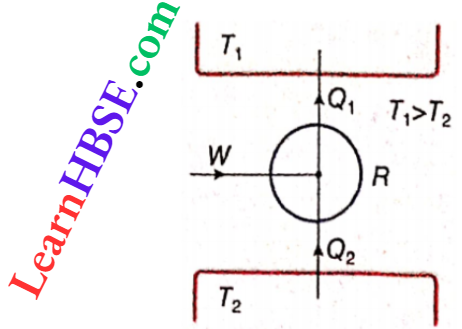
  • A mechanical device that transfers heat from a colder to a hotter place is called a refrigerator.
  • An ideal heat engine and an ideal refrigerator do not exist in nature.
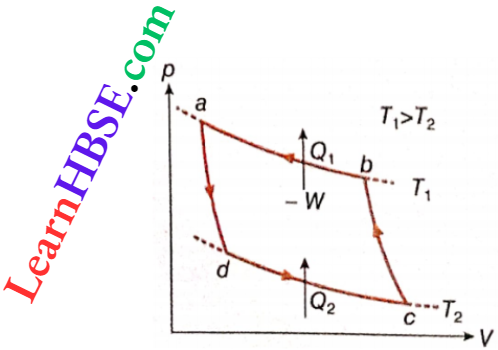
  • A cycle enclosed by four reversible processes, two iso-thermals and two adiabatics, is called a Carnot cycle.
  • A clockwise Carnot cycle acts as a heat engine which is enclosed by two reversible isothermal and two revers¬ible adiabatic processes. This is called a Carnot engine.

Entropy And Second Law Of Thermodynamics Class 11 Physics

Carnot showed that

  1. All reversible engines working between the same two temperatures have the same efficiency and
  2. No engine working between two given temperatures can be more efficient than a reversible engine working between the same two temperatures. This is Carnot’s theorem.

HBSE Class 11 Physics Notes For Heat Measurement of Calorimeter

Calorimetry Determination Of High Temperature

A mercury thermometer cannot be used direcdy for the measurement of temperature of a furnace or a flame. But the fundamental principle of calorimetry may be adopted to measure such high temperatures accurately and easily.

  • A small piece of solid whose specific heat is known and which has a sufficiendy high melting point (example, iron whose melting point is 1811 K) is to be placed in the source for a considerable period of time and allowed to attain thermal equilibrium with the source.
  • It is then quickly transferred to the water in a calorimeter. Initial temperature of the water is to be noted before the addition of the solid. The water is stirred well and the final temperature attained is measured by a thermometer.
  • There should be sufficient water in the calorimeter so that the final temperature attained remains below the upper fixed point of the thermometer used.

Heat Measurement Of Calorimeter Class 11 HBSE Notes

Calculation: Let the temperature of the source = t2 = initial temperature of the solid, mass of the solid taken = M, specific heat of the solid = s, water equivalent of the calorimeter with stirrer = W, mass of the water in the calorimeter = m, its specific heat = sw, initial temperature of the calorimeter and the water = t1, the final temperature of the water and the solid = t.

∴ Heat lost by the solid = Ms(t2 – t)

Heat gained by the calorimeter and its stirrer = Wsw(t- t1)

Heat gained by the water = m x sw x (t -t1)

Hence, from the fundamental principle of calorimetry, \(M s\left(t_2-t\right)=W s_{w^{(}}\left(t-t_1\right)+m s_w\left(t-t_1\right)\)

or, \(\left(t_2-t\right)=\frac{(W+m) s_w\left(t-t_1\right)}{M s}\)

or, \(t_2=\frac{(W+m) s_{w^{\prime}}\left(t-t_1\right)}{M s}+t\)….(1)

As magnitudes of all the quantities in the right hand side of equation (1) are known, t2 can be calculated.

Calorimetry Determination Of High-Temperature Numerical Examples

Example 1. 50 g of an alloy containing 80% copper and 20% silver is heated up to t1 = 80°C and then dropped in a calorimeter of water equivalent W = 10 g containing m = 90 g of water at t2 = 20°C. What will be the final temperature of the mixture? The specific heat capacity of copper and silver are sc = cal · g-1 · °C-1 and ss = 0.15 cal · g-1 · °C-1 respectively.
Solution:

Given

50 g of an alloy containing 80% copper and 20% silver is heated up to t1 = 80°C and then dropped in a calorimeter of water equivalent W = 10 g containing m = 90 g of water at t2 = 20°C.

Mass of copper in the alloy, \(m_c=\frac{50 \times 80}{100}=40 \mathrm{~g}\)

∴ Mass of silver, ms = 50 – 40 = 10 g

Let the final temperature of the mixture be t.

Applying the formula, H = mst

Heat lost by copper = 40 x 0.09 x (80 – t) = (288 – 3.6t) cal

Heat lost by silver = 10 x 0.05 x (80 – t) = (40 – 0.5t) cal

Total heat lost by copper and silver = (328 – 4.1t) cal

Heat gained by water and the calorimeter

= (10 + 90) x 1 x (t — 20) = (100 t-2000) cal

∴ Heat lost = heat gained

∴ 328-4.1t = 100t-2000

or 104.1t = 2328

or, t = \(\frac{2328}{104.1}=22.36^{\circ} \mathrm{C}\)

∴ Final temperature of the mixture is 22.36°C

Principle Of Calorimeter Class 11 Physics HBSE

Example 2. A piece of platinum of mass 200 g, is heated for a sufficiently long time in a furnace and dropped quickly in 650 g of water at 10°C, kept in a container of water equivalent 50g. Final temperature of the mixture becomes 25°C. If the specific heat capacity of platinum is 0.03 cal · g-1 · °C-1, find the temperature of the furnace.
Solution:

Given

A piece of platinum of mass 200 g, is heated for a sufficiently long time in a furnace and dropped quickly in 650 g of water at 10°C, kept in a container of water equivalent 50g.

Let the temperature of the furnace be t °C which is also the initial temperature of the piece of platinum.

Heat lost by the platinum piece = 200 x 0.03 x (t-25) = 6(t-25) cal

Heat gained by the container and water

= 50 x (25 – 10) + 650 x 1 x (25 – 10)

= 750 + 9750 = 10500 cal

Assuming no loss of heat to the surroundings, heat lost = heat gained

or, 6(t-25) = 10500 or, t = 1775°C

∴ The temperature of the furnace is 1775°C.

Heat Measurement Using Calorimeter Class 11 Derivation

Example 3. A solid of mass 70 g is heated and dropped in a cal-orimeter of water equivalent 10 g containing 116g of water. If the fall in temperature of the solid is 15 times the rise in temperature of water, find the specific heat capacity of the solid.
Solution:

Given

A solid of mass 70 g is heated and dropped in a cal-orimeter of water equivalent 10 g containing 116g of water. If the fall in temperature of the solid is 15 times the rise in temperature of water,

Let t be the rise in temperature of water and s the specific heat of the solid.

Fall in temperature of the solid = 15 t

Heat lost by the solid =70 x s x 15t

Heat gained by the calorimeter and water

= 10 x t + 116 x 1 x t = 126t

Since, heat lost = heat gained 70 x s x 15t = 126t

or, \(s=\frac{126}{70 \times 15}=0.12 \mathrm{cal} \cdot \mathrm{g}^{-1} \cdot{ }^{\circ} \mathrm{C}^{-1}\)

Example 4. Ratio between the densities and specific heats of the materials of two bodies are 2 : 3 and 0.12: 0.09 respectively. If their volumes are in the ratio 7:8, what is the ratio of their thermal capacities?
Solution:

Given

Ratio between the densities and specific heats of the materials of two bodies are 2 : 3 and 0.12: 0.09 respectively. If their volumes are in the ratio 7:8,

Let the density of the first substance be d1, its specific heat s1, and volume V1.

Also, let the density, specific heat, and volume for the second body be d2, s2, and V2 respectively.

Hence, thermal capacity of the first one, C1 = m1s1 = V1d1s1

and that of the second body, C2 = m2s2  = V2d2s2

∴ \(\frac{C_1}{C_2}=\frac{V_1}{V_2} \times \frac{d_1}{d_2} \times \frac{s_1}{s_2}=\frac{7}{8} \times \frac{2}{3} \times \frac{0.12}{0.09}=\frac{7}{9}\)

Hence, their thermal capacities are in the ratio of 7: 9.

Specific Heat Capacity And Calorimeter Class 11 HBSE

Example 5. A body of mass 100 g is heated up to 122°G and dropped quickly in water of mass 300 g kept at 28°C in a copper calorimeter of mass 50 g. The final temperature of the mixture becomes 30°C. If the specific heat of copper is 0.09 cal · g-1 · °C-1, find the specific heat of the material of the body.
Solution:

Given

A body of mass 100 g is heated up to 122°G and dropped quickly in water of mass 300 g kept at 28°C in a copper calorimeter of mass 50 g. The final temperature of the mixture becomes 30°C. If the specific heat of copper is 0.09 cal · g-1 · °C-1,

Let the specific heat of the material be s.

Heat lost by the body = 100 x s x (122 – 30)

= 100 x s x 92 = 9200s cal

Heat gained by water = 300 x 1 x (30 – 28)

= 300 x 2 = 600 cal

Heat gained by the calorimeter

= 50 x 0.09 x (30-28) = 4.5×2 = 9 cal

We know, heat lost = heat gained

or, 9200 s = 600 + 9

or, \(s=\frac{609}{9200}=0.0662 \mathrm{cal} \cdot \mathrm{g}^{-1} \cdot{ }^{\circ} \mathrm{C}^{-1}\)

Example 6. Calculate the increase in energy (in joule) per atom of a piece of aluminum when its temperature is raised by 1°C. Given, 27 g of aluminium contains 6 x 10²³ atoms, and specific heat capacity of aluminium = 0.2 cal · g-1 · C-1.
Solution:

Solution:

Given

27 g of aluminium contains 6 x 10²³ atoms, and specific heat capacity of aluminium = 0.2 cal · g-1 · C-1.

Heat required to raise the temperature of 1 g aluminium through 1°C = 1 x 0.2 x 1 = 0.2 cal = 0.2 x 4.2 J = 0.84 J.

Number of atoms in 1 g of aluminium = \(\frac{6 \times 10^{23}}{27}\)

Hence, increase in energy per atom = \(\frac{0.84}{\frac{6 \times-10^{23}}{27}} \mathrm{~J}\) = 3.78 x 10⁻²³ J

Working Of Calorimeter Class 11 Physics HBSE

Example 7. When 210 g of water at 80°C is kept in a calorimeter of water equivalent 90 g, its temperature decreases to 60°C in 10min. If the water is replaced by a liquid of mass 100 g, the same fall in temperature takes place in 5 min. If the rate of cooling is the same in both cases, what is the specific heat capacity of the liquid?
Solution:

Given

When 210 g of water at 80°C is kept in a calorimeter of water equivalent 90 g, its temperature decreases to 60°C in 10min. If the water is replaced by a liquid of mass 100 g, the same fall in temperature takes place in 5 min. If the rate of cooling is the same in both cases

Heat lost by the calorimeter and water in 10 min = 90 x (80- 60) + 210 x 1 x (80-60) =6000 cal

∴ Rate of cooling = \(\frac{6000 \mathrm{cal}}{10 \mathrm{~min}}\)  = 600 cal · min-1

Let the specific heat of the liquid be s.

Heat lost by the calorimeter and liquid in 5 min

= 90 x (80-60) +100 x s x (80-60)

= (1800 + 2000s) cal

Hence, rate of cooling = \(\frac{(1800+2000 \mathrm{~s})}{5} \mathrm{cal} \cdot \mathrm{min}^{-1}\)

As per given condition, \(\frac{(1800+2000 s)}{5}=600\)

or, 1800 + 20005 = 3000

or, s = 0.6 cal · g-1· °C-1

Example 8. Liquids A, B, and C are at temperatures 15°C, 25°C, and 35°C respectively. When equal masses of A and B are mixed, the temperature becomes 21°C. The temperature of the mixture of equal masses of B and C becomes 32°C.

  1. Show that the ratio of the specific heats of A and C is 2:7.
  2. What will be the final temperature of the mixture of equal masses of A and C?

Solution: Let the specific heats of A, B, and C be sA, sB, and sC respectively.

1. When liquid A of mass m and liquid B of mass m are mixed, heat lost by B = heat gained by A

i.e., mx sB x (25-21) = m x sA x(21 -15)

or, s 6 = sB · 4

or, \(\frac{s_A}{s_B}=\frac{2}{3}\)…(1)

When liquid B of mass m and liquid C of mass m are mixed, the heat lost by C = heat gained by B.

i.e., \(m \times s_C \times(35-32)=m \times s_B \times(32-25)\)

or, \(s_C \cdot 3=s_B \cdot 7\)

or, \(\frac{s_B}{s_C}=\frac{3}{7}\)…(2)

From (1) and (2), we get

⇒ \(\frac{s_A}{s_B} \times \frac{s_B}{s_C}=\frac{2}{3} \times \frac{3}{7} \text { or, } \frac{s_A}{s_C}=\frac{2}{7}\)

∴ \(s_A: s_C=2: 7\)

2. Let the final temperature of the mixture of liquid A of mass m and liquid C of mass m be t° C.

So, heat gained by A = heat lost by C

∴ m x sA x (t-15) = m x sC x (35-t)

or, \(\frac{s_A}{s_C}=\frac{35-t}{t-15} \quad \text { or, } \frac{2}{7}=\frac{35-t}{t-15} \quad \text { or, } t=30.56^{\circ} \mathrm{C}\)

∴ Temperature of the mixture is 30.56°C.

Formula For Heat Measurement In Calorimeter Class 11 HBSE

Example 9. An iron ball of mass 10 g and of specific heat 0.1 cal · g-1 · °C-1 is heated in a furnace and quickly transferred to a thick-walled copper vessel of mass 200 g and of specific heat 0.09 cal · g-1 · °C-1, kept at 50°C. The vessel along with its contents, is placed in a calorimeter of water equivalent 20g, containing 180 g of water at 20°C. A thermometer dipped in the water of the calorimeter shows the maximum temperature to be 26 °C. Find the temperature of the furnace. Will there be any local boiling of water in the calorimeter?
Solution:

Given

An iron ball of mass 10 g and of specific heat 0.1 cal · g-1 · °C-1 is heated in a furnace and quickly transferred to a thick-walled copper vessel of mass 200 g and of specific heat 0.09 cal · g-1 · °C-1, kept at 50°C. The vessel along with its contents, is placed in a calorimeter of water equivalent 20g, containing 180 g of water at 20°C. A thermometer dipped in the water of the calorimeter shows the maximum temperature to be 26 °C.

Let the temperature of the furnace be θ.

Heat lost by the hot iron ball and copper vessel

= 10 x 0.1 x (θ – 26) + 200 x 0.09 x (50 – 26)

= (0 – 26) + 18 x 24 = (θ + 406) cal

Heat gained by the calorimeter and water = (20 + 180) x (26 – 20) = 1200 cal

∴ Heat gain = heat loss

∴ θ + 406 = 1200 or, 0 = 1200 – 406 = 794°C

Temperature of the furnace is 794°C.

Let the intermediate temperature attained by the iron ball and copper vessel be t.

As heat lost by the iron ball = heat gained by the copper vessel

So, 10 x 0.1 x (794 – t) – 200 x 0.09 x (t- 50)

or, 794- t = 18t-900

∴ t = 89.16°C

Temperature of the system of iron ball and copper vessel is 89.16°C. This is below the boiling point 100°C of water. So there will be no local boiling in the calorimeter water.

Applications Of Calorimeter In Heat Measurement Class 11

Example 10. Three liquids of the same amount are mixed. The specific heats of these liquids are s1, s2, and s3 and their initial temperatures are θ1, θ2, and θ3, respectively. Find out the final temperature of the mixture.
Solution:

Given

Three liquids of the same amount are mixed. The specific heats of these liquids are s1, s2, and s3 and their initial temperatures are θ1, θ2, and θ3, respectively.

Let the final temperature of the mixture be θ and the mass of each liquid be m.

∴ Heat absorbed by the 1st liquid, H1 = ms1(θ-θ1)

Heat absorbed by the 2nd liquid, H2 = ms2(θ – θ2)

Heat absorbed by the 3rd liquid, H3 = ms3(θ – θ3)

Since no heat is supplied from outside,

∴ H1 + H2 + H3 = 0 ……(1)

[any one or two of H1, H2, H3 must be negative, implying heat lost then equation (1) means, heat gained = heat lost]

∴ \(m s_1\left(\theta-\theta_1\right)+m s_2\left(\theta-\theta_2\right)+m s_3\left(\theta-\theta_3\right)=0\)

or, \(\theta\left(s_1+s_2+s_3\right)=s_1 \theta_1+s_2 \theta_2+s_3 \theta_3 \)

or, \(\theta=\frac{s_1 \theta_1+s_2 \theta_2+s_3 \theta_3}{s_1+s_2+s_3}\)

Example 11. Water, flowing a pipe At the rate of 0.15 kg · min-1, Is heated by a 25.2 W heater. Temperatures of the Incoming and the outgoing water are 15.2°C and 17.4°C respectively. When the rate of flow of water Is increased to 0.2318 kg · min-1 and rate of heating to 37.8 W, temperatures of Incoming and outgoing water remain the same. Find the specific heat capacity of water and the rate of loss of heat through the pipe.
Solution:

Given

Water, flowing a pipe At the rate of 0.15 kg · min-1, Is heated by a 25.2 W heater. Temperatures of the Incoming and the outgoing water are 15.2°C and 17.4°C respectively. When the rate of flow of water Is increased to 0.2318 kg · min-1 and rate of heating to 37.8 W, temperatures of Incoming and outgoing water remain the same.

Let specific heat of water be s J · kg-1 ·°C-1 and rate of heat loss be H J · s-1.

From the given data, \(\frac{0.15}{60} \times s \times(17.4-15.2)+H=25.2\)…(1)

and \(\frac{0.2318}{60} \times s \times(17.4-15.2)+H=37.8\)….(2)

Subtracting equation (1) from equation (2) we get,

⇒ \(\frac{s \times 2.2}{60}(0.2318-0.15)=12.6\)

or, s = \(4200 \mathrm{~J} \cdot \mathrm{kg}^{-1 .{ }^{\circ} \mathrm{C}^{-1}}\)

Then from equation (1),

H = \(25.2-\frac{0.15}{60} \times 4200 \times 2.2\)

= \(2.1 \mathrm{~J} \cdot \mathrm{s}^{-1}=\frac{2.1}{4.2} \mathrm{cal} \cdot \mathrm{s}^{-1}\)

= \(0.5 \mathrm{cal} \cdot \mathrm{s}^{-1}\)

Example 12. A vacuum flask contains 0.3 kg of liquid paraffin whose temperature can be increased at the rate of 1°C per minute using an immersion heater of power 12.3 W. When a 19.2 W heater is used to heat 0.4 kg of liquid paraffin, in the same flask, the rate of rise of temperature is 1.2 °C per minute. Find the specific heat of paraffin and the thermal capacity of the flask.
Solution:

Given

A vacuum flask contains 0.3 kg of liquid paraffin whose temperature can be increased at the rate of 1°C per minute using an immersion heater of power 12.3 W. When a 19.2 W heater is used to heat 0.4 kg of liquid paraffin, in the same flask, the rate of rise of temperature is 1.2 °C per minute.

Let s = specific heat of paraffin, C = thermal capacity of the flask.

Heat developed per minute by the 1st heater

= \(\frac{12.3 \times 60}{4.2} \mathrm{cal}=175.71 \mathrm{cal}\)

[4.2 J of energy = 1 cal of heat]

Similarly, heat developed per minute by the second heater

= \(\frac{19.2 \times 60}{4.2}=274.28 \mathrm{cal}\)

From the given data, heat gained by paraffin in the first case = heat supplied by the heater

∴ 0.3 x 1000 x s x 1 + C x 1 = 175.71

or, 300s + C = 175.71…(1)

and similarly, for the heat gained by paraffin and the flask in the second case,
0.4 x 1000 x s x 1 + C x 1 = 274.28

or, 480 s + 1.2C= 274.28…(2)

Solving (1) and (2), we get

s =0.529 cal · g-1 · °C-1 and C = 17 cal · °C-1 (approx.)

Heat Lost And Heat Gained In Calorimeter Class 11 HBSE

Example 13. Two calorimeters of water equivalent 25 g and 60 g are initially at 0°C. Some water at 50°C is poured in the first calorimeter and after thermal equilibrium is attained, the first calorimeter is emptied into the second one. If the final temperature of water and the second calorimeter becomes 25°C, find the mass of water.
Solution:

Given

Two calorimeters of water equivalent 25 g and 60 g are initially at 0°C. Some water at 50°C is poured in the first calorimeter and after thermal equilibrium is attained, the first calorimeter is emptied into the second one. If the final temperature of water and the second calorimeter becomes 25°C

Let at equilibrium, the temperature of the 1st calorimeter = θ, mass of water added = m.

Since, heat lost by hot water = heat gained by the 1st calorimeter

∴ m x 1 x (50 -θ) = 25 x 1 x θ

or, \(\theta=\frac{50 m}{25+m}\)…(1)

In the second calorimeter, heat lost by mg of water at θ = m x 1 x (θ – 25) and heat gained by the calorimeter = 60 x 25

∴ m(θ – 25) = 60 x 25

or, \(\theta=\frac{60 \times 25}{m}+25\)

Equating equations (1) and (2), \(\frac{50 m}{25+m}=\frac{60 \times 25}{m}+25\)

or, \(\frac{50 m}{25+m}=25\left(\frac{60}{m}+1\right) \quad \text { or, } \frac{2 m}{25+m}=\frac{60+m}{m}\)

or, \(2 m^2=(60+m)(25+m)\)

or, \(2 m^2=1500+85 m+m^2\)

or, \(m^2-85 m-1500=0\)

or, \((m-100)(m+15)=0\)

∴ m=-15 or, m=100

Since negative mass is not acceptable, m = 100.

∴ The required mass of water is 100 g.

Example 14. 1 kg of water in a kettle of water equivalent 200 g can be heated from 15°C to 90°C in 15 min by the heat supplied by a kerosene stove at the rate of 6 X 10⁵ cal · h-1. What percentage of the heat produced by the stove is absorbed by the kettle and water?
Solution:

Given

1 kg of water in a kettle of water equivalent 200 g can be heated from 15°C to 90°C in 15 min by the heat supplied by a kerosene stove at the rate of 6 X 10⁵ cal · h-1.

Heat produced in 60 min by the kerosene stove = 6 x 10⁵ cal

∴ Heat produced in 15 min by the stove = \(\frac{6 \times 10^5 \times 15}{60}\) = 15 x 104 cal

Heat gained by the kettle and water in 15 min

= 200 x (90 -15) + 1000 x (90 – 15)

= 1200 x 75 = 90000 = 9 x 10⁴ cal

∴ Heat absorbed = \(=\frac{9 \times 10^4}{15 \times 10^4} \times 100=60 \%\)

Example 15. A calorimeter holds 200 g of water at 10°C. When 50 g of water at 100°C is added to it, the tempera¬ture of the mixture becomes 27°C. A metal ball of mass 100 g at 10°C is now added to water, and the final temperature reaches 26°C. Find the specific heat of the metal.
Solution:

Given

A calorimeter holds 200 g of water at 10°C. When 50 g of water at 100°C is added to it, the tempera¬ture of the mixture becomes 27°C. A metal ball of mass 100 g at 10°C is now added to water, and the final temperature reaches 26°C

Let water equivalent of the calorimeter be W and specific heat of the metal be s.

In the first case, heat gained by the calorimeter and 200 g of water = heat lost by 50 g of water

i.e., (W+200) x 1 x (27 – 10) = 50 x 1 x (100-27)

or, W + 200 = \(\frac{50 \times 73}{17}\)….(1)

Now the amount of water in the calorimeter becomes (200 + 50) = 250 g.

Hence, in the second case, heat lost by the calorimeter and 250 g of water = heat
gained by the metal ball (W+ 250) x 1 x (27- 26) = 100 x s x (26- 10)

or, W+ 250 = 1600s…(2)

(2) – (1) gives,

50 = \(1600 s-\frac{50 \times 73}{17}\)

or, \(1600 s=50+\frac{50 \times 73}{17}=50\left(1+\frac{73}{17}\right)=\frac{50 \times 90}{17}\)

∴ s = \(\frac{50 \times 90}{17 \times 1600}=0.165 \mathrm{cal} \cdot \mathrm{g}^{-1 \cdot{ }^{\circ} \mathrm{C}^{-1}}\)

Numerical Problems On Calorimeter Class 11 HBSE

Example 16. Specific gravities of two liquids are 0.7 and 0.4 respectively. 4 L of the first liquid has the same thermal capacity as 3 L of the second. Find the ratio of their specific heat capacities.
Solution:

Given

Specific gravities of two liquids are 0.7 and 0.4 respectively. 4 L of the first liquid has the same thermal capacity as 3 L of the second.

Let m1 and m2 be the masses of the two liquids and s1 and s2 be their specific heats respectively.

Now, m1 = 0.7 x 4 x 1000 g and m2 = 0.4 x 3 x 1000 g

By the problem, m1s1 = m2s2

or, \(\frac{s_1}{s_2}=\frac{m_2}{m_1}=\frac{0.4 \times 3 \times 1000}{0.7 \times 4 \times 1000}\)

or, \(s_1: s_2=3: 7\)

Example 17. 40 g of water at 12°C is kept in a container. When 50 g of water at 80°C is added to it, the final temperature becomes 46° C. Find the thermal capacity of the container.
Solution:

Given

40 g of water at 12°C is kept in a container. When 50 g of water at 80°C is added to it, the final temperature becomes 46° C

Let the water equivalent of the container be W.

∴ Heat received by water and the container at 12 °C

= Wx lx (46-12) + 40 x 1 x (46-12)

= (W+ 40) x 34 cal

Heat given out by water at 80°C

= 50 x 1 x (80-46) = 50×34 cal

∴ (W+ 40) x 34 = 50 x 34 or, W = 10 g

Thermal capacity of the container = 10 cal · °C-1.

Example 18. 50 g of an alloy containing 60% copper and 40% nickel is dropped in 55g of water at 10° C, and kept in a calorimeter of water equivalent 5 g. The final temperature becomes 20 °C. What was the initial temperature of the alloy? Specific heats of copper and nickel are 0.095 cal · g-1 · °C-1 and 0.11 cal · g-1 · °C-1 respectively.
Solution:

Given

50 g of an alloy containing 60% copper and 40% nickel is dropped in 55g of water at 10° C, and kept in a calorimeter of water equivalent 5 g. The final temperature becomes 20 °C.

Let the masses of copper and nickel in the alloy be m1 and m2 respectively and the initial temperature of the alloy be t. From the fundamental principle of calorimetry,

heat lost by the alloy = heat gained by water and the calorimeter

i.e., (m1 s1 + m2s2)( t- 20) = (55 + 5) x 1 x (20 – 10)

or, t = \(\frac{600}{m_1 s_1+m_2 s_2}+20\)

Given, \(m_1=50 \times \frac{60}{100}=30 \mathrm{~g}, m_2=50 \times \frac{40}{100}=20 \mathrm{~g}\)

⇒ \(s_1=0.095 and s_2=0.11\)

∴ t = \(\frac{600}{30 \times 0.095+20 \times 0.11}+20=138.81^{\circ} \mathrm{C}\)

Example 19. Temperatures of three liquids A, B, and C of equal mass are 12°C, 19°C, and 28°C respectively. If A and B are mixed the temperature becomes 16° C, but on mixing B and C it becomes 23°C. What will be the temperature of the mixture of A and C?
Solution:

Given

Temperatures of three liquids A, B, and C of equal mass are 12°C, 19°C, and 28°C respectively. If A and B are mixed the temperature becomes 16° C, but on mixing B and C it becomes 23°C.

Let mass of each liquid be m and their specific heats be sA, sB, and sC respectively.

By mixing liquids A and B, heat gained by A = heat lost by B

i.e., \(m \cdot s_A(16-12)=m \cdot s_B(19-16)\)

or, \(s_A \cdot 4=s_B \cdot 3\)

or, \(\frac{s_A}{s_B}=\frac{3}{4}\) ….(1)

By mixing liquids B and C, heat gained by B= heat lost by C

i.e., \(m \cdot s_B(23-19)=m \cdot s_C(28-23)\)

or, \(s_B \cdot 4=s_C \cdot 5\)

or, \(\frac{s_B}{s_C}=\frac{5}{4}\) …(2)

∴ Multiplying (1) and (2),

⇒ \(\frac{s_A}{s_B} \times \frac{s_B}{s_C}=\frac{3}{4} \times \frac{5}{4} \quad \text { or, } \frac{s_A}{s_C}=\frac{15}{16}\)

Let the temperature of the mixture of liquids A and C be θ.

Since, heat gained by A = heat lost by C

⇒ \(m \cdot s_A(\theta-12)=m \cdot s_C(28-\theta)\)

∴ \(\frac{s_A}{s_C}=\frac{28-\theta}{\theta-12} \text { or, } \frac{15}{16}=\frac{28-\theta}{\theta-12}\)

or, \(15 \theta-180=448-16 \theta \text { or, } 31 \theta=628\)

∴ \(\theta=20.26^{\circ} \mathrm{C}\)

Example 20. A 20 kg load Is suspended from a copper wire of radius 1 nun. If the wire suddenly snaps, does Its temperature change? Calculate this change in temperature. For copper Young’s modulus = 12 x 1010 N · m-2; density =9000 kg · m-3; specific heat = 100 cal · kg-1 · K-1. Mechanical equivalent of heat = 4.2 J · cal-1 g = 9.8 m · s-1.
Solution:

Given

A 20 kg load Is suspended from a copper wire of radius 1 nun. If the wire suddenly snaps

The work done in order to increase the length of the wire by the application of force is stored as potential energy inside the wire. If the wire suddenly snaps, then the accumulated potential energy of the wire is converted into heat energy.

Hence, the temperature of the wire increases.

Potential energy stored in the wire = work done in stretching the wire

= 1/2 x applied force x elongation = 1/2 x F x l

We know that, \(Y=\frac{F \cdot L}{A \cdot l}\)

or, \(l =\frac{F \cdot L}{Y \cdot A}=\frac{20 \times 9.8 \times L}{12 \times 10^{10} \times 3.14 \times\left(10^{-3}\right)^2}\)

= \(5.2 \times 10^{-4} L \mathrm{~m}\)

Potential energy stored in the wire

= \(\frac{1}{2} \times 20 \times 9.8 \times 5.2 \times 10^{-4} \times L=5.1 \times 10^{-2} \times L J\)

Equivalent heat energy, H = \(\frac{5.1 \times 10^{-2} \times L}{4.2} \mathrm{cal}\)

Let the increase in temperature of the wire be \(\theta \mathrm{K}\).

∴ H = m s θ

= \(\pi \times\left(10^{-3}\right)^2 \times L \times 9000 \times 100 \times \theta\)

or, \(\frac{5.1 \times 10^{-2} \times L}{4.2}=\pi \times\left(10^{-3}\right)^2 \times 9000 \times L \times 100 \times \theta\)

or, \(\theta=\frac{5.1 \times 10^{-2}}{4.2 \times \pi \times\left(10^{-3}\right)^2 \times 9000 \times 100}\)

= \(0.0043 \mathrm{~K}\)


HBSE Notes For Class11 Physics on Water Equivalent Calorimetry

Calorimetry Water Equivalent

Water Equivalent Definition: Water equivalent of a given body is the mass of water for which the rise in temperature is the same as that for the body, when the amount of heat supplied is the same for both.

Let, the mass of a body be m and its specific heat be s.

Hence, the amount of heat required to raise the temperature of the body by t, H = mst

If this amount of heat is also required for a mass W of water (specific heat = sw)-for the same rise in temperature, then

H = mst = W x sw x t

∴ W = \(\frac{m s}{s_w}\)…(1)

So, water equivalent of the body, W = \(\frac{m s}{s_w}\)

Water Equivalent Formula In Calorimetry Class 11 HBSE

In CGS system and SI, the value of sw are 1 cal · g-1 · °C-1 and 4186 J · kg-1 · K-1 respectively.

So the expressions of W in CGS and SI are, W = ms…..(2)

and W = \(\frac{m s}{4186}\)….. (3)

Hence, heat gained or lost by a body, H=Wswt ……(4)

So, heat gained or lost by a body = water equivalent of the body x specific heat of water x rise or fall in temperature.

‘Water equivalent of a body is 10 g ’ means, heat required to raise the temperature of the body by 10 C can raise the temperature of 10 g of water by 1° C.

Calorimetry Water Equivalent Numerical Examples

Example 1. Specific heat capacity of aluminium is 0.21 cal · g-1 · °C-1. What will be the thermal capacity and water equivalent of an aluminum strip of mass
200 g?
Solution:

Given

Specific heat capacity of aluminium is 0.21 cal · g-1 · °C-1.

Here, m = 200 g and s = 0.21 cal · g-1 · °C-1

Thermal capacity of the aluminum strip = m · s = 200 x 0.21 = 42 cal · °C-1.

Water equivalent of the aluminium strip

= \(\frac{m s}{s_w}\) = 200×0.21 [sw = 1 cal · g-1 · °C-1 ] = 42g

Water Equivalent In Calorimetry Class 11 HBSE Notes

Example 2. The ratio of the densities of the materials of two bodies is 2: 3 and that of their specific heat capacities is 0. 12:0.09. Find the ratio of their thermal capacities per unit volume.
Solution:

Given

The ratio of the densities of the materials of two bodies is 2: 3 and that of their specific heat capacities is 0. 12:0.09.

Let the densities of two substances be ρ1 and ρ2, and their specific heats be s1 and s2, respectively.

According to the ρ1 : ρ2 = 2:3 and s1 : s2 = 0.12 : 0.09.

Let their thermal capacities per unit volume be H1 and H2 respectively.

As mass per unit volume is density ρ, we have thermal capacity per unit volume = ρ · s.

∴ \(\frac{H_1}{H_2}=\frac{\rho_1 s_1}{\rho_2 s_2}=\frac{2}{3} \times \frac{0.12}{0.09}=\frac{8}{9} .\)

Derivation Of Water Equivalent In Calorimetry Class 11

Example 3. The thermal capacities of mercury and glass of the same volume are equal. Densities of mercury and glass are 13.6 g ·cm-3 and 2.5 g · cm-3 respectively. If the specific heat capacity of mercury is 0.03 cal · g-1 · °C-1, find that of glass.
Solution:

Given

The thermal capacities of mercury and glass of the same volume are equal. Densities of mercury and glass are 13.6 g ·cm-3 and 2.5 g · cm-3 respectively. If the specific heat capacity of mercury is 0.03 cal · g-1 · °C-1

Let the volume of each of mercury and glass be V and specific heat of glass be s.

Thermal capacity of mercury = Vx 13.6 x 0.03 and thermal capacity of glass =V x 2.5 x s

According to the problem, Vx 13.6 x 0.03 = V x 2.5 x s

∴ s = \(\frac{13.6 \times 0.03}{2.5}=0.163 \mathrm{cal} \cdot \mathrm{g}^{-1} \cdot{ }^{\circ} \mathrm{C}^{-1} \text {. }\)

Water Equivalent And Specific Heat Class 11 Physics HBSE

Example 4. 600 g of water at 30°C is kept in a vessel of water equivalent 60 g. If the vessel is supplied heat at the rate of 100 cal · s-1, how much time will the water take to reach its boiling point?
Solution:

Given

600 g of water at 30°C is kept in a vessel of water equivalent 60 g. If the vessel is supplied heat at the rate of 100 cal · s-1

Heat absorbed by the water = 600 x 1 x (100 – 30) = 600 x 70 = 42000 cal

Heat absorbed by the container = 60 x 1 x (100-30) = 60 x 70 = 4200 cal

∴ Total heat absorbed = 42000 + 4200 = 46200 cal

∴ Required time = ^99^ = 462 s = 7 min 42 s.

Numerical Problems On Water Equivalent Class 11 HBSE

Example 5. Specific gravities of two liquids are 0.8 and 0.5. The thermal capacity of 3 L of the first one is equal to j that of 2 L of the second one. Compare their specific heats.
Solution:

Given

Specific gravities of two liquids are 0.8 and 0.5. The thermal capacity of 3 L of the first one is equal to j that of 2 L of the second one

Volume of the first liquid = 3 L = 3000 cm³

∴ Mass of the first liquid, m1 = 3000 x 0.8 g

Volume of the second liquid = 2 L = 2000 cm³

∴ Mass of the second liquid, m2 = 2000 x 0.5 g

As the thermal capacities of the two liquids arc equal, m1s1 = m2s2

or, \(\frac{s_1}{s_2}=\frac{m_2}{m_1}=\frac{2000 \times 0.5}{3000 \times 0.8}=\frac{2 \times 5}{3 \times 8}=\frac{5}{12} .\)

HBSE Notes for Heats of Reactions and Calorimetry

Calorimetry Effect Of The High Specific Heat Of Water

In CGS system, the specific heat of water is 1, which is the highest among all solids and liquids. Therefore, for the same rise or fall in temperature, heat gained or lost by water is more than that gained or lost by the same mass of other solids or liquids.

Hence, under identical conditions, water requires more time to be warmed up or cooled down in comparison with others. Due to this property, water is used as a cooling or a heating agent.

Numerical Problems On Heats Of Reactions Class 11 HBSE

  • As water needs a long time to be heated up, it is used in car radiators to keep the engine cool. Again as hot water needs a long time to cool down, it is used in heat reservoirs, in hot water bottles, etc.
  • Specific heat of sand, the main constituent of the earth’s surface, is very low. It warms up rapidly in daytime, while water in the sea remains comparatively cool.
  • Thus the air over the land becomes hot and light and rises up, while the cool and heavier air over the sea flows towards the land setting up a sea breeze. At night, land cools faster than sea.
  • The air over the sea surface being hot and light, rises up and the cool, heavier air over the land flows towards the sea setting up a land breeze.
  • Sea-shore and nearby areas remain comparatively cooler during the daytime and warmer during the night. Water in the sea takes a long time to be warmed up under the sun.

Because of its high specific heat, water in the sea also takes a long time to cool at night. Hence, sea shore is neither very hot during the summer nor very cold during the winter.

Calorimetry Effect Of The High Specific Heat Of Water Numerical Examples

Example 1. Mass of an object is 200 g and its specific heat is 0. 09 cal · g-1 · °C-1. How much heat is required to increase its temperature from 20°C to 90°C?
Solution:

Given

Mass of an object is 200 g and its specific heat is 0. 09 cal · g-1 · °C-1.

Here, m = 200 g, s = 0.09 cal · g-1 · °C-1,

t1 = 20°C, t2 = 90°C

∴ Heat required,

H = ms(t2-t1) = 200 x 0.09 x (90-20)

= 200 x 0.09 x 70 = 1260 cal.

1260 cal heat is required to increase its temperature from 20°C to 90°C

Heats Of Reactions And Calorimetry Class 11 HBSE Notes

Example 2. In which case more heat is required?

  1. The temperature of 1 kg of water is raised from 30° C to 100°C.
  2. Temperature of 3 kg of iron, is raised from 30°C to 230°C. (specific heat of iron = 0.12 cal · g-1 · °C-1).

Solution:

Heat gained in the first case = m x s x (t2 – t1)

[m = 1000 g, t1 = 30°C, t2 = 100°C]

= 1000 x 1 x (100-30)

= 1000 x 70 = 70000 cal

Heat gained in the second case

= m x s x(t2– t1) [m = 3000 g, t1 = 30°C, t2 = 230°C, s = 0.12 cal · g-1 · °C-1]

= 3000 x 0.12 x (230 – 30) = 72000 cal

Therefore in the second case, more heat is required.

Definition Of Heats Of Reactions And Calorimetry Class 11

Example 3. It is given that the specific heat of water in cal · g-1 unit is s = 0.6t², where t is the temperature in Celsius scale. How much amount of heat is required to raise the temperature of 10g water from 0°C to 10°C?
Solution:

Given

It is given that the specific heat of water in cal · g-1 unit is s = 0.6t², where t is the temperature in Celsius scale.

Heat required to increase the temperature of water by an amount dt is,

dH = ms dt = mx 0.6t² dt

So, to raise the temperature of water from 0°C to 10°C, heat is required,

H = \(\int d H=\int_0^{10} m \times 0.6 t^2 d t=m \times 0.6\left[\frac{t^3}{3}\right]_0^{10}\)

= \(10 \times 0.6 \times \frac{(10)^3}{3}=2000 \mathrm{cal} .\)

Heat Of Reaction Formula In Calorimetry Class 11 HBSE

Calorimetry Thermal Capacity Or Heat Capacity

Thermal Capacity Of A Body Or Heat Capacity Of A Body Definition: Thermal capacity of a body is defined as the quantity of heat required to raise its temperature by unity.

Let the mass of a body be m and its specific heat be 5. Heat gained by the body to raise its temperature by unity is H = m s · 1 = ms. By definition, this is the thermal capacity. It is usually denoted by the symbol C.

Hence, thermal capacity of a body = mass of the body x specific heat capacity of its material.

Units of thermal capacity:

  1. cal · °C-1 CGS System
  2. J · K-1

Importance Of Calorimetry In Heat Reactions Class 11

Relation between thermal capacity and specific heat: We know, thermal capacity of a body

= mass of the body x specific heat of its material

or, specific heat of the material

= \(\frac{\text { thermal capacity of the body }}{\text { mass of the body }}\)

If the mass of the body is 1 unit, the specific heat of the material = thermal capacity of the body.

Hence, thermal capacity of the unit mass of a body is the specific heat of its material.


HBSE Class 11 Physics Notes For First Law of Thermodynamics: Closed Systems

Thermodynamics – First And Second Law Of Thermodynamics Specific Heat Of A Gas

From calorimetry, we know that H = mst or s = \({H}{mt}\)

i.e., specific heat = \(\frac{m t}{\text { mass } \times \text { change in temperature }}\)

For a body of unit mass, specific heat (s)

= \(\frac{\text { heat transfer }(H)}{\text { change in temperature }(t)}\)

This definition of specific heat is useful for solids and liquids but is incomplete in case of gases. For example, if a gas is suddenly compressed, its temperature rises, even when no heat is exchanged with the surroundings. Here, H = 0, but t ≠ 0.

So, s = \(\frac{H}{t}=\frac{0}{t}=0\)

Again, if the die temperature of an expanding gas is to be kept constant, some heat must be supplied from outside. Here, H = 0, but t ≠ 0.

i.e., when change in temperature = 0, specific heat ∞

This shows that the specific heat of a gas can have any value from zero to infinity. So, the specific heat can have a definite and useful value only when some condition is imposed on the gas.

In general, when a gas is healed, not only does its temperature change, but the volume and the pressure also change at the same time.

First Law Of Thermodynamics For Closed Systems Class 11 HBSE Notes

Now, two special cases are considered:

  1. The absorbed heat increases the temperature and pressure of the gas while the volume Is kept constant.
  2. CTD Hie absorbed heat increases the temperature and volume of the gas while the pressure is kept constant.

Heat required by unit mass of gas to raise its temperature by one degree, keeping its volume or pressure constant, is called specific heat of the gas. So, we get definitions of two specific heal in case of a gas

  1. Specific heat at constant volume and
  2. Specific heat at constant pressure.

Specific heat at constant volume: Heat absorbed by unit mass of a gas to raise its temperature by one degree, keeping the volume constant, is called the specific beat of that gas at constant volume (cv).

So, heat taken by a gas of mass m for rise in temperature t, at constant volume, is Qv = mcvt….(1)

Specific heat at constant pressure: Heat absorbed by the unit mass of a gas to raise its temperature by one degree, keeping the pressure constant, is called the specific heat of that gas at constant pressure (cp).

So, heat taken by a gas of mass m for the rise in temperature t, at constant pressure,  Qp = mcpt…(2)

First Law Of Thermodynamics Closed System Derivation Class 11 HBSE

Heat Capacity Formula: The heat capacity of a body is defined as the heat absorbed by the body per unit rise in temperature. The above discussions show that appropriate conditions are to be imposed on the definition of heat capacity.

So, heat capacity at constant volume, \(C_v =\frac{\text { heat absorbed }}{\text { change in temperature }}=\frac{Q_v}{t}=m c_v\) [using 1]

or, heat capacity at constant volume = mass x specific heat at constant volume

Similarly, Cp = mcp

or, heat capacity at constant pressure = mass x specific heat at constant pressure

Specific heat is an intrinsic thermodynamic property. But the relations Cv = mcv and Cp = mcp show that Cv and Cp are proportional to the mass. So, heat capacity is an extrinsic thermodynamic property.

Molar heat capacity or molar specific heat: if M is the molecular weight of a gas (or of any other substance) mass of 1 mol = M g. The heat capacity of 1 mol of a substance is called molar heat capacity or molar specific heat.

Molar specific heat at constant volume, Cv = Mcv, and molar specific heat at constant pressure, Cp = Mcp

The molecular weight M is constant for a particular substance. So, like cv and cp, the molar specific heats Cv and Cp are also intrinsic thermodynamic properties.

First Law Of Thermodynamics For Closed Systems Formula Class 11

Units of specific heat:

\(\begin{array}{|c|c|c|}
\hline \text { specific heat }\left(c_\nu \text { or } c_p\right) \mathrm{cal} \cdot \mathrm{g}^{-1} \cdot{ }^{\circ} \mathrm{C}^{-1} \mathrm{~J} \cdot \mathrm{kg}^{-1} \cdot \mathrm{K}^{-1} \\
\hline \begin{array}{c}
\text { molar specific heat }\left(C_\nu\right. \\
\text { or } \left.C_n\right)
\end{array} \mathrm{cal} \cdot \mathrm{mol}^{-1} \cdot{ }^{\circ} \mathrm{C}^{-1} \mathrm{~J} \cdot \mathrm{mol}^{-1} \cdot \mathrm{K}^{-1} \\
\hline
\end{array}\)


Specific heat Of solids and liquids: When a solid or from a liquid is heated, thermal expansion of volume takes place. However, a change in pressure due to a change in temperature is not usually observed in practice.

So, for solids and liquids, the specific heat at constant volume (cv) is not a useful property. The specific heat of a solid or a liquid, as discussed in calorimetry, is actually its specific heat at constant pressure (cp).

The observation of cv may be very difficult, but still every solid and liquid has definite values of both cv and cp, just like that of a gas. For water, the specific heat at constant pressure is cp = 1 cal · g-1 · °C-1 (CGS)

= 4200 J ·  kg-1 · K-1 (SI)

As M = 18 for water, the molar specific heat at constant pressure is,

Cp = 18 cal · mol-1 °C-1 (CGS)

= 18 x 4.2 J · mol-1 K-1 (SI)

Applications Of First Law Of Thermodynamics In Closed Systems Class 11

Relation with internal energy: The first law of thermodynamics states that dQ = dU+ dW or, dQ = dU+ pdV…(3)

If we take a process at constant volume, the heat absorbed by a mass m for a temperature change dT may be expressed as dQv = mcvdT.

Here, as V = constant, dV = 0. So from equation (3), we get, mcvdT = dU or, dU = mcvdT…(4)

When m, cv, and dT are known, equation (4) gives a measure of the change of internal energy.

In integral form, Uf – Ui = mcv (Tf – Ti). It is also clear that dU or Uf– Ui, is proportional to mass. So, die difference in internal energy, and the internal energy Itself, is an extrinsic thermodynamic property.

cp is greater than cv: The first law of thermodynamics gives, dQ= dU+dW= dU+pdV

For a process at constant volume, dQv = mcvdT and dV= 0. So, mcvdT= dU or, dU = mcvdT.

Now let us consider an ideal gas as the working substance. For a process at constant pressure with the same temperature change dT, we have dQp = mcpdT.

As the internal energy U of a gas depends on temperature only, the value of dU in this process will be the same, i.e., dU = mcvdT. So from the relation dQ = dU+ dW, we have for the process at constant pressure,

dQp = mcvdT+ dW

or, mcpdT = mcvdT+ pdV or, m(cp– cv)dT = pdV

or, \(c_p-c_\nu=\frac{p}{m} \frac{d V}{d T}\)…..(5)

As the volume of gas increases with temperature rise, \(\frac{d V}{d T}\)>0

∴ Equation (5) shows that cp > cv for a gas.

In general, this is true for solids and liquids also. For any substance, the specific heat at constant pressure is greater than the specific heat at constant volume. This is because at constant volume, no work is done. So the heat absorbed changes the internal energy only.

But at constant pressure, the heat absorbed changes the internal energy and also does some work. Thus, a greater amount of heat is absorbed in the latter case, and as a result, the specific heat at constant pressure is higher.

First Law Of Thermodynamics Closed System Equation Class 11 HBSE

Difference between the Two specific heats of an ideal gas: Let us consider n mol of an ideal gas. Its volume V, pressure p, and absolute temperature T are related by the equation of state pV = nRT ….(1)

where, R = universal gas constant or molar gas

= 8.31 x 10⁷ erg · mol-1 · °C-1

= 8.31 J · mol-1 · K-1 ≈ 2 cal · mol-1 · K-1

From the first law of thermodynamics, dQ = dU+dW = dU+pdV…(2)

Now, suppose the temperature of the gas is raised by dT at constant volume. So, the heat taken is dQv = nCvdT, where Cv = molar specific heat of the gas at constant volume.

Also, as V = constant, dV = 0. So, from equation (2), dU = nCvdT…(3)

For an ideal gas, U is a function of T only. So, for the same change dT of temperature, dU will remain the same for all processes. Then equation (2) can be written as, dQ = nCvdT+pdV….(4)

This equation is applicable to all processes. Now, Suppose the temperature of the gas is raised by the same amount dT at constant pressure. The heat taken is dQp = nCpdT, where Cp = molar specific heat at constant pressure. So, from equation (4),

nCpdT = nCvdT+pdV or, n(Cp-Cv)dT= pdV

or, \(n\left(C_p-C_v\right)=p \frac{d V}{d T}\)

From (1), \(V=\frac{n R T}{p}\)

So at constant pressure, \(\frac{d V}{d T}=\frac{n R}{p} or, p \frac{d V}{d T}=n R\) Then we have, \(C_p-C_v=R\)….(5)

So, the difference between the two molar-specific heats of an ideal gas is equal to the universal gas constant. As R is a constant, Cp – Cv has the same value for all gases.

The specific heats per unit mass of an ideal gas are, \(c_v=\frac{C_v}{M} \text { and } c_p=\frac{C_p}{M} \text {, }\)

where M = molecular weight of the gas

Then, \(c_p-c_v=\frac{1}{M}\left(C_p-C_\nu\right)=\frac{R}{M}=r .\)

where, r = gas constant for the unit mass of the gas.

As the molecular weight M is different for different gases, the value of (cp-cv) is also different. Because of this, 1 mol of a gas is more useful in thermodynamic discussions than unit mass of a gas.

It should be noted that, in the application of equation (5), all three quantities are to be converted into the same unit. If Cp and Cv are expressed in unit of heat (cal · mol-1 · °C-1) and R in unit of work (erg · mol-1 · °C-1), then R is to be divided by J to express it in unit of heat. In this case, equation (5) can be written as, \(C_p-C_v=\frac{R}{J}\)…(6)

Examples Of First Law Of Thermodynamics In Closed System Class 11

Importance of the Ratio of the Two Molar Specific Heats: The ratio between Cp and Cv is usually denoted by the Greek letter γ:

⇒ \(\gamma=\frac{C_p}{C_v}=\frac{\text { molar specific heat at constant pressure }}{\text { molar specific heat at constant volume }}\)

As Cp> Cv, we have γ > 1. The ratio between the specific heats per unit mass is also the same because

⇒ \(\frac{c_p}{c_v}=\frac{C_p / M}{C_v / M}=\frac{C_p}{C_v}=\gamma,\) where M = molecular weight.

The value of γ is important for different applications in physics and chemistry :

1. The value of γ gives an idea of the molecular structure of any gas.

  • For monatomic gases, \(\gamma=\frac{5}{3}\) = 1.67 (helium, neon, argon, etc.)
  • For diatomic gases, \(\gamma=\frac{5}{3}\) = 1.4 (hydrogen, oxygen, nitrogen, carbon monoxide, etc.)
  • For triatomic gases, \(\gamma=\frac{5}{3}\) = 1.33 (water vapor, carbon dioxide, ozone, etc.)
  • For polyatomic gases like ammonia, methane, and many organic gases, the value of γ lies between 1.1 and 1.3. So, the knowledge of γ gives an idea about the number of atoms in a molecule of a gas.

2. The thermodynamic relationships between different properties of a gas in an adiabatic process involve the value of γ.

3. The expression for the velocity of sound in involves the value of γ.

Specific Heat of a Mixture of Gases: Let masses m1, m2,…… of some gases, which do not react chemically, form a mixture.

The respective specific heats at constant volume are \(c_{\nu_1}\), \(c_{\nu_2}\)……

So, in the mixture, heat capacity of the 1st gas = \(m_1 c_{\nu_{1}}\), heat capacity of the 2nd gas = \(m_2 c_{\nu_{2}}\) and so on.

The total heat capacity of the mixture = \(m_1 c_{v_1}+m_2 c_{v_2}+\cdots\)…..

As the total mass = m1 + m2 + …….. the effective specific heat of the mixture, i.e., the heat capacity per unit mass at constant volume is

⇒ \(c_v=\frac{m_1 c_{v_1}+m_2 c_{v_2}+\cdots}{m_1+m_2+\cdots}\)….(1)

Similarly, the effective specific heat of the mixture at constant pressure is

⇒ \(c_p =\frac{m_1 c_{p_1}+m_2 c_{p_2}+\cdots}{m_1+m_2+\cdots}\)…(2)

∴ \(\gamma =\frac{m_1 C_{p_1}+m_2 C_{p_2}+\cdots}{m_1 C_{v_1}+m_2 C_{v_2}+\ldots}\)

Similar expressions are obtained for the molar-specific heats of a mixture of gases (see the chapter Kinetic Theory of Gases). As an example, we may consider air as a mixture of oxygen, nitrogen, water vapor, carbon dioxide, etc. However, the presence of all the gases other than oxygen and nitrogen is extremely small in comparison.

  • To calculate specific heat, we can easily ignore those gases. In air, oxygen and nitrogen behave as ideal gases and both of them are diatomic. Now, the value of molar specific heat at constant volume (Cv) is the same for all ideal diatomic gases. So, Cv for oxygen is equal to the Cv for nitrogen. As a result, air will have the same effective value of Cv.
  • Similar arguments are applicable for the effective molar-specific heat C of air at constant pressure. Accordingly, the value of γ for air is the same as that of oxygen or nitrogen. However, the effective specific heat of air per unit mass cannot be obtained in such a simple way.

The values of cv and cp of oxygen gas are different from those of nitrogen gas. So equations (1) and (2) have to be used. In those equations, we may put m1 = 22 g for oxygen and m2 = 78 g for nitrogen, because approximately 22% of oxygen by mass mixes with 78% of nitrogen by mass to form air.

Relation Between Internal Energy And First Law Of Thermodynamics Closed System

Unit 8 Thermodynamics Chapter 1 First And Second Law Of Thermodynamics Specific Heat Of A Gas Numerical examples

Example 1. The specific heat of oxygen gas at constant volume is 0.155 cal · g-1 · °C-1. What is its specific heat at constant pressure? Given, the molecular mass of oxygen = 32 and R = 2 cal · mol-1 • °C-1.
Solution:

Given

The specific heat of oxygen gas at constant volume is 0.155 cal · g-1 · °C-1.

Molar specific heats of oxygen gas at constant volume and constant pressure respectively, are \(C_v=M c_v \text { and } C_p=M c_p\)

Now, \(C_p-C_\nu=R or, C_p=C_\nu+R or, M c_p=M c_\nu+R\)

or, \(c_p=c_v+\frac{R}{M}=0.155+\frac{2}{32}=0.2175 \mathrm{cal} \cdot \mathrm{g}^{-1} \cdot{ }^{\circ} \mathrm{C}^{-1}\).

Example 2. For 1 mol of a triatomic ideal gas Cv = 3R (R is the universal gas constant). Find δ (= Cp/Cv) for that gas.
Solution:

For 1 mol of an ideal gas, Cp -Cv= R

∴ \(C_p=C_v+R=3 R+R=4 R\)

∴ \(\delta=\frac{C_p}{C_v}=\frac{4 R}{3 R}=\frac{4}{3} .\)

Example 3. The temperature of 20 g of oxygen gas is raised from 10°C to 90°C. Find out the heat supplied, the rise in internal energy, and the work done by the gas, if the temperature rises at

  1. Constant volume,
  2. Constant pressure. Given, the specific heats of oxygen are 0.155 cal ·  g-1 · °C-1 at constant volume, and 0.218 cal · g-1 · °C-1 at constant pressure.

Solution:

1. Heat supplied at constant volume is \(Q_v=m c_v\left(t_f-t_i\right)\)

= 20 x 0.155 x (90 – 10) = 248 cal

As the volume is constant, the work done, W = 0.

From the first law of thermodynamics, rise in internal energy is Uf – Ui = Q-W= 248-0 = 248 cal.

2. Heat supplied at constant pressure is \(Q_p=m c_p\left(t_f-t_i\right)\)

= 20 x 0.218 x (90 -10) = 348.8 cal

Now, oxygen may be considered as an ideal gas. The temperature rise is the same in both cases. As internal energy is a function of temperature only, the rise in internal energy will also be the same.

∴ \(U_f-U_i=248 \mathrm{cal}\)

Then, \(U_f-U_i=Q-W\)

or, \(W=Q-\left(U_f-U_i\right)=348.8-248=100.8 \mathrm{cal}\) .

Limitations Of First Law Of Thermodynamics In Closed System Class 11

Example 4. Find out the molar-specific heats Cp and Cv of an ideal gas having γ = 1.67. Given, R = 2 cal · mol-1 · °C-1.
Solution:

γ = \(\frac{C_p}{C_\nu} \text { or, } C_p=\gamma C_\nu\)

For an ideal gas, \(C_p-C_v=R \text { or, } \gamma C_\nu-C_v=R \text { or, } C_\nu(\gamma-1)=R\)

or, \(C_v=\frac{R}{\gamma-1}=\frac{2}{1.67-1}=\frac{2}{0.67}=2.985 \mathrm{cal} \cdot \mathrm{mol}^{-1} \cdot{ }^{\circ} \mathrm{C}^{-1}\)

∴ \(C_p=C_v+R=2.985+2=4.985 \mathrm{cal} \cdot \mathrm{mol}^{-1} \cdot{ }^{\circ} \mathrm{C}^{-1} .\)

Example 5. A gas of density 0.00125 g · cm-3, volume 8 1, at 0‘C temperature and 1 atm pressure is supplied with 50 ral of heat to raise its temperature to 15 C at constant pressure. Determine the specific heat of the gas at constant pressure and at constant volume. Given, R = 2 cal · mol-1 C-1.
Solution:

Given

A gas of density 0.00125 g · cm-3, volume 8 1, at 0‘C temperature and 1 atm pressure is supplied with 50 ral of heat to raise its temperature to 15 C at constant pressure.

Mass of the gas, m = (8 x 10³ cm³) x 0.00125 g · cm-3 = 10 g.

Heat is gained by the gas at constant pressure.

Q = \(m c_p\left(t_f-t_i\right)\)

or, \(c_p=\frac{Q}{m\left(t_f-t_i\right)}=\frac{30}{10 \times(15-0)}=0.2 \mathrm{cal} \cdot \mathrm{g}^{-1} \cdot{ }^{\circ} \mathrm{C}^{-1}\)

Now, mass of 8L of the gas at STP = 10 g.

∴ Mass of 22.4 L of the gas at STP = \(\frac{10 \times 22.4}{8}\) = 28 g.

∴ Molecular mass of the gas, M = 28.

So, molar specific heat at constant pressure, \(C_p=M c_p=28 \times 0.2 \mathrm{cal} \cdot \mathrm{mol}^{-1} \cdot{ }^{\circ} \mathrm{C}^{-1}\)

Molar-specific heat at constant volume. \(C_v=C_p-R=(28 \times 0.2-2) \mathrm{cal} \cdot \mathrm{mol}^{-1} \cdot{ }^{\circ} \mathrm{C}^{-1}\)

∴ Specific heat of the gas at constant volume, \(c_y=\frac{C_y}{M}=\frac{28 \times 0.2-2}{28}=0.2-\frac{2}{28}\)

= \(0.1286 \mathrm{cal} \cdot \mathrm{g}^{-1} \cdot{ }^{\circ} \mathrm{C}^{-1}\)

First Law Of Thermodynamics Closed System Numerical Problems Class 11

Example 6. The temperature of 20 g of oxygen gas is raised from 50°C to 100°C

  1. At constant volume and
  2. At constant pressure. Find out the amount of heat supplied and the rise in internal energy in each case. Given, R = 2 cal · mol-1 · K-1 for oxygen, c = 0.155 cal · g-1 · °C-1

Solution:

1. Heat supplied at constant volume,

Qv = mcv(tf– ti)

= 20 x 0.155 x (100 -50) = 155 cal

Work done, W = 0

So, rise in internal energy,

Uf – Ui = Q – W – 155 – 0 = 155 caJ

= 155 x 4.2 J = 651 J.

2. Oxygen may be taken as an ideal gas. Internal energy is a function of temperature only.

i.e., \(U_f-U_i=155 \mathrm{cal}=651 \mathrm{~J}\).

⇒ \(C_v=M c_v=0.155 \times 32=4.96 \mathrm{cal} \cdot \mathrm{mol}^{-1} \cdot \mathrm{K}^{-1}\)

M = molecular mass of oxygen = 32

∴ \(C_p=C_v+R=4.96+2=6.96 \mathrm{cal} \cdot \mathrm{mol}^{-1} \cdot \mathrm{K}^{-1}\)

∴ \(20 \mathrm{~g} \text { oxygen }=\frac{20}{32} \mathrm{~mol} \text { oxygen }\)

Heat supplied at constant pressure,

= \(\frac{20}{32} \times 6.96 \times(100-50)\)

= 217.5 cal.


Overview Of Thermodynamic Cycles

First And Second Law Of Thermodynamics Carnot Cycle

According to the second law of thermodynamics, no heat engine can have 100% efficiency. In 1824 french scientist N.L Sadi Camot. developed a hypothetical, idealized heat engine that has the maximum efficiency (given two heat reservoirs at temperatures T1 and T2 consistent with the second law of thermodynamics. The cycle over which this engine operates is called the Camot cycle.

Standard cylinder piston Arrangement: C is a cylinder. The piston P is an airtight one, capable of sliding within C. This, expansions or contractions of a substance kept inside the cylinder may occur. B is the bottom surface of the cylinder through which an exchange of heat between the cylinder and the surroundings can take place.

  • If a cylinder filled with some quantity of a gas is placed on plate A, the gas exchanges no heat with the surroundings through any wall.
  • So upward or downward movement of the piston causes adiabatic expansion or adiabatic contraction, respectively.
  • On the other hand, if the cylinder is placed on a heat reservoir at temperature T, the equilibrium temperature of the gas inside the cylinder also becomes T.
  • Now, if the piston is moved upward or downward, the gas takes heat from or rejects heat to the heat reservoir, respectively, and all along the temperature of the gas remains at T.

In this way, isothermal expansion or isothermal contraction takes place. Of course, the piston is to move up and down very slowly, so that sufficient time is obtained for heat exchange between the cylinder and the heat reservoir.

Class 11 Physics Thermodynamics First And Second Law Of Thermodynamics Standard Cylinder Piston Arrangement

Overview Of Thermodynamic Cycles

Description of a Carnot code on a pV-diagram: Two isothermal curves at temperatures T1 and T2 are shown on a pV-diagram. In addition, two adiabatic curves are also shown. The points of intersection of these four curves are a, b, c, d

Class 11 Physics Thermodynamics First And Second Law Of Thermodynamics Carnot Cycle On A pV Diagram

Initially, the system is taken in a cylinder fitted with a piston in such a way that it is in the state a. In this condition pressure, volume, and temperature of the gas are pa, Va, and T1 respectively. Next, the following four reversible processes are performed on the system.

1. Reversible isothermal expansion a  → b: At the state b the properties of the gas are pb, Vb, T1. According to the figure, since Vb> V4, it is an expansion. Since this expansion takes place along an isothermal curve, the temperature T1 remains constant.

2. Reversible adiabatic expansion b → c: At the state c the properties of the gas are pc, Vc, T2. In this case also, since Vc > Vb, it is an expansion. Due to this expansion, the temperature comes down to T2 from T1.

3. Reversible isothermal contraction c → d: The point d is situated on the adiabatic curve through the point a. The properties of the gas at the state d are pd, Vd, T2.

4. Reversible adiabatic contraction d → a: Due to this contraction, the gas returns to its initial state a, i.e., a cycle becomes complete. This cycle is a Carnot cycle.

So, a cycle enclosed by four reversible processes, two isothermals and two adiabatics, is called a Carnot cycle.

Action of a Carnot cycle: The Carnot cycle shown is a clockwise cycle. So the work done due to this cycle is positive and the area abed of the cycle on the p-V diagram indicates this work (W).

Class 11 Physics Thermodynamics First And Second Law Of Thermodynamics Action Of Carnot Cycle

The two processes b → c and d → a are adiabatic, i.e., in these two processes, no heat exchange takes place with the surroundings. Again, the process a → b is an isothermal expansion. So the gas takes up heat Q1 from the source at higher temperature T1.

  • On the other hand, the process c → d is an isothermal contraction. So an amount of heat Q2 is rejected to the sink at lower temperature T2.
  • This action of the Carnot cycle can be expressed. Obviously, in a complete cycle, the Q1 amount of heat is taken from the source at a higher temperature T1. A part of this heat is converted into work W, and the remaining part Q2 is rejected to the sink at lower temperature T2.
  • This means that this clockwise Carnot cycle acts as a heat engine. This is called a Carnot engine. Since each process of the cycle is reversible, the engine E is a reversible heat engine working between two temperatures.

Types Of Thermodynamic Cycles With Examples

Efficiency of a Carnot engine using an ideal gas: Suppose, n mol of an ideal gas is used as the working substance of the Carnot cycle. In this case, the temperature of the source = T1 and the temperature of the sink = T2: T2 < T1.

In isothermal expansion a → b,

heat taken, \(Q_1=n R T_1 \ln \frac{V_b}{V_a}\)…(1)

Again, in isothermal compression c →d,

heat rejected, \(-Q_2=n R T_2 \ln \frac{V_d}{V_c}\);

as \(Q_2\) is rejected heat, the negative sign is taken.

∴ \(Q_2=n R T_2 \ln \frac{V_c}{V_d}\)…(2)

So, the efficiency of the Carnot engine,

⇒ \(\eta=1-\frac{Q_2}{Q_1}=1-\frac{T_2}{T_1} \cdot \frac{\ln \left(\frac{V_c}{V_d}\right)}{\ln \left(\frac{V_b}{V_a}\right)}\)…(3)

Now, in case of an adiabatic process of an ideal gas, \(T V^{\gamma-1}=\text { constant }\)

where \(\gamma\) is the ratio of the two specific heats \(C_p and C_\nu\) of the gas.

So, for the adiabatic process b → c, \(T_1 V_b^{\gamma-1}=T_2 V_c^{\gamma-1}\)

or, \(\frac{T_1}{T_2}=\left(\frac{V_c}{V_b}\right)^{\gamma-1}\)…(4)

For the adiabatic process d → a, \(T_2 V_d^{\gamma-1}=T_1 V_a^{\gamma-1}\)

or, \(\frac{T_1}{T_2}=\left(\frac{V_d}{V_a}\right)^{\gamma-1}\)

Comparing equations (4) and (5) we have,

⇒ \(\frac{V_c}{V_b}=\frac{V_d}{V_a} \text { or, } \frac{V_c}{V_d}=\frac{V_b}{V_a}\)…(6)

So, from equations (1) and (2) we have, \(\frac{Q_1}{Q_2}=\frac{T_1}{T_2}\)…(7)

Again from equation (3), the efficiency of a Carnot engine

⇒ \(\eta=1-\frac{T_2}{T_1}\)…(8)

From this equation, it is evident that the efficiency of a Carnot engine depends only on the temperatures of the source and the sink. Again, η = 1 = 100% if T2 = 0.

Since absolute zero is not attainable, a Carnot engine with 100% efficiency is a practical impossibility.

Thermodynamic Cycles Used In Power Plants

Use of other materials In a Carnot angina: it is not that only ideal gas is always used as a working substance in heat engines. Substances like a real gas, or a mixture of a liquid and vapor (for example, mixture of steam and water in a steam engine) are used in many cases as working substances.

Using the second law of thermodynamics, Carnot showed that

  1. All reversible engines working between the same two temperatures have the same efficiency and
  2. No engine working between two given temperatures can be more efficient than a reversible engine working between the same two temperatures.

This is Carnot’s theorem. Proof of this theorem is beyond our syllabus.

  • Carnot engine is a reversible engine. Its efficiency between the temperatures T1 and T2 is \(\eta=1-\frac{T_2}{T_1}\), when the working substance is an ideal gas.
  • According to Carnot’s theorem, it is not that this expression is only applicable to ideal gases. Whatever the working substance used in a Carnot engine may be, if it works between the same two temperatures, its efficiency will be the same.
  • In general, a Carnot cycle can be performed with any thermodynamic system as a working substance example, hydrostatic, chemical, electrical, magnetic, or otherwise.

So die expression of the efficiency of the Carnot engine, i.e., equation (8) will be valid not only for ideal gases but also for any working substance.

Carnot refrigerator cycle: A clockwise Carnot cycle behaves as a heat engine. This is called a Carnot engine. If this Carnot cycle operates in an anticlockwise direction debt, then work done and the exchange of heat in the four reversible processes will be equal but opposite to the corresponding quantities of the Carnot engine. This means that the anticlockwise Carnot cycle will act as an arrangement such that in each cycle

Class 11 Physics Thermodynamics First And Second Law Of Thermodynamics Carnot Refrigerator

  1. Some amount of heat Q2 will be taken from lower temperature T2.
  2. Some amount of external work (W) is to be supplied
  3. Some amount of heat Q1 will be rejected to higher temperature T1.

Thermodynamic Cycles In Refrigeration And Air Conditioning

It is obvious that the arrangement R shown acts as a refrigerator. In this case, the anticlockwise Carnot cycle bounded by two reversible isothermal processes and two reversible adiabatic processes is called a Carnot refrigerator.

Class 11 Physics Thermodynamics First And Second Law Of Thermodynamics Amount Of heat Will Be Taken From Lower Temperature Carnot Refrigerator

Interconversion between Carnot engines and refrigerators: Both Carnot engines and Carnot refrigerators are reversible. So it is possible to use Carnot engine as a Carnot refrigerator, and vice versa. For this, only the processes of a Carnot cycle should be reversed.

But no process is reversible in reality. All real processes are irreversible. So Carnot engine or Carnot refrigerator is only an ideal arrangement. They cannot be prepared practically. All practical engines or refrigerators are irreversible. These cannot be operated in reverse. So no heat engine can be converted into a refrigerator, and vice versa.

Coefficient of performance of a Canot refrigerator: The coefficient of performance of a Carnot refrigerator,

e = \(\frac{\text { output }}{\text { input }}=\frac{\text { heat taken from cold body }}{\text { work supplied from outside }}\)

= \(\frac{Q_2}{W}\) according to figures,

= \(\frac{Q_2}{Q_1-Q_2}=\frac{1}{\frac{Q_1-Q_2}{Q_2}}=\frac{1}{\frac{Q_1}{Q_2} e^1}\)

Now, in case of a Carnot refrigerator, work done and heat exchange are equal and opposite to the corresponding quantities of a Carnot engine. So, following the calculations for the determination of the efficiency of a Carnot engine, it is evident that in case of a Carnot refrigerator, \(\frac{Q_1}{Q_2}=\frac{T_1}{T_2}\)

Therefore, e = \(\frac{1}{\frac{T_1}{T_2}-1}=\frac{1}{\frac{T_1-T_2}{T_2}}=\frac{T_2}{T_1-T_2}\)

Thermodynamics

First And Second Law Of Thermodynamics Carnot Cycle Numerical Examples

Example 1. A Carnot engine is being operated by taking heat from a source at a temperature 527°C. If the surrounding temperature is 27°C, what is the efficiency of the engine? If the source supplies heat at the rate of 109 J per minute, how much usable work is obtained per minute?
Solution:

Given

A Carnot engine is being operated by taking heat from a source at a temperature 527°C. If the surrounding temperature is 27°C

Temperature of the source, T1 = 527°C = (527 + 273) K = 800 K

The temperature of the sink, T2 = 27°C = (27 + 273) K = 300 K T.

So, efficiency \(\eta=1-\frac{T_2}{T_1}=1-\frac{300}{800}=\frac{5}{8}=\frac{5}{8} \times 100 \%=62.5 \%\)

Now, \(\eta=\frac{W}{Q_1}\)

∴ W = \(\eta Q_1=\frac{5}{8} \times 10^9=6.25 \times 10^8 \mathrm{~J} \cdot \mathrm{min}^{-1}\) .

Comparison Of Different Thermodynamic Cycles

Example 2. A Carnot engine takes up 200 cal of heat per cycle from a source at a temperature 500K and rejects 150 cal of heat to the sink. What is the temperature of the sink and the efficiency of the engine?
Solution:

Given

A Carnot engine takes up 200 cal of heat per cycle from a source at a temperature 500K and rejects 150 cal of heat to the sink.

⇒ \(\frac{Q_1}{Q_2}=\frac{T_1}{T_2} or, T_2=T_1 \cdot \frac{Q_2}{Q_1}=500 \times \frac{150}{200}=375 \mathrm{~K}\)

Efficiency, \(\eta=1-\frac{Q_2}{Q_1}\)

= \(1-\frac{T_2}{T_1}=1-\frac{375}{500}=1-\frac{3}{4}=\frac{1}{4}\)

= \(\frac{1}{4} \times 100 \%=25 \% .\)

Example 3. The temperatures of the source and the sink of a Carnot engine are 500 K and 300 K respectively. If the temperature of the source diminishes to 450 K, what will be the percentage change in efficiency?
Solution:

Given

The temperatures of the source and the sink of a Carnot engine are 500 K and 300 K respectively. If the temperature of the source diminishes to 450 K

In the first case, efficiency, \(\eta_1=1-\frac{T_2}{T_1}=1-\frac{300}{500}=\frac{2}{5}\)

In the second case, efficiency, \(\eta_2=1-\frac{T_2}{T_1}=1-\frac{300}{450}=\frac{1}{3}\)

∴ Fractional change in efficiency

= \(\frac{\eta_2-\eta_1}{\eta_1}=\frac{\eta_2}{\eta_1}-1=\frac{1 / 3}{2 / 5}-1=\frac{5}{6}-1=-\frac{1}{6}\)

∴ Percentage change = -1/6 x 100 = -16.67%

So, efficiency decreases by 16.67%.

Efficiency Of Thermodynamic Cycles

Example 4. The temperature of the ice box of a refrigerator is -7°C and the room temperature is 31°C. To maintain the temperature of the ice box, the refrigerator rejects 20000 cal of heat per minute. If the refrigerator approximates a Carnot refrigerator, what is its power consumption?
Solution:

Given

The temperature of the ice box of a refrigerator is -7°C and the room temperature is 31°C. To maintain the temperature of the ice box, the refrigerator rejects 20000 cal of heat per minute.

Temperature of the ice-box = (-7 + 273) K = 266 K

Temperature of the surrounding = (31 + 273)K = 304 K

∴ Coefficient of performance,

e = \(\frac{T_2}{T_1-T_2}=\frac{266}{304-266}=\frac{266}{38}=7\)

Again, e = \(\frac{Q_2}{W}\)

∴ W = \(\frac{Q_2}{e}=\frac{20000}{7} \mathrm{cal} \cdot \mathrm{min}^{-1}\)

= \(\frac{20000 \times 4.2}{7 \times 60} \mathrm{~J} \cdot \mathrm{s}^{-1}=200 \mathrm{~J} \cdot \mathrm{s}^{-1}\)

= 200 W.

Example 5. An ideal gas is kept in a closed, rigid, and heat-insulating vessel. A coil of resistance 100 ohm, carrying a current of 1 ampere, is supplying heat to the gas. What will be the change of internal energy of the gas?
Solution:

Given

An ideal gas is kept in a closed, rigid, and heat-insulating vessel. A coil of resistance 100 ohm, carrying a current of 1 ampere, is supplying heat to the gas.

Since the vessel is insulated, the exchange of heat Q = 0

Work done by electrical energy in 5 minutes i.e., 300 seconds, W = I²Rt = I² x 100 = 300 = 30000J

This work is supplied to the gas from outside. So it is negative, i.e., W = -30000 J.

From the first law of thermodynamics,

Q=(Uf – Ui)+W or, 0 = ΔU +(-30000)

[ΔU = Uf– Ui = change of internal energy] or, ΔU = 30000 J.

Difference Between Otto Cycle And Diesel Cycle

Example 6. A Carnot engine takes 3000 kcal of heat from a reservoir at 627°C. The sink is at 27°C. What is the amount of work done by the engine?
Solution:

Given

A Carnot engine takes 3000 kcal of heat from a reservoir at 627°C. The sink is at 27°C.

Temperature of the reservoir, T1 = (627 + 273)K = 900K

Temperature of the sink, T2 = (27 + 273)K = 300K

∴ Efficiency, \(\eta=1-\frac{T_2}{T_1}=1-\frac{300}{900}=\frac{2}{3}\)

Again, \(\eta=\frac{W}{Q_1},\)

W = \(\eta Q_1=\frac{2}{3} \times 3000\)

= \(2000 \mathrm{kcal}=2000 \times 4.2 \times 10^3 \mathrm{~J}\)

= \(8.4 \times 10^6 \mathrm{~J}\)

Applications Of Thermodynamic Cycles In Real Life

Example 7. An ideal gas is taken through the cycle A → B → C→A as shown in. If the net heat supplied to die gas in the cycle is 5 J, determine the work done by the gas in the process C → A.

Class 11 Physics Thermodynamics First And Second Law Of Thermodynamics Ideal gas Is Taken Through Cycle

Solution:

Heat taken by the gas, Q = 5 J

Since in the cycle A → B → C → A, the initial and the final states are both A, the change of internal energy, \(\Delta U=U_A-U_A=0\)

Now, \(W_{A B}\)= area of ABED = A D x E D = 10 x(2-1)=10 J

∴ \(W_{B C}=0\)

So, W = \(W_{A B}+W_{B C}+W_{C A}=10+W_{C A}\)

From the first law of thermodynamics, we have,

Q = \(\Delta U+W\)

or, 5 = \(0+\left(10+W_{C A}\right) \text { or, } W_{C A}=5-10=-5 \mathrm{~J} .\)

Explanation Of Thermodynamic Cycles For Beginners

Example 8. If a system is taken from i to f by the process i → a → f, Q is 50 cal and W is 20 cal. If in the process i → b → f, Q is 36 cal, what is the value of W?

Class 11 Physics Thermodynamics First And Second Law Of Thermodynamics A Thermodynamic Process Pressure And Volume Corresponding To Some Points

Solution:

In both the processes, initial state i and final state f are the same.

So change of internal energy Uf– Ui is also equal.

In process \(i \rightarrow a \rightarrow f, U_f-U_i=Q-W=50-20=30 \mathrm{cal}\)

∴ In process \(i \rightarrow b \rightarrow f. U_f-U_i=Q-W\)

or, \(W=Q-\left(U_f-U_i\right)=36-30=6 \mathrm{cal}\).

Importance Of Thermodynamic Cycles In Engineering

Example 9. A thermodynamic process is shown. The pressures and volumes corresponding to some points in the figure are pA = 3 x 10⁴ Pa; pB = 8 x 10⁴ Pa; VA = 2 x 10⁻³ m³; VD = 5 x 10⁻³ m³. In process AB, 600 J of heat is added to the system, and in process BC, 200 J of heat is added. What would be the change in internal energy of the system in the process AC?

Solution:

Given

A thermodynamic process is shown. The pressures and volumes corresponding to some points in the figure are pA = 3 x 10⁴ Pa; pB = 8 x 10⁴ Pa; VA = 2 x 10⁻³ m³; VD = 5 x 10⁻³ m³. In process AB, 600 J of heat is added to the system, and in process BC, 200 J of heat is added.

Since AB is an isochoric process, no work is done.

∴ From the first law of thermodynamics,

Q = ΔU+ W or, 600 = ΔU+ 0 or, ΔU = 600 J

Again, work done in the process BC = area under the line BC

= PB (VD – VB) = PB(VD – VA)

= 8 x 103 x (5 x 10-3 – 2 x 10⁻³) = 240 J .

∴ Q = ΔU+ W or, ΔU= Q-W= 200-240 = -40J

So, the change of internal energy in the process ABC = 600 – 40 = 560 J

Since internal energy is independent of the path, the change of internal energy in the process AC = 560 J.

Carnot Cycle Vs Rankine Cycle Comparison

Example 10. What is the amount of heat energy absorbed by a system going through a cyclic process shown.

Class 11 Physics Thermodynamics First And Second Law Of Thermodynamics Amount Of Heat Energy Absorbed By A System Through A Cyclic Process

Solution:

The system is shown on a p-V diagram. In the diagram, the cycle is circular.

Radius of the cycle = \(\frac{30-10}{2}=10 \text { unit }\)

∴ Work done, W = area of the cycle

= π x 10² (litre x kPa)

= 100π x 10-3 m3 x 103 Pa

= 100π J = 100×3.141 = 314 J

In a cyclic process, change of internal energy = 0

So according to the first law of thermodynamics, Q = ΔU+ W = 0 + 314 = 314 J

Numerical Problems On Thermodynamic Cycles Class 11

Example 11. A thermodynamic system is taken through the cycle PQRSP. What is the net work done by the system?

Class 11 Physics Thermodynamics First And Second Law Of Thermodynamics Thermodynamic System Is taken Through The Cycle PQRSP

Solution:

Area of the cycle

= PQ · PS = (300 – 100)cm³ x (200 – 100) kPa

= 200 x 100 x 10-6 m3 x 103 Pa

= 20000 x 10-3 J = 20J

Since the cycle is anticlockwise, work done is negative.

∴ W = -20J.

Example 12. A sample of an ideal monatomic gas is taken around the cycle ABC A. Calculate the work done during the cycle.

Class 11 Physics Thermodynamics First And Second Law Of Thermodynamics Work Done Through Cycle

Solution:

Area of the cycle = \(\frac{1}{2}\) AC BC = \(\frac{1}{2}\)(3 V – V)(4 p-p) = 3pV

Since the cycle is clockwise, work done is positive.

∴ W=3pV.

Adiabatic and Isothermal Processes

Thermodynamics

First And Second Law Of Thermodynamics Isothermal And Adiabatic Process

Isothermal Process Definition: A process in which the temperature of a system remains constant is called an isothermal process. The changes in volume, pressure, and other quantities in iso-thermal processes are called isothermal changes.

Let a gas be enclosed inside a metallic cylinder-piston arrangement. The cylinder and the piston are made of a conducting material. The piston can move without friction along the inner walls of the cylinder.

  • Now, if the gas expands very slowly, external work is done by the gas. As a result, the internal energy of the gas will tend to fall, as it supplies the energy necessary to do the work.
  • But the internal energy of a gas depends on its temperature. So the temperature of the gas will also tend to fall. As metal is a good conductor of heat and the expansion of the gas is very slow, heat will enter the metallic cylinder from its surroundings and keep the temperature of the gas constant.
  • This is called an isothermal expansion because there is no change in temperature during expansion.

Similarly, if the gas contracts very slowly, work is done on the gas. For that, heat is evolved, and the temperature of the gas increases. As the compression of the gas is very slow, heat evolved will be transmitted to the surroundings through the conducting cylinder, so that the temperature of the gas remains constant Such type of compression of a gas is called isothermal compression.

For an ideal gas, if the temperature remains constant, the internal energy also remains constant.

So, \(U_f=U_i \quad \text { or, } U_f-U_i=0\)

Then from the first law of thermodynamics,

Q = \(\left(U_f-U_i\right)+W=0+W \text { or, } Q=W\)

i.e., heat taken from the surroundings = external work done.

For an isothermal compression, both Q and W are negative. This means that work is done on the system by its surroundings and the system loses an equal amount of heat.

Isothermal conditions In Thermodynamic:

  1. The heat exchange between the system and its surroundings should occur very fast. So the gas should be kept in a good conducting container and surrounded by a medium of high thermal capacity.
  2. The process should be very slow so that the time is sufficient for heat exchange to keep the temperature constant. Because this expansion or compression of a gas should take place very slowly, an isothermal process is a very slow process, and any slow thermal process is usually regarded as isothermal.

Isothermal process of an ideal gas on a pV-diagram: For n mol of an ideal gas, pV = nRT. For an isothermal process, T = constant.

So, pV = constant.

Class 11 Physics Thermodynamics First And Second Law Of Thermodynamics Isothermal Process Of An Ideal Gas On a pV Diagram

This equation is represented by a rectangular hyperbola on a pV diagram, Isothermal processes at higher temperatures have higher values of RT, i.e., higher values of pV. So the corresponding curves will be at greater distances from the origin.

The curves shown are called isothermal curves for an ideal gas. No two curves can intersect, because a point of intersection denotes two values of temperature of a gas simultaneously. This can never happen.

Adiabatic and Isothermal Processes 

Work done by an ideal gas in an isothermal process: For a change in volume dV at constant temperature of a certain amount of an ideal gas, work done dW = pdV. If the volume changes from Vi to Vj, the total work done is

W = \(\int_{V_i}^{V_f} p d V\)

= the area ABCDA on the pV-diagram

Class 11 Physics Thermodynamics First And Second Law Of Thermodynamics Work Done By An Ideal Gas In An Isothermal Process

For n mol of an ideal gas, pV = nRT or, p = \(\frac{n R T}{V}\).

For an isothermal process, T = constant.

∴ \(W =\int_{V_i}^{V_f} \frac{n R T}{V} d V=n R T \int_{V_i}^{V_f} \frac{d V}{V}\)

= \(n R T \ln \frac{V_f}{V_i} \quad\left[\ln x=\log _e x\right]\)

Again, from Boyle’s law for an isothermal process,

⇒ \(p_i V_i=p_f V_f \quad \text { or, } \frac{V_f}{V_i}=\frac{p_i}{p_f}\)

So, \(W=n R T \ln \frac{V_f}{V_i}=n R T \ln \frac{p_i}{p_f}\)…(1)

For isothermal expansion, \(V_f>V_i\), so the ratio \(V_f / V_i\) is greater than 1.

Hence. W = \(n R T \ln \frac{V_f}{V_i}>0\)

Now for an isothermal compression of a gas, W = \(n R {In}\frac{V_f}{V_i}<0\).

So for an isothermal expansion, work done is positive while for an isothermal compression, associated work done is negative.

For an ideal gas, U = constant, when T = constant. So from the first law of thermodynamics,

Q = (Uf – Ui) + W = 0 + W = W.

Thus from equation (1),

Q = \(n R T \ln \frac{V_f}{V_i}=n R T \ln \frac{p_i}{p_f}\)….(2)

Adiabatic Process In Thermodynamics: A process in which no heat is exchanged between a system and its surroundings, is called an adiabatic process. The changes in volume, pressure, temperature, and other quantities in an adiabatic process are called adiabatic changes.

  • Let a gas be enclosed inside a cylinder-piston arrangement. The cylinder and the piston are made of a non-conducting material. This piston can move without friction along the inner walls of the cylinder. When the gas expands rapidly, work is done by die gas.
  • The internal energy of the gas decreases, as it supplies die energy necessary to do the work. However, the internal energy of a gas depends on its temperature. So the temperature of the gas wall also decreases.
  • As the walls of the cylinder are non-conducting and the expansion of gas takes place very fast, no heat can enter from the surroundings to stop this fall in temperature. So there will be no heat exchange during this expansion.
  • This is called an adiabatic expansion. The corresponding fall in temperature is known as adiabatic cooling.
  • Similarly, if the gas contracts rapidly, work is done on the gas. Hence, heat is generated, and temperature of the gas increases.
  • As the gas is compressed very fast, the heat evolved will not be transmitted to the surroundings through the non-conducting cylinder and the gas will remain hot.
  • Such type of compression of the gas is called adiabatic compression and the corresponding rise in temperature is known as adiabatic heating.

In an adiabatic process, no heat is exchanged. So Q = 0. Then from the first law of thermodynamics, Q = (Uf – Ui) +W

or, 0 = ( Uf– Ui) + W

or, W = -(Uf– Ui) = -ΔU

i.e., external work done = decrease in internal energy.

For adiabatic compression, W is negative. This means that work is done on the system by its surroundings. As a result, the internal energy increases.

Adiabatic and Isothermal Processes 

Adiabatic Conditions In Thermodynamics:

  1. In an adiabatic change, temperature does not remain constant. No heat should be exchanged between a system and its surroundings during this process. So the containers should be made of highly non-conducting materials. Here, the walls of the containers are known as adiabatic walls. A common example is the walls of a thermos flask.
  2. The process should be very fast no effective heat exchange can take place in that very short time interval. Because of this reason expansion or compression of the gas should take place very fast. So adiabatic process is a very rapid process and any rapid thermal process is usually regarded as an adiabatic process.

We know that even good conduction is a relatively slow process. If we heat one end of a copper rod, the other end is not heated instantly. The heat takes some time to be conducted to the other end.

So a very rapid process is adiabatic even when the container is made of a conducting material. For this reason, a bicycle pump made of brass gets adiabatically heated due to very rapid pumping operations.

Relation between volume, pressure, and temperature of an Ideal gas in an adiabatic process: in an adiabatic process of an ideal gas, the relation pV = constant (Boyle’s law) is not obeyed, because the temperature is no longer a constant. Instead, the relation between volume and pressure becomes

pVγ = constant ….(1)

where \(\gamma=\frac{C_p}{C_p}\) = constant for an ideal gas.

For n mol of an ideal gas, pV = nRT

So, \(p=\frac{n R T}{V} \text { and } V=\frac{n R T}{p}\)

Now, \(p V^\gamma= constant =A (say)\)

Then,  \(\frac{n R T}{V} V^\gamma=A\)

or, \(T V^{\gamma-1}=\frac{A}{n R}\)

i.e., \(T V^{\gamma-1}=\) constant ….(2)

Again, \(p\left(\frac{n R T}{p}\right)^\gamma=A or, T^\gamma p^{1-\gamma}=\frac{A}{(n R)^\gamma}\)

i.e., \(T^\gamma p^{1-\gamma}= constant\)….(3)

Relations (1) to (3) relate V, p, and T during an adiabatic process of an ideal gas.

Proof of equation pVγ = constant: It has been shown that the first law of thermodynamics for a hydrostatic system can be written as

dQ = \(n C_\nu d T+p d V\)…(4)

Again for \(n \mathrm{~mol}\) of an ideal gas,

pV = nRT

or, pdV + Vdp = nRdT

or, \(d T=\frac{p d V+V d p}{n R}\)…(5)

For an adiabatic process, dQ = 0

∴ From equations (4) and (5) we get,

0 = \(n C_v\left(\frac{p d V+V d p}{n R}\right)+p d V\)

or, \(0=C_v V d p+(C_v+R) p d V\)

or, \(C_\nu V d p=-C_p p d V\) (because \(C_p-C_V=R\))

or, \(\frac{d p}{p}=-\frac{C_p}{C_v} \frac{d V}{V} or, \frac{d p}{p}+\gamma \frac{d V}{V}=0\) (because \(\gamma=\frac{C_p}{C_\nu}\))

∴ \(\int \frac{d p}{p}+\gamma \int \frac{d V}{V}=\text { constant }\)

or, \(\ln p+\gamma \ln V=\) constant

or, \(\ln p+\ln V^\gamma=\) constant

or, \(p V^\gamma=\) constant

Adiabatic process of an ideal gas on a pV- diagram: p V diagrams of adiabatic changes are called adiabatic curves. For a gas of particular mass, these curves are shown where S1, S2, and S3 are the entropies of the gas.

The relation pVγ = constant indicates that the adiabatic curves on a pV diagram will be different from the isothermal curves.

Calculations show that at every point on a pV diagram, the adiabatic curve has a greater slope. This means that the adiabatic curves are steeper than the isothermal curves.

Class 11 Physics Thermodynamics First And Second Law Of Thermodynamics Adiabatic Process Of An Ideal gas On A pV Diagram

Two adiabatic curves cannot intersect because a point of intersection means two entropies of a gas, which is impossible. The slopes of an isothermal and an adiabatic curve on a pV-diagram are called isothermal slope and adiabatic slope, respectively.

Adiabatic and Isothermal Processes 

Relation between Isothermal and adiabatic slopes: For an isothermal change, pV = constant

Differentiating, pdV+ Vdp = 0

or, \(\frac{d p}{d V}=-\frac{p}{V}\) = slope of isothermal curve

For an adiabatic change, pVγ = constant

Differentiating, \(\gamma p V^{\gamma-1} d V+V^\gamma d p=0\)

or, \(\frac{d p}{d V}=-\gamma \frac{p}{V}=\) = slope of adiabatic curve

So, adiabatic slope at a point = γ x isothermal slope at that point

As γ > 1, the adiabatic slope at every point is greater than the isothermal slope.

Work done by an ideal gas in an adiabatic process: The first law can be written (for all processes of an ideal gas) as

dQ = nCvdT+ dW

Now, for an adiabatic process, dQ = O.

Then dW = -nCvdT.

So for a change in temperature from Ti to Tf in an adiabatic process of an ideal gas, the total work done is,

W = \(\int d W=-n C_v \int_{T_i}^{T_f} d T=n C_v\left(T_i-T_f\right)\)

Again, \(\frac{R}{C_v}=\frac{C_p-C_v}{C_v}=\frac{C_p}{C_p}-1=\gamma-1\)

or, \(C_v=\frac{R}{\gamma-1}\)

So, \(W=\frac{n R}{\gamma-1}\left(T_i-T_f\right)\)…(7)

Again, \(p_i V_i=n R T_i$ and $p_f V_f=n R T_f\)

⊂ W = \(\frac{n R T_i-n R T_f}{\gamma-1}=\frac{p_i V_i-p_f V_f}{\gamma-1}\)

In relations (6) and (7), \(C_\nu and \frac{R}{\gamma-1}\) are positive quantities.

1. For an adiabatic expansion, W is positive. So Ti – Tf is positive, or Tf < Ti This means that the temperature decreases. This is adiabatic cooling. For this reason, the air coining out of a bursting bicycle or car tire appears to be cooler. This process is sometimes utilised to liquefy some gases.

2. For adiabatic compression, similar arguments show that the temperature increases. This is adiabatic heating. For this reason, a bicycle or football pump becomes hot during air compression due to pumping. However, adiabatic heating has no practical utilization.

Comparison between isothermal and adiabatic processes:

Class 11 Physics Thermodynamics First And Second Law Of Thermodynamics Differences Between Isothermal And Adiabatic Process

 Thermodynamics

First And Second Law Of Thermodynamics Isothermal And Adiabatic Process Numerical Examples

Example 1. 10 mol of an ideal gas is taken through an isothermal process in which the volume is compressed from 40 L to 30 L. If the temperature and the pressure of the gas are 0°C and 1 atm respectively, find the work done in the process. Given: R = 8.31 J · mol-1 · K-1.
Solution:

Given

10 mol of an ideal gas is taken through an isothermal process in which the volume is compressed from 40 L to 30 L. If the temperature and the pressure of the gas are 0°C and 1 atm respectively

R = 8.31 J · mol-1 · K-1

Work done for  n mole of gas, due to change in volume is an isothermal process,

W = \(n R T \ln \frac{V_f}{V_l}=n R T \times 2.3026 \log _{10} \frac{V_f}{V_l}\)

= \(10 \times 8.31 \times 273 \times 2.3026 \log _{10} \frac{30}{40}\)

= \(10 \times 8.31 \times 273 \times 2.3026 \log _{10} \frac{3}{4}\)

= \(10 \times 8.31 \times 273 \times 2.302610 .4771-0.6020]\)

= \(-10 \times 8.31 \times 273 \times 2.3026 \times 0.1251\)

The work done in the process= \(-6534.91 \mathrm{~J}\)

[the negative sign shows that work is done on the gas]

Adiabatic and Isothermal Processes 

Question 2. A gas has an initial volume of ll at a pressure of 8 atm. An adiabatic expansion takes the gas to a pressure of I atm. What will be its final volume? Given, γ = 1.5.
Solution:

Given

A gas has an initial volume of ll at a pressure of 8 atm. An adiabatic expansion takes the gas to a pressure of I atm.

⇒ \(p_1 V_1^\gamma=p_2 V_2^\gamma or, V_2^\gamma=V_1^\gamma \cdot \frac{p_1}{p_2}\)

Here, \(p_1=8 \mathrm{~atm}, V_1=1 \mathrm{l}, p_2=1 \mathrm{~atm}\)

∴ \(V_2=V_1\left(\frac{p_1}{p_2}\right)^{\frac{1}{\gamma}}=1 \times\left(\frac{8}{1}\right)^{\frac{2}{3}}\left[\gamma=1.5=\frac{3}{2}  \frac{1}{\gamma}=\frac{2}{3}\right]\)

= \(\left(2^3\right)^{\frac{2}{3}}=2^2=4 \mathrm{~L}\)

Example 3. Some amount of air, initially at STP, is adiabatically compressed to 1/5 th its initial volume. Determine the rise in temperature. Given, γ = 1.41.
Solution:

Given

Some amount of air, initially at STP, is adiabatically compressed to 1/5 th its initial volume.

In an adiabatic process, TVγ-1 = constant

or, \(T_1 V_1^{\gamma-1}=T_2 V_2^{\gamma-1}\)

or, \(T_2=T_1\left(\frac{V_1}{V_2}\right)^{\gamma-1}\)

Here, \(T_1=0^{\circ} \mathrm{C}=273 \mathrm{~K}  \frac{V_1}{V_2}=5  \gamma-1=1.41-1=0.41\)

∴ \(T_2=273 \times(5)^{0.41}\)

= \(528.13 \mathrm{~K}=(528.13-273)^{\circ} \mathrm{C}=255.13^{\circ} \mathrm{C}\)

∴ Rise in temperature = \(255.13-0=255.13^{\circ} \mathrm{C}\).

Example 4. Some amount of gas at 27 °C is suddenly compressed to 8 times its initial pressure. If γ = 1.5, find out the rise in temperature.
Solution:

Given

Some amount of gas at 27 °C is suddenly compressed to 8 times its initial pressure. If γ = 1.5

As the gs is suddenly compressed, the process is adiabatic.

So, \(T_1^\gamma p_1{ }^{1-\gamma}=T_2^\gamma p_2{ }^{1-\gamma} or, \left(\frac{T_1}{T_2}\right)^\gamma=\left(\frac{p_2}{p_1}\right)^{1-\gamma} or, T_2=T_1\left(\frac{p_1}{p_2}\right)^{\frac{1-\gamma}{\gamma}}\)

Here, \(T_1=27^{\circ} \mathrm{C}=300 \mathrm{~K} ; \frac{p_2}{p_1}=8; \gamma=1.5=\frac{3}{2} or, 1-\gamma=1-\frac{3}{2}=-\frac{1}{2}\)

or, \(\frac{1-\gamma}{\gamma}=-\frac{1}{3}\)

∴ \(T_2=300 \times\left(\frac{1}{8}\right)^{-1 / 3}\)

= \(300 \times(8)^{1 / 3}\)

= \(300 \times 2=600 \mathrm{~K}\)

∴ Rise in temperature =600-300 =300 K = \(300^{\circ} \mathrm{C}\).

Adiabatic and Isothermal Processes 

Example 5. Find out the work done to expand an ideal gas isothermally to twice its initial volume.
Solution:

If 1 mol of an ideal gas is at a temperature T K

then, p V=R T or, \(p=\frac{R T}{V}\)

∴ Work done in isothermal process,

W = \(\int_{V_i}^{V_{f^{\prime}}} p d V=\int_{V_i}^{V_f} \frac{R T}{V} d V=R T \int_{V_i}^{V_f} \frac{d V}{V}=R T \ln \frac{V_f}{V_i}\)

[ T = constant in isothermal process]

Here,  \(\frac{V_f}{V_i}=2 \text { and } R=8.31 \mathrm{~J} \cdot \mathrm{mol}^{-1} \cdot \mathrm{K}^{-1}\)

W = \(8.31 \times T \times \ln 2=8.31 \times 0.693 T\)

= 5.76 T J

Example 6. Find out the work done in adiabatic compression of 1 mol of an ideal gas. The initial pressure and volume of the gas are 105 N · m-2 and 6 L respectively; the final volume is 2 L; the molar specific heat of the gas at constant volume is 3/2 R
Solution:

Here, \(C_v=\frac{3}{2} R\)

As \(C_p-C_v=R, C_p=C_v+R=\frac{3}{2} R+R=\frac{5}{2} R; so, \gamma=\frac{C_p}{C_v}=\frac{5}{3}\)

For 1 mol of the gas, \(p V=R T\) or, \(T=\frac{1}{R} p V\); the fall in temperature is \(T_i-T_f=\frac{1}{R}\left(p_i V_i-p_f V_f\right)\)

For this adiabatic process, \(p_i V_i^\gamma=p_f V_f^\gamma\)

or, \(p_f=p\left(\frac{V_f}{V_f}\right)^\gamma=10^5 \times\left(\frac{5}{2}\right)^{5 / 3}=6.24 \times 10^5 \mathrm{~N} \cdot \mathrm{m}^{-2}\)

∴  Work done, W = \(\frac{R}{\gamma-1}\left(T_i-T_f\right)=\frac{R}{7-1} \cdot \frac{1}{R}\left(p_i V_i-p_f V_f\right)\)

= \(\frac{p_i V_i-p_f V_f}{\gamma-1}\)

= \(\frac{10^5 \times 6 \times 10^{-3}-6.24 \times 10^5 \times 2 \times 10^{-3}}{\frac{5}{3}-1}\)

= \(\frac{3}{2} \times\left(6 \times 10^2-6.24 \times 2 \times 10^2\right) \quad\left[1 \mathrm{~L}=10^{-3} \mathrm{~m}^3\right]\)

= \(\frac{3}{2} \times 10^2 \times(6-12.48)=-\frac{3}{2} \times 10^2 \times 6.48\)

=-972 J.

Adiabatic and Isothermal Processes 

Example 7. The molar specific heat of an Ideal gas at constant pressure is Cp = 5/2 R. Some amount of this gas in a closed container has a volume of 0.0083 m³, a temperature 300 K, and a pressure 1.6 x 10⁶ N · m-2. if 2.49 x 10⁴ J of heat is supplied at a constant volume of the gas, find out the final temperature and pressure. Given, R = 8.3 J · mol-1 · K-1
Solution:

Given

The molar specific heat of an Ideal gas at constant pressure is Cp = 5/2 R. Some amount of this gas in a closed container has a volume of 0.0083 m³, a temperature 300 K, and a pressure 1.6 x 10⁶ N · m-2. if 2.49 x 10⁴ J of heat is supplied at a constant volume of the gas,

Let n mol of the gas be present in the container.

∴ p V=n R T

or, n =\(\frac{p V}{R T}\)

= \(\frac{\left(1.6 \times 10^6\right) \times 0.0083}{8.3 \times 300}=5.33\)

Now, \(C_y  =C_p-R=\frac{5}{2} R-R=\frac{3}{2} R\)

= \(1.5 \times 8.3 \mathrm{~J} \cdot \mathrm{mol}^{-1} \cdot \mathrm{K}^{-1}\)

Heat supplied at constant volume, \(Q_v=n C_v\left(T_f-T_i\right)\)

or, \(T_f-T_i=\frac{Q_v}{n C_v}=\frac{2.49 \times 10^4}{5.33 \times(1.5 \times 8.3)}=375.2 \mathrm{~K}\)

or, \(T_f=T_i+375.2=300+375.2=675.2 \mathrm{~K}\)

∴ Final temperature is 675.2 K

At constant volume, \(\frac{p_i}{T_i} \neq \frac{p_f}{T_f}\)

or, \(p_f=p_i \frac{T_f}{T_i}=\left(1.6 \times 10^6\right) \times \frac{675.2}{300}\)

= \(3.6 \times 10^6 \mathrm{~N} \cdot \mathrm{m}^{-2}\)

∴ Final pressure is 3.6 x 10⁶ N m-2

Example 8. 8 g oxygon, 14 g nitrogen, and 22 g carbon dioxide arc mixed in a container of volume 4 1. Find out the pressure of the gas mixture at 27°C. Given, R = 8.315 j • mol-1 • K-1.
Solution:

Given

8 g oxygon, 14 g nitrogen, and 22 g carbon dioxide arc mixed in a container of volume 4 1.

If n = number of moles in a gas, then pV = nRT.

So, p = \(\frac{n R T}{V}=\frac{m}{M} \frac{R T}{V}\), where m = mass of the gas and M = molecular weight.

Then the pressures due to oxygen, nitrogen, and carbon dioxide gases,  respectively, are

∴ \(p_1=\frac{8}{32} \frac{R T}{V}, p_2=\frac{14}{28} \frac{R T}{V}, p_3=\frac{22}{44} \frac{R T}{V}\)

∴ Net pressure of the gas mixture is

p = p1 + p2 + p3

= \(\left(\frac{8}{32}+\frac{14}{28}+\frac{22}{44}\right) \frac{R T}{V}=\left(\frac{1}{4}+\frac{1}{2}+\frac{1}{2}\right) \frac{R T}{V}=\frac{5}{4} \frac{R T}{V}\)

= \(\frac{5}{4} \times \frac{8.315 \times 300}{4 \times 10^{-3}}\)

(Here, \(T=27^{\circ} \mathrm{C}=300 \mathrm{~K}, V=41=4 \times 10^{-3} \mathrm{~m}^3\))

= \(7.795 \times 10^5 \mathrm{~N} \cdot \mathrm{m}^{-2}\)

HBSE Class 11 Biology Sense Organs Multiple Choice Question and Answers

Question 1. One End Of Each Semicircular Is Enlarged to form A Small Rounded Structure Called

  1. Ampulla
  2. Lagena
  3. Crislnc
  4. Pars Basilaris.

Answer: 1. Ampulla

Question 2. Extraordinary Hearing Ability Is Possessed By :

  1. Owl
  2. Mosquito
  3. Frog
  4. Bat.

Answer: 4. Bat.

sense organs definition

Question 3. In Man, The Vision Is :

  1. Uniocular
  2. Binocular
  3. Mosaic
  4. Opposition Type.

Answer: 2. Binocular

Question 4. The Sense Of Hearing Is Located In The :

  1. Semi-Circular Canals
  2. Organ Of Corti
  3. Eustachian Tube
  4. Ampulla.

Answer: 2. Organ Of Corti

Question 5. The Nose Is A :

  1. Mechanoreceptors
  2. Chemoreceptor
  3. Thermal Receptor
  4. Cold Receptor.

Answer: 2. Chemoreceptor

HBSE Class 11 Biology Sense Organs

Question 6. The Chemoreceptors Are The :

  1. Organs Of Smell
  2. Organs Of Hearing
  3. Organs Of Smell And Taste
  4. Organs Of Touch.

Answer: 3. Organs Of Smell And Taste

Question 7. Proprio -Receptors Respond To :

  1. Mechanical Stimuli
  2. Chemical Stimuli
  3. Odour
  4. None Of The Above.

Answer: 1. Mechanical Stimuli

Question 8. Naked Dendrites Are Receptors For :

  1. Taste
  2. Touch
  3. Smell
  4. Odour.

Answer: 2. Touch

Question 9. Receptors Of Deep Pressure Present In Deep Layers Of Skin Are :

  1. Krause’s End Bulbs
  2. Meissner’S Corpuscles
  3. Pacinian Corpuscles
  4. Corpuscles Of Ruffini.

Answer: 3. Pacinian Corpuscles

sensory organs function

Question 20. Jacobson’s Organ Is Concerned With :

  1. Smell
  2. Burrowing
  3. Touch
  4. Sight.

Answer: 1. Smell

Human Sense Organs Diagram

Question 21. The Ear Pinna In Mammals Has :

  1. Protective Action
  2. Sound Collecting Action
  3. Sound Perceiving Action
  4. No Function.

Answer: 2. Sound Collecting Action

Question 22. In Frog, The Taste Buds Are Confined To :

  1. Tongue
  2. Buccal Cavity
  3. Tongue And Roof Of Buccal Cavity
  4. Tongue And Floor Of Buccal Cavity.

Answer: 3. Tongue And Roof Of Buccal Cavity

Question 23. Receptors Which Have Sensitive To Pain Are Called :

  1. Tangoivceptors
  2. Algesiivceptors
  3. Frigidonvcplors
  4. Theo receptors.

Answer: 2. Algesiivceptors

Question 24. The Maintenance Of Proper Balance in Daring Athletic Activity Is Done By :

  1. Cochlea
  2. Auditory Canal
  3. Tympanic Membrane
  4. Semicircular Canal.

Answer: 4. Semicircular Canal

five organs in the human body

Question 25. In Comparison To The Internal Ear Of a Frog, The Internal Of a Rabbit Has:

  1. A Smaller Cochlea
  2. A Longer Coiled Cochlea
  3. Fused Utriculus And Sacculus
  4. No Sacculus.

Answer: 2. A Longer Coiled Cochlea

Question 26. Ear Is Most Sensitive To :

  1. 20 Cycles /Sec
  2. 1000 Cycles /Sec
  3. 10,000 Cycles /Sec
  4. 40,000 Cycles/Sec.

Answer: 2. Increased Pressure Of Fluid In The Eye Ball

Question 27. Glaucoma Is An Eye Disease Arising From :

  1. Increased Pressure Of Fluid In The Eye Ball
  2. Elongation Of Eye Ball
  3. Shortening Of Eye Ball
  4. Opacity Of The Retina.

Answer: 1. Increased Pressure Of Fluid In The Eye Ball

what are sense organs how are they useful to us

Question 28. Which One Of The Following Is The Function Of Iris In The Eye Of Frog?

  1. Alters The Size Of Pupil
  2. Moves The Lens Forward
  3. Moves The Lens Backward
  4. Brings About The Movement Of Nictitating Membrane.

Answer: 1. Alters The Size Of Pupil

Question 29. Human Eye Lens Is :

  1. Spherical And Can Be Moved Forward
  2. Biconvex And Cannot Be Moved Forward
  3. Spherical And Cannot Be Moved Forward
  4. Biconvex And Can Be Moved Forward.

Answer: 2. Biconvex And Cannot Be Moved Forward

Five Sense Organs and Their Functions

Question 30. A Molecule Cannot Be Tasted Or Smelled Until It Has Been :

  1. Converted Into A Protein
  2. Converted Into A Neurotransmitter
  3. Grouped Into A Multimolecular Complex
  4. Dissolved In A Liquid.

Answer: 4. Dissolved In A Liquid.

Question 31. The Receptors For Both Taste And Smell Are :

  1. Mechanoreceptors
  2. Chemoreceptors
  3. Thermoreceptors
  4. Electromagnetic Receptors.

Answer: 2. Chemoreceptors

Question 32. The Taste Receptors Of A Bottom-Feeding Fish Are Located :

  1. All Over Its Body Surface
  2. Within Taste Buds Near Its Fins
  3. Within Taste Buds On Its Gills
  4. Within Its Mouth.

Answer: 1. All Over Its Body Surface

Question 33. Baroreceptors Or Pressure Receptors Tyre Present In The Walls Of:

  1. Arteries
  2. Veins
  3. Right Atrium
  4. All The Above.

Answer: 4. All The Above.

Question 34. The Taste Receptors Of All Terrestrial Vertebrates Are Located :

  1. All Over The Body Surface
  2. Within Taste Buds In The Trachea
  3. Within The Nasal Cavity
  4. Within Taste Buds In The Mouth.

Answer: 4. Within Taste Buds In The Mouth.

Structure and Function of Sense Organs

Question 35. Most Of What We “Taste” In Food Is Actually :

  1. Imagined By Our Cerebral Cortex
  2. A Memory From Childhood, When We Had More Taste Receptors
  3. Odours
  4. Normal Components Of Saliva.

Answer: 3. Odours

Question 36. The Taste Receptors Of A Bottom Feeding Fish Are Located :

  1. Within Taste Buds In The Mouth
  2. Within The Taste Buds In Trachea
  3. Within The Nasal Cavity
  4. All Over Its Body Surface.

Answer: 4. Within The Nasal Cavity

Question 37. Camera Eyes Are Found In :

  1. Insects
  2. Spiders
  3. Birds
  4. Crab.

Answer: 3. Birds

Question 38. Which Of The Following Types Of Eyes Has The Widest Range Of Vision?

  1. Ocelli
  2. Camera Eyes
  3. Compound Eyes Of Insects
  4. Simple Eyes Of Insects.

Answer: 2. Camera Eyes

Question 39. Well Developed Sonar System Is Present In :

  1. Monkeys
  2. Crocodiles
  3. Bats
  4. Pigeon.

Answer: 3. Bats

Sense Organs Class 11 Notes

Question 40. The Eye Of The Following Group Resembles The Vertebrate Eye:

  1. Cephalopoda
  2. Bivalvia
  3. Gastropoda
  4. Pelecypoda.

Answer: 1. Cephalopoda

Question 41. The Coats Of Eyeball Are :

A. Sclera

B. Retina

C. Conjunctiva

D. Otolith Membrane.

Answer Codes :

  1. A And C Are Correct
  2. B And D Are Correct
  3. A And B Are Correct
  4. A, B And C Are Correct.

Answer: 3. A And B Are Correct

Question 42. A 22-year student Goes To His Ophthalmologist. He Has a Problem In Reading Books Because He Is Not Able To Contract His :

  1. Iris
  2. Pupil
  3. Ciliary Muscles
  4. Suspcusoty Ligament.

Answer: 3. Ciliary Muscles

Question 43. The Ivivcptum Ot Sound In Mammals Is By Stimulation Of Mechanoreceptors Located In :

  1. Saculus
  2. Semicircular Canal
  3. Organ Of Coni
  4. Reissner’s Membrane.

Answer: 3. Organ Of Coni

Question 44. Which Statement About Olfaction Is Not True?

  1. Dogs Are Unusual Among Mammals, In That They Depend More On Olfaction Than On Vision, As Their Dominant Sensory Modality.
  2. Olfactory Stimuli Are Recognised By The Interaction Between The Stimulus And A Specific Macromolecule On Olfactory Hairs
  3. The Greater The Number Of Action Potentials Generated By An Olfactory Receptor, The Greater The Intensity Of Die Perceived Smell
  4. The Perception Of Different Smells Results From The Activation Of Different Combinations Of Olfactory Receptors.

Answer: 3. The Greater The Number Of Action Potentials Generated By An Olfactory Receptor, The Greater The Intensity Of Die Perceived Smell

Question 45. The Membrane That Gives Us The Ability To Discriminate Different Pitches Of Sound Is The :

  1. Round Window
  2. Tympanic Membrane
  3. Tectorial Membrane
  4. Basilar Membrane.

Answer: 3. Tectorial Membrane

Question 46. The Colour In Vision Results From The :

  1. Different Absorption Of Wavelengths Of Light By Different Classes Of Rods
  2. Ability Of Each Cone To Absorb All Wavelengths Of Light Equally
  3. Lens Of The Eye Acting Like A Prism And Separating The Different Wavclenphts Hy Light
  4. Three Different Isomers Of Opsin In Different Classes Of Cone Cells.

Answer: 4. Three Different Isomers Of Opsin In Different Classes Of Cone Cells.

Question 47. During Accommodation For Near Vision :

  1. Images From The Distant Objects Arc Focussed Behind The Retina
  2. The Focussing Power Of The Lens Is Increased
  3. The Sympathetic Nerves To The Eye Arc Activated
  4. The Pupil Does Not Constrict.

Answer: 2. The Focussing Power Of The Lens Is Increased

Question 48. Which Of The Following Is Incorrect?

  1. Perception Is The Conscious Awareness And Interpretation Of Sensation
  2. Dancers And Sports Persons Can Maintain Their Proper Body Position By Using Their Internal Sense Of Balance
  3. Each Eye Weighs Only 7 Gms
  4. Embedded In The Tarsal Plate Of the Eyelid Is a Row Of Elongated Modified Sebaceous Glands Called Meibomian Glands.

Answer: 2. Dancers And Sports Persons Can Maintain Their Proper Body Position By Using Their Internal Sense Of Balance

Question 49. Which Of The Following Is Not Correct Pairing?

  1. Glands Of Zeis – Modified Sebaceous Glands (Oil Glands)
  2. Glands Of Moll – Modified Sweat Glands (Sudori¬Ferous Glands)
  3. Meibomian Glands – Modified Sebaceous Glands
  4. Harderian Glands – Modified Sweat Glands.

Answer: 4. Harderian Glands – Modified Sweat Glands.

Question 50. Rhabdome Is Found In The Eyes Of:

  1. Insects
  2. Annelids
  3. Rabbit
  4. Frog.

Answer: 1. Insects

HBSE Class 12 Biology Elements Of Heredity And Variations Multiple Choice Questions

Question 1. Two non-allelic genes produce the new phenotype when present together but fail to do so independently, then it is called:

  1. Epistasis
  2. Polygene
  3. Non-complementary gene
  4. Complementary gene.

Answer: 4. Complementary gene

Question 2. Two individuals with similar external appearance but different genetic make up have the similar:

  1. Genotype
  2. Phenotype
  3. Hctcrozygotc
  4. Homozygote.

Answer: 2. Phenotype

Question 3. Two crosses between the same pair of genotypes or phenotypes in which the sources of the gametes arc reversed in one cross, is known as:

  1. Test cross
  2. Reciprocal cross
  3. Dihybrid cross
  4. Reverse cross.

Answer: 2. Reciprocal cross

mcq on principles of inheritance and variation

Question 4. The genes controlling the seven pea characters studied by Mendel are now known to be located on how many different chromosomes?

  1. Seven
  2. Six
  3. Five
  4. Four

Answer: 4. Four

mcq on principles of inheritance and variation

Question 5. Which one of the following traits of garden pea studied by Mendel was a recessive feature?

  1. Round seed shape
  2. Axial flower position
  3. Green seed colour
  4. Green pod colour

Answer: 3. Green seed colour

Question 6. When a cluster of genes shows linkage behaviour they :

  1. Induce cell division
  2. Do not show a chromosome map,
  3. Show recombination during meiosis
  4. Do not show independent assortment.

Answer: 4. Do not show independent assortment

HBSE Class 12 Biology Heredity And Variation Notes

Question 7. Alleles represent :

  1. Different forms of a gene
  2. Same loci on homologous chromosomes
  3. Two or more forms
  4. All the above

Answer: 4. All the above

inheritance and variation mcq

Question 8. If a cross between two plants gives 50% tall and 50% dwarf progeny, then the parent’s genotype is:

  1. Tt x Tt
  2. Tt x tt
  3. TT x tt
  4. TT x Tt.

Answer: 2. Tt x tt

Question 9. How many different types of gametes can be formed by F, progeny, resulting from the cross AABBCC × aabbcc?

  1. 3
  2. 8
  3. 27
  4. 64.

Answer: 2. 8

Question 10. A person with blood group A has :

  1. Antigen A and antibody b
  2. Antigen B and antibody a
  3. Antigen A and antibody B
  4. No antibody and no antigen.

Answer: 1. Antigen A and antibody b

Question 11. Self-fertilising trihybrid plants form :

  1. Eight different gametes and 64 different zygotes
  2. Four different gametes and sixteen different zygotes
  3. Eight different gametes and sixteen different zygotes
  4. Eight different gametes and thirty-two different zygotes.

Answer: 1. Eight different gametes and 64 different zygotes

Mendelian Genetics Class 12 HBSE Important Questions

Question 12. When a tall and red flowered individual is crossed with a dwarf and white flowered individual, the phenotype of the progeny will be :

  1. Homozygous tall and red
  2. Heterozygous tall and red
  3. Homozygous tall and white
  4. Homozygous dwarf and white

Answer: 2. Heterozygous tall and red

Question 13. Genetic counsellors can identify heterozygous individuals by

  1. Height of individuals
  2. Colour of individuals
  3. Screening procedures
  4. All of these

Answer: 4. All of these

Question 14. If a homozygous red-flowered plant is crossed with a homozygous white-flowered plant, the offspring would be :

  1. All red flowered
  2. Half red flowered
  3. Half white flowered
  4. All white flowered.

Answer: 1. All red flowered

biology objective question in english

Question 15. Which Mendelian idea is depicted by a cross in which the F, generation resembles both the parents?

  1. Law of dominance
  2. Co-dominance
  3. Inheritance of one gene
  4. Incomplete dominance

Answer: 3. Inheritance of one gene

Question 16. Given below is a pedigree chart of a family with five children. It shows the inheritance of attached earlobes as opposed to the free ones. The squares represent the male individuals and circles the female individuals. Which one of the following conclusions drawn is correct?

Electron Of Heredity And Variations A Pedigree Chart Of A Family With Five Children

  1. The parents are homozygous recessive
  2. The trait is Y-linked
  3. The parents are homozygous dominant
  4. The parents are heterozygous.

Answer: 4. The parents are heterozygous

inheritance and variation mcq

Question 17. Which of the following terms represents a pair of contrasting characters?

  1. Allele
  2. Phenotype
  3. Homozygous
  4. Heterozygous.

Answer: 1. Allele

Question 18. Following are the statements, which are either true or false. Examine them and find out the incorrect answer. Mendel had selected Pisum sativum (garden pea) as his experi¬ mental tool because :

  1. The hybrids remain infertile
  2. The plants can be self-fertilized
  3. These small herbaceous plants can be easily cultivated
  4. There are several pairs of contrasting characters of allotrophic traits.

Answer: 4. There are several pairs of contrasting characters of allotrophic traits

Laws Of Inheritance Class 12 HBSE Biology

Question 19. Cross between a homozygous black rough (BBRR) guinea pig and a homozygous white smooth guinea pig (bbrr) produced F, progeny all black and rough. Assuming that the black colour is dominant over white skin rough skin is dominant over smooth skin and the two genes involved are present on different chromosomes. The percentage of F2 individuals who are heterozygous for both gene pairs would be :

  1. 25%
  2. 50%
  3. 75%
  4. 35%.

Answer: 1. 25%

Question 20. The genetic ratio of 9:3:3:1 is due to:

  1. Segregation of characters
  2. Crossing over of chromosomes
  3. Independent assortment of genes
  4. Homologous pairing between chromosomes

Answer: 3. Independent assortment of genes

Question 21. When a cross is made between two species of the same genus, then the cross is known as :

  1. Intraspecific hybridization
  2. Interspecific hybridization
  3. Intergeneric hybridization
  4. Intervarietal hybridization.

Answer: 2. Interspecific hybridization

Question 22. Pure tall plants are crossed with pure dwarf plants. In the F1 generation, all plants were tall. All the plants of the F1 generation were selfed and the ratio of tall to dwarf plants obtained was 3:1. This is called :

  1. Dominance
  2. Inheritance
  3. Codominance
  4. Heredity

Answer: 1. Dominance

Genetic Disorders Class 12 HBSE Biology

Question 23. Epistasis is the:

  1. One pair of genes can completely mask the expression of another pair of genes
  2. One pair of genes independently controls a particular phenotype
  3. One pair of genes enhances the phenotype expression of another pair of gene
  4. Many genes collectively control a particular phenotype.

Answer: 1. One pair of genes can completely mask the expression of another pair of genes

Question 24. When one gene hides the effect of another gene, the interaction factor is known as:

  1. Epistatic factor
  2. Duplicate factor
  3. Complementary factor
  4. Supplementary factor

Answer: 1. Epistatic factor

Question 25. A genetically dwarf plant made tall by use of Gibberellin was crossed with a plant purely tall. Then the progenies would be :

  1. All dwarf
  2. All tall
  3. 50% tall and 50% dwarf
  4. May be tall or dwarf

Answer: 2. All tall

biology objective question in english

Question 26. Which of the following is considered a recessive character of Mendel?

  1. Round seed
  2. Wrinkled seed
  3. Axial flower
  4. Green pod.

Answer: 2. Wrinkled seed

Question 27. Which of the following characters chosen by Mendel are recessive?

  1. Green pod colour dwarf plant
  2. Tall plant and axial flowers
  3. Yellow pod colour and wrinkled seeds
  4. Dwarf plant and round seeds.

Answer: 3. Yellow pod colour and wrinkled seeds

Difference Between Dominance And Co-Dominance Class 12

Question 28. Which is the functional unit of inheritance?

  1. Gene
  2. Cistron
  3. Intron
  4. Chromosome

Answer: 1. Gene

Question 29. Heterosis requires :

  1. Crossing
  2. Selection
  3. Transformation
  4. Mutations

Answer: 1. Crossing

Question 30. The phenotypic ratio obtained in quantitative inheritance of a dihybrid cross is :

  1. 1: 2: 1
  2. 1: 4 : 6: 4: 1
  3. 1 :6: 15:20: 15:6: 1
  4. 9:3:3: 1.

Answer: 2. 1: 4 : 6: 4: 1

Question 31. Mating between two individuals differing in genotype to produce genetic variation is called :

  1. Mutation
  2. Introduction
  3. Hybridization
  4. Domestication.

Answer: 3. Hybridization

Question 32. Grain colour in wheat is determined by three pairs of polygenes. Following is the cross AABBCC (dark colour) and aabbcc (light colour), in the F2 generation what proportion of the progeny is likely to resemble either parent?

  1. None
  2. Half
  3. One third
  4. Less than 5 per cent.

Answer: 4. less than 5 per cent.

Question 33. The primary source of allelic variation is :

  1. Mutation
  2. Polyploidy
  3. Recombination
  4. Independent assortment

Answer: 3. Recombination

Chromosomal Mutations And Genetic Variation Class 12 HBSE

Question 34. To find out the different types of gametes produced by a pea plant having the genotype AaBb, it should be crossed to a plant with the genotype :

  1. aaBB
  2. AaBb
  3. AABB
  4. Aabb

Answer: 4. Aabb

Question 35. At a particular locus frequency of the ‘A’ allele is 0.6 that of the ‘A’ allele is 0.6 and that of ‘a’ is 0.4. What would be the frequency of heterozygotes in a random mating population at equilibrium? 

  1. 0.16
  2. 0.48
  3. 0.36
  4. 0.24.

Answer: 2. 0.48

Question 36. Test cross involves :

  1. Crossing the F1 hybrid with a double recessive genotype
  2. Crossing between two genotypes with the dominant trait
  3. Crossing between two genotypes with a recessive trait
  4. Crossing between two F1 hybrids.

Answer: 1. Crossing the F1 hybrid with a double recessive genotype

Question 37. In Mendel’s experiments with the garden pea, round seed shape (RR) was dominant over wrinkled seeds (rr), and yellow cotyledon (YY) was dominant over green cotyledon (yy). What are the expected phenotypes in the F2 generation of the cross RRYY × rryy

  1. Only wrinkled seeds with green cotyledons
  2. Round seeds with yellow cotyledons, and wrinkled seeds with yellow cotyledons
  3. Only wrinkled seeds with yellow cotyledons
  4. Only round seeds with green cotyledons.

Answer: 2. Round seeds with yellow cotyledons, and wrinkled seeds with yellow cotyledons

Question 38. How many different kinds of gametes will be produced by a plant having the genotype AABbCC?

  1. Nine
  2. Two
  3. Six
  4. Three.

Answer: 2. Two

Question 39. In maize, hybrid vigour is exploited by :

  1. Harvesting seeds from the most productive plants
  2. Inducing mutations
  3. Bombarding the protoplast with DNA
  4. Crossing of two inbred parental lines.

Answer: 4. Crossing of two inbred parental lines

Question 40. The phenotype of an organism is the result of:

  1. Environmental changes and sexual dimorphism
  2. Genotype and environment interactions
  3. Mutations and linkages
  4. Cytoplasmic effects and nutrition.

Answer: 2. Genotype and environment interactions

DNA Replication And Transcription Class 12 HBSE

Question 41. Which one of the following is an example of polygenic inheritance?

  1. Pod shape in garden pea
  2. Skin colour in humans
  3. Flower colour in Mirabilis jalapa
  4. Production of male honey bee

Answer: 2. Skin colour in humans

Question 42. A common test to find the genotype of a hybrid is by :

  1. Crossing of one F2 progeny with a female parent
  2. Studying the sexual behaviour of F2 progenies
  3. Crossing of one F1 progeny with a male parent
  4. Crossing of one F2 progeny with a male parent.

Answer: 2. Studying the sexual behaviour of F2 progenies

Question 43. Two genes R and Y are located very close on the chromosomal linkage map of a maize plant. When RRYY and rryy genotypes are hybridized, the F2 segregation will show :

  1. Segregation in the expected 9 : 3 : 3: 1 ratio.
  2. Segregation in 3: 1 ratio.
  3. A higher number of the parental types.
  4. Highernumberoftherecombinant types.

Answer: 2. Segregation in 3: 1 ratio

Question 44. Inheritance of skin colour in humans is an example of:

  1. Point mutation
  2. Polygenic inheritance
  3. Codominance
  4. Chromosomal aberration.

Answer: 2. Polygenic inheritance

Question 45. In pea plants, yellow seeds are dominant to green. If a heterozygous yellow-seeded plant is crossed with a green-seeded plant, what ratio of yellow and green-seeded plants would you expect in Ff generation?

  1. 9: 1
  2. 1 : 3
  3. 3: 1
  4. 50:50

Answer: 4. 50:50

Question 46. A human male produces sperms with the genotypes AB, Ab, aB, and ab about two diallelic characters in equal proportions. What is the corresponding genotype of this person?

  1. AaBB
  2. AABb
  3. AABB
  4. AaBb

Answer: 4. AaBb

Question 47. When a cross is conducted between a black-feathered hen and a white-feathered cock, blue-feathered fowls are formed. When these fowls are allowed for interbreeding, in F, generation, there are 20 blue fowls. What would be the number of black and white fowls?

  1. Black 10, white 10
  2. Black 10, white 20
  3. Black 20, white 10
  4. Black 20, white 20

Answer: 1. Black 10, white 10

Question 48. Grain colour in wheat is determined by three pairs of polygenes. Following the cross AABBCC (dark colour) x aabbcc light colour), in the F2 generation what proportion of the progeny is likely to resemble either parent?

  1. Half
  2. Less than 5%
  3. One third
  4. None of the above

Answer: 3. One third

Question 49. Match the genetic phenomena with the respective ratios

Electron Of Heredity And Variations Genetic Phenomena With Their Respective Ratio

  1. 1=E,2=D,3=C,4=B,5=A
  2. 1=A,2=B,3=D,4=C,5=E
  3. 1=D,2=E,3=A,4=,5=C
  4. 1=E,2=D,3=A,4=B,5=C,

Answer: 3. 1=D,2=E,3=A,4=,5=C

Question 50. A pedigree analysis Electron Of Heredity And Variations Pedigree Analysisrepresents

  1. Unrelated mating
  2. Consanguinous mating
  3. Affected parents
  4. Siblings
  5. Non-identical twins.

Answer: 2. Consanguinous mating

Question 51. Indicate, the inheritance of which of the following is controlled by multiple alleles:

  1. Colour blindness
  2. Sickle cell anaemia
  3. Blood group
  4. Phenylketonuria

Answer: 3. Blood group

Question 52. Which of the following is related to haemophilia?

  1. A recessive gene responsible for present in the X chromosome
  2. A dominant gene responsible for present in the autosomal chromosome
  3. A responsible dominant gene present in the Y chromosome
  4. A responsible dominant gene presents the autosomal chromosome

Answer: 1. A recessive gene responsible for present in the X chromosome

Question 53. F2 generation in a Mendelian cross showed that both genotypic and phenotypic ratios are the same as 1 : 2: 1. It represents a case of:

  1. Dihybrid cross
  2. Monohybrid cross with complete dominance
  3. Monohybrid cross with incomplete dominance
  4. Co-dominance

Answer: 3. Monohybrid cross with incomplete dominance

Question 54. A normal-visioned man whose father was colour-blind marries a woman whose father was also colour-blind. They have their first child as a daughter. What are the chances that this child would be colour-blind?

  1. Zero per cent
  2. 25%
  3. 50%
  4. 100%.

Answer: 1. zero per cent

Examples Of Polygenic Inheritance Class 12 Biology

Question 55. A man having the genotype EEFfGgHH can produce P number of genetically different sperms and a woman of genotype liU.MmNn can generate (J number of genetically different eggs. Determine the values of P and Q.

  1. P = 4, Q = 4
  2. P = 4. Q = 8
  3. P = 8. Q = 4
  4. P = 8. Q = 8.

Answer: 2. P = 4. Q = 8

Question 56. In an organism, a tall phenotype is dominant over a recessive dwarf phenotype, and the alleles are designated as T and t, respectively. Upon crossing two different individuals, a total of 250 offspring were obtained, out of which 124 displayed tall phenotype and the rest were dwarf. Thus, the genotype of the parents was

  1. TTxTT
  2. TT x tt
  3. Tt x Tt
  4. Tt x ti.

Answer: 4. Tt x ti

Question 57. When yellow round heterozygous pea plants are self-fertilized, the frequency of occurrence of the RrYY genotype among the offspring is

  1. 9/16
  2. 3/16
  3. 2/16
  4. 1/16

Answer: 3. 2/16

Question 58. ABO blood groups are determined by three different alleles. How many genotypes and phenotypes are possible?

Electron Of Heredity And Variations Genotype And Phenotype

Answer: 2

Question 59. If two persons with ‘An AB’ blood group marry and have a sufficiently large number of children, these children could be classified as ‘A’ blood group: ‘AB’ blood group: ‘B’ blood group in a 1:2:1 ratio. The modern technique of protein electrophoresis reveals the presence of both ‘A’ and ‘B’ type proteins in ‘AB’ blood group individuals. This is an example of:

  1. Incomplete dominance
  2. Partial dominance
  3. Complete dominance
  4. Codominance

Answer: 4. Codominance

Question 60. The incorrect statement about Haemophilia is :

  1. It is a recessive disease
  2. It is a dominant disease
  3. A single protein involved in the clotting of blood is affected
  4. It is a sex-linked disease

Answer: 2. It is a dominant disease