Haryana Board Class 10 Science Chapter 2 Acids, Bases, and Salts Notes

In this article, we’ll cover the essential notes for Haryana Board Class 10 Science Chapter 2, focusing on Acids, Bases, and Salts. This chapter is crucial for understanding basic chemical concepts that are not only important for your exams but also for everyday life. We’ll break down the definitions, properties, and reactions of acids and bases, along with their practical applications. Whether you’re preparing for tests or just want to grasp these concepts better, these notes will guide you through the key points you need to know.

  • Acids are substances that donate protons, while bases accept them.
  • The pH scale measures how acidic or basic a solution is, ranging from 0 to 14.
  • Neutralization is a reaction between an acid and a base that produces salt and water.
  • Salts are formed when acids react with bases, with various types like sodium chloride and potassium sulfate.
  • Understanding acids, bases, and salts is important for their applications in industry, health, and daily life.

Understanding Acids, Bases, And Salts

Definition of Acids and Bases

Okay, so let’s break down what acids and bases actually are. It’s more than just tasting sour or feeling slippery! Acids are substances that increase the concentration of hydrogen ions (H+) in water, while bases increase the concentration of hydroxide ions (OH-). Think of it like this: acids donate H+ ions, and bases accept them. There are different theories, like the Arrhenius theory Arrhenius acid, that help explain this.

Haryana Board Class 10 Chapter 2 Science Notes Properties of Acids and Bases

Acids and bases have distinct properties that make them easy to identify (well, sometimes!).

Acids:

  • Taste sour (but don’t go around tasting chemicals!).
  • Are corrosive.
  • Turn blue litmus paper red.
  • React with some metals to release hydrogen gas.

Bases:

  • Taste bitter.
  • Feel slippery.
  • Turn red litmus paper blue.
  • React with acids to neutralize them.

It’s important to remember that strong acids and bases can be dangerous and should be handled with care. Always wear appropriate safety gear and follow instructions carefully when working with these substances.

Haryana Board Class 10 Chapter 2 Science Notes  Common Examples of Acids and Bases

Acids and bases are all around us! Here are some common examples:

Acids:

  • Hydrochloric acid (HCl): Found in your stomach to help digest food.
  • Sulfuric acid (H2SO4): Used in car batteries and industrial processes.
  • Acetic acid (CH3COOH): Found in vinegar.

Bases:

  • Sodium hydroxide (NaOH): Also known as lye, used in soap making and drain cleaners.
  • Potassium hydroxide (KOH): Used in some soaps and batteries.
  • Ammonium hydroxide (NH4OH): Found in household cleaners.

It’s interesting to see how these common acids and bases play such different roles in our daily lives!

Haryana Board Class 10 Chapter 2 Science Notes Chemical Properties of Acids and Bases

Reactions with Metals

Acids and metals? They can get pretty reactive. Acids react with certain metals to produce hydrogen gas and a metallic salt. It’s kind of like a science fair volcano, but with less mess (hopefully!). The reactivity of the metal matters, though. Some metals are more eager to react than others. For example, zinc and iron react readily with hydrochloric acid, while copper and silver are much less reactive.

Reactions with Carbonates

Acids also react with carbonates and bicarbonates. When an acid meets a carbonate (like baking soda), it bubbles! This is because the reaction produces carbon dioxide gas, water, and a salt. It’s the same gas that makes soda fizzy. This reaction is often used in experiments to demonstrate the presence of an acid or a carbonate. The general reaction can be summarized as:

Acid + Metal Carbonate → Salt + Water + Carbon Dioxide

Neutralization Reactions

Acids and bases are like opposites that attract. When they react together, they neutralize each other, forming a salt and water. This is called a neutralization reaction. The H+ ions from the acid combine with the OH- ions from the base to form water (H2O). The remaining ions form the salt. For example, hydrochloric acid (HCl) reacts with sodium hydroxide (NaOH) to form sodium chloride (NaCl) (table salt) and water. This chemical properties are important in many applications, from titrating solutions in the lab to treating indigestion with antacids.

Neutralization reactions are exothermic, meaning they release heat. This is why you might notice a slight warming when you mix an acid and a base together. It’s like they’re so happy to be together that they give off a little energy!

Haryana Board Class 10 Chapter 2 Science Notes Importance of pH in Daily Life

Understanding pH Scale

The pH scale is something we encounter pretty often, even if we don’t realize it. It’s basically a way to measure how acidic or basic a substance is, ranging from 0 to 14. A pH of 7 is neutral (like pure water), anything below 7 is acidic, and anything above 7 is basic (also called alkaline). It’s a logarithmic scale, which means each whole pH value below 7 is ten times more acidic than the next higher value. For example, a pH of 4 is ten times more acidic than a pH of 5 and 100 times (10 times 10) more acidic than a pH of 6. Understanding this scale helps us understand a lot about the world around us.

Haryana Board Class 10 Chapter 2 Science Notes Applications of pH in Everyday Life

pH plays a huge role in many aspects of our daily lives. Here are a few examples:

  • Digestion: Our stomachs use hydrochloric acid to break down food. The pH in our stomach needs to be acidic (around 1.5 to 3.5) for this process to work correctly. If the pH gets out of whack, we can experience indigestion or heartburn.
  • Gardening: Plants thrive in specific pH ranges. Soil pH affects how well plants can absorb nutrients. Most plants prefer slightly acidic soil (around 6.0 to 7.0). Gardeners often test their soil and adjust the pH to create the best growing conditions.
  • Cleaning: Many cleaning products are either acidic or basic. Acidic cleaners are good for removing mineral deposits (like lime scale), while basic cleaners are good for cutting through grease and oil. Using the right cleaner for the job depends on understanding pH.
  • Aquariums: Maintaining the correct pH is vital for the health of fish and other aquatic life. Different species have different pH requirements. Monitoring and adjusting the pH is a regular task for aquarium owners. The pH value is important for aquatic ecosystems.

I remember when I first started gardening, I had no idea about soil pH. My tomatoes were always struggling, and I couldn’t figure out why. Then, I learned about pH and tested my soil. It turned out to be way too alkaline! After adjusting the pH with some soil amendments, my tomatoes started thriving. It was a total game-changer.

Haryana Board Class 10 Chapter 2 Science Notes Effects of pH on Health

Our bodies are very sensitive to pH levels. Our blood needs to maintain a pH of around 7.35 to 7.45 to function properly. Even small changes in blood pH can have serious health consequences. Here’s how pH affects different aspects of our health:

  • Enzyme Function: Enzymes, which are proteins that speed up chemical reactions in our bodies, work best within specific pH ranges. If the pH is too high or too low, enzymes can become inactive, disrupting important bodily processes.
  • Tooth Decay: The enamel on our teeth starts to dissolve in acidic conditions. When the pH in our mouth drops below 5.5, tooth decay can occur. That’s why sugary drinks, which create an acidic environment in the mouth, are bad for our teeth.
  • Acid Rain: Acid rain, caused by pollution, has a pH lower than 5.6. It can damage forests, lakes, and buildings. It can also contaminate drinking water sources, posing a threat to human health.

Here’s a simple table showing the pH of some common substances:

SubstancepH
Lemon Juice2
Vinegar3
Tomato Juice4
Black Coffee5
Milk6
Pure Water7
Baking Soda8
Hand Soap9-10
Bleach12
Sodium Hydroxide14


Haryana Board Class 10 Chapter 2 Science Notes Formation and Types of Salts

Definition of Salts

Okay, so what exactly is a salt? A salt is basically a compound formed when an acid reacts with a base, where the hydrogen ions of the acid are replaced by a metal ion or an ammonium ion. Think of it like a chemical swap – the acid gives up its hydrogen, and a metal takes its place. This process is called neutralization, and it’s how salts are born. You see salts all over the place, not just the table salt you sprinkle on your food. They’re in the ground, in your body, and used in tons of industrial processes.

Types of Salts

Salts aren’t all created equal. They come in different flavors, depending on the acid and base that reacted to form them. Here’s a quick rundown:

  • Normal Salts: These are the straightforward ones. They don’t have any replaceable hydrogen or hydroxide ions left. Table salt (NaCl) is a perfect example.
  • Acidic Salts: These salts still have some hydrogen ions that can be replaced. Sodium bisulfate (NaHSO4) is an example. They’re formed when the acid isn’t completely neutralized.
  • Basic Salts: These salts contain replaceable hydroxide ions. An example is basic lead chloride (Pb(OH)Cl). They form when the base isn’t fully neutralized.

Also, salts can be classified based on their pH values:

  • Neutral salts: pH = 7
  • Acidic salts: pH < 7
  • Basic salts: pH > 7

Haryana Board Class 10 Chapter 2 Science Notes Formation of Salts through Neutralization

Neutralization is the key to salt formation. It’s the reaction between an acid and a base that produces salt and water. The properties of the resulting salt depend on the strength of the acid and base involved. For example:

  • Strong Acid + Strong Base = Neutral Salt (pH around 7)
  • Strong Acid + Weak Base = Acidic Salt (pH less than 7)
  • Weak Acid + Strong Base = Basic Salt (pH greater than 7)

It’s important to remember that the pH of a salt solution tells you about the relative strengths of the acid and base that formed it. It’s a neat way to figure out the chemical history of the salt.

Here’s a table showing some common salts and the acids and bases they’re derived from:

Salt NameFormulaAcid Derived FromBase Derived From
Sodium ChlorideNaClHClNaOH
Potassium SulfateK2SO4H2SO4KOH
Calcium CarbonateCaCO3H2CO3Ca(OH)2


Haryana Board Class 10 Chapter 2 Science Notes Practical Applications of Acids, Bases, and Salts

Industrial Uses of Acids and Bases

Acids and bases are workhorses in many industries. Sulfuric acid, for example, is vital for fertilizer production, petroleum refining, and various chemical syntheses.

  • Acids are used in metal processing to remove rust and scale.
  • Bases are used in the manufacturing of soaps and detergents.
  • Acids act as catalysts in many chemical reactions.

The versatility of acids and bases makes them indispensable in industrial processes, contributing significantly to the production of countless goods we rely on daily.

Household Uses of Acids and Bases

You might not realize it, but your home is a chemistry lab! Vinegar (acetic acid) is a common cleaning agent and food preservative. Baking soda (a base) is used in baking and as an antacid. Even drain cleaners often contain strong bases to dissolve clogs. For example, acetic acid uses are quite diverse.

  • Citric acid, found in lemons, is a natural cleaning agent.
  • Ammonia is a common ingredient in many household cleaners.
  • Boric acid is used as an antiseptic and insecticide.

Role of Salts in Biological Systems

Salts are more than just table seasoning; they play critical roles in biological systems. Electrolytes, which are salts dissolved in bodily fluids, are essential for nerve function, muscle contraction, and maintaining fluid balance. Without the right balance of salts, our bodies simply wouldn’t work.

  • Sodium chloride (NaCl) helps regulate blood pressure.
  • Potassium (K) is vital for nerve impulse transmission.
  • Calcium (Ca) is essential for bone health and muscle function.

Revision Strategies for Chapter 2

Key Concepts to Remember

Okay, so you’re trying to nail down Chapter 2, huh? It’s all about acids, bases, and salts, and there’s a fair bit to keep straight. Make sure you really understand the definitions of each. Don’t just memorize them; try to explain them in your own words. Here’s a quick rundown of what you should be focusing on:

  • Acid-Base Indicators: Know your litmus, methyl orange, and phenolphthalein.
  • pH Scale: Understand what it measures and how it relates to acidity and alkalinity.
  • Neutralization Reactions: Acid + Base = Salt + Water. Simple, but important.

It’s a good idea to create flashcards for all the key terms and reactions. Test yourself regularly, and don’t be afraid to ask for help if something isn’t clicking. Seriously, a quick chat with a friend or teacher can clear up a lot of confusion.

Important Diagrams and Illustrations

Visual aids can be a lifesaver when you’re trying to remember complex stuff. For this chapter, pay close attention to:

  • The pH scale: Know where strong acids, weak acids, strong bases and weak bases fall.
  • Neutralization process: A diagram showing how H+ and OH- ions combine to form water can be super helpful.
  • Reactions with metals: Visualizing the gas being produced can help you remember the reaction.

Haryana Board Class 10 Chapter 2 Science Notes Practice Questions and Sample Papers

Honestly, the best way to prep for any science exam is to just do a ton of practice questions. Work through all the examples in your textbook, and then find some sample papers online. Here’s a strategy that might help:

  1. Start with easier questions to build your confidence.
  2. Move on to more challenging problems that require you to apply multiple concepts.
  3. Time yourself when you’re working on sample papers to simulate exam conditions.

Also, don’t just look at the answers. If you get something wrong, take the time to figure out why. Understanding your mistakes is way more valuable than just memorizing the correct answers.

Resources for Further Study

Recommended Textbooks

Okay, so you’ve gone through the chapter, maybe aced the practice questions, but still feel like you want to know more? Totally get it. Textbooks are your friends! They go super in-depth, and often have way more examples than your class notes. Look for textbooks specifically designed for the Haryana Board Class 10 Science syllabus. They’ll cover everything you need to know, and probably some extra cool stuff too. Don’t just stick to the one your school uses; check out a few different ones to see which explains things in a way that clicks for you.

Online Resources and Videos

YouTube is a goldmine, seriously. There are tons of channels that explain science concepts in a really easy-to-understand way. Plus, you can pause and rewind as many times as you need! Khan Academy is great, and there are also channels run by teachers who know the Haryana Board syllabus inside and out. Just search for “Acids Bases and Salts Class 10 Haryana Board” and see what pops up. Also, don’t forget educational websites. Many have interactive quizzes and simulations that can help you master key concepts and make learning more fun.

Study Groups and Tutoring Options

Sometimes, the best way to learn is to teach someone else. Form a study group with your friends! You can quiz each other, explain concepts, and work through problems together. It’s way more fun than studying alone, and you’ll probably learn a lot from each other. If you’re still struggling, consider getting a tutor. A good tutor can give you personalized attention and help you with the areas where you’re having the most trouble.

Don’t be afraid to ask for help! Science can be tough, but there are tons of resources available to help you succeed. Whether it’s a textbook, a YouTube video, or a study group, find what works best for you and stick with it.

Here’s a quick list of things to consider:

  • Check out different textbooks.
  • Explore online video resources.
  • Form a study group with friends.
  • Consider tutoring if you need extra help.
  • Don’t be afraid to ask questions!

Haryana Board Class 10 Chapter 2 Science Acids, Bases, and Salts Notes Conclusion

In conclusion, understanding acids, bases, and salts is key for students in Class 10. This chapter not only covers the basics but also dives into how these substances interact with each other and their surroundings. By using the notes and resources provided, students can get a solid grip on the concepts, which will definitely help during exams. Remember, practice makes perfect, so keep revising and solving problems. With the right preparation, you can ace this chapter and boost your overall science score!

Haryana Board Class 10 Chapter 2 Science Acids, Bases, and Salts Notes Frequently Asked Questions

What are acids and bases?

Acids are substances that taste sour and can turn blue litmus paper red. Bases are slippery to touch and turn red litmus paper blue.

Can you give some examples of common acids and bases?

Sure! Common acids include vinegar (acetic acid) and lemon juice (citric acid). Common bases include baking soda (sodium bicarbonate) and soap.

What happens when acids react with metals?

When acids react with metals, they usually produce hydrogen gas and a salt. For example, when hydrochloric acid reacts with zinc, it produces zinc chloride and hydrogen.

What is a neutralization reaction?

A neutralization reaction occurs when an acid and a base combine to form water and a salt. This process neutralizes the properties of both substances.

Why is pH important in our daily lives?

pH helps us understand how acidic or basic a substance is. It is important for things like soil health for plants, swimming pool safety, and even our own body functions.

How are salts formed?

Salts are formed when an acid reacts with a base in a neutralization reaction. For example, mixing hydrochloric acid with sodium hydroxide produces sodium chloride (table salt) and water.

Haryana Board Class 10 Science Chapter 1 Chemical Reactions and Equations Notes

HBSE Class 10 Chemical Reactions and Equations

In the world of science, understanding chemical reactions is essential, especially for students preparing for their Haryana Board Class 10 exams. Chapter 1 focuses on the basics of chemical reactions and equations, which lay the groundwork for more advanced topics in chemistry. This article provides key notes and insights that will help students grasp the concepts better and perform well in their exams. Whether you’re looking to review definitions, types of reactions, or how to balance equations, these notes are designed to make your study sessions more effective.

  • Chemical reactions involve the transformation of substances into different products.
  • There are several types of chemical reactions, including synthesis, decomposition, and displacement.
  • Balancing chemical equations is crucial for accurately representing reactions.
  • Real-life applications of chemical reactions are seen in industries and environmental processes.
  • Effective revision strategies include practicing with NCERT solutions and sample questions.

Key Concepts of Chemical Reactions

Definition of Chemical Reactions

Okay, so what exactly is a chemical reaction? Well, it’s basically when some substances get together and change into something new. Think of it like baking a cake – you mix flour, eggs, and sugar, and boom, you’ve got a cake. The flour, eggs, and sugar are the reactants, and the cake is the product. It’s all about the rearrangement of atoms and molecules. You can usually tell a chemical reaction happened if you see things like:

  • A change in temperature (it gets hot or cold).
  • A color change.
  • Bubbles forming (gas being produced).
  • A solid forming (called a precipitate).

Chemical reactions are fundamental to everything around us. They’re not just something that happens in a lab; they’re happening all the time, everywhere.

HBSE Class 10 Chemical Reactions and Equations Types of Chemical Reactions

There are a bunch of different types of chemical reactions, each with its own special characteristics. Here are a few common ones:

  1. Combination reactions: When two or more things join together to make one new thing. Like when hydrogen and oxygen combine to make water.
  2. Decomposition reactions: When one thing breaks down into two or more things. Like when water is split into hydrogen and oxygen.
  3. Displacement reactions: When one element takes the place of another in a compound. It’s like musical chairs, but with atoms.
  4. Double displacement reactions: When two compounds swap elements. It’s like a dance where partners switch.
  5. Redox reactions: These involve the transfer of electrons between substances. Oxidation is loss of electrons, reduction is gain of electrons. Remember OIL RIG (Oxidation Is Loss, Reduction Is Gain).

HBSE Class 10 Chemical Reactions and Equations Importance of Chemical Reactions

Chemical reactions are super important for a bunch of reasons. They’re not just something that happens in test tubes; they’re essential for life and industry. For example:

  • Our bodies use chemical reactions to digest food, breathe, and move.
  • Plants use photosynthesis (a chemical reaction) to make food.
  • Industries use chemical reactions to make everything from plastics to medicines.
  • Even cooking involves chemical reactions! Think about browning meat or baking a cake.

Without chemical reactions, the world as we know it wouldn’t exist. They’re the engine that drives everything.

Understanding Chemical Equations

What Are Chemical Equations?

Okay, so we’ve talked about chemical reactions. Now, how do we actually show them? That’s where chemical equations come in. A chemical equation is basically a shorthand way of representing a chemical reaction using symbols and formulas. Think of it like a recipe, but for chemistry! Instead of listing ingredients in words, we use chemical symbols. It’s way more efficient. For example, instead of writing “Hydrogen gas reacts with oxygen gas to produce water,” we can write: 2H₂ + O₂ → 2H₂O. Much simpler, right?

Components of Chemical Equations

Let’s break down what goes into a chemical equation:

  • Reactants: These are the substances that start the reaction. They’re on the left side of the arrow.
  • Products: These are the substances formed in the reaction. They’re on the right side of the arrow.
  • Arrow (→): This shows the direction of the reaction. It’s read as “reacts to produce” or “yields.”
  • Chemical Formulas: These represent the actual substances involved (e.g., H₂O for water, NaCl for sodium chloride).
  • Coefficients: These are the numbers in front of the chemical formulas. They tell us how many molecules of each substance are involved. They are super important for balancing equations.
  • State Symbols: These are little symbols in parentheses that tell us the physical state of each substance:
    • (s) for solid
    • (l) for liquid
    • (g) for gas
    • (aq) for aqueous (dissolved in water)

It’s important to note that the arrow doesn’t always point to the right. Sometimes you’ll see a reversible reaction arrow (⇌), which means the reaction can go both ways. But for now, let’s stick to the basics.

Types of Chemical Equations

There are a couple of ways to write chemical equations. The two main types are:

  1. Word Equations: These use the names of the reactants and products. For example: “Sodium + Chlorine → Sodium chloride”. They’re useful for understanding the basic reaction, but they don’t give you any information about the quantities involved.
  2. Formula Equations: These use the chemical formulas of the reactants and products. For example: 2Na + Cl₂ → 2NaCl. These are more informative because they show the actual substances and their ratios. Formula equations can be further divided into:
    • Skeletal Equations: These are unbalanced formula equations. They show the correct formulas but don’t necessarily have the same number of atoms on both sides.
    • Balanced Equations: These are formula equations where the number of atoms of each element is the same on both sides. This is crucial for following the law of conservation of mass.

HBSE Class 10 Chemical Reactions and Equations Balancing Chemical Equations

Importance of Balancing

Why bother balancing equations? Well, it all comes down to the law of conservation of mass. This law states that matter cannot be created or destroyed in a chemical reaction. So, the number of atoms of each element must be the same on both sides of the equation. If an equation isn’t balanced, it’s basically saying atoms are appearing or disappearing, which is a big no-no in chemistry!

Steps to Balance Equations

Balancing chemical equations can seem tricky, but here’s a simple step-by-step approach:

  1. Write the unbalanced equation, listing all reactants and products.
  2. Count the number of atoms of each element on both sides of the equation.
  3. Start balancing by adding coefficients (the numbers in front of the chemical formulas). Begin with elements that appear in only one reactant and one product. Don’t change the subscripts within the chemical formulas!
  4. If you have polyatomic ions (like SO4), treat them as a single unit if they appear unchanged on both sides.
  5. If hydrogen and oxygen appear in many compounds, balance them last.
  6. Double-check your work! Make sure the number of atoms of each element is the same on both sides.

Balancing equations is like solving a puzzle. It might take some trial and error, but with practice, you’ll get the hang of it. Don’t be afraid to erase and try different coefficients until you find the right combination.

HBSE Class 10 Chemical Reactions and Equations Common Mistakes in Balancing

Balancing equations can be frustrating, and it’s easy to slip up. Here are some common mistakes to watch out for:

  • Changing subscripts: This changes the chemical formula, which is a big no-no. Only change coefficients.
  • Forgetting to distribute coefficients: Make sure to multiply the coefficient by all the atoms in the formula.
  • Not double-checking: Always, always double-check your work to make sure the equation is truly balanced. Understanding chemical equations is key to avoiding these mistakes.

Here’s a table showing an example of an unbalanced and balanced equation:

Equation TypeChemical Equation
Unbalanced EquationH2 + O2 → H2O
Balanced Equation2H2 + O2 → 2H2O

HBSE Class 10 Chemical Reactions and Equations – Real-Life Applications of Chemical Reactions

Chemical Reactions in Daily Life

Okay, so you might think chemical reactions are just something that happens in a lab, but they’re everywhere around us, all the time. Think about cooking. When you bake a cake, you’re causing chemical reactions that change the ingredients into something completely different.

  • Burning fuel in your car’s engine is a combustion reaction.
  • Rust forming on metal is an oxidation reaction.
  • Even digestion is a series of chemical reactions breaking down food.

It’s easy to forget how much chemistry impacts our daily routines. From the moment we wake up and brew coffee (extraction and oxidation!) to when we use cleaning products (neutralization, oxidation-reduction), chemical reactions are constantly at play, shaping our experiences and environment.

Industrial Applications

Industries rely heavily on chemical reactions to produce all sorts of materials. The creation of plastics, pharmaceuticals, fertilizers, and even the processing of metals all involve carefully controlled chemical reactions. For example, the Haber-Bosch process is a super important industrial reaction that combines nitrogen and hydrogen to make ammonia, which is then used in fertilizers. Without it, feeding the world would be a lot harder. The production of steel from iron ore involves reduction reactions to remove oxygen.

Environmental Impact

Chemical reactions also play a big role in environmental issues. Acid rain, for example, is formed when pollutants like sulfur dioxide and nitrogen oxides react with water in the atmosphere. These reactions can damage ecosystems and buildings. On the other hand, chemical reactions are also used to clean up pollution. For example, catalytic converters in cars use chemical reactions to reduce harmful emissions. Understanding these reactions is key to finding solutions for environmental problems.

Here’s a simple table showing some environmental impacts:

Reaction TypeExampleEnvironmental Impact
CombustionBurning fossil fuelsGreenhouse gas emissions, air pollution
Acid-Base ReactionsFormation of acid rainDamage to ecosystems, corrosion of materials
Redox ReactionsCorrosion of metalsMaterial degradation, release of harmful substances

HBSE Class 10 Chemical Reactions and Equations Revision Strategies for Chapter 1

Effective Study Techniques

Okay, so you’re trying to nail down Chapter 1? Don’t just read it over and over. That’s a waste of time. Instead, try active recall. Close the book and try to write down everything you remember about chemical reactions and equations. Then, check your notes and fill in the gaps. This is way more effective than passive reading. Also, try teaching the material to someone else. If you can explain it, you really understand it.

  • Use flashcards for key terms like oxidation and reduction.
  • Create mind maps to connect different concepts.
  • Solve problems without looking at the solutions first.

The key to effective revision isn’t just about spending hours studying; it’s about using the right strategies to make the most of your time. Focus on understanding the underlying principles rather than memorizing facts.

Important Questions for Exam Preparation

Frequently Asked Questions

Okay, so you’re gearing up for the exam, right? Let’s tackle some of those frequently asked questions about chemical reactions and equations. I remember when I was studying this stuff, I was always tripped up on the same few concepts. It’s all about understanding the basics and applying them to different scenarios.

  • What’s the difference between a physical change and a chemical change?
  • How do I know if a chemical reaction has taken place?
  • Why do we need to balance chemical equations?

HBSE Class 10 Chemical Reactions and Equations Sample Problems

Time to put your knowledge to the test! Working through sample problems is super important. It’s one thing to understand the theory, but it’s another to apply it. Here are a few examples to get you started:

  1. Write a balanced chemical equation for the reaction between magnesium and hydrochloric acid.
  2. Identify the type of reaction in the following equation: 2H₂O → 2H₂ + O₂
  3. What mass of carbon dioxide is produced when 24g of carbon is burned in excess oxygen?

HBSE Class 10 Chemical Reactions and Equations – Tips for Answering Exam Questions

Alright, let’s talk strategy. Exams can be stressful, but with the right approach, you can totally nail it. Here are some tips that helped me:

  • Read the question carefully. Seriously, read it twice. Make sure you understand what’s being asked.
  • Show your work. Even if you get the answer wrong, you can still get partial credit if you show your steps.
  • Manage your time. Don’t spend too long on one question. If you’re stuck, move on and come back to it later.

Remember, practice makes perfect. The more you work through problems and review the material, the more confident you’ll feel on exam day. And don’t forget to breathe! You’ve got this.

HBSE Class 10 Chemical Reactions and Equations Conclusion

In conclusion, understanding chemical reactions and equations is key for Class 10 students in Haryana. This chapter lays the groundwork for many future topics in chemistry. By grasping the basics of how substances interact and change, students can tackle more complex concepts later on. Remember, practice is essential. The more you work with these equations, the easier they become. So, make sure to review the notes and practice problems regularly. With the right preparation, you’ll be ready to ace your exams and build a solid foundation in science.

HBSE Class 10 Chemical Reactions and Equations Frequently Asked Questions

What is a chemical reaction?

A chemical reaction happens when substances change into new ones. This means the atoms in the starting materials, called reactants, rearrange to form new products.

What are the different types of chemical reactions?

There are several types of chemical reactions, including combination reactions, decomposition reactions, displacement reactions, and redox reactions.

Why are chemical reactions important?

Chemical reactions are important because they are involved in everything from cooking food to how our bodies work. They help us understand changes in matter.

What are chemical equations?

Chemical equations are written ways to show what happens in a chemical reaction. They use symbols and formulas to represent the reactants and products.

How do you balance a chemical equation?

To balance a chemical equation, you make sure that the number of atoms of each element is the same on both sides of the equation. This often involves adding coefficients.

Can you give an example of a chemical reaction in everyday life?

Yes! When you bake a cake, the heat causes a chemical reaction between the ingredients, transforming them into a delicious treat.

Haryana State Board Class 11 Chemistry Solutions For Chapter 6 Thermodynamics

Question 1. Discuss whether the difference between the heat of the reaction at constant pressure and constant volume will depend on the temperature of the following reaction.
Answer: 

2CO(g) + O2(g)→+2CO2(g)

We know, AH = AU+AnRT

For the given reaction, An = 2-(2 + 1) = -1

ΔH-ΔU = ΔnRT = -RT

So, the value of (ΔH-ΔU) depends on the temperature.

Question 2. Calculate the change in internal energy of the gas when it expands from 2L to 8L at a constant pressure of 2 atm absorbing 400 J of heat in the process. (1 L-atm = 101.35 J)
Answer:

We know, w = -Pex (V2-V1)

∴ ω=_2(8- 2)=-12 L.atm=-12 x 101.3 J =-1215.6 J.

According to the 1st law of thermodynamics, A U=q + ω

Given that q = 400 J

∴ ΔU= (400- 1215.6)J = -815.61

∴ Change in internal energy of the gas =-815.61.

thermodynamics class11 chemistry

Question 3. At 25 °C the standard heat of formation of liquid H20 is -286.0 kJ mol-1. Calculate the change in standard internal energy for this formation reaction.
Answer:

Formation reaction of \(\mathrm{H}_2 \mathrm{O}(l): \mathrm{H}_2(\mathrm{~g})+\frac{1}{2} \mathrm{O}_2(\mathrm{~g}) \rightarrow \mathrm{H}_2 \mathrm{O}(l)\)

For this rections \(\Delta n=0-\left(1+\frac{1}{2}\right)=-\frac{3}{2} \text {. }\)

We know, ΔH° = ΔU° + ΔnRT

∴ \(-286.0 \mathrm{~kJ}=\Delta U^0+\left(-\frac{3}{2}\right) \times 8.314 \times 10^{-3} \times(273+25) \mathrm{kJ}\)

or, ΔU° = -282.28 kj

Therefore, the change in internal energy for the formation reaction of H20(/) is -282.28 kJ.

Haryana State Board Class 11 Chemistry Solutions Chapter 6

Question 4. The temperature of 4 mol of a gas decreases from 40°C to -60 °C on adiabatic reversible expansion. The molar-specific heat of the gas at a constant volume being 12 J.K-1 mol-1, determines the change in internal energy and work done in this process
Answer:

For an adiabatic expansion

\(w=\Delta U=n C_{V, m}\left(T_2-T_1\right)\left[T_2<T_1\right]\)

∴ ΔU = 4 X 12 X (213- 313) J = -4.8 kj and w = Δt = -4.8 kj

∴ In the process, the change in internal energy = -4.8 kJ, and the amount of work done = 4.8 kJ.

Question 5. Write the thermodynamic relation generally used to predict whether a reaction is spontaneous or not For exothermic and endothermic reactions with their change in entropies being positive and independent of temperature variations, comment on the spontaneity of the reactions in both cases for temperature variations. Compute ΔH° at 298 K for: OH(g)→+H(g) + O(g)
Answer:

The thermodynamic relation that is generally used to predict the spontaneity of a reaction is AG = AH- TAS, where AG, AH, and AS are the changes in free energy, enthalpy, and entropy in the reaction at a given pressure and temperature of T K. At a given pressure and temperature, for a spontaneous reaction AG < 0. In exothermic reaction, AH < 0.

In such a reaction, if AS> 0, then AG = AH-TAS = -ve-T(+ve). As T is always positive, AG will always be negative at any value of T. Hence, an exothermic reaction will always be spontaneous at any temperature if AS > 0.

In an endothermic reaction, AH > 0. In such a reaction, if AS >0, then AG = AH-TAS =+ve-T(+ve) So, AG will be -ve only when |TASl > |AH|. It happens at high temperatures. So, an endothermic reaction with AS > 0 will be spontaneous at high temperatures.

chapter 6 chemistry class 11

⇒ \(\frac{1}{2} \mathrm{H}_2(\mathrm{~g})+\frac{1}{2} \mathrm{O}_2(\mathrm{~g}) \rightarrow \mathrm{OH}(\mathrm{g}) ; \Delta H^0=10.06 \mathrm{kcal} \quad \cdots[1]\)

⇒ \(\begin{aligned}
& \mathrm{H}_2(\mathrm{~g}) \rightarrow 2 \mathrm{H}(\mathrm{g}) ; \Delta H^0=104.18 \mathrm{kcal} \\
& \mathrm{O}_2(\mathrm{~g}) \rightarrow 2 \mathrm{O}(\mathrm{g}) ; \Delta H^0=118.32 \mathrm{kcal}
\end{aligned}\)

By dividing each of the equations [2] and [3] by 2, and then adding them together, we have

⇒ \(\frac{1}{2} \mathrm{H}_2(\mathrm{~g})+\frac{1}{2} \mathrm{O}_2(\mathrm{~g}) \rightarrow \mathrm{H}(\mathrm{g})+\mathrm{O}(\mathrm{g}) \text {; }\)

ΔHº= (52.09 + 59.161) kcal = 111.25 kcal

Subtracting equation [1] from equation [4], we have

OH(g)→H(g) + O(g) ; ΔHº = (111.25 -10.06) kcal = 101.19 kcal

So, ΔHº for the given reaction is 101.19 kcal.

Thermodynamics Class 11 Chemistry Notes

Question 6. For which of the following reactions, AS > 0 —

  1. \(\mathrm{H}_2(\mathrm{~g})+\mathrm{I}_2(\mathrm{~g}) \rightleftharpoons 2 \mathrm{HI}(\mathrm{g})\)
  2. \(\mathrm{HCl}(g)+\mathrm{NH}_3(g) \rightleftharpoons \mathrm{NH}_4 \mathrm{Cl}(s)\)
  3. \(\mathrm{NH}_4 \mathrm{NO}_3(s) \rightleftharpoons \mathrm{N}_2 \mathrm{O}(g)+2 \mathrm{H}_2 \mathrm{O}(g)\)
  4. \(\mathrm{MgO}(s)+\mathrm{H}_2(g) \rightleftharpoons \mathrm{Mg}(s)+\mathrm{H}_2 \mathrm{O}(g)\)

Answer: 3. \(\mathrm{NH}_4 \mathrm{NO}_3(s) \rightleftharpoons \mathrm{N}_2 \mathrm{O}(g)+2 \mathrm{H}_2 \mathrm{O}(g)\)

⇒ \(\mathrm{NH}_4 \mathrm{NO}_3(\mathrm{~s}) \rightleftharpoons \mathrm{N}_2 \mathrm{O}(\mathrm{g})+2 \mathrm{H}_2 \mathrm{O}(\mathrm{g})\)

Question 7. The heat of combustion of benzene is x J-mol-1. The heat of the formation of carbon dioxide and water are y J.mol-1 and k J .mol-1 respectively. Calculate the heat of the formation of benzene.
Answer: \(\mathrm{C}_6 \mathrm{H}_6(l)+\frac{15}{2} \mathrm{O}_2(\mathrm{~g}) \rightarrow 6 \mathrm{CO}_2(\mathrm{~g})+3 \mathrm{H}_2 \mathrm{O}(l) ;\)

With increasing the number of species in the system, the entropy system increases for which AS > 0.

ΔH = -x J-mol-1

C(s) +O2(g) CO2(g) ; AH = -y J. mol-1

⇒ \(\mathrm{H}_2(\mathrm{~g})+\frac{1}{2} \mathrm{O}_2(\mathrm{~g}) \rightarrow \mathrm{H}_2 \mathrm{O}(\mathrm{g}) ; \Delta H=-z \mathrm{~J} \cdot \mathrm{mol}^{-1}\)

6 x eqn.(2) + 3 x eqn.(3)- eqn.(1) we get,

6C(s) + 3H2(g)→CgH6(l) ;

= (x- 6y- 3z) J .mol-1

ch 6 chemistry class 11

Question 8…… The combustion reaction for methane is—

⇒ \(\mathrm{CH}_4(g)+2 \mathrm{O}_2(g) \rightarrow \mathrm{CO}_2(g)+2 \mathrm{H}_2 \mathrm{O}(l)\)

For this reaction, An = 1- (1 + 2) = -2

we know ΔH0 = ΔU° + ΔnRT

For the above combustion reaction, ΔH° = – X- 2RT

As T is positive, ΔH0 < ΔU0

Laws of Thermodynamics Class 11 Chemistry

Question 9. The reaction of cyanamide, NH2CN(s), with dioxygen was carried out in a bomb calorimeter, and A U was found to be -742.7 kj.mol-1 at 298 K. Calculate the enthalpy change for the reaction at 298 K:

⇒ \(\mathrm{NH}_2 \mathrm{CN}(s)+\frac{3}{2} \mathrm{O}_2(g) \rightarrow \mathrm{N}_2(g)+\mathrm{CO}_2(g)+\mathrm{H}_2 \mathrm{O}(l)\)

thermodynamics exercises

Answer: For the given reaction. Δn \(=(1+1)-\frac{3}{2}=+\frac{1}{2}\)

We know, ΔH = ΔU+ΔnRT

∴ \(\Delta H=\left(-742.7+\frac{1}{2} \times 8.314 \times 10^{-3} \times 298\right)\)

= -741.64kJ . mol-1

∴ The change in enthalpy for the reaction is -741.46kJ.mol-1

Question 10. Calculate the number of kj necessary to raise the temperature of 60g of aluminum from 35°C to 55°C. The molar heat capacity of A1 is 24J.mol-1. K-1.
Answer: Heat (q) required to raise temp, of m g of a substance (specific heat capacity=c) from T1 to T2 is: q=mc(T2-T1)

⇒ \(c=\frac{\text { Molar heat capacity }}{\text { Molar mass }}=\frac{24 \mathrm{~J} \cdot \mathrm{K}^{-1}}{27 \mathrm{~g}}=\frac{24}{27}\left(\mathrm{~J} \cdot \mathrm{g}^{-1} \cdot \mathrm{K}^{-1}\right)\)

⇒ \(\text { So, } q=60 \times \frac{24}{27}[(273+55)-(273+35)] \mathrm{J}=1.066 \mathrm{~kJ}\)

Hence, 1.066kJ heat is required.

Question 11. Calculate enthalpy change on freezing 1 mol water at 10°C to ice at -10°C. A = 6.03kJ. mol1 at 0°C. Cp[H20(J)]=75.3J.mol-1.K-1 , Cp[H20(s)]=36.8J. mol-1.K-1
Answer: The given process can be considered as the sum of the following two processes—

Water(10°C) -4 water(0°C) 4 ice(0°C) 4 ice (-10°C)

To calculate enthalpy changes in steps (1) and (3), we use the relation, qp=AH=Cp(T2-T1) [At constant P, q = AH].

Step 1: AHj =Cp[H2O(l)](T2-T1)

= 75.31. mol-1.K-1 [273- (273 + 10)]K

=-0.753 kl-mol-1

Step 2: Freezing of water takes place. In this step,

AH2 = -AfusH = -6.03kj.mol-1

Step 3: AH3 =Cp[H20(s)](T2- TJ)

= 36.8[(273—10)—(273+0)] =-0.368 kj-mol-1

Step 2: Freezing of water takes place. In this step

ΔH2 = -ΔfusH = -6.03kj. mol-1

Step 3: AH3 =Cp[H20(s)](T2- TJ)

= 36.8[(273—10)—(273+0)] =-0.368 kl-mol-1

So, the total change in enthalpy in the entire process,
AH =AHJ+AH2 + AH3

=[- 0.753- 6.03- 0.368]kJ. mol-1

=-7.151kj.mol-1

Note: The answer to this problem is given as -5.65kJ.mol-1. The process may be: water at -10°C -> ice at -10°C,

solutions thermodynamics

Question 12. Enthalpy of combustion of C to CO2: -393.5 kj.mol-1. Calculate the heat released upon formation of 35.2 g of CO2 from carbon and dioxygen gas.
Answer:

Given:C(s) + O2(g)→CO2(g); AH0 = -393.5 kj.mol-1

According to this equation, 44 g of CO2 = 12 g of C

∴ \(35.2 \mathrm{~g} \text { of } \mathrm{CO}_2 \equiv \frac{12}{44} \times 35.2 \equiv 9.6 \mathrm{~g} \text { of } \mathrm{C} \equiv 0.8 \mathrm{~mol} \text { of } \mathrm{C}\)

From above equation, 1 mol C = 393.5 kJ of heat released

∴ 0.8 mol of C = 393.5 x 0.8kJ = 314.8kJ of heat released Therefore, the heat released on the formation of 35.2 g of CO2 from C and O2 is 314.8 kj

Question 13. Enthalpies of formation of CO(g), CO2(g) , N2O(g) and N2O4(g) are -110, -393, 81 and 9.7kj-mol-1 respectively. Find the value of ArH for the reaction: N2O4(g) + 3CO(g)→N2O(g) + 3CO2(g)
Answer:

⇒ \(\begin{aligned}
& \Delta_r H=\Sigma \Delta_f H \text { (Products) }-\Sigma \Delta_f H \text { (Reactants) } \\
&=3 \Delta_f H\left[\mathrm{CO}_2(g)\right]+\Delta_f H\left[\mathrm{~N}_2 \mathrm{O}(g)\right] \\
&-\Delta_f H\left[\mathrm{~N}_2 \mathrm{O}_4(g)\right]+3 \Delta_f H[\mathrm{CO}(g)] \\
&= {[3(-393)+1(81)-1(9.7)-3(-110)]=-777.77 \mathrm{~kJ} }
\end{aligned}\)

Class 11 Chemistry Thermodynamics Numericals with Solutions

Question 14. Calculate the standard enthalpy of the formation of CH3OH(l) from the following data:

⇒ \(\begin{aligned}
\mathrm{CH}_3 \mathrm{OH}(l)+\frac{3}{2} \mathrm{O}_2(\mathrm{~g}) \rightarrow \mathrm{CO}_2(\mathrm{~g})+2 \mathrm{H}_2 \mathrm{O}(l) ; \\
\Delta_r \mathrm{H}^0=-726 \mathrm{~kJ} \cdot \mathrm{mol}^{-1}
\end{aligned}\)

⇒ \(\begin{aligned}
& \mathrm{C}(s)+\mathrm{O}_2(\mathrm{~g}) \rightarrow \mathrm{CO}_2(\mathrm{~g}) ; \Delta_c H^0=-393 \mathrm{~kJ} \cdot \mathrm{mol}^{-1} \\
& \mathrm{H}_2(\mathrm{~g})+\frac{1}{2} \mathrm{O}_2(\mathrm{~g}) \rightarrow \mathrm{H}_2 \mathrm{O}(l) ; \Delta_f H^0=-286 \mathrm{~kJ} \cdot \mathrm{mol}^{-1}
\end{aligned}\)
Answer: To get the formation reaction for CH3OH(l), we combine three thermochemical equations provided in the given way:

\(\begin{array}{r}
\left.\mathrm{C}(s)+\mathrm{O}_2(\mathrm{~g})+2\left[\mathrm{H}_2(\mathrm{~g})+\frac{1}{2} \mathrm{O}_2(\mathrm{~g})\right]-\mathrm{CH}_3 \mathrm{OH}(l)-\frac{3}{2} \mathrm{O}_2(\mathrm{~g})\right\rceil \\
\mathrm{CO}_2(\mathrm{~g})+2 \mathrm{H}_2 \mathrm{O}(l)-\mathrm{CO}_2(\mathrm{~g})-2 \mathrm{H}_2 \mathrm{O}(l) ;
\end{array}\)

AH0 =[- 393 + 2(—286)- (-726)]kJ.mol-1 or, C(s) + 2H2(g) + O2(g)→CH3OH(Z); AH0 = -239 kj-mol-1 Eq. [1] represents formation reaction of CH3OH(Z). So, standard enthalpy offormation is -239 kl.mol-1.

Thermodynamics Class 11 Important Questions

Question 15. Calculate the enthalpy change for the process CCl4(g)→C(g) + 4Cl(g) & calculate the bond enthalpy of C—Cl in CCl4(g). Given: AvapH°(CCl4) = 30.5 kj-mol1, Af H°(CCl4) = -135.5 kl.mol-1, AaH°(C)=715.0 kj. mol-1, AaH°(Cl2) =242 kj-mol-1 where AaH° is enthalpy of atomisation. m For the reaction 2Cl(g)→Cl2(g) , what are the signs of AH and AS?
Answer:

Based on the given information, we can write the following thermochemical equations-

⇒ \(\begin{aligned}
& \mathrm{CCl}_4(l) \rightarrow \mathrm{CCl}_4(g) ; \Delta H^0=30.5 \mathrm{~kJ} \cdot \mathrm{mol}^{-1} \\
& \mathrm{C}(s)+2 \mathrm{Cl}_2(g) \rightarrow \mathrm{CCl}_4(l) ; \Delta H^0=-135.5 \mathrm{~kJ} \cdot \mathrm{mol}^{-1}
\end{aligned}\)

C(s)-C(g) ; ΔH0 = 715.0 kl. mol-1

Cl2(g)→2Cl(g) ; ΔH0 = 242 kl .mol-1

By, eq. [3]- eq. [2]- eq. [1] + 2 x eq. [4] we have,

⇒ \(\begin{gathered}
\mathrm{C}(s)-\mathrm{C}(s)-2 \mathrm{Cl}_2(g)-\mathrm{CCl}_4(l)+2 \mathrm{Cl}_2(g) \\
\mathrm{C}(g)-\mathrm{CCl}_4(l)-\mathrm{CCl}_4(g)+4 \mathrm{Cl}(g)
\end{gathered}\)

ΔH° = [715.0- (-135.5)- 30.5 + 2 x 242] kj

Or, CCl4(g)C(g) + 4Cl(g); ΔH° = 1304 k

In the CC14 molecule, there are four C—Cl bonds. To break all these bonds, 1304 kj of energy is required. Hence, C—Cl bond enthalpy in CCl4(g) = 1/4x 1304 = 326 kj.mol-1.

Haryana Board Class 8 Maths Solutions

  • Chapter 1 Rational Numbers
  • Chapter 2 Linear Equation in One Variable
  • Chapter 3 Understanding Quadrilaterals
  • Chapter 4 Practical Geometry
  • Chapter 5 Data Handling
  • Chapter 6 Square and Square Roots
  • Chapter 7 Cube and Cube Roots
  • Chapter 8 Comparing Quantities
  • Chapter 9 Algebraic Expressions and Identities
  • Chapter 10 Visualising Solid Shapes
  • Chapter 11 Mensuration
  • Chapter 12 Exponents and Powers
  • Chapter 13 Direct and Indirect Proportions
  • Chapter 14 Factorisation
  • Chapter 15 Introduction to Graphs
  • Chapter 16 Playing with Numbers

Class 10 Heredity and Evolution Questions and Answers

Heredity Questions and Answers

Question 1.

  1. What is genetics?
  2. Give the common name of the plant on which Mendel performed his experiments.
  3. What for did Mendel use the term factors and what are these factors called now?
  4. What are genes? Where are the genes located?

Heredity and Evolution, Class 10 question answer

Answer:

  1. Genetics: It is the study of genes, genetic variations and laws governing the passage of heredity from generation to generation.
  2. Garden Pea, Edible Pea.
  3. Factors: They are particulate entities which function as units of inheritance that are transferred from generation to generation without being deleted or lost. The factors are now known as
  4. Genes: Genes are units of genetic material that have particular functions in inheritance. They are linear segments of DNA/chromosomes.

Evolution and Natural Selection Class 10

Question 2. How do Mendel’s experiments show that the

  1. Traits may be dominant or recessive.
  2. Traits are inherited independently.

Answer:

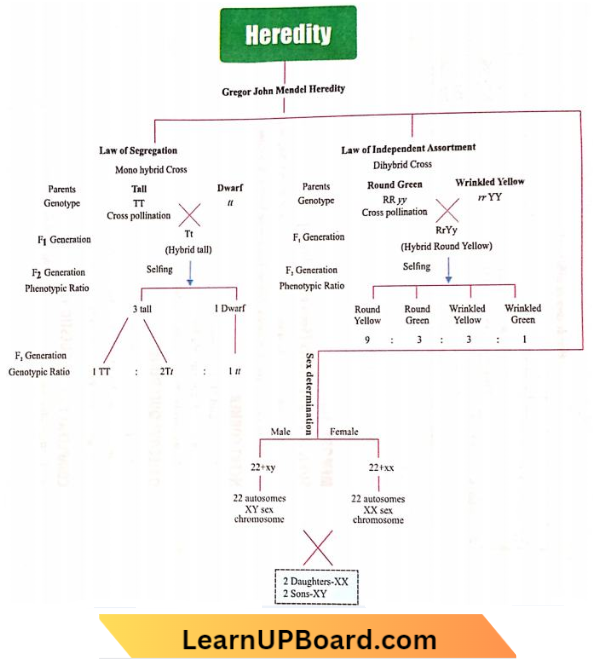
Traits are Dominant or Recessive: This can be discovered by performing a monohybrid cross. A between pure round-seeded and pure wrinkled-seeded plants yields only round-seeded plants in the F1 generation. Self-pollination of F1 plants yields both round-seeded and wrinkled-seeded plants in the ratio of 3:1. TIIIH to poHHiblo only If (lie allele lor wrinkled seed to present in F1 generation but is unable to express its effect, Therefore, the trail of wrinkled seed is recessive while the trait of round seed which is expressed in a generation is dominant.

Mendel’s Laws of Inheritance Class 10

Independent Inheritance of Traits: This can be found by performing a dihybrid cross. A cross between pure round and yellow seeded (RRYY) Pea plant with pure wrinkled and green seeded (rryy) plant yields rounded and yellow seeded F1 generation. Self-polIination of F1 plants gives rise to four types of plants—round yellow (9/16), round green (3/16), wrinkled yellow (3/16) and wrinkled green (1/16). Here round yellow and wrinkled green are parental types. Round green and wrinkled yellow are recombinations which can develop only if the factors for these traits are inherited independently of one another.

Question 3.

  1. How many pairs of chromosomes are present in human beings? Out of these how many arc sex chromosomes 7 How many types of sex chromosomes are found in human beings?
  2. “The sex of a newborn child is a matter of chance and none of the parents may be considered responsible for it”. Draw a flowchart showing the determination of the sex of the newborn to justify the statement.

Answer:

Human beings have 23 pairs of chromosomes. One pair of chromosomes are sex chromosomes or allosomes. In females both the sex chromosomes are similar. They are called XX chromosomes. In males, the two sex chromosomes are different (heteromorphic). One is a normal X chromosome (as found in females). The second is a shorter Y chromosome.

Question 4.

  1. What are dominant and recessive traits?
  2. “Is it possible that a trait is inherited but may not be expressed in the next generation ?’’ Give a suitable example to justify this statement.

Answer:

Dominant Trait: It is that trait which expresses its effect in both homozygous and heterozygous states, Example TT, Tt.

Recessive Trait: It is that trait which is unable to express its effect in the heterozygous state, i.e., in the presence of its alternate trait. The trait expresses its effect in only the homozygous state, Example tt.

Difference between Heredity and Evolution

Question 5. If we cross purebred tail (dominant) Pea plants with purebred dwarf (recessive Pea plants) we get Pea plants of F1 generation. If we now self-cross the Pea plants of the F1 generation, then we obtain Pen plants of the F2 generation

  1. What do the plants of the F1 generation look like?
  2. What is the ratio of tall plants to dwarf plants in F2 generation?
  3. State the types of plants not found in the F1 generation but appeared in the F2 generation, mentioning the reason for the same.
  4. What are homologous structures? Give an example. Is it necessary that homologous structures always have common ancestors?

Answer:

  1. F1 Generation. All tall p
  2. F2 Gcncmtlon: 3 tall; I dwarf.
  3. Dwarf plant: The trait of dwarfness is recessive and cannot express its effect in the presence of an alternate dominant trait.
  4. Homologous Structures, See question 5 above. Homologous structures always have common ancestors,

Heredity and Evolution Class 10 Notes

Question 6.

  1. What Is the law of dominance? Explain with an example.
  2. What is genetics?
  3. What are genes? Where are the genes located?

Answer:

Law of Dominance. Out of the two contrasting factors or alleles of a character if present together as in a hybrid, only one factor called dominant expresses its effect. The other factor called recessive docs not express its effect.

Example Cross a pure tall Rea plant with a pure dwarf Pea plant. All the individuals of the F1 generation are tall though they carry the factor of dwarfness as well.

Heredity Genes Located

Class 10 Heredity and Evolution

Question 7. 

  1. What does the F1 progeny of tall plants with round seeds and short plants with wrinkled seeds look like?
  2. What are recessive traits?
  3. Mention the type of new combination of plants obtained in F2 progeny along with their ratio, if F1 progeny was allowed to self-pollinate.
  4. If 1600 plants were obtained in F2 progeny, write the number of plants having traits
    1. Tall with round seeds
    2. Short with wrinkled seeds. Write the conclusion of the above experiment.

Answer:

  1. Round and tall (both the traits are dominant over wrinkled seed and short height).
  2. Recessive traits are those traits which are unable to express their effect in the presence of their alternate traits, as in the F1 generation.
  3. New Combinations
    1. Tall and wrinkled seeded = 3/16
    2. Short and round seeded = 3/16
  4. Tall with round seeds—1600 x 9/16 = 900
    1. Short with wrinkled seeds—1600 x 1/16 = 100.

Conclusion: The two factors of a character separate independently of the two factors of another character, coming together randomly at the time of fertilization. It is called the law of independent assortment.

Heredity Of Heredity

Class 10 Biology Respiration Question and Answers

Respiratory System Questions And Answers

Question 1. What advantage over an aquatic organism does a terrestrial organism have with regard to obtaining oxygen for respiration?
Answer:

Respiratory System Questions

The advantage over an aquatic organism does a terrestrial organism have with regard to obtaining oxygen for respiration

Aquatic organisms obtain oxygen for their respiration from water. Water has about 1% oxygen in a dissolved state. Terrestrial organisms obtain oxygen directly from the air. The oxygen content of air is 21%. So terrestrial organisms are in a favourable position to obtain the required oxygen without too much work.

On the other hand, aquatic animals which extract oxygen from water have to perform more vigorous and rapid breathing to obtain the required oxygen. A fish will breathe 100 times/ min as compared to 14-20/min in humans.

Class 10 Biology Respiration

Question 2. What are the different ways in which glucose is oxidized to provide energy in various organisms?
Answer:

The different ways in which glucose is oxidized to provide energy in various organisms

There are three common methods by which glucose is catabolised to release energy-aerobic respiration, lactic acid anaerobic respiration and alcoholic anaerobic respiration.

Respiratory Questions

Aerobic Respiration. Glucose is completely oxidised with oxygen as a terminal oxidant. It yields carbon dioxide and energy. The energy yield is 686 kcal/2870 kJ per mole of glucose. About 38 ATP molecules are formed for storing energy. The process occurs partly in cytoplasm and partly in mitochondria.

Respiration Aerobic Respiration In Various Organisms

Lactic Acid Anaerobic Respiration. Glucose is incompletely catabolised to form two molecules of lactic acid without involving the use of oxygen. It occurs in many bacteria and skeletal muscles during vigorous exercise. Only about 50 kcal/210 kJ of energy is released from which 2 ATP molecules are formed. The process occurs exclusively in the cytoplasm.

Respiration Lactic Acid Anaerobic Respiration

Respiration in Biology Class 10 Notes

Ethyl Alcohol Anaerobic Respiration. A molecule of glucose is catabolised to form two molecules of ethyl alcohol. Two molecules of carbon dioxide are evolved. The energy yield is about 50 kcal/210 kJ, equivalent to 2ATP molecules. Oxygen is not required. Respiration occurs inside the cytoplasm. Mitochondria are not required.

Respiration Ethyl Alcohol Anaerobic Respiration

Aerobic and Anaerobic Respiration Class 10

Question 3. How are oxygen and carbon dioxide transported in human beings?
Answer:

Transport of Oxygen. It occurs through blood. 97% of oxygen combines with haemoglobin to form oxyhaemoglobin (Hb4O8). The remaining 3% dissolves in blood plasma. In the tissues, oxyhaemoglobin breaks down to release oxygen. The deoxygenated blood travels to the lungs for reoxygenation.

Transport of Carbon Dioxide. Carbon dioxide produced in cellular respiration passes into the blood. 70% of carbon dioxide forms sodium bicarbonate inside the plasma. 23% of carbon dioxide combines with haemoglobin to produce carbaminohaemoglobin. The remaining 7% gets dissolved in blood plasma. Blood-carrying carbon dioxide reaches alveoli where carbon dioxide diffuses into alveolar air.

Respiration in Plants and Animals Class 10

Question 4. How are the lungs designed in human beings to maximize the area for the exchange of gases?
Answer:

Lungs designed in human beings to maximize the area for the exchange of gases as follows

Human Respiratory System, Class 10 pdf

After entering a lung, each bronchus divides and redivides repeatedly to form segmental bronchi and then each segmental bronchus produces different ranks of bronchioles. The terminal bronchioles form respiratory bronchioles.

The latter form alveolar sacs that are studded with bunches of alveoli. It is estimated that a human lung has about 300 million alveoli. The total alveolar surface of the two lungs is about 80 m2 or roughly 40 times the surface area of the human body. Such a large surface area is most suitable for rapid gaseous exchange between the blood and the alveolar air.

Human Health And Disease Class 12 Multiple Choice Questions

Question 1. Rabies is also called:

  1. Infantile paralysis
  2. Lock Jaw
  3. Hydrophobia
  4. Amoebiasis.

Answer: 3. Hydrophobia

Question 2. Rubeola virus causes:

  1. Smallpox
  2. Measles
  3. Chickenpox
  4. Influenza.

Answer: 2. Measles

Question 3. Black Death or Great Mortality is the name given to:

  1. Plague
  2. Malaria
  3. Cholera
  4. Cancer.

Answer: 1. Plague

human health and disease pyq 

Question 4. A person with blood group ‘O’ can receive blood transfusion from persons with blood groups:

  1. O and A B
  2. O, A and B
  3. O only
  4. AB only.

Answer: 3. O only

Human Health And Disease Class 12 HBSE Notes

Question 5. After which animal is the ‘Rh’ factor named?

  1. Dragon fly
  2. Monkey
  3. Man
  4. Rat.

Answer: 2. Monkey

Human Health And Disease Class 12 Multiple Choice Questions

Question 6. The universal recipient in blood transfusion belongs to the group:

  1. A
  2. O
  3. AB
  4. B.

Answer: 3. AB

Question 7. Rh factor is connected with:

  1. Carbohydrate metabolism in the body
  2. Initiation of protein synthesis
  3. Blood clotting
  4. Blood of man.

Answer: 4. Blood of man

Types Of Immunity Class 12 Biology HBSE

Question 8. Haemophilia is a disease caused by deficiency of:

  1. Water in plasma
  2. RBCs
  3. WBCs
  4. Thromboplastin.

Answer: 4. Thromboplastin.

Question 9. Rh negative individuals are:

  1. Homozygous dominant (RR)
  2. Heterozygous (Rr)
  3. Homozygous recessive (rr)
  4. Possess only one gene (R or r).

Answer: 3. Homozygous recessive (rr)

Question 10. Which of the following is a genetic trait?

  1. Albinism
  2. Leucoderma
  3. Tuberculosis
  4. Diphtheria.

Answer: 1. Albinism

Question 11. The Rh factor was discovered by:

  1. William Harvey
  2. Landsteiner and Weiner
  3. James Watson
  4. Robert Hooke.

Answer: 2. Landsteiner and Weiner

Question 12. Universal donor in blood transfusion belongs to the blood group:

  1. A
  2. O
  3. AB
  4. B.

Answer: 2. O

Bacterial And Viral Diseases Class 12 HBSE Biology

Question 13. A woman with blood group O marries a man with blood group A. The child conceived to such a woman will:

  1. Survive with normal health
  2. Survive with slight anaemic conditions
  3. Will not survive long
  4. Will die soon after birth.

Answer: 1. Survive with normal health

Question 14. Which of the following is biologically incompatible marriage because of the danger of erythroblastosis foetal?

  1. Rh man and Rh woman
  2. Rh+ man and Rh+ woman
  3. Both Rh positive
  4. Both Rh negative.

Answer: 2. Rh+ man and Rh+ woman

Question 15. Down’s Syndrome has karyotype make-up as:

  1. 44 + 3x
  2. 44 + xxy
  3. 45 + xx in female
  4. 44 + xy or 44+ xx in female.

Answer: 3. 45 + xx in female

Question 16. If a man is Rh+ and the lady is Rh then:

  1. The first child will die
  2. The first child will survive
  3. No child will be bom
  4. None of these.

Answer: 2. The first child will survive

Question 17. If a human mother has blood group ‘O’, the foetus in the womb would die, the blood group of the foetus is

  1. A
  2. B
  3. AB
  4. No effect in any case.

Answer: 4. No effect in any case.

Vaccination And Immunization Class 12 HBSE

Question 18. To a person of blood group AB blood groups of A and B are given separately, what will happen:

  1. Clumping occurs with A
  2. Clumping occurs with B
  3. Clumping occurs with both
  4. Clumping does not occur.

Answer: 4. Clumping does not occur.

Question 19. Which of the following diseases is genetically similar to haemophilia?

  1. Albinism
  2. Colour blindness
  3. Phenylketonuria
  4. None of the above.

Answer: 2. Colour blindness

Question 20. The disease Erythroblastosis foetal in human embryos is caused by to:

  1. Disadjustment of blood groups
  2. Disadjustment of Rh factor
  3. Both of these
  4. None of these.

Answer: 2. Disadjustment of Rh factor

Question 21. ABO blood groups were discovered by:

  1. Landsteiner
  2. Darwin
  3. Harvey
  4. Weiner.

Answer: 1. Landsteiner

Question 22. The second Rh+ child conceived to an Rh the woman will:

  1. Die immediately
  2. Surely survive
  3. Survive with serious malformations
  4. Usually die at an early stage.

Answer: 1. Die immediately

Difference Between Active And Passive Immunity Class 12

Question 23. Persons with blood group ‘O’ lack:

  1. Antigens
  2. Antibody ‘a’
  3. Antibody ‘b’
  4. Haemophilia.

Answer: 1. Antigens

Question 24. Foetal sex can be determined by examining cells from amniotic fluid looking for

  1. Barr bodies
  2. Chiasmata
  3. Sex chromosome
  4. Kinetochores.

Answer: 1. Barr bodies

Question 25. The causes of diseases like peptic ulcers, hypertension, coronary heart diseases, and liver cirrhosis are:

  1. Certain viruses and bacteria
  2. Excess of fats in food
  3. Excessive use of alcoholic drinks
  4. Not yet identified.

Answer: 3. Excessive use of alcoholic drinks

Question 26. Trisomic condition of Down’s syndrome arises due to:

  1. Triploidy
  2. Non-disjunction
  3. Translocation
  4. Dicentric bridge formation.

Answer: 2. Non-disjunction

Cancer Treatment Chemotherapy And Radiation Class 12

Question 27. Condition of sex chromosomes in male children with Down’s syndrome will be:

  1. XY
  2. XXY
  3. XX
  4. XO.

Answer: 1. XY

Question 28. Phenylketonuria (PKU) is:

  1. A nutritional disorder due to protein deficiency
  2. An inborn error of metabolism due to a recessive autosomal gene mutation
  3. A sex-linked disorder which is more common in males than in females
  4. None of the above.

Answer: 2. An inborn error of metabolism due to a recessive autosomal gene mutation

Question 29. Chromosomes of Klinefelter’s syndrome usually have:

  1. One X
  2. XXY
  3. 2X only
  4. No Y.

Answer: 2. XXY

Causes And Prevention Of Cancer Class 12 Biology HBSE

Question 30. XO chromosome abnormality is:

  1. Turner’s syndrome
  2. Klinefelter’s syndrome
  3. Criminal syndrome
  4. Down’s syndrome.

Answer: 1. Turner’s syndrome

Question 31. Tay Sach’s disorder is:

  1. A chromosomal disorder in young children
  2. The result of severe protein deficiency in diet damages the muscle development in growing children
  3. An inherited disorder in which the spinal cord and brain are severely damaged within a few months of birth leading to paralysis and mental retardation, and finally the infant’s death in 3 or 4 years
  4. A genetic abnormality which appears at the age of 25-30 years and damages the bones.

Answer: 3. An inherited disorder in which the spinal cord and brain are severely damaged within a few months of birth leading to paralysis and mental retardation, and finally the infant’s death in 3 or 4 years

Question 32. Active immunity is due to:

  1. Memory cells
  2. Killer T-cells
  3. Helper T-cells
  4. Suppressor T-cells.

Answer: 1. Memory cells

Question 33. Passive immunity is provided through:

  1. Exogenous supply of antigens
  2. Exogenous supply of antibodies
  3. Endogenous supply of antigens
  4. Endogenous supply of antibodies.

Answer: 2. Exogenous supply of antibodies

Question 34. B-cells produce antibodies in response to instruction received from:

  1. Killer T-cells
  2. Suppressor T-cells
  3. B-lymphocytes
  4. All of the above.

Answer: 4. All of the above.

Question 35. Opsonisaiion is carried out by:

  1. IgM
  2. IgG
  3. IgA
  4. IgD and IgE.

Answer: 2. IgG

Question 36. Lysis of foreign cells is mediated through:

  1. IgM and IgG
  2. IgG and IgA
  3. IgA and IgD
  4. IgD and IgE.

Answer: 1. IgM and IgG

Drug Addiction And Prevention Class 12 HBSE

Question 37. T-cells have a life of:

  1. 4-5 days
  2. 4-5 weeks
  3. 4-5 months
  4. 4-5 years.

Answer: 4. 4-5 years.

Question 38. Antigenic determinant sites bind to which portions of an antibody molecule?

  1. Light chains
  2. Heavy chains
  3. Intermediate chains
  4. Both (1) and (2).

Answer: 4. Both (1) and (2).

Question 39. The cells that actually release the antibodies are:

  1. Helper T-cells
  2. Cytotoxic T-cells
  3. Mast cells
  4. Memory cells.

Answer: 3. Mast cells

Question 40. Types of T-cells are

  1. Killer cells and helper cells
  2. Killer cells and suppressor cells
  3. Killer, helper and suppressor cells
  4. Killer, helper and depressor cells.

Answer: 3. Killer, helper and suppressor cells

Question 41. Interferon is a protein that:

  1. Inactivates a virus
  2. Protects unattacked cells from virus
  3. Prevents viruses from taking over the cellular machinery
  4. All of the above.

Answer: 2. Protects unattacked cells from virus

Question 42. The most modern technique of vaccine preparation is:

  1. Extraction of antigens from pathogens
  2. Multiplication of antigens through DNA technique
  3. Weakening of pathogens through chemical treatment
  4. Attenuation of the pathogen through heat.

Answer: 2. Multiplication of antigens through DNA technique

Common Infectious Diseases And Their Prevention HBSE

Question 43. AIDS testing on normal individuals is done by:

  1. Separation of virus
  2. Reduction in immunity of the individual
  3. Identification of antibodies
  4. Identification of antigen-toxin.

Answer: 3. Identification of antibodies

Question 44. When people are born without B-cells or T-cells, they suffer from:

  1. Autoimmune diseases
  2. Immunodeficiency diseases
  3. Both of these
  4. None of these.

Answer: 2. Immunodeficiency diseases

Question 45. Which of the following is incorrect:

  1. Skin is a tough outer layer, so it prevents entry of bacteria and viruses
  2. Skin secretes oil and sweat by the glands which makes the surface basic and thus kills the microbes
  3. Skin secretes lysozyme along with sweat which prevents infection
  4. Some bacteria are present on the skin which release acids and other metabolic wastes that inhibit the growth of pathogens.

Answer: 2. Skin secretes oil and sweat by the glands which makes the surface basic and thus kills the microbes

Importance Of Health And Hygiene Class 12 HBSE

Question 46. Which one of the following diseases is due to an allergic reaction?

  1. Enteric fever
  2. Hay fever
  3. Skin cancer
  4. Goitre.

Answer: 2. Hay fever

Class 11 Chemistry Hydrogen Question and Answers

Hydrogen Question and Answers

Question 1. Explain why concentrated HCl is not used in the laboratory preparation of H2 gas.
Answer:

Concentrated HCl is not used for the laboratory preparation of dihydrogen because HCl, being highly volatile, gets mixed with dihydrogen.

Question 2. Write down the name and formula of a compound that on electrolysis produces dihydrogen at the anode.
Answer:

Sodium hydride(NaH).

thermodynamics class11 chemistry

Question 3. What is syngas?
Answer:

syngas

All mixtures of CO and H2 irrespective of their composition are called synthesis gas or syngas.

Question 4. Which isotope of hydrogen is used as a tracer in organic reactions?
Answer:

Deuterium D is usually used as a tracer in determining the mechanism of organic reactions.

Class 11 Chemistry Hydrogen

Question 5. Explain why dihydrogen is not suitable for balloons.
Answer:

As dihydrogen, the lightest substance known, is a highly inflammable gas, it is not suitable for balloons.

Question 6. Which bond between two atoms has the highest bond dissociation enthalpy?
Answer:

Bond dissociation enthalpy of the H —H bond is highest.

Question 7. Explain why H2 is more reactive than D2
Answer:

This is because the H —H bond dissociation enthalpy is less than the D —D bond dissociation enthalpy.

Isotopes of Hydrogen Class 11 Chemistry

Question 8. What change is expected to take place when vegetable oils are hydrogenated?
Answer:

Carbon-carbon double bonds are converted to carbon-carbon single bonds.

Question 9. Which isotope of hydrogen is used in nuclear reactors?
Answer:

Deuterium(H or D).

Question 10. Why are ionic hydrides used as solid fuels?
Answer:

When heated, ionic hydrides decompose to evolve dihydrogen gas which ignites readily.

chapter 6 chemistry class 11

Question 11. The densities of ionic hydrides are greater than that of the metal from which they are formed—why?
Answer:

The densities of ionic hydrides are greater than that of the metal from which they are formed

This is because hydride ions (H) occupy the holes in the lattice of the metal without distorting the metal lattice.

Question 12. Give examples of two interstitial hydrides.
Answer:

CuH and FeH.

Question 13. Which gaseous compound on treatment with dihydrogen produces methanol?
Answer:

Carbon monoxide(CO).

Uses of Hydrogen Class 11 Chemistry

Question 14. Give the chemical reaction that occurs when hydrogen is used as a rocket fuel.
Answer:

\(\mathrm{H}_2(g)+\frac{1}{2} \mathrm{O}_2(g) \rightarrow \mathrm{H}_2 \mathrm{O}(l)+286 \mathrm{~kJ}\)

hydrogen solutions

Question 15. A sample of water containing KCl does not behave as hard water, but a sample of water containing CaCI2 or MgCl2 behaves as hard water—why?
Answer:

A sample of water containing KCl does not behave as hard water, but a sample of water containing CaCI2 or MgCl2 behaves as hard water

The potassium salt of soap is soluble in water and forms a lather while calcium or magnesium salt of soap is insoluble in water and does not form a lather.

Question 16. What is EDTA, a compound used to determine the hardness of water?
Answer:

EDTA

EDTA is the disodium salt of ethylenediamine tetraacetic acid \(\left[\mathrm{NaO}_2 \mathrm{C}(\mathrm{COOH}) \mathrm{NCH}_2 \mathrm{CH}_2 \mathrm{~N}(\mathrm{COOH}) \mathrm{COONa}\right]\)

ch 6 chemistry class 11

Question 17. Can distilled water be called deionized water?
Answer:

Distilled water can be called deionized water because it does not contain any cations and anions.

Question 18. What is the difference between the water softened by the permit process and the water softened by the organic ion exchangers?
Answer:

The difference between the water softened by the permit process and the water softened by the organic ion exchangers

Although the water softened by the permit process contains no cation, it contains various anions (for example Cl-, SO|- etc.). However, the water softened by the organic ion exchangers contains no cations and anions.

chapter 9 Chemistry, class  11 

Question 19. What will be the hardness of a sample of water, 106 g of which contains| mol A12(SO4)3?
Answer:

50 ppm.

Properties of Hydrogen Class 11

Question 20. What is Calgon?
Answer:

Calgon

Sodium hexametaphosphate, Na2[Na4(PO3)6]

Question 21. Give the chemical formula of permtit.
Answer:

Na2Al2Si2O8 xH8O.

Question 22. What is the main source of heavy water?
Answer:

The main source of heavy water

Ordinary water is the main source of heavy water.

Question 23. Can sea animals survive in distilled water?
Answer:

Sea animals cannot survive in distilled water because distilled water contains no salt or dissolved oxygen.

Question 24. Although D20 resembles H20 chemically, it is a toxic substance—why?
Answer:

D2O is toxic because D+ ions react at a much slower rate than H+ ions in enzyme-catalyzed reactions.

Question 25. Which compound is used to color hair golden?
Answer:

Dilute solution of H2O2.

Question 26. What is the trade name of hydrogen peroxide used as an antiseptic?
Answer:

Perhydrol.

Question 27. What is the strength in the normality of an ‘11.2 volume’ H2O2 solution?
Answer:

2(N) H2O2 solution.

Question 28. Name a compound that suppresses the decomposition of H2O2.
Answer:

Acetanilide (PhNHCOCH3).

Question 29. H2O2 molecule has an open-book-like structure. What is the angle between the two pages of the book in the gas phase?
Answer:

111.5°.

Question 30. Name an organic compound without peroxo bond which is used to manufacture H2O2.
Answer:

2-ethylanthraquinol.

Hydrogen Class 11 Notes

Question 31. Why do most of the reactions of H2 occur at much higher temperatures?
Answer:

Due to the much higher bond dissociation enthalpy of the H —H bond, dihydrogen is quite stable and relatively inert at temperature. It dissociates into atoms at about 5000K. For this reason, most of the reactions of dihydrogen occur at much higher temperatures.

ch 6 chemistry class 11

Question 32. What characteristics do you expect from electron-deficient hydrides with respect to their structure and chemical reactivity?
Answer:

Electron-deficient hydrides have less number of electrons in the valence shell of the central atom and so, their mononuclear units do not satisfy the usual Lewis octet rule. Due to a deficiency of electrons, these hydrides act as Lewis acids and form complex entities with Lewis bases such as NH3, H- ion, etc.

⇒ \(\mathrm{B}_2 \mathrm{H}_6+2 \ddot{\mathrm{N}}_3 \rightarrow\left[\mathrm{BH}_2\left(\mathrm{NH}_3\right)_2\right]^{+}\left[\mathrm{BH}_4\right]^{-}\)

⇒ \(\mathrm{B}_2 \mathrm{H}_6+2 \mathrm{LiH} \rightarrow 2 \mathrm{Li}^{+}\left[\mathrm{BH}_4\right]^{-} \text {(Lithium borohydride) }\)

Question 33. Explain whyit is harmful to bathe in heavy water and use it for drinking purposes.
Answer:

Being a very hygroscopic substance, heavy water (D2O) absorbs water from the body and thereby damages body cells. Also, it retards some cellular processes such as mitosis, cell division, and various enzyme-catalyzed reactions. For these reasons, it is harmful to bathe in heavy water and use it for drinking purposes.

Question 34. Explain why the thermal stability of H2O2 is very low.
Answer:

The bond dissociation enthalpy of the O —O bond presenting H2O2 molecule is very low (35kcal . mol-1) i.e., the bond is very weak. For this reason, the thermal stability of H2O2 is extremely low.

Question 35. How the presence of H- ions be confirmed in ionic hydrides?
Answer:

In the molten state, ionic hydrides conduct electricity with the liberation of dihydrogen at the anode. This confirms the presence of hydride (H ) ions in them.

Question 36. How do you separate 2 allotropic forms of hydrogen?
Answer:

Ordinary hydrogen is a mixture of 75% of ortho and 25% of para-isomer at room temperature. On passing through activated charcoal kept at 20K, the para-isomer is adsorbed leaving behind the ortho-isomer. From the charcoal surface, para-hydrogen can be released by reducing pressure.

thermodynamics exercises

Question 37. Mention the difference in chemical characteristics of the two hydrides obtained when hydrogen combines with two elements having atomic numbers 17 and 20.
Answer:

The highly electronegative Cl having atomic number 17 combines with hydrogen to form the covalent hydride H —Cl. On the other hand, the highly electropositive Ca atom having atomic number 20 combines with hydrogen to form the ionic hydride CaH2.

Question 38. Two samples of hard water contain the same cations, Ca2+ & Mg2+. One is marked as temporary and the other as permanent. In which respect do they differ?
Answer:

The two samples of water differ with respect to the anions of calcium and magnesium salts present. the sample watermarked as temporary hard water contains bicarbonates of Ca2+ and Mg2+ ions while the sample watermarked as permanent hard water contains chlorides and sulfates of Ca2+ and 2+ ions.

Question 39. Tube-well water, if left for some time, assumes brownish turbidity—explain.
Answer:

Tube-well water, if left for some time, assumes brownish turbidity

Tube-well water sometimes contains soluble ferrous bicarbonate [Fe(HCO3)2]. This compound, on aerial oxidation, is converted into brown ferric hydroxide, Fe(OH)3, which remains in water as colloidal suspension, and because of this, water assumes a brownish turbidity.

⇒ \(4 \mathrm{Fe}\left(\mathrm{HCO}_3\right)_2+2 \mathrm{H}_2 \mathrm{O}+\mathrm{O}_2 \rightarrow \underset{\text { (brown) }}{4 \mathrm{Fe}(\mathrm{OH})_3}+8 \mathrm{CO}_2\)

Question 40. Write the reactions for:

  1. Preparation of H2O2 from two sodium salts and
  2. Preparation of D2O2 from potassium persulphate.

Answer:

Hydrogen Sodium dihydrogen

⇒ \(\begin{aligned} & \mathrm{K}_2 \mathrm{~S}_2 \mathrm{O}_8+2 \mathrm{D}_2 \mathrm{O} \rightarrow \mathrm{D}_2 \mathrm{O}_2+2 \mathrm{KDSO}_4 \\ & \text { Potassium } \\ & \text { persulphate } \end{aligned}\)

Question 41. Between deionised water and distilled water which one is more pure and why?
Answer:

Both deionized and distilled water are free from ions. Yet distilled water is superior to deionized water in terms of purity. This is because of the fact that deionized water contains a small amount of dissolved silica and CO2 along with some germs and organic impurities. However, distilled water prepared in a glass apparatus does not contain any impurities other than trace amounts of silica and CO2.

Question 42. Why is Na2O2 used for purifying air in submarines and in crowded places?
Answer:

Na2O2 reacts with CO2 of air to evolve O2 (2Na2O2 + 2CO2 —> 2Na2CO3 + O2t). For this reason, Na2O2 is used for the purification of air in submarines and in crowded places.

solutions thermodynamics

43. Comment on the reactions of dihydrogen with

  1. Chlorine
  2. Sodium And
  3. Copper
  4. Oxide.

Answer:

  1. Dihydrogen reduces chlorine (Cl) to chloride ion (Cl-) and itself gets oxidized to form H+ ions. These two ions (H+ and Cl-) share an electron pair between themselves to form a covalent molecule of hydrogen chloride (HCl)
    ⇒ \(\mathrm{H}_2(g)+\mathrm{Cl}_2(g)\rightarrow 2 \mathrm{HCl}(g)\)
  2. Sodium reduces dihydrogen to hydride ion (H~) and itself gets oxidized to sodium ion (Na+). In this reaction, an electron gets completely transferred from Na thereby forming ionic sodium hydride (NaH).
    \(2\mathrm{Na}(s)+\mathrm{H}_2(s)\stackrel{\Delta}{\longrightarrow} 2\mathrm{Na}^{+} \mathrm{H}^{-}(s)\)
  3. Dihydrogen reduces copper(II) oxide to metallic copper while it gets oxidized to form a covalent molecule of H2O.
    ⇒ \(\stackrel{+2}{\mathrm{CuO}}\stackrel{-2}{\mathrm{O}}(s)+\stackrel{0}{\mathrm{H}_2}(s)\stackrel{\Delta}{\longrightarrow}\stackrel{0}{\mathrm{Cu}}(s)+\stackrel{+1}{\mathrm{H}_2}\stackrel{-2}{\mathrm{O}}(l)\)

Question 45. An ionic alkali metal hydride has a covalent character to some extent and it does not react with oxygen and chlorine. This hydride is used in the synthesis of another hydride. Write the formula of the hydride and what happens when it reacts with AI2CI6.
Answer:

Since the alkali metal hydride possesses sufficient covalent character, the hydride is of the smallest alkali metal, Li, i.e. the hydride is LiH. As LiH is quite stable, it does not react with oxygen and chlorine. Lithium hydride reacts with AI2CI6 to form lithium aluminum hydride (LiAlH4) which is extensively used as a reagent in the synthesis of different organic compounds.

⇒ \(8\mathrm{LiH}+\mathrm{Al}_2\mathrm{Cl}_6\longrightarrow2\mathrm{LiAlH}_4+6\mathrm{LiCl}\)

Question 46. Sodium reacts with dlliydrogcn to form a crystalline ionic solid. It is non-volatile and a non-conductor of electricity. It also reacts vigorously with water to liberate II2 gas. Write the formula of the Ionic solid and give a reaction between the lids solid & water. What happens when the ionic solid in its molten stater Is electrolysed?
Answer:

Sodium reacts with dihydrogen to form sodium hydride which is a crystalline ionic solid.

⇒ \(2\mathrm{Na}+\mathrm{H}_2\stackrel{\Delta}{\longrightarrow}2\mathrm{Na}^{+}\mathrm{H}^{-}\)

Sodium hydride reacts with water as follows:

⇒  \(2 \mathrm{NaH}+2 \mathrm{H}_2 \mathrm{O} \longrightarrow 2 \mathrm{NaOH}+2 \mathrm{H}_2\)

Sodium hydride, in its solid state, does not undergo electrolysis. However, in its molten state, undergoes electrolysis. However, in its molten state, NaH undergoes electrolysis to liberate dihydrogen (H2) at the anode and metallic sodium at the cathode.

⇒ \(\mathrm{Na}^{+} \mathrm{H}^{-}(\text {molten }) \stackrel{\text { Electrolysis }}{\longrightarrow} \underset{\text { Cathode }}{2 \mathrm{Na}(\text { molten })}+\underset{\text { anode }}{\mathrm{H}_2(g)}\)

Question 47. Why is seawater not used in boilers?
Answer:

  1. Sea water is hard water. It contains Mg(HCO3)2 and Ca(HCO3)2, which on boiling, form a hard heat-insulating thick layer or scale of MgCO3 and CaCO3 on the inner surface of the boiler. Consequently, much heat is required to raise the temperature of the boiler, and thus, fuel economy is adversely affected.
  2. Again at much higher temperatures, the boiler scales and the metal of the boiler expand unequally. Due to such uneven expansion, cracks are formed on the scales. When hot water comes in contact with the hot metal surface of the boiler through these cracks, it is suddenly converted into steam. Due to the high pressure, thus developed, the boiler may burst leading to accidents. Again, MgCl2 and MgSO4 present in seawater undergo hydrolysis to form HCl and H2SO4 which degrade the metallic component of the boiler. So, seawater is not used in boilers.

Question 48. The values of melting point, enthalpy of vaporization, and viscosity of H2O and D2O are given below:

  1. Melting point(K)     373.0             374.4
  2. Enthalpy of
    vaporisation
    (kJ • mol-1, 373K)     40.66         41.61
  3. Viscosity(centipoise) 0.8903      1.107

From the given data, determine which liquid has a greater magnitude of intermolecular forces of attraction.

Answer:

The magnitude of intermolecular forces of attraction depends on the magnitudes of melting point, enthalpy of vaporization, and viscosity of liquid. As, these parameters have higher values in the case of D2O, the magnitude of intermolecular forces of attraction is greater for D2O than for H2O.

Question 49. How will you prepare heavy water from ordinary water? Explain its principle.
Answer:

Heavy water (D2O) is prepared by prolonged electrolysis of ordinary water. As water is not a good conductor of electricity, an alkaline solution of water [~0.5(N) NaOH] is used for electrolysis. The bond dissociation energy of the O —H bond is less than that of the O —D bond. So, electrolysis of H2O occurs at a faster rate and more easily than D2O. Consequently, the amount of D2O in ordinary water increases. Pure D2O is obtained when the amount of residual liquid decreases.

Question 50. Can phosphorus form PHg with its outer electronic configuration of 3s23p3?
Answer:

Phosphorus cannot form PH5 although it shows +3 and +5 oxidation states. Dihydrogen acts as a weak oxidizing agent due to the high bond dissociation enthalpy of H—Hbond (435.88 kJ-mo-1) and slightly negative electron-gain enthalpy (-73 kJ mol-1). So, dihydrogen can oxidize phosphorus to a +3 oxidation state but not to its highest oxidation state of +5. Therefore, phosphorous can form only PH3 and not PH5.

Question 51. How will you prepare dinitrogen from HNO3?
Answer:

Magnesium and manganese react with a very dilute solution of HN03(2%) to form dihydrogen.

⇒ \(\mathrm{Mg}+2\mathrm{HNO}_3\rightarrow\mathrm{Mg}\left(\mathrm{NO}_3\right)_2+\mathrm{H}_2 \uparrow\)

⇒ \(\mathrm{Mn}+2\mathrm{HNO}_3\rightarrow\mathrm{Mn}\left(\mathrm{NO}_3\right)_2+\mathrm{H}_2 \uparrow\)

Question 52. Do you think the hydrides of N, O, and F will have lower boiling points than the hydrides of their corresponding group members? State reasons.
Answer:

The hydrides of the elements N, O, and F are NH3, H2O, and HF respectively. These hydrides are expected to have lower boiling points than that of their corresponding group members (PH3, H2S & HCl) when their masses are considered.
However, because of the high electronegativity of N, O, and F, their hydrides undergo extensive hydrogen bonding (intermolecular). As a result, boiling points of NH3, H2O, and HF are much higher than the hydrides of their corresponding group members, i.e., PH3, H2S, and HCl respectively.

Question 53. KF reacts with HF to form the compound, KF-2HF. Discuss the probable structure of the compound.
Answer:

The h-bond in the HF molecule is very strong. When KF gets added to HF, one F ion forms an H — bond with two HF molecules to form the H2F3 ion [F—-H —F—H —F —].

Question 54. Calculate the amount of energy liberated due to combustion of 4g dihydrogen.
Answer:

Amount of energy liberated due to combustion of1 mol, i.e., 2g dihydrogen = 242 kJ • mol-1

⇒ \(\left[\mathrm{H}_2(g)+\frac{1}{2} \mathrm{O}_2(g) \rightarrow \mathrm{H}_2 \mathrm{O}(g) ; \Delta \mathrm{H}=-242 \mathrm{~kJ}\cdot\mathrm{mol}^{-1}\right]\)

Amount of energy liberated due to 4g dihydrogen = 242×2 = 484 kJ-mol-1

Question 55. Under what conditions, water reacts with calcium cyanamide and what are the products formed due to this reaction?
Answer:

Superheated steam reacts with calcium cyanamide under high pressure to form ammonia gas and calcium carbonate as a result of hydrolysis.
\(\text { CaNCN }(\text{Calciumcyanamide })+3\mathrm{H}_2\mathrm{O}\rightarrow\mathrm{CaCO}_3+2\mathrm{NH}_3\)

Question 56. Why H2O2 is a better oxidant than water?
Answer:

H2O2 is a better oxidant than water because H2O2 being unstable readily dissociates to form stable water molecules along with the evolution of O2 gas. \(2 \mathrm{H}_2 \mathrm{O}_2 \rightarrow 2 \mathrm{H}_2 \mathrm{O}+\mathrm{O}_2+\text { Heat }\)

Solved Questions

Question 1. What is heavy water? Why is it so-called?
Answer:

Heavy water

Deuterium oxide is commonly known as heavy water because its density is higher than that of ordinary water, i.e., it is heavier than ordinary water.

Question 2. A water sample contains 1 millimole of Mg2+ ion per liter. Calculate the hardness of the water sample in ppm units.
Answer:

1 millimol of Mg2+=1 millimole of MgCl2 = 0.095 g of MgCL2.

1 1. or 1000 g or 103 g of water contains 0.1 g of MgCl2.

106g of water contains 0.095 x 103 = 95g of MgCl2

The degree of hardness of water is 95 ppm.

Question 3. BaO2 is a peroxide but MnO2 is not a peroxide explain.
Answer:

There is peroxide linkage in the Ba02 molecule ( —O —O—). But there is no such bonding present in MnO, molecule (O —Mn=0). Thus Mn02 is not a peroxide.


Class 11 Biology Human Growth Development Multiple Choice Questions

Biology Human Growth Development Multiple Choice Questions

Question 1. Which breaks the dormancy of potato tuber?

  1. Gibbercllin
  2. IAA
  3. ABA
  4. Zcalin.

Answer: 1. Gibberellin

mcq of biology

Question 2. The hormone responsible for senescence is:

  1. ABA
  2. Auxin
  3. GA
  4. Cytokinin.

Answer: 1. ABA

Question 3. Which of the following prevents the fall of fruits?

  1. GA3
  2. NAA
  3. Ethylene
  4. Zcatin.

Answer: 2. NAA

Class 11 Biology Human Growth and Development

Question 4. The plants respond to photoperiods due to (the presence of:

  1. Stomata
  2. Phytochromes
  3. Phytohormones
  4. Enzymes.

Answer: 2. Phytochromes

multiple choice biology questions

Question 5. Which of the following types of phytohormones resemble nucleic acids in some structural aspects?

  1. Cytokinins
  2. Auxins
  3. Gibberellins
  4. Abscisic acid.

Answer: 2. Auxins

Question 6. Ripening of fruits can be accelerated by :

  1. Heating
  2. Ethylene
  3. Nitrogen
  4. IAA.

Answer: 2. Ethylene

Class 11 Biology Human Growth Development Multiple Choice Questions


biology multiple choice questions

Question 7. Coconut milk factor is:

  1. abscisic acid
  2. cytokinins
  3. an auxin
  4. a gibberellin.

Answer: 2. cytokinins

Question 8. In arithmetic growth, following mitotic cell division, only one daughter cell continues to divide while others differentiate by plotting the length of the organ against time, a linear curve is obtained. It is expressed as :

  1. Lt = rt – LO
  2. Lt = tR + LO
  3. LO = Lt + rt
  4. Lt = LO + rt.

Answer: 4. Lt = LO + rt.

Human Growth and Development Diagram

Question 9. The stress-related hormone abscisic acid also :

  1. aids in the development of fruit
  2. helps in the closure of stomata
  3. stimulates cell division
  4. accelerates fruit ripening.

Answer: 2. helps in the closure of stomata

Question 10. Apical dominance is due to a high concentration of:

  1. auxin in terminal bud
  2. gibberellin in the apical bud
  3. auxin in lateral bud
  4. auxin and gibberellin in the lateral bud.

Answer: 1. auxin in terminal bud

Question 11. Regulation of flowering by length of day and night is :

  1. phototropism
  2. photoperiodism
  3. nyctinasty
  4. none of the above.

Answer: 2. photoperiodism

Question 12. Pruning of plants promotes branching due to sensitization of axillary buds by :

  1. Ethylene
  2. Cytokinin
  3. Gibberellin
  4. IAA.

Answer: 4. IAA.

Factors Affecting Human Growth and Development

Question 13. One set of plants was grown at 12 hours day and 12 hours night period cycles and it flowered while in other set night phase was interrupted by a flash of light and did not produce flowers. Under which one of the following categories will you place this plant?

  1. Long day plant
  2. Day-neutral plant
  3. Short day plant
  4.  Darkness neutral plant.

Answer: 3. Short day plant

Question 14. Cell elongation in internodal regions of green plants takes place due to :

  1. Cylokinm
  2. Gibberellin
  3. Indolcacctic acid
  4. Ethylene,

Answer: 2. Gibberellin

Question 15. Senescence is inhibited by :

  1. Ethylene
  2. Gibberellic acid
  3. Abscisic acid
  4. Cytokinin.

Answer: 4. Cytokinin

Question 16. To lest any chemical substance by using the living system is called

  1. Grafting
  2. Cloning
  3. Biopsy
  4. Bioassay.

Answer: 4. Bioassay.

Question 17. Which hormone is the maximum in coconut milk?

  1. Gibberellin
  2. Ethylene
  3. Cytokinin
  4. Auxin.

Answer: 3. Cytokinin

Question 18. Gibberellins can promote seed germination because they influence

  1. the rate of cell division
  2. production by hydrolyzing enzyme
  3. synthesis. abscisic acid
  4. absorption of water through the hard seed coat.

Answer: 2. production of hydrolyzing enzymes

Question 19. Avena curvature lest is a bioassay for examining the activity of:

  1. auxins
  2. gibberellins
  3. cytokinins
  4. ethylene,

Answer: 1. auxins

Stages of Human Growth and Development

Question 20. An enzyme that can stimulate the germination of barley seeds is:

  1. Inverlasc
  2. Protease
  3. a-amylase
  4. Lipase.

Answer: 3. a-amylase

Question 21. In which of the following fruits is the edible part of the aril?

  1. Orange
  2. Litchi
  3. Pomegranate
  4. Custard apple.

Answer: 2. Litchi

Question 22. Treatment of seed at low temperature under moist conditions to break its dormancy is called :

  1. Chelation
  2. Stratification
  3. Scarification
  4. Vernalization.

Answer: 4. Vernalization

Question 23. Parthenocarpic tomato fruits can be produced by :

  1. raising the plants from vernalized seeds
  2. treating the plants with phenylmercuric acetate
  3. removing androecium of flowers before pollen grains are released
  4. treating the plants with low concentrations of gib-acrylic acid and auxins.

Answer: 4. Treat the plants with low concentrations of gib- bicyclic acid and auxins.

Question 24. How does pruning help in making the hedge dense?

  1. The apical shoot grows faster after pruning
  2. It releases wound hormones
  3. It induces the differentiation of new shoots from the rootstock
  4. It frees axillary buds from apical dominance

Answer: 4. It frees axillary buds from apical dominance

Human Growth and Development Class 11 Notes

Question 25. Which one of the following pairs, is not correctly matched?

  1. Gibberellic Acid-Leaf fall
  2. Cytokinin-Cell division
  3. IAA-Ccll wall elongation
  4. Abscisic Acid-Stomatal closure.

Answer: 1. Gibberellic Acid-Leaf fall

Question 26. The wavelength of light absorbed by the Pr form of phytochrome is:

  1. 680 nm
  2. 720 nm
  3. 620 nm
  4. 640 nm

Answer: 1. 680 nm

Question 27. “Foolish Seedling” disease of rice led to the discovery of:

  1. ABA
  2. 2, 4 – D
  3. IAA
  4. GA.

Answer: 4. GA.

Question 28. One hormone helps in the ripening of fruits while the other stimulates the closure of stomata. These are respectively :

  1. abscisic acid and auxin
  2. ethylene and abscisic acid
  3. abscisic acid and ethylene
  4. ethylene and gibberellic acid
  5. gibberellic acid and abscisic acid.

Answer: 2. ethylene and abscisic acid

Question 29. Pick out the correct statements :

A. Cytokinins especially help in delaying senescence

B. Auxins are involved in regulating apical dominance

C. Ethylene is especially useful in enhancing seed germination

D. Gibberellins are responsible for the immature falling of leaves.

  1. (A) and (C) only
  2. (A) and (D) only
  3. (B) and (C) only
  4. (A) and (B) only
  5. (B) and (D) Only.

Answer: 4. (B) and (D) Only.

Question  30. Match List I and List II and select the correct option.

Growth And Development Match The Correct Answer

  1. (A)-3 (B)-1,  (C)-5,  (D)-4,  (E)-2
  2. (A)-4 (B)-5,  (C)-1  (D)-3,  (E)-2
  3. (A)-2. (B)- 1, (C)-5,  (D)-3.  (E)-4
  4. (A)-3, (B)- l  (C)-5.  (D)-2,  (E)-4
  5. (A)-4. (B)- 1,  (C)-5  (D)- 3,  (E)-2.

Answer: 1. A)-3 (B)-1,  (C)-5,  (D)-4,  (E)-2

Question 31. Senescence is an active developmental cellular process in the growth and functioning of a flowering plant, is indicated in:

  1. annual plants
  2. floral parts
  3. vessels and tracheid differentiation
  4. leaf abscission.

Answer: 2. floral parts

Question 32. The importance of day length in the flowering of plants was first shown in

  1. cotton
  2. Petunia
  3. Lemna
  4. tobacco.

Answer: 4. tobacco.

Question 33. One hormone is used to speed up the malting process in barley, another is used to promote flowering in pineapple, and the third helps in the delay of leaf senescence. These are respectively.

  1. auxin, gibberellin, and cytokinin
  2. gibberellin, cytokinin, and auxin.
  3. gibberellin, auxin, and cytokinin
  4. cytokinin, auxin, and gibberellin
  5.  auxin, cytokinin, and gibberellin.

Answer: 3. gibberellin, auxin, and cytokinin

Human Health And Disease MCQ With Answers For Class 12 Biology

Question 1. Growth of the population of an area depends upon:

  1. Natality rate
  2. Immigration
  3. Environmental resistance
  4. All of these.

Answer: 4. All of these.

Question 2. In India, there is a decline in the female population as compared to males. This is because of:

  1. Female infanticide
  2. Fewer females reach reproductive age
  3. The number of female children born is less
  4. All the above.

Answer: 1. Female infanticide

Question 3. Woman plays a greater role in procreation than man (women are biologically superior to men) because they:

  1. Nurses the foetus in her womb
  2. Feeds the infant on her milk
  3. Cleans infant’s excreta
  4. Does all the above.

Answer: 4. Does all the above?

Question 4. Which of the following causes the storage of fat in the liver?

  1. Amphetamines
  2. Barbiturates
  3. All synthetic drugs
  4. Alcohol.

Answer: 4. Alcohol.

Human Health And Disease Class 12 HBSE Notes

Question 5. Depression in the activities of central nervous system may be caused by:

  1. Narcotics
  2. Stimulants
  3. Both narcotics as well as stimulants
  4. Neither narcotics nor stimulants.

Answer: 1. Narcotics

Question 6. Which of the following is not a derivative of opium?

  1. Morphine
  2. Heroin
  3. Cocaine
  4. Codein.

Answer: 3. Cocaine

Human Health And Disease MCQ With Answers For Class 12 Biology

Types Of Immunity Class 12 Biology HBSE

Question 7. Which of the following is not obtained from Cannabis indica?

  1. Marijuana
  2. Bhang
  3. Charas
  4. Ganja.

Answer: 1. Marijuana

Question 8. The drug extracted from Argot fungus is:

  1. Pethidine
  2. Methadone
  3. L.S.D.
  4. Opium.

Answer: 3. L.S.D.

Question 9. Which of the following drugs is responsible for the production of an abnormal foetus?

  1. L.S.D.
  2. Cocaine
  3. Heroin
  4. Alcohol.

Answer: 1. L.S.D.

Question 10. Match the words in Column A with those in Column B

Drugs And Drug Dependence Mental Health Growth Of Human Populations Match The Column

  1. (1-E), (2-B), (3-A) and (4-C)
  2. (1-D), (2-A), (3-C), and (4-E)
  3. (1-D), (2-A), (3-E) and (4-B)
  4. (1-D), (2-E), (3-A) and (4-B).

Answer: 2. (1-D), (2-A), (3-C), and (4-E)

Bacterial And Viral Diseases Class 12 HBSE Biology

Question 11. Consumption of alcohol causes:

  1. Dilation of blood vessels
  2. Constriction of blood vessels
  3. Both of the above
  4. None of the above.

Answer: 1. Dilation of blood vessels

Question 12. LSD is obtained from:

  1. Papaver somniferum
  2. Cannabis sativa
  3. Claviceps
  4. Solanum nigrum.

Answer: 3. Claviceps

Question 13. Morphine is obtained from:

  1. Papaver somniferum
  2. Cannabis sativa
  3. Claviceps
  4. None of the above.

Answer: 1. Claviceps

Question 14. Barbiturates and valium area

  1. Stimulants
  2. Sedatives
  3. Hallucinogens
  4. Carcinogens.

Answer: 2. Sedatives

Vaccination And Immunization Class 12 HBSE

Question 15. Which one of the following is the most harmful derivative of opium?

  1. Codein
  2. Pethidine
  3. Methadone
  4. Heroin.

Answer: 4. Heroin.

Question 16. Tobacco smoke contains

  1. CO2, hydrocarbon and tar
  2. CO2 and tar
  3. CO2 polycyclic aromatic hydrocarbon and tar.
  4. CO2, CO and tar.

Answer: 3. CO2, polycyclic aromatic hydrocarbon and tar.

Question 17. Neuritis is an inflammation of:

  1. Only axon
  2. Entire neuron
  3. Only cyton
  4. Only dendrites.

Answer: 1. Only axon

Question 18. Mental health is influenced by:

  1. Biological factors
  2. Social factors
  3. Both (1) and (2)
  4. Economic factors.

Answer: 3. Both (1) and (2)

Question 19. Barbiturates are extensively used as:

  1. Antiseptics
  2. Stimulants
  3. Disinfectants
  4. Sedatives.

Answer: 4. Sedatives.

Difference Between Active And Passive Immunity Class 12

Question 20. The most important organ damaged by alcohol is:

  1. Heart
  2. Brain
  3. Lung
  4. Liver.

Answer: 4. Liver.

Question 21. A severe type of mental illness in which patients lose touch with reality is known as:

  1. Psychosis
  2. Neurosis
  3. Epilepsy
  4. All of the above.

Answer: 1. Psychosis

Question 22. Bhang, charas, marijuana and hashish are obtained from:

  1. Nicotiana plant
  2. Papaver somniferum
  3. Cannabis sativa
  4. None of the above.

Answer: 3. Cannabis sativa

Question 23. The continuous and excessive intake of alcohol causes:

  1. Fatty liver syndrome
  2. Cirrhosis
  3. Hypertension
  4. All of the above.

Answer: 4. All of the above.

Causes And Prevention Of Cancer Class 12 Biology HBSE

Question 24. Which of the following diseases are included under the global immunisation programme launched by WHO?

  1. Diphtheria, whooping cough, tetanus, polio, tuberculosis and measles
  2. Diphtheria, pertussis, tetanus, measles, polio and mumps
  3. Pertussis, tuberculosis, tetanus, mumps, malaria and measles
  4. Diphtheria, tetanus, tuberculosis, smallpox and measles.

Answer: 1. Diphtheria, whooping cough, tetanus, polio, tuberculosis and measles

Question 25. Which of the following compounds can alter a person’s thoughts, feelings and perceptions?

  1. LSD
  2. Mescalin and psilocybin
  3. ganja
  4. All of the above

Answer: 4. All of the above

Question 26. Seizure is a condition of:

  1. Mood fluctuation
  2. Epileptic attack
  3. Trembling caused by mental sickness
  4. Tremor of limbs in Parkinson’s disease.

Answer: 2. Epileptic attack

Question 27. Paralysis agitans was discovered by:

  1. Parkinson
  2. Huntington
  3. Waller
  4. Einthoven.

Answer: 1. Parkinson

Question 28. ECTis:

  1. Electro-cardio-traction
  2. Electro convulsive therapy
  3. Emergency cardiac treatment
  4. Effects of chewing tobacco.

Answer: 2. Electroconvulsive therapy

Drug Addiction And Prevention Class 12 HBSE

Question 29. Mental diseases can be treated by:

  1. Shock treatment
  2. Psychotherapy
  3. Social therapy
  4. All of the above.

Answer: 4. All of the above.

Question 30. The universal immunisation programme was launched in:

  1. 1947
  2. 1990
  3. 1985
  4. 1975.

Answer: 3. 1985

Question 31. Global Immunisation Programme was started in:

  1. May, 1974
  2. May, 1984
  3. August, 1985
  4. May, 1963.

Answer: 1. May, 1974

Question 32. Project Pulse Polio is concerned with

  1. Eliminating polio by 2000
  2. Widespread attack of polio in certain pockets
  3. Segregation of polio-prone areas
  4. Repeated vaccination for polio.

Answer: 1. Eliminating polio by 2000

Question 33. Any drug which is taken intravenously is called:

  1. 1-drug
  2. 2-drug
  3. 3-drug
  4. 4-drug.

Answer: 4. 4-drug.

Importance Of Health And Hygiene Class 12 HBSE

Question 34. Select the vitamin deficiency reported in an alcoholic:

  1. A
  2. D
  3. E
  4. K.

Answer: 1. A

Question 35. Ciliotoxin present in tobacco smoke is:

  1. Acrolein
  2. Formaldehyde and acetaldehyde
  3. Nitrogen oxides
  4. All the above.

Answer: 4. All the above.

Question 36. The most serious form of mental illness is:

  1. Neurosis
  2. Psychosis
  3. Epilepsy
  4. Cancer.

Answer: 2. Psychosis

Question 37. Nicotine derived from tobacco plants is:

  1. Steroid
  2. Glycoproteins
  3. Lipoproteins
  4. Alkaloid.

Answer: 4. Alkaloid.

Question 38. Any chemical which causes loss of sensation is:

  1. Sedative
  2. Analgesic
  3. Anaesthetic
  4. Stimulant.

Answer: 3. Anaesthetic

Question 39. Tobacco smoke causes inflammation of lung alveoli and causes:

  1. Bronchitis
  2. Lung cancer
  3. Pulmonary TB
  4. Emphysema.

Answer: 4. Emphysema

Question 40. In an alcoholic, urine is generally:

  1. Hypo-osmotic
  2. Hyper-osmotic
  3. Iso-osmotic
  4. None of these.

Answer: 2. Hyper-osmotic

Question 41. Which of the following chemicals is derived from urea malonic acid and used in inducing sleep?

  1. Diazepam
  2. Benzodiazepine
  3. Barbiturate
  4. Amphetamine.

Answer: 3. Barbiturate

Common Infectious Diseases And Their Prevention HBSE

Question 42. Select the correct statement from the ones given below:

  1. Morphine is often given to persons who have undergone surgery as a painkiller
  2. Cocaine is given to patients after surgery as it stimulates recovery)
  3. Chewing tobacco lowers blood pressure and heart rate
  4. Barbiturates when given to criminals make them tell the truth.

Answer: 1. Morphine is often given to persons who have undergone surgery as a painkiller