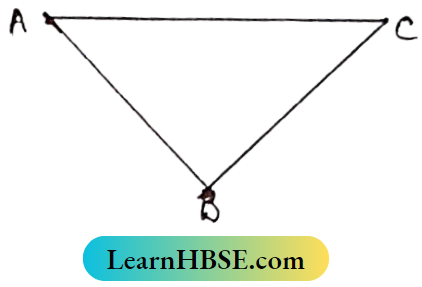
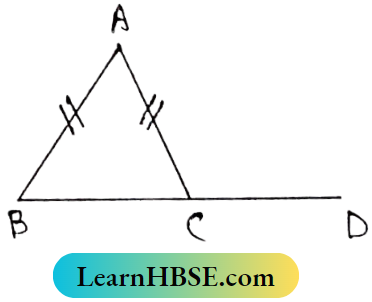
Haryana Board Class 8 Maths Solutions For Geometry Chapter 1 Revision

Revision

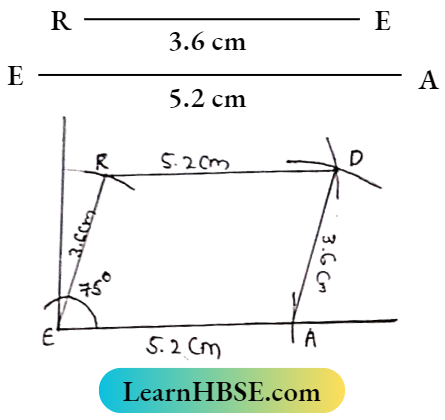
Question 1. Draw a parallelogram READ where RE = 3.6cm, EA = 5.2cm, and ∠REA = 75°.

Solution:

Class 8 Maths Geometry Chapter 1 Revision A Parallelogram

I drew a parallelogram READ where RE = AD = 3.6cm, EA = RD = 5.2cm and ∠REA = 75°

Haryana Board Class 8 Maths Chapter 1 Solutions

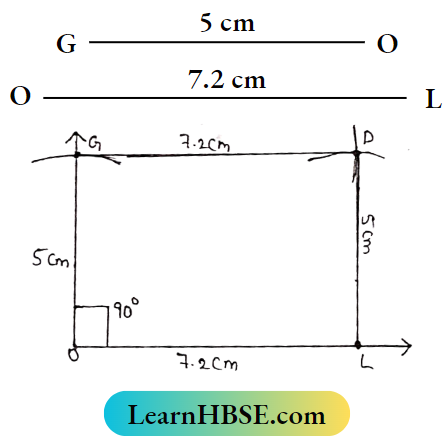
Question 2. Draw a rectangle GOLD where GO = 5m and OL = 7.2cm

Solution:

Class 8 Maths Geometry Chapter 1 Revision A Rectangle

I drew a parallelogram GOLD where GO = LD = 5cm, OL = GD = 7.2 cm and ∠GOL = 90°.

Class 8 Maths Chapter 1 Revision Notes Haryana Board

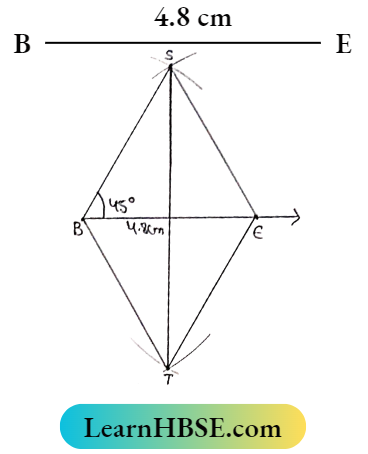
Question 3. Draw a rhombus BEST where BE = 4.8cm, ∠BES = 45°.

Solution:

Class 8 Maths Geometry Chapter 1 Revision A Rhombus

The Diagonal Of a rhombus bisect each other perpendicularly.

I drew a rhombus BESt where BE = ES = BS = BT = ET = 4.8 cm

Haryana Board Class 8 Geometry Chapter 1 Important Questions

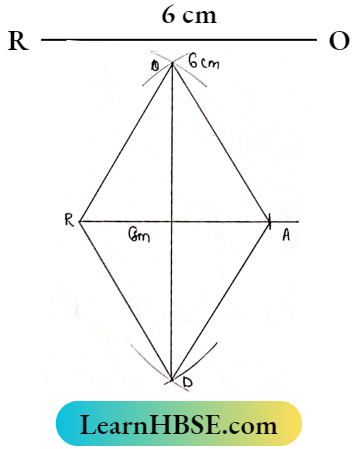
Question 4. Draw a square ROAD where RO = 6cm.

Solution:

Class 8 Maths Geometry Chapter 1 Revision A Square

Diagonals of a square bisect each other perpendicularly.

I drew a square where RA = OD = 6cm

Haryana Board Class 8 Maths Solutions For Chapter 2 Complementary Angles, Supplementary Angles, And Adjacent Angles

Haryana Board Class 8 Maths Solutions For Chapter 2  Complementary Angles, Supplementary Angles, And Adjacent Angles

Question 1. Find the measurement of Complementary angles of 38.5°, \(33 \frac{2}{3}^{\circ}\), 90°.

Solution:

The measurement of the Complementary angle of 38.5°, (90°-38.5°) or 51.5°.

The Complementary angle of \(33 \frac{2}{3}^{\circ}\) is (90° – \(33 \frac{2}{3}^{\circ}\)) or \(56 \frac{1}{3}^{\circ}\)

The Complementary angle of 90° is (90°-90°) or 0.

Question 2. Find the measurement of Supplementary angles of 120°, 0°, 128.6°, 90°.

Solution:

The measurement of the Supplementary angle of 120° is (180°-120°) or 60°.

The Supplementary angle of 0° is (180°-0°) or 180°

The Supplementary angle of 128.6° is (180°- 128.6°) or 51.4°

The Supplementary angle of 90° is (180°-90°) or 90°

Haryana Board Class 8 Maths Chapter 6 Solutions

Question 3. Which pair of angles are complementary?

  1. 52°, 48°
  2. x°, 90°-x°,
  3. 60°, 120°.

Solution:

52°+48° = 100°

x°+90°-x° = 90° [complementary angles]

60°+128° = 180°

Angle-Side Relationship Theorem Class 8 Haryana Board

Question 4. Which pair of angles are Supplementary?

  1. 42°, 139°
  2. 70°, 110°,
  3. 90°, 90°

Solution:

42°+1839° = 181°

70° +110° = 180° – Supplementary angles

90+90= 180° – Supplementary angles

Verification of the Relation Between Angles and Sides of a Triangle Class 8

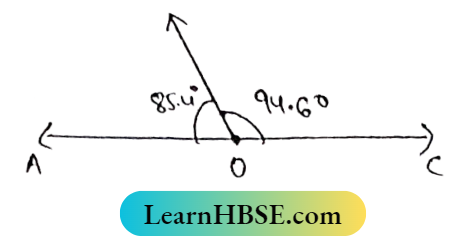
Question 5. If measurements of two adjacent angles are 85.4° and 94.6%, then how external sides of those two angles are Situated?

Solution:

The Sum of two adjacent angles is 85.4°+ 94.6° = 180°

So, the external sides of the two angles are situated on the Same Straight line.

Class 8 Maths Chapter 2 Complementary Angles, Supplementary Angles And Adjacent The external sides of two angles

Question 6. A and B are Supplementary angles to each other. If ∠A = (x + 20)°, then find the value of ∠B.

Solution:

∠A and ∠B are Supplementary angles.

∠A + ∠B = 180

(x+20°) + ∠B = 180°

∠B = 180°- x° – 20°

∴ ∠B = (160-x)°

Haryana Board 8th Class Maths Chapter 6 Important Questions

Question 7. If one angle of the Complementary angle is u times the Other then find the measurement of the Smaller angle.

Solution:

Let the measurement of the Smaller angle be x.

∴ The other angle is 4x°

⇒ 4x°+2°-90°

⇒ 5x° = 90°

⇒ \(x^{\circ}=\frac{90^{\circ}}{5}\)

⇒ x°= 18°

The measurement of the Smaller angle is 18°.

Question 8. Find the Complementary and Supplementary angles of 72°13′24′′.

Solution:

The Complementary angle of 72° 13’24” is (90-72°13’24”)

⇒ \(\begin{aligned}
& 90^{\circ}=89^{\circ} 59^{\prime} 60^{\prime \prime} \\
&\quad \quad-72^{\circ} 13^{\prime} 24^{\prime \prime} \\
& \hline \quad \quad \quad 17^{\circ} 46^{\prime} 36^{\prime \prime} \\
& \hline
\end{aligned}\)

= 17°46’36”

The Supplementary angle of 72°13′24′′ is (180°-72°13′24′′)

⇒ \(\begin{aligned}
& 180^{\circ}=179^{\circ} 59^{\prime} 60^{\prime \prime} \\
&\quad \quad -72^{\circ} 13^{\prime} 24^{\prime \prime} \\
& \hline \quad \quad \quad 107^{\circ} 46^{\prime} 36^{\prime \prime} \\
& \hline
\end{aligned}\)

= 107°46’36”

Triangle Properties Class 8 Haryana Board Solutions

Question 9. In the adjacent figure, how are the line Segment OA and OE situated?

Solution:

∠AOF = ∠AOB + ∠BOC+ ∠COD + ∠DOE + ∠EOF

= 25° + 32° + 41°+ 40°+ 42° = 180° (one Straight line)

∴ OA and OF are on the Same straight line.

Question 10. Find the measurements of complementary and Supplementary angles of (2x-15)°

Solution:

The Complementary angles of (2x-15)° is (90-2x+15)° Or (105-2x)° and Supplementary angles is (180°-2x-+15)° or (195-2x)°.

Question 11. Choose the Correct answer:

1. The Complementary angle of 90° is

  1. 90°
  2. 45°
  3. None of these.

Solution: (90°-90°) = 0°

The Correct answer is (3).

Class 8 Geometry Triangle Angle Sum Property Proof Haryana Board

2. The Supplementary angle of 45° is

  1. 90°
  2. 135°
  3. 45°

Solution:

(180°-45°) = 135°

The Correct answer is (2)

3. Which pair of angles are not Supplementary?

  1. 42°, 139°
  2. 70°, 110°
  3. 90°, 90°
  4. x, 180°-x°

Solution:

42°+139° = 181°

70+110° = 180° – Supplementary angle

90°-+90° = 180° – Supplementary angle

X+180x = 180° – Supplementary angle

The Correct answer is (1)

Question 12. Write ‘True’ or ‘False’.

1. Any two adjacent angles are Complementary to each other.

Solution:

If the Sum of measurements of two angles is equal to 90°, then each angle is Called Complementary to the other angle.

The sum of any two adjacent angles maybe 90° or may not be 90°

So the statement is false.

Verification of Triangle Properties Class 8 Worksheet Haryana Board

2. The Supplementary angle of the right angle is a right angle.

Solution:

The Supplementary angle of the right angle is (180°-90°) or 90° which is a right angle.

So the statement is true.

Question 13. Fill in the blanks are not _________ to each other.

1. Two acute angles

Solution: Supplementary.

2. The Complementary angle of x° is

Solution: 90°-x°

Haryana Board Class 8 Maths Geometry Solutions For Chapter 3 Concept of Vertically Opposite Angles

Haryana Board Class 8 Maths Geometry Chapter 3  Concept of Vertically Opposite Angles

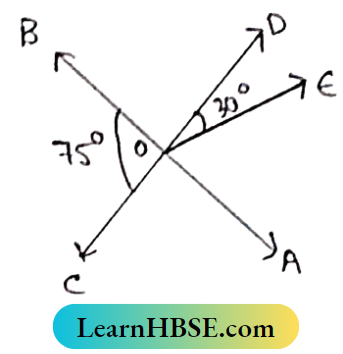
Question 1. In the adjacent figure find the measurement of ∠AOE, ∠BOD, and ∠AOC.

Solution:

∠AOD = ∠BOC (vertically opposite angles)

∠AOD = 90°

i.e., ∠AOE + ∠DOE = 75°

⇒ ∠AOE = 75-30 = 45°

Again, ∠BOD + ∠BOC = 180° (AS BO stands on CD)

∠BOD + 75° = 180°

⇒ ∠BOD = 180°- 75° = 105°

∠AOC = ∠BOD (Vertically opposite angles) = 105°

Class 8 Maths Geometry Chapter 3 Concept of Vertically Opposite Angles The Measurement of vertical angles

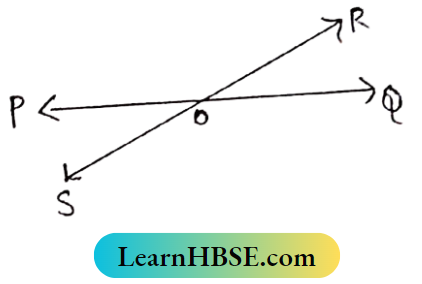
Question 2. In the adjoining figure if ∠POR=2 ∠QOR, then find the value of ∠POS.

Solution:

∠PQR + ∠QOR = 180° (AS OR Stands on PQ]

2∠QOR + ∠QOR = 180°

⇒ 3∠QOR = 180°

⇒ \(\angle Q O R=\frac{180^{\circ}}{3}=60^{\circ}\)

∠POS = ∠QOR (vertically opposite angles) = 60°

Class 8 Maths Geometry Chapter 3 Concept of Vertically Opposite Angles OR stands on PQ

Class 8 Maths Chapter 3 Vertically Opposite Angles Haryana Board

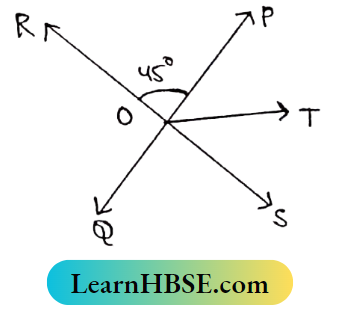
Question 3. Two Straight lines ∠PQ and ∠RS intersect at point O; OT is the bisector of ∠POS. If POR = 45°, then find ∠TOS.

Solution:

∠OP Stands On ∠RS.

∴ ∠POR + ∠POS = 180°

⇒ 45° + ∠POS = 180°

⇒∠POS= 180 °-45°= 135°

OT is the bisector of ∠POS

∴ ∠TOS = \(\frac{1}{2} \angle P O S=\frac{1}{2} \times 135^{\circ}=67 \frac{1}{2}^{\circ}\)

Class 8 Maths Geometry Chapter 3 Concept of Vertically Opposite Angles Two straight lines PQ and RS intersect at point O

Haryana Board Class 8 Maths Vertically Opposite Angles Solutions

Question 4. If two straight lines intersect each other then four angles are formed. Find the Sum of the measurement of four angles.

Solution:

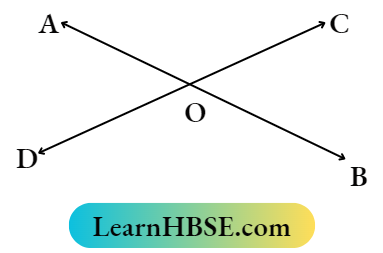
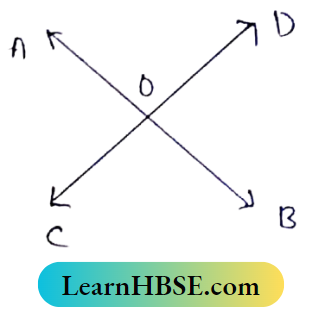
Let two straight lines AB and CD intersed at point O.

CO Stands on AB.

∴ ∠ADC + ∠COB = 180°

OD is stands on AB.

∴ ∠AOD + ∠BOD = 180°

∴ ∠AOC+ ∠COB + ∠AOD + ∠BOD = 130°+ 180°= 360°.

Class 8 Maths Geometry Chapter 3 Concept of Vertically Opposite Angles Two straight lines intersect each other then four angles are formed

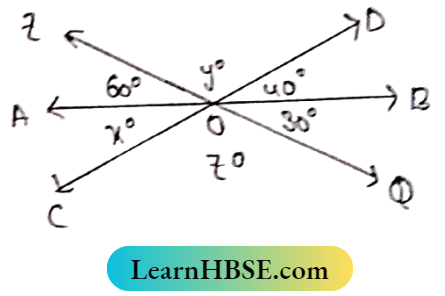
Question 5. In the adjacent figure find the value of x, y, and z?

Solution:

∠AOC = ∠BOD (vertically opposite angles)= 40°

∠AOP + ∠OOD + ∠BOD = 180°

60°+ y° + 48 = 180°

⇒ y° = 180°-100° = 80°

∠AOC + ∠COQ + ∠BOQ = 180°

40°+z°+30° = 180° ⇒ z° = 180°-70° = 110°

Class 8 Maths Geometry Chapter 3 Concept of Vertically Opposite Angles The Value of x,y and z

Haryana Board 8th Class Maths Vertically Opposite Angles Questions and Answers

Question 6. The straight lines AB and CD intersect at point O; ∠AOD + ∠BOC = 102°, If Op is the bisector of ∠BOD, then find the measurement of ∠BOP.

Solution:

∠AOD = ∠BOC [vertically opposite angles)

∠AOD + ∠BOC = 102°

∠AOD + ∠AOD = 120°

⇒ 2∠AOD = 102°

⇒ ∠AOD = \(\frac{102^{\circ}}{2}=57^{\circ}\)

OD stands on AB

∴ ∠AOD + ∠BOD = 180°

51°+ ∠BOD = 180°

⇒ ∠BOD = 180°-51° = 129°

Op is the bisector of ∠BOD

∴ \(\angle B O P=\frac{1}{2} \angle B O D=\frac{1}{2} \times 129^{\circ}=64 \frac{1}{2}^{\circ}\)

Class 8 Maths Geometry Chapter 3 Concept of Vertically Opposite Angles Two straight lines AB and CD intersect at point O

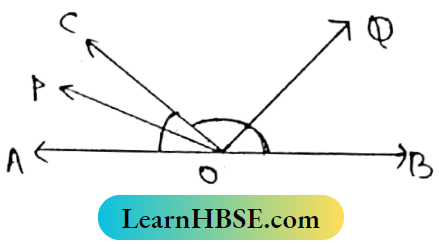
Question 7. Prove that internal and external bisectors of an angle are perpendicular to each other.

Solution:

Let op and OQ be the internal and external bisectors of ∠AOC respectively.

Required to prove: Op and OQ are perpendicular to each other.

Proof: OQ Is the external bisector of ∠AOC,

So OQ is the bisector of BOC.

∠POQ = ∠POC + ∠COQ

= \(\frac{1}{2}\) ∠AOC + \(\frac{1}{2}\) ∠COB

= \(\frac{1}{2}\) (∠AOC+ ∠COB) = \(\frac{1}{2}\) x ∠AOB

= \(\frac{1}{2}\) x 180° (one straight angle] = 90°

OP and OQ are perpendicular to each other.

Class 8 Maths Geometry Chapter 3 Concept of Vertically Opposite Angles The internal and external bisector of an angle are perpendicular to each other

Chapter 3 Vertically Opposite Angles Class 8 Solutions in Hindi Haryana Board

Question 8. PQ and RS are two straight lines intersecting at a point O. Prove that if the bisector of the LPOR is produced through O, it will bisect the ∠SOQ.

Solution:

Let AO is the bisect LPOR and let it be Produced to B.

Required to prove: OB bisects SOQ.

Proof: ∠SOB = ∠AOR [vertically opposite angles]

∠BOQ = ∠AOP [vertically opposite angles]

Again, ∠AOR = ∠AOP [AO is the bisector of POR]

∴ ∠SOB = ∠BOQ

∴OB bisects ∠SOQ (Proved).

Question 9. Choose the Correct answer:

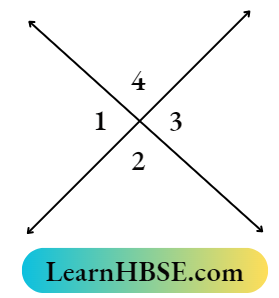
1. In the adjacent figure if ∠1 = 35°, then find the value of ∠2 is

  1. 35°
  2. 145°
  3. 70°
  4. 55°

Solution:

∠1 + ∠2 = 180°

35 + ∠2 = 180°

⇒ ∠2 = 180°-35° = 145°

So the Correct answer is (1).

Class 8 Maths Geometry Chapter 3 Concept of Vertically Opposite Angles The angle of 2

Haryana Board Class 8 Maths Exercise 3.1 Solutions

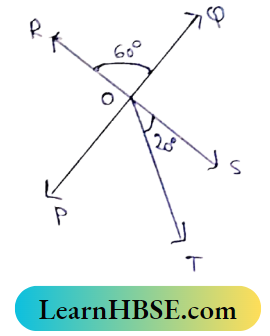
2. In the adjacent figure, if ∠TOS =20° and ∠ROQ = 60°, then the Value of ∠POT is

  1. 66°
  2. 120°
  3. 40°
  4. 80°

Solution:

∠POS = ∠ROQ (vertically opposite angles)

= 60°

i.e., ∠POT+∠TOS = 60°

⇒∠POT+20° = 60°

⇒∠POT = 60°-20° = 40°

So the Correct answer is (3)

Class 8 Maths Geometry Chapter 3 Concept of Vertically Opposite Angles The value of POT

Step-by-Step Solutions for Vertically Opposite Angles Class 8 Haryana Board

3. In the adjacent figure if ∠AOC + ∠BOP = 112°, the value of ∠BOC is

  1. 112°
  2. 56°
  3. 68°
  4. 124°

Solution:

∠AOC = ∠BOD

∠AOC+ ∠BOD = 112°

∠AOC + ∠AOC = 112°

⇒ 2∠A0C = 112°

⇒ ∠AOC = \(\frac{112^{\circ}}{2}=56^{\circ}\)

∴ ∠BOC + ∠AOC = 180°

⇒ ∠BOC = 180°-56° = 124°

So the Correct answer is (4)

Class 8 Maths Geometry Chapter 3 Concept of Vertically Opposite Angles The Value of BOC

Question 10. Write ‘True’ or ‘False”

1. The vertically opposite angle of 68° is 112°

Solution:

The vertically opposite angle of 68° is 68°

So the statement is false.

Important Questions for Class 8 Maths Chapter 3 Haryana Board

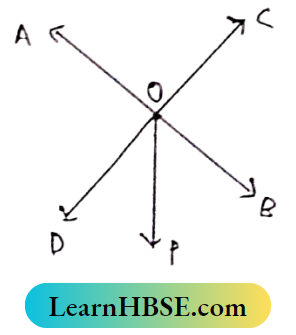
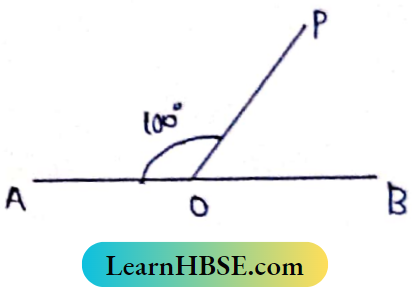
2. If op stands on line AB and ∠AOP = 100°, then the value of ∠BOP is 80°.

Solution:

OP is standing on AB

∴ ∠AOP + ∠BOP = 180°

∠AOP + 80° = 180°

⇒ ∠AOP = 180°-80° = 100°

So the Statement is true.

Class 8 Maths Geometry Chapter 3 Concept of Vertically Opposite Angles OP stands on a line

Question 11. Fill in the blanks:

1. If a ray Stands on a Straight line, then the Sum of measurement of two ________ angles so formed is 180°.

Solution: Adjacent.

2. The value of right angle is half of _________.

Solution: Straight angle.

Haryana Board Class 8 Maths Geometry Solutions For Chapter 4 Properties Of Parallel Lines And Their Transversal

Haryana Board Class 8 Maths Geometry Chapter 4 Properties Of Parallel Lines And Their Transversal

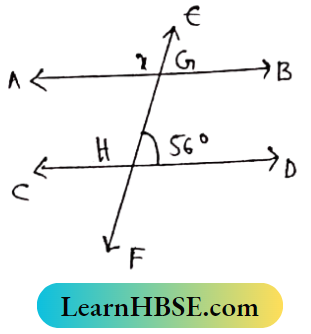
Question 1. In the adjacent figure find the Value of x.

Solution:

AB||CD and EF is transversal

∠EGB = ∠GHD (corresponding angles] = 56°

∠AGE + ∠EGB = 180° [AS GE stands on AB)

x + 56°= 180°

⇒ x = 180 ° – 56°

⇒ x = 124°

Class 8 Maths Chapter 4 Properties Of Parallel Lines And Their Transversal EF is transversal

Properties of Parallel Lines and Their Transversal Worksheet Class 8

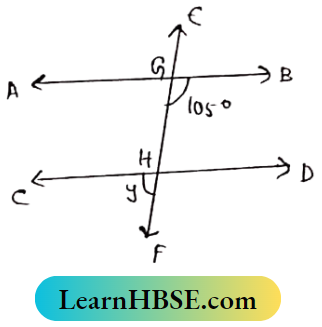
Question 2. In the adjacent figure find the value of y.

Solution:

AB||CP and EF are transversal.

∠DHF = ∠BGH. (Corresponding angles] = 105°

∠CHF = ∠DHF = 180°

y + 105° = 180°

⇒ y = 180°-105°

⇒ y = 75°

Class 8 Maths Chapter 4 Properties Of Parallel Lines And Their Transversal The value of y

Haryana Board Class 8 Maths Geometry Chapter 4 Solutions

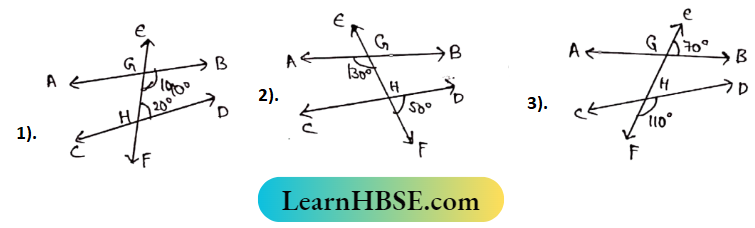
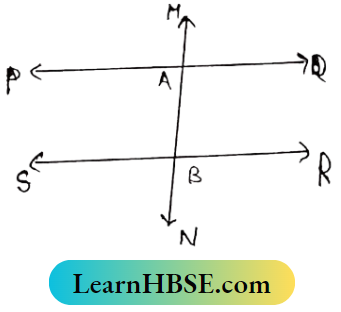
Question 3. Examine the measurement of the angles given below Concludes logically that AB and CD are parallel.

Class 8 Maths Chapter 4 Properties Of Parallel Lines And Their Transversal AB and CD are parallel

Solution:

1. ∠BGH + ∠GHD = 140°+ 20° = 160° ≠ 180 °

∴ AB and CD are not parallel lines to each other.

2. ∠BGH = 180°- ∠AGH

= 180°- 130°

= 50°

Again, ∠DHF = 50°

∠BGH = ∠DHF and these angles are Corresponding angles.

∴ AB||CD

3. ∠BGH = 180° – ∠EGB = 180°-70°

= 110°

Again, ∠DHF = 110°

∴ ∠BGH = ∠DHF and these angles are Corresponding angles.

∴ AB||CD.

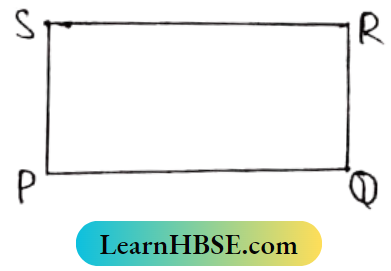
Question 4. In parallelogram PQRS, if ∠P=90°, then find the values of the other three angles.

Solution:

In parallelogram PQRS,

SP||RQ and PQ is transversal.

∴ ∠P + ∠Q = 180°

∴ 90° + ∠Q= 180°

⇒ ∠Q = 180°-90°

= 90°

Again, SR||PQ and RQ are transversal.

Class 8 Maths Chapter 4 Properties Of Parallel Lines And Their Transversal The value of other three angles

Properties of Parallel Lines and Their Transversal Class 8 Solutions

Question 5. If the adjacent figure is PQ||RS; if ∠BAQ = 3∠ABS, then find the value of ∠RBN.

Solution:

AB||RS and MN is transversal.

∴ ∠BAQ + ∠ABS = 180°

3∠ABS + ∠ABS = 180°

⇒ 4∠ABS = 180°

⇒ ∠ABS = \(\frac{180^{\circ}}{4}=45^{\circ}\)

∠RBN = ∠ABS = 45°

Class 8 Maths Chapter 4 Properties Of Parallel Lines And Their Transversal The value of angle RBN

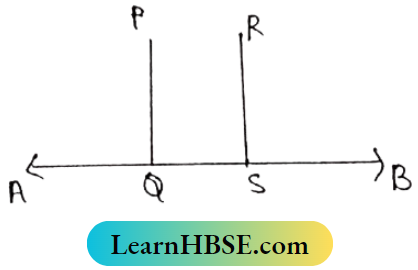
Question 6. Prove that Straight lines perpendicular to the Same straight line are parallel to one another.

Solution:

let PQ and Rs are both perpendicular to AB.

Required to prove: PQ||RS

Proof: PQ⊥AB

∴ ∠PQB = 90°

∴ RS⊥AB

∴ ∠RSB = 90°

∴ ∠PQB = ∠RSB and these are Corresponding angles.

∴ PQ||RS (Proved).

Class 8 Maths Chapter 4 Properties Of Parallel Lines And Their Transversal Straight lines perpendicular to the same straight line

Parallel Lines and Transversals Class 8 Haryana Board Questions

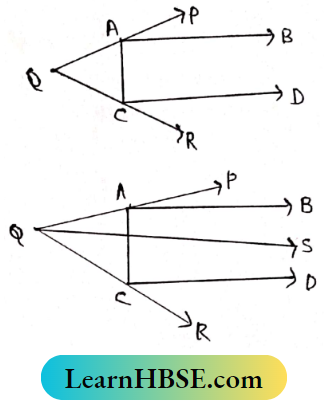
Question 7. In the adjacend figure AB||CD, ∠RCD = 30°, ∠PAB = 50°, ∠PAC= 140°. Find the measurement of all the angles of ΔAQC.

Solution:

I drew Qs through Q which is parallel to AB.

Class 8 Maths Chapter 4 Properties Of Parallel Lines And Their Transversal The measurement of all the angles of AQC

As AB||CD and AB||QS

∴ AB||QS||CP

AB||QS and PQ is transversal.

∴ ∠PQS = ∠PAB [Conrresponding angles) = 50°

QS||CD and QR is transversal.

∴ ∠RQS = ∠RCD (Corresponding angles) = 30°

∠AQC = ∠PQS +∠ RQS = 50°+30° = 80°

∠QAC + ∠PAC = 180°

∠QAC+ 140° = 180°

⇒ ∠QAC = 180°-140° = 40°

In ∠AQC, ∠AQC = 80°, ∠QAC = 40°

∴ ∠ACQ = 180°- (80°+40°) [In ΔAQC, ∠QAC+ ∠AQC + ∠ACQ = 180°)

= 180°-120° = 60°

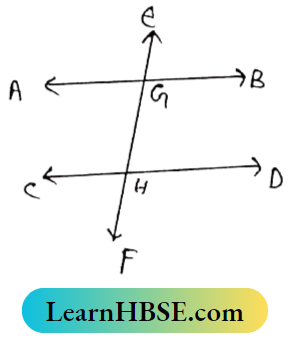
Question 8. In the adjacent figure, AB||CD and ∠EGB = 50% Find the Values of ∠AGE, ∠AGH, ∠CHF, and ∠DHF.

Solution.

∠AGE +∠ EGB = 180°

∠AGE +50° = 180°

∠AGE = 180°- 50° = 130°

∠AGH = ∠EGB [vertically opposite angles) = 50°

AB||CD and EF are transversal.

∴ ∠GHD = ∠AGH (Altemate angles] = 50°

∠CHF = ∠GHD = 50°

∠CHF + ∠OHF = 180°

50° + ∠DHF = 180°

∠DHF = 180°-50° = 130°

Class 8 Maths Chapter 4 Properties Of Parallel Lines And Their Transversal The value of angle AGE

Class 8 Maths Chapter 4 Haryana Board Important Questions

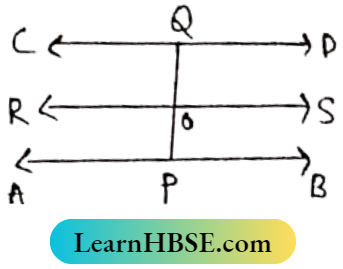
Question 9. O is any point inside two parallel lines AB and CD. Op and OQ are two perpendiculars on AB and CD respectively. prove that P, O, and Q are Collinear.

Solution:

Through O the straight line RS is drawn parallel to AB.

AB||CD and AB||RS.

∴ AB||CD||RS

OP⊥AB ∴∠OPB = 90°

OQ⊥CD ∴ ∠OQD = 90°

AB||RS and op is transversal.

∴ ∠OPB + ∠POS = 180°

90°+ Pos = 180°

⇒ ∠POS = 180°-90° = 90°

CD||RS and OQ are transversal.

∠OQD + ∠QOS = 180°

90°+ ∠QOS = 180°

⇒ ∠QOS = 180°- 90° = 90°

∠POQ = ∠QOS + ∠POS = 90° + 90° = 180°

∴ OP and OQ lie on the Same Straight line.

∴ P, O, and Q are collinear.

Class 8 Maths Chapter 4 Properties Of Parallel Lines And Their Transversal P, O and Q are collinear

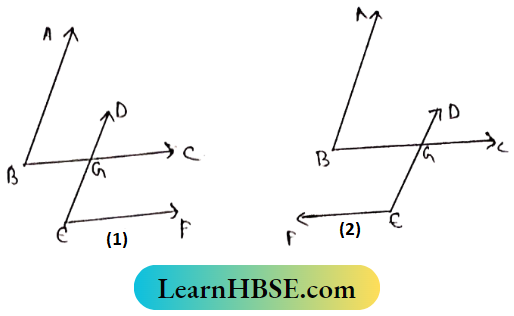
Question 10. If the Sides of angles are respectively parallel to the Sides of another angle, then the angles are either equal or Supplementary.

Solution:

Given: Let in angles ABC and ∠DEF, AB||DE and BC||EF, BC and DE intersect at G.

Class 8 Maths Chapter 4 Properties Of Parallel Lines And Their Transversal The angles are either equal or supplementary

Required to prove:

1. ∠ABC = ∠DCF

2. ∠ABC and ∠DEF Supplementary i.e., ∠ABC + ∠DEF = 180°

Proof:

From (1) AB||DE and BC are transversal.

∴ ∠ABC = ∠DGC (Corresponding angles)

Again, BC||EF and DE is transversal.

∴ ∠DGC = ∠DEF (Corresponding angles)

AS ∠ABC = ∠DGC and ∠DGC = ∠DEF

∴ ∠ABC = ∠DEF (Proved).

From (2) BC||EF and DE is transversal

∴ ∠DGB = ∠DEF (Corresponding angles)

Again, AB||DE and Bc is transversal.

∴ ∠ABC + ∠DGB = 180°

∴ ∠ABC + ∠DEF = 180°

∴ ∠ABC and ∠DEF are Supplementary angles.

Haryana Board 8th Class Maths Geometry Notes Chapter 4

Question 11. Choose the Correct answer:

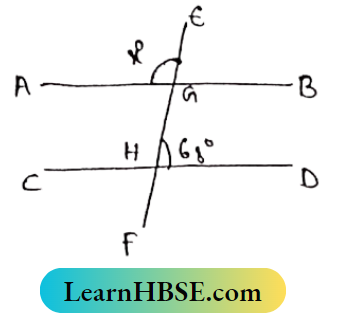
1. In the adjacent figure. If AB||CD, then the value of x is,

  1. 68°
  2. 22°
  3. 112°
  4. 34°

Solution:

Class 8 Maths Chapter 4 Properties Of Parallel Lines And Their Transversal The value of x

AB||CD and EF are transversal.

∴ ∠EGB = ∠GHD (Corresponding angles) = 68°

The ray GE is stands on line AB

∴ ∠AGE + ∠EGB = 180°

∠AGE + 63° = 180

⇒ ∠AGE = 180°- 68°-112° ⇒ x = 112°

So the Correct answer is (3).

Haryana Board Class 8 Chapter 4 Maths MCQ Questions

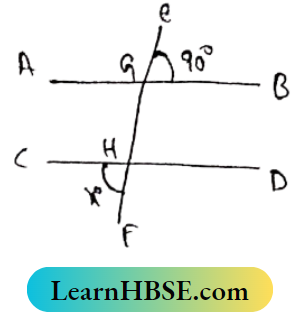
2. In the adjacent figure AB||CD, iF E∠GB = 50°, then the Value of x is

  1. 130°
  2. 40°
  3. 50°
  4. 60°

Solution:

Class 8 Maths Chapter 4 Properties Of Parallel Lines And Their Transversal The value of x..

∠GHD = ∠EGB = 50°

∠CHF = ∠GHD (vertically opposite angle) = 50°

So the Correct answer is (3).

Question 12. Write ‘True’ or ‘False”:

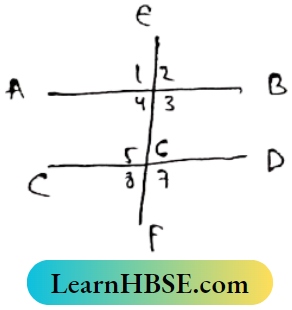
1. In the adjacent figure if 3 = 120° and 8 = 60°, then AB||CD.

Solution:

∠6 + ∠8 = 60°

∠3 + ∠8= 120° + 60° = 180°

∴ AB||CD

So the Statement is true.

Class 8 Maths Chapter 4 Properties Of Parallel Lines And Their Transversal The adjacent figure

Class 8 Geometry Parallel Lines Theorem Explanation Haryana Board

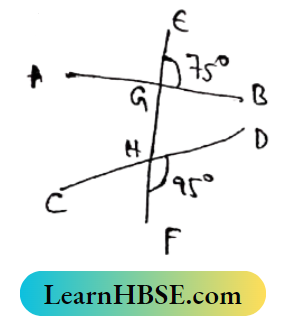
2. In the adjacent figure if ∠EGB = 75° and ∠PHF = 95°, then AB||CD

Solution:

∠AGH= ∠EGB (vertically opposite Angles) = 45°

∴ ∠GHC = ∠DHF = 95°

∠AGH + ∠GHC = 75°+95° = 170°

∴ AB and CD are not parallel to each other.

So the Statement is False.

Class 8 Maths Chapter 4 Properties Of Parallel Lines And Their Transversal Vertically opposite angles

Question 13. Fill in the blanks:

1. If a straight line intersects a pair of Straight lines and the measurement of one pair of Corresponding angles is equal, then the two straight lines are _______.

Solution: Parallel.

2. If the sides of an angle are respectively parallel to the sides of another angle, then the angles are either equal or _________.

Solution: Supplementary.

Haryana Board Class 8 Maths Solutions For Geometry Chapter 5 Relation Between Two Sides Of A Triangle And Their Opposite Angles

Haryana Board Class 8 Maths Geometry Chapter 5 Relation Between Two Sides Of A Triangle And Their Opposite Angles

Question 1. If the measurement of the angle of an isosceles triangle is low, then find the measurement of the other two angles.

Solution:

The Sum of two acute angles is (180°-105°)

or 75°

Let ∠A = 105° and AB = AC

∴ \(\angle B=\angle C=\frac{180^{\circ}-105^{\circ}}{2}=\frac{75^{\circ}}{2}=37.5^{\circ}\)

Class 8 Maths Geometry Chapter 5 Relation Between Two Sides Of A Triangle And Their Opposite Angles The measurement of two angles

Question 2. In an Isosceles triangle one angle of the base is 550, then find the measurement of the Vertical angle.

Solution:

In an isosceles triangle, one angle of the base is 55°.

The other angle of the base is 55°.

Then the vertical angle is 180°- (55°+ 55°) = 180°-110°= 70°

What is the relation between two sides of a triangle and their opposite angles?

Question 3. In the adjacent figure, in ΔABC, AB = AC, If ∠A+∠B = 115°, find the measurement of ∠A.

Solution:

In ΔABE, ∠A + ∠B + ∠C = 180°

115° + ∠C = 180°

⇒ ∠C = 180° = 115°

⇒ ∠C = 65°

As AB = AC

∴ ∠B = ∠C = 65°

∠A = 115°-65° = 50°

Class 8 Maths Geometry Chapter 5 Relation Between Two Sides Of A Triangle And Their Opposite Angles The measurement of angles A

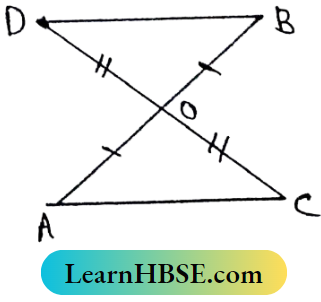
Question 4. Two line Segments AB and CD bisect each other at 0; If AC = 4cm, then find the length of BD.

Solution:

In ΔAOC and ΔBOD,

OA = OB, OC = OD

and ∠AOC = ∠BOD (vertically Opposite angle)

∴ ΔAOC ≅ ΔBOD (by AAS Congruency)

∴ Ac = BP

4cm = BD

∴ The length of BD is 40m.

Class 8 Maths Geometry Chapter 5 Relation Between Two Sides Of A Triangle And Their Opposite Angles The Length BD

How to prove the relation between sides and angles of a triangle in Class 8 Maths?

Question 5. In an isosceles triangle, the vertical angle is three times each angle of the base. Find the measurement of the Supplementary angle of the Vertical angle.

Solution:

Let the measurement of each angle of the base be x°

∴ The measurement of the vertical angle is 37°

The sum of the three angles of a triangle is 180°.

∴ 3x°+x°+x° = 180°

⇒ 5x°=180°

⇒ \(x^{\circ}=\frac{180^{\circ}}{5^{\circ}}=36^{\circ}\)

∴ The Vertical angle Is (3×36°) or 180°

The Supplementary angle of the Vertical angle is (180°-108°) Or 72°.

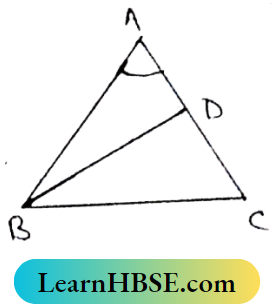
Question 6. In ΔABC, AB=AC, The bisector of ∠ABC intersects AC at D. If ∠A=56°, then find the Value of ∠ABD.

Solution:

In ΔABC,

AB = AC

∴ ∠ABC = ∠ACB

∠BAC=560

In ΔABC,

∠BAC + ∠ABC + ∠ACB = 180°

56° + ∠ABC + ∠ABC = 180°

⇒ 2 ∠ABC = 180°-56°=124°

⇒ \(\angle A B C=\frac{124^{\circ}}{2}=62^{\circ}\)

As BD is the bisector of ABC.

∴ \(\angle A B D=\frac{1}{2} \angle A B C=\frac{1}{2} \times 62^{\circ}=31^{\circ}\)

Class 8 Maths Geometry Chapter 5 Relation Between Two Sides Of A Triangle And Their Opposite Angles The value of angle ABC

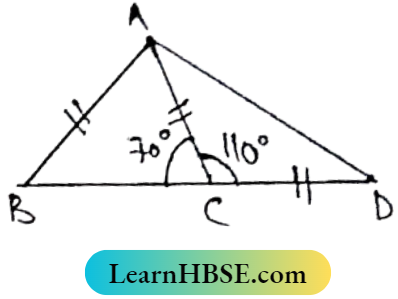
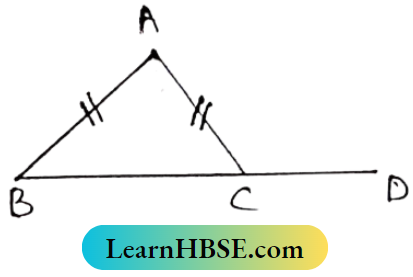
Question 7. In ΔABC, AB = AC; BC is extended to D Such that AC=CD; if ∠ABC=70°, then find the value of ∠BAD.

Solution:

In ABC, AB=AC

‍∴ ∠ACB = ∠ABC = 70°

Again, ∠ACB + ∠ACD = 180°

70° + ∠ACD = 180°

⇒ ∠ACD = 180°-70°

⇒ ∠ACD = 110°

In ΔACD, AC= CD ∴ ∠DAC = ∠ADC

∠ACD + ∠ADC + ∠DAC = 180°

110° + ∠ADC + ∠ADC = 180°

2∠ADC = 180°- 110° = 70°

⇒ \(\angle A D C=\frac{70^{\circ}}{2}=35^{\circ}\)

In ∠ABD + ∠ADB + ∠BAD = 180°

i.e., ∠ABC + ∠ADC+ ∠BAD = 180°

70°+35°+ BAD = 180°

⇒ ∠BAD = 180°-105° = 75°

Class 8 Maths Geometry Chapter 5 Relation Between Two Sides Of A Triangle And Their Opposite Angles The value of angle BAD

What is the theorem on the relation between sides and angles of a triangle?

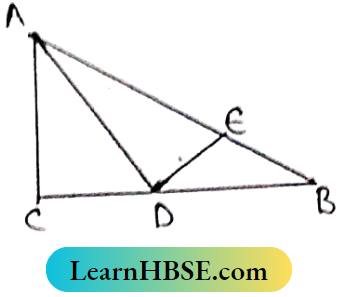
Question 8. AB is the hypotenuse of the isosceles right-angled triangle ABC AD is the bisector of ∠BAC and AD intersects BC at D. Prove that AC + CD = AB.

Solution:

In the right-angled Isosceles triangle ABC, AB is the hypotenuse.

AD is the bisector of ∠BAC and AD Intersects BC at D.

Required to prove: Ac+CD = AB.

Construction: Through D I draw DC which is perpendicular to AB.

Class 8 Maths Geometry Chapter 5 Relation Between Two Sides Of A Triangle And Their Opposite Angles The isoceles right angled triangle ABC

Proof: In ΔACD and ΔADE,

∠CAD = ∠EAD [as AD is the bisector of ∠BAC]

∠ACD = ∠AED = 90° [∵ DE ⊥ AB]

and AD is Common side.

∴ ΔACD ≅ ΔADE [by AAS Congruency)

∴ AC = AE [Corresponding Sides of Congwent triangles]

and CD = DE [Corresponding Sides]

In ΔABC, ∠ACB = 90° and AC = BC.

∴ ∠BAC = \(\angle A B C=\frac{90^{\circ}}{2}=45^{\circ}\)

In ΔBDE, ∠BED = 90°, B=45°

∴ ∠BDE = 180°-90° = 45° = 45°

∴ ∠BDE = ∠B ∴ BE = DE

Again CD = DE DE = CD = BE

AC+ CD = AE + BE = AB (Proved)

Question 9. Choose the Correct Answer:

1. In the adjacent figure, in ΔABC, which relation is correct?

  1. AB = BC
  2. AB = AC
  3. AC = BC
  4. AC ≠ BC

Solution:

Class 8 Maths Geometry Chapter 5 Relation Between Two Sides Of A Triangle And Their Opposite Angles The two angles of a triangle are equal

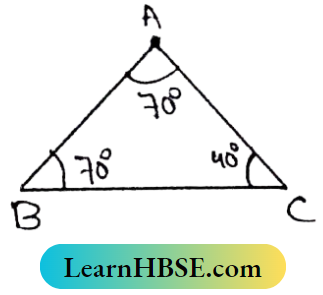
In ΔABC, ∠BAC = ∠ABC= 70°

∴ AC = BC (If the two angles of a triangle are equal then their opposite sides are equal)

So the Correct answer is (3).

What are the important theorems in Haryana Board Class 8 Maths Chapter 5?

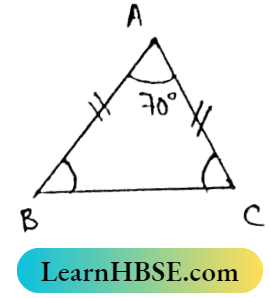
2. In ΔABC, AB = AC; If ∠BAC = 70°, then the value of ∠ACB is

  1. 70°
  2. 110°
  3. 35°
  4. 55°

Solution:

Class 8 Maths Geometry Chapter 5 Relation Between Two Sides Of A Triangle And Their Opposite Angles The value of angle ACB

In ΔABC, AB = AC ∴ ∠ACB = ∠ABC.

Again, ∠BAC+ ∠ABC + ∠ACB = 180°

70° + ACB + ACB = 180°

⇒ 2∠ACB = 180°-70°

⇒ 2∠ACB = 110°

⇒ \(\angle A C B=\frac{110^{\circ}}{2}=55^{\circ}\)

So the correct answer is (4).

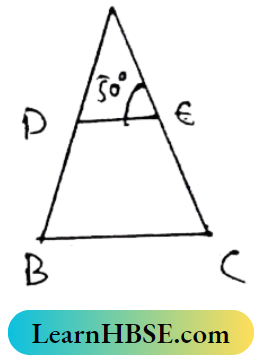
3. In the adjacent figure, in ΔABC, AB = AC and DE||BC; If ∠AED = 50°, then the value of ∠ABC is

  1. 50°
  2. 80°
  3. 100°
  4. 70°

Solution:

Class 8 Maths Geometry Chapter 5 Relation Between Two Sides Of A Triangle And Their Opposite Angles DE is parallel to BC and AC is transversal

DE||BC and AC is transversal.

∴ ∠ACB = ∠AED (Corresponding angles) = 50°

In ΔABC, AB=AC ∴ ∠ACB = ∠ABC = 50° = ∠ABC.

So the correct answer is (1).

Question 10. Write ‘True’ and ‘False”.

1. The external bisector of the Vertical angle of an isosceles triangle is parallel to the base.

Solution: The Statement is true.

2. The Corresponding angles of two Congruent triangles are equal.

Solution: The statement is true.

How to solve Haryana Board Class 8 Geometry Chapter 5 problems step by step?

Question 11. Fill in the blanks:

1. The lengths of the hypotenuse of two _______ right-angled triangles are equal.

Solution: Congruent.

2. In an isosceles obtuse angle triangle the unequal angle is _________.

Solution: Obtuse angle

Haryana Board Class 8 Maths Geometry Solutions For Chapter 6 Verification Of The Relation Between The Angles And Sides Of A Triangle

Haryana Board Class 8 Maths Geometry Chapter 6  Verification Of The Relation Between The Angles And Sides Of A Triangle

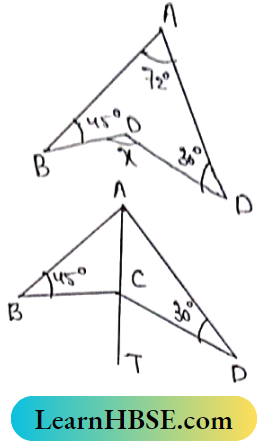
Question 1. In the adjacent figure, find the value of x.

Solution:

Class 8 Maths Geometry Chapter 6 Verification Of The Relation Between The Angles And Sides Of A Triangle The value of x

I joined A, C and AC is produced to T.

In ΔABC,

Exterior ∠BCT = ∠BAC + ∠ABC

In ΔACO,

Exterior ∠BCT = ∠BAC+ ∠ABC

In ΔACD,

Exterior ∠DCT = ∠DAC + ∠ADC

∠BCT + ∠DCT = (∠BAC+ ∠DAC) + ∠ABC + ∠APC

i.e ∠BCD = ∠BAD + ∠ABC + ∠ADC

x = 72°+45+30° ⇒ x = 147°.

Haryana Board Class 8 Maths Chapter 6 Solutions

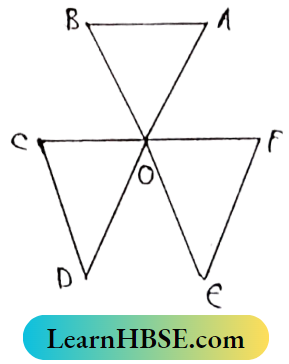
Question 2. In the adjacent figure find the Value of ∠A + ∠B + ∠C + ∠D + ∠E + ∠F.

Solution:

(∠A+∠B)+(∠C+∠D)+(∠E+∠F)

= ∠BOD + ∠DOF + ∠FOB = 360°

Class 8 Maths Geometry Chapter 6 Verification Of The Relation Between The Angles And Sides Of A Triangle The value of A, B, C, D, E and F

Question 3. In ABC, BC is produced to D. If ∠ACD = 126° and ∠B = \(\frac{3}{4}\) ∠A then find the Value of ∠A.

Solution:

Class 8 Maths Geometry Chapter 6 Verification Of The Relation Between The Angles And Sides Of A Triangle The value of angle A

In ΔABC,

∠A + ∠B = exterior ∠ACD

⇒ \(\angle A+\frac{3}{4} \angle A=126^{\circ}\)

⇒ \(\frac{7 \angle A}{4}=126^{\circ}\)

⇒ \(\angle A=\frac{4}{7} \times 126^{\circ}\)

⇒ ∠A = 4 x 126°

⇒ ∠A = 4 x 18°

⇒ ∠A = 72°

Verification of the Relation Between Angles and Sides of a Triangle Class 8

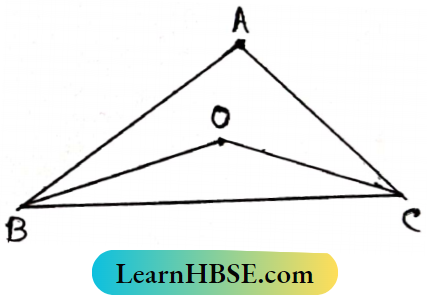
Question 4. If O is an interior point of ABC, then find the relation between ∠BOC and ∠BAC.

Solution:

I join A, O and AD is extended to T

In ΔAOB, the exterior ∠BOT = ∠BAO + ∠ABO

∴ ∠BOT > ∠BAO

Similarly, In ΔAOC, ∠COT > ∠CAO

∴ ∠BOT + ∠COT > ∠BAO + ∠CAO

i.e., ∠BOC > ∠BAC. This is the relation.

Question 5. Find the Sum of measurement of all angles of a quadrilateral.

Solution:

Class 8 Maths Geometry Chapter 6 Verification Of The Relation Between The Angles And Sides Of A Triangle All angles of quadrilateral

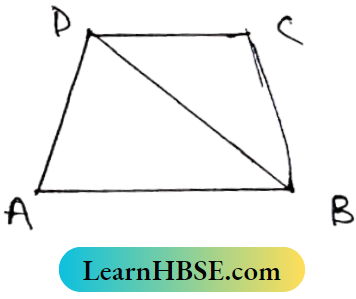
In quadrilateral ABCD, I join A,C.

In ΔABC,

∠BAC + ∠ABC + ∠ACB = 180°

In ΔADC, ∠DAC + ∠ADC + ∠ACD = 180°

(∠BAC + ∠DAC) + ∠ABC + ∠ADC + (∠ACB + ∠ACD) = 180° + 180°

∴ ∠BAD + ∠ABC+ ∠ADC + ∠BCD = 360°

Haryana Board Class 8 Maths Geometry Chapter 6

Question 6. In PQR, If ∠P = 80° and ∠Q= 70°, then find the relation between PQ and QR.

Solution:

Class 8 Maths Geometry Chapter 6 Verification Of The Relation Between The Angles And Sides Of A Triangle The relation between PQ and QR

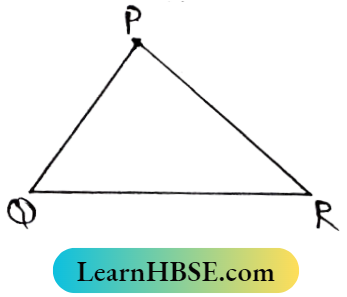
In ΔPQR, ∠P = 80°, ∠Q = 70°

∴ ∠R = 180°- (80°+70°) = 30°

As ∠P > ∠R ∴ QR >PQ (This the relation)

Question 7. The hypotenuse of a right-angled triangle is greatest One ____ Explain.

Solution:

Class 8 Maths Geometry Chapter 6 Verification Of The Relation Between The Angles And Sides Of A Triangle The hypotenuse of a right angled triangle

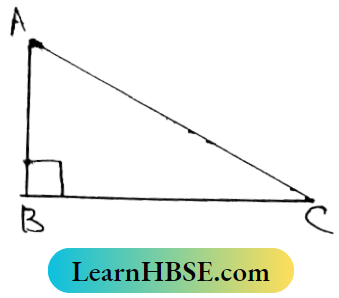
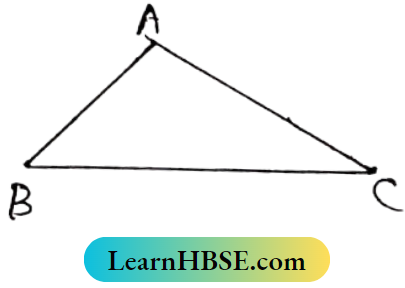
In ΔABC, ∠ABC = 90°

∴ Ac is the hypotenuse.

∠A and ∠C each are acute angles.

∴ ∠ABC > ∠A and ∠ABC > ∠C

As ∠ABC > ∠A ∴ ∠AC > ∠BC

As ∠ABC > ∠C ∴ AC > AB

∴ Ac is the largest side.

Triangle Angles and Sides Class 8 Haryana Board Questions

Question 8. If the ratio of measurement of angles of a triangle is 4:5:9; then write the nature of the triangle.

Solution:

Let the measurement of three angles are 4x°, 5x° and 9x°

4x°+5x°+9x° = 180°

⇒ 18x° = 180°

⇒ \(x^{\circ}=\frac{180^{\circ}}{18}=10^{\circ}\)

∴ The angles are 4×10° or 40°, 5×10° or 50° and 9×10° or 90°

∴ The triangle is a right-angled triangle.

Question 9. In ΔABC, the bisectors of ∠ABC and ∠ACB meet at 0. If AB > Ac then Prove that OB > OC.

Solution:

Class 8 Maths Geometry Chapter 6 Verification Of The Relation Between The Angles And Sides Of A Triangle Bisector of angle ABC and angle ACB

Given: In ΔABC, AB > AC, OB, and OC are the bisectors of ∠ABC and ∠ACB respectively.

RTP: OB > OC.

Proof: AB > AC

∴ ∠ACB > ∠ABC ⇒ ∠ACB > \(\frac{1}{2}\) ∠ABC

∴ ∠OCB > ∠OBC

∴ OB > OC (Proved).

Haryana Board Class 8 Maths Chapter 6 Important Questions

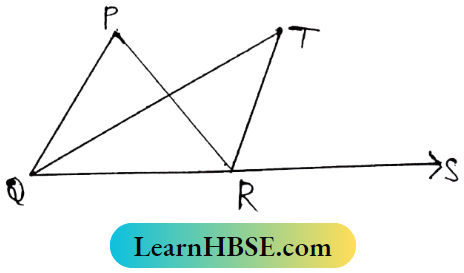
Question 10. In ΔPQR, the Internal bisector of ∠PQR and the external bisector of ∠PRQ intersect at T. If ∠QPR = 40° then find the Value of ∠QTR.

Solution:

Class 8 Maths Geometry Chapter 6 Verification Of The Relation Between The Angles And Sides Of A Triangle The internal bisector of angle PQR and external bisector of angle PRQ

In ΔPQR,

⇒ ∠QTR + ∠TQR = exterior ∠TRS

⇒ ∠QTR = \(\frac{1}{2}\) ∠PRS = \(\frac{1}{2}\) ∠PQR

⇒ \(\frac{1}{2}\) (∠QPR + ∠PQR) – \(\frac{1}{2}\) ∠PQR

⇒ \(\frac{1}{2}\) ∠QPR + \(\frac{1}{2}\) ∠PQR – \(\frac{1}{2}\) ∠PQR

⇒ \(\frac{1}{2}\) ∠QPR = \(\frac{1}{2}\) x 40°

⇒ 20°

Class 8 Geometry Triangle Theorem Explanation Haryana Board

Question 11. Choose the Correct answer:

1. In ΔABC, AB = AC, BC is produced to D. If ∠ACD = 112°, then the Value of ∠BAC is

  1. 44°
  2. 68°
  3. 22°
  4. 34°

Solution:

Class 8 Maths Geometry Chapter 6 Verification Of The Relation Between The Angles And Sides Of A Triangle The value of angle BAC

∠ACD + ∠ACB = 180°

112° + ∠ACB = 180°

Or, ∠ACB = 180°- 112° = 68°

In ΔABC, AB = AC, ∴ ΔABC = ∠ACB = 68°

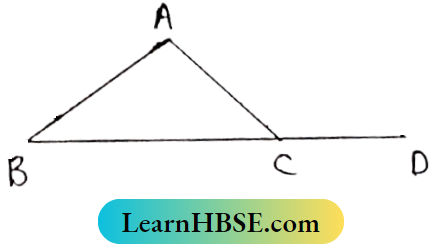
In ΔABC, exterior ∠ACD = ∠BAC+ ∠ABC

112°= ∠BAC + 68°

⇒ ∠BAC = 112°-68° = 44°

So the Correct answer is (1).

2. In ΔABC, If ∠A =70° and ∠B=60°, then the relation between AB and BC is

  1. AB = BC
  2. AB > BC
  3. AB < BC
  4. None of these

Solution:

Class 8 Maths Geometry Chapter 6 Verification Of The Relation Between The Angles And Sides Of A Triangle The relation between AB and BC

In ΔABC, ∠A + ∠B + ∠C = 180°

70° + 60° + ∠C = 180°

⇒ ∠C = 180° – 130° = 50°

As, ∠A > ∠C

∴ BC > AB ⇒ AB > BC

So the correct answer is (3).

Haryana Board Class 8 Maths Chapter 6 MCQ Questions

3. If the measurement of an angle of a triangle is equal to the Sum of the other two angles, then the triangle becomes.

  1. Acute angled triangle
  2. Obtuse angled triangle
  3. Equilateral triangle
  4. Right-angled triangle.

Solution:

In ΔABC, ∠A = ∠B + ∠C

∠A + ∠B + ∠C = 80°

∠A + ∠A = 180°

⇒ 2∠A = 180°

⇒ ∠A = 90°

The triangle is the right-angled triangle.

So the Correct answer is (4).

Question 12. Write ‘True’ or ‘False”.

1. If the ratio of measurements of the three angles of a triangle is 1:2:3, then the triangle becomes a right-angled triangle.

Solution:

Let the angles are x°, 2x°, and 3x°.

x+2x+3x = 180

⇒ 6x = 180

⇒ x = 30.

∴ The angles are 30°, 30°x2 or 6o° and 30°x3 or 90°

∴ The triangle is a right-angled triangle.

So the statement is true.

2. In the adjacent figure, if PQ || TS, then the Value of x is 80.

Solution:

∠QTS = ∠PQT [Alternate angle] = 55°

i.e., ∠RTS = 55°

In ΔRTS,

∠TRS + ∠RTS + ∠RST = 180°

x + 55° + 40° = 180°

⇒ x = 180° – 95° = 85°

So the statement is false.

Question 13. Fill in the blanks:

1. In an obtuse-angled triangle, the Opposite Side of __________ is the largest

Solution:

Class 8 Maths Geometry Chapter 6 Verification Of The Relation Between The Angles And Sides Of A Triangle Obtuse angle

Let, In ΔABC, ∠B is an obtuse angle,

∴ ∠A and ∠C are both acute angles.

∴ ∠B > ∠A and ∠B > ∠C

As ∠B > A then AC > AB

∴ AC is largest

∴ The obtuse-angled triangle on the opposite side of the obtuse angle is the largest.

Relation Between Angles and Sides of a Triangle Class 8 Notes

2. In ΔABC, AB = AC; BC is produced to D. If ∠ACD = 105° then the value of ∠BAC is _________.

Solution:

Class 8 Maths Geometry Chapter 6 Verification Of The Relation Between The Angles And Sides Of A Triangle The value of angle BAC.

In, ∠ABC, ∠ACD = 105°

∠ACB = 180°- ∠ACD

= 180°-105° = 75°

AB = AC

∴ ∠ABC = ∠ACB = 75°

∠BAC + ∠ABC = Exterior ∠ACD

∠BAC + 75°= 105°

⇒ ∠BAC = 105° – 75°

= 30°

Haryana Board Class 8 Maths Algebra Solutions For Chapter 2 Multiplication And Division Of Polynomials

Haryana Board Class 8 Maths Algebra Chapter 2 Multiplication And Division Of Polynomials

Question 1. Multiply the following:

1. (4-5x) by (7x+6)

Solution:

Given (4-5x) by (7x+6)

(4-5x) by (7x+6) = (4-5x) (7x+6)

(4-5x) (7x+6) = 28x + 24 – 35x2 = 30x

(4-5x) (7x+6) = -35x2 = 2x+24

2. (a2-30+7) by (2a-5)

Solution:

Given (a2-3a+7) by (2a-5)

(a2-3a+7) by (2a-5) = (a2-3a+7) (2a-5)

(a2-3a+7) (2a-5) = \(2 a^3-6 a^2+14 a-5 a^2+15 a-35\)

(a2-3a+7) (2a-5) = \(2 a^3-11 a^2+29 a-35\)

Haryana Board Class 8 Maths Multiplication and Division of Polynomials Solutions

3. \(\left(x^2+x y+y^2\right) \text { by }\left(x^2-x y+y^2\right)\)

Solution:

Given \(\left(x^2+x y+y^2\right) \text { by }\left(x^2-x y+y^2\right)\)

= \(x^2\left(x^2+x y+y^2\right)-x y\left(x^2+x y+y^2\right)+y^2\left(x^2+x y+y^2\right)\)

= \(x^4+x^2 y+x^2 y^2-x x^y y-x^2 y^2-x y_3^3+x^2 y^2+x y_3^3+y^4\)

= \(x^4+x^2 y^2+y^4\)

4. \(\left(\frac{a^2}{b c}+\frac{b^2}{c a}\right) \text { by }\left(\frac{a}{b c}-\frac{b}{c a}\right)\)

Solution:

Given \(\left(\frac{a^2}{b c}+\frac{b^2}{c a}\right) \text { by }\left(\frac{a}{b c}-\frac{b}{c a}\right)\)

= \(\frac{a}{b c}\left(\frac{a^2}{b c}+\frac{b^2}{c a}\right)-\frac{b}{c a}\left(\frac{a^2}{b c}+\frac{b^2}{c a}\right)\)

= \(\frac{a^3}{b^2 c^2}+\frac{a b^2}{b c^2 a}-\frac{a^2 b}{a b c^2}-\frac{b^3}{a^2 c^2}\)

= \(\frac{a^3}{b^2 c^2}+\frac{b}{c^2}-\frac{a}{c^2}-\frac{b^3}{a^2 c^2}\)

Question 2. Find the Successive product of the following:

1. \((a+b),(a-b),\left(a^2-a b+b^2\right),\left(a^2+a b+b^2\right)\)

Solution:

Given \((a+b),(a-b),\left(a^2-a b+b^2\right),\left(a^2+a b+b^2\right)\)

= \(((a+b)(a-b))\left(\left(a^2-a b+b^2\right)\left(a^2+a b+b^2\right)\right)\)

= \(\left(a^2-a b+a b b-b^2\right)\left(a^4+a^3 b+a^2 b^2-a^3 b-a^2 b^2-a b^3+a^2 b^2+ab^3+b^4)\right.\)

= \(\left(a^2-b^2\right)\left(a^4+b^4\right)\)

= \(\left(a^2-b^2\right)\left(a^4-b^4\right)\)

= \(\left(a^6-b^6\right)\)

Class 8 Maths Chapter 2 Multiplication and Division of Polynomials Haryana Board

2. \(\left(a^2-b^2\right),\left(b^2-c^2\right),\left(c^2-a^2\right)\)

Solution:

Given \(\left(a^2-b^2\right),\left(b^2-c^2\right),\left(c^2-a^2\right)\)

= \(\left(\left(a^2-b^2\right)\left(b^2-c^2\right)\right)\left(c^2-a^2\right)\)

= \(\left(a^2 b^2-a^2 c^2-b^4+b^2 c^2\right)\left(c^2-a^2\right)\)

= \(c^2\left(a^2b^2-a^2 c^2-b^4+b^2 c^2\right)-a^2\left(a^2 b^2-a^2 c^2-b^4+b^2 c^2\right)\)

= \(\left(a^2 b^2 c^2-a^2 c^4-b^4 c^2+b^2 c^4-a^4 b^2+a^4 c^2+a^2 b^4-a^2 b^2 c^2\right)\)

= \(a^4 c^2-a^4 b^2-a^2 c^4-b^4 c^2+a^2 b^4+b^2 c^4\)

3. (x+1)(x-1)(x2 + 1)(x4 +1)

Solution:

Given: (x+1), (x−1), (x2 + 1), (x4+1)

= \(((x+1)(x-1))\left(\left(x^2+1\right)\left(x^4+1\right)\right)\)

= \(\left(x^2-x+x-1\right)\left(x^6+x^2+x^4+1\right)\)

= \(\left(x^2-1\right)\left(x^6+x^2+x^4+1\right)\)

= \(\left(x^2-1\right)\left(x^6+x^2+x^4+1\right)\)

= \(x^2\left(x^6+x^2+x^4+1\right)-1\left(x^6+x^2+x^4+1\right)\)

= \(x^8+x^4+x^8+x^4-x^6-x^2-x^4-1\)

= \(x^8-1\)

3. Simplify: (2x-3) (x+2)− (3x-5)(x-6) – (5+x)(7-x)

Solution:

Given: (2x-3)(x+2)-(3x-5) (x −6) − ( 5+x)(7-x)

(2x-3)(x+2)-(3x-5) (x −6) − ( 5+x)(7-x) = (2x2+4x-3x-6)-(3x2-18x-5x+30)-(35-5x+7x-x2)

(2x-3)(x+2)-(3x-5) (x −6) − ( 5+x)(7-x) = 2x2+x-6-3x2+23x-30-35-2x-x2

(2x-3)(x+2)-(3x-5) (x −6) − ( 5+x)(7-x) = 24x – 2x – 36 – 35 ⇒ 228-71

Question 4. If x= (a-b+c), y=(b-c+a) and 2 = (b+c-a) then find the value of (xy+yz+zx).

Solution:

Given x=(a+b+c), Y= (b-c+a), Z = (b+(-a)

xy+yz+Zx = ((a-b+c)(b-c+a)) + ((b-c+a) (b+c-a))+((b+c-a)(a-b+c))

xy+yz+Zx =(ab-ac + a2-b2 + bc-ab+cb-c2+ac) + (b2 + bc-ab-bc-c2+ac+ab+ac-a2)+(ab-b2+ bc+ac-bc+c2-a2+ab-ac)

xy+yz+Zx = a2– b2 +bc+cb-c2+b2-c2+ac+ac-a2+ab-b2+c2-a2+ab

xy+yz+Zx = 2ab+2bc+2ac-a2-b2-c2

Haryana Board 8th Class Maths Multiplication and Division of Polynomials Questions and Answers

Question 5. The area of a rectangle is (84x2-xy-15y2) Sq.cm and the length is (12x+5y) cm. Find the breadth of the rectangle.

Solution:

Length of a rectangle = 12x+5y

Breadth of a rectangle = B

Area of rectangle = 84x2-xy-15y2
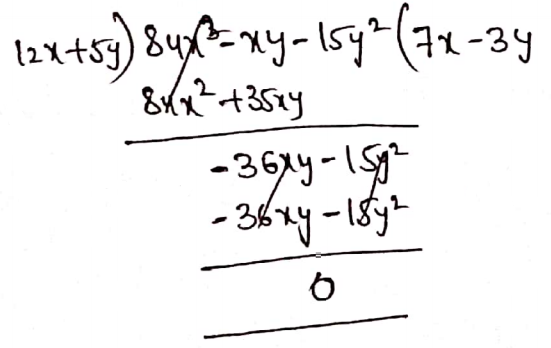
Class 8 Maths Algebra Chapter 2 Multiplication And Division Of Polynomials Breadth Of A Rectangle

Breadth of a rectangle = 7x-3y

Question 6. The product of two numbers is (x3– 8) and one number is (x-2). Find the other number.

Solution:

Product of two numbers = x3-8

One number = (x-2)

Another number =?
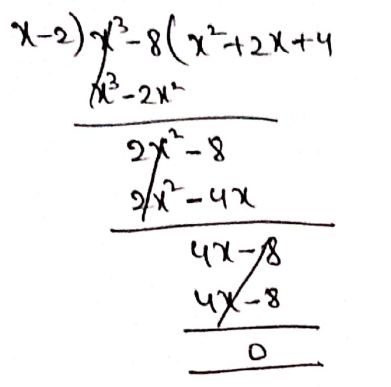
Class 8 Maths Algebra Chapter 2 Multiplication And Division Of Polynomials The product of the other number

The product of another number = x2+2x+4

Question 7. Divide:

1. (x3 +17x-8x2-10) by (x-5)

Solution:

Given (x3+17x-8x2-10) by (x-5)
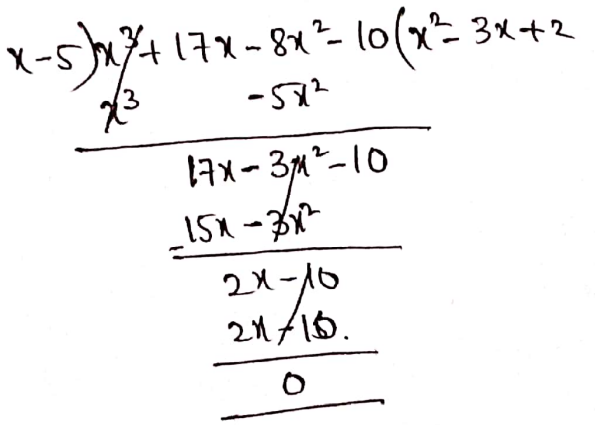
Class 8 Maths Algebra Chapter 2 Multiplication And Division Of Polynomials Division of x-5

∴ (x2 – 3x+2)(x-5) = x3 +17x – 8x2-10

Chapter 2 Multiplication and Division of Polynomials Class 8 Solutions in Hindi Haryana Board

2. (x3-3x2y + 3xy2-y3) by (x-y)

Solution:

Given: (x3-3x2y + 3xy2-y3) by (x-y)
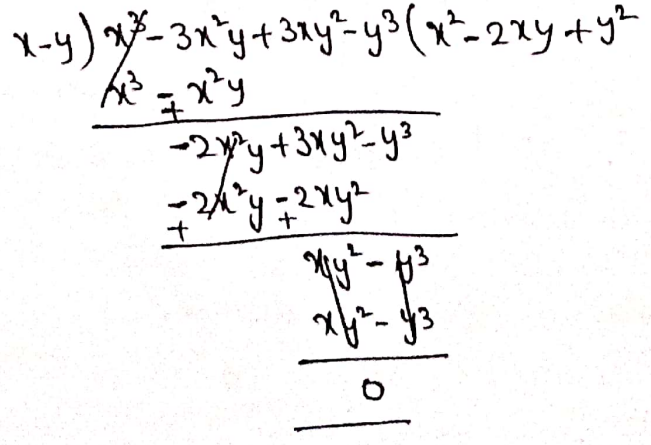
Class 8 Maths Algebra Chapter 2 Multiplication And Division Of Polynomials Division of x-y

∴ (x2-2xy+y2)(x-y) = x3-3x2y+3xy2-y3

3. (a2/3+a1/3b1/3+b2/3) by (a-b)

Solution:

Given: (a2/3+a1/3b1/3+b2/3) by (a-b)
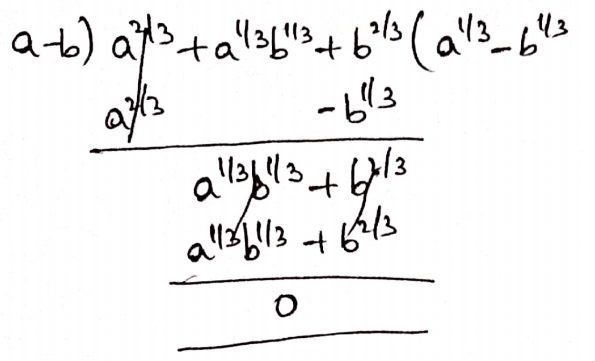
Class 8 Maths Algebra Chapter 2 Multiplication And Division Of Polynomials Division of a-b

(a2/3+a1/3b1/3+b2/3) = (a-b)(a1/3– b1/3)

4. (5x – x2 – 6) by (12x3 – 66 + 97x – x4– 52x2)

Solution:

Given: (5x – x2 – 6) by (12x3 – 66 + 97x – x4– 52x2)
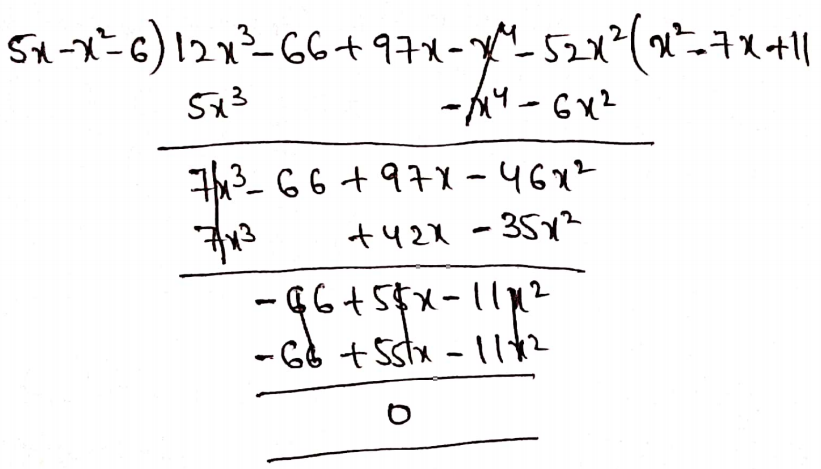
Class 8 Maths Algebra Chapter 2 Multiplication And Division Of Polynomials Division of 5x-x2-6

Question 8. Find the quotient and the remainder:

1. (x2-12x+30) by (x-5)

Solution:
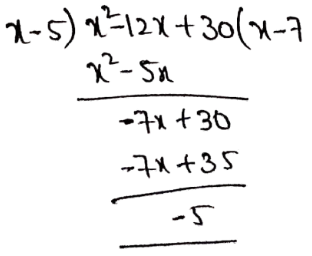
Class 8 Maths Algebra Chapter 2 Multiplication And Division Of Polynomials Quotient is x-7 and remainder is -5

Quotient = (x-7)

Remainder = -5

Haryana Board Class 8 Maths Exercise 2.1 Solutions

2. (x2-3x+8) by (x4+2x3-14x2+63x-57)

Solution:

Given: (x4+2x3-14x2+63x-57) by (x2-3x+8)
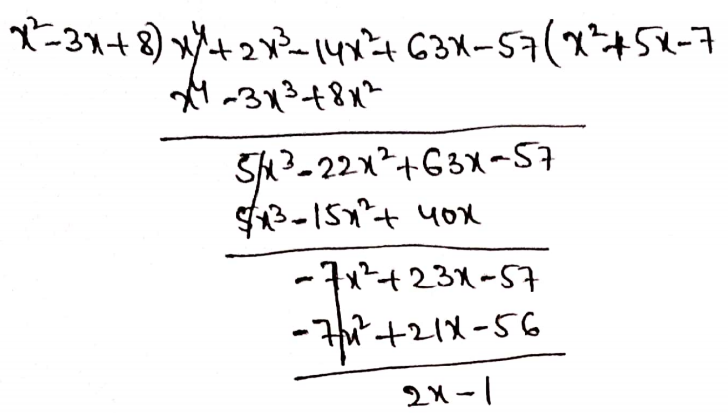
Class 8 Maths Algebra Chapter 2 Multiplication And Division Of Polynomials Quotient is x2+5x-7 and remainder is 2x-1

Quotient = (x2+5x-7)

Remainder = (2x-1)

3. (a3-2a2b+3ab2-5b3) by (a-2b)

Solution:

Given: (a3-2a2b+3ab2-53) by (a-2b)
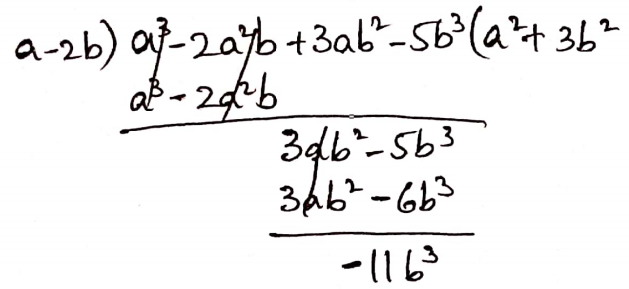
Class 8 Maths Algebra Chapter 2 Multiplication And Division Of Polynomials Quotient is a2+3b2 and remainder is -11b3

Quotient = (a2+3b2)

Remainder = -113

4. (x4+x2y2+2y4) by (x2+xy+y2)

Solution:

Given: (x4+x2y2+2y4) by (x2+xy+y2)
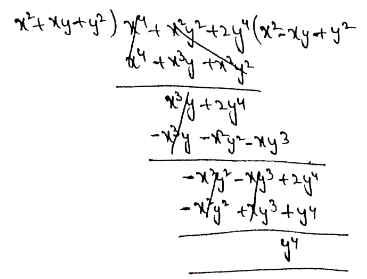
Class 8 Maths Algebra Chapter 2 Multiplication And Division Of Polynomials Quotient is x2-xy+y2 and remainder is y4

Quotient = (x2-xy + y2)

Remainder = y4

Important Questions for Class 8 Maths Chapter 2 Haryana Board

Question 9. Choose the correct answer:

1. (a+3) (a+4) (a+5)= _____________

  1. a3+12a2+47a+60
  2. a2+47a2+12a+60
  3. a3+12a2 +60a+47
  4. None of these

Solution: (a+3) (a+y) (a+5)

= (a2+4a+3a+12) (a+5) = (a2+7a+12)(a+5) = a3+35a+60+7a2+12a+5a2

= a3+12a2+47a+60

So, the Correct answer is (1)

2. (x4+2x2-x3+3+x) ÷ (x2+x+ 1) = _________

  1. x2=2x+3
  2. x2+2x-3
  3. x2+2x+3
  4. x2=2x-3

Solution:

So, the Correct answer is (1).
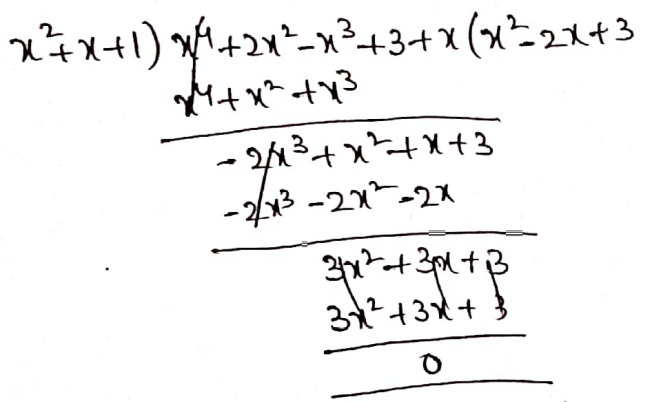
Class 8 Maths Algebra Chapter 2 Multiplication And Division Of Polynomials Division of x2-2x+3

3. (8x8-8x2=-36x)÷ 4x = ____________

  1. 2x8-2x2-9
  2. 2x8-8x-36
  3. 2x7-2x-9
  4. 2x7-2x-18

Solution:

∴ \(\frac{8 x^8-8 x^2-36 x}{4 x}=2 x^7-2 x-9\)

The Correct answer is (3).

Step-by-Step Solutions for Multiplication and Division of Polynomials Class 8 Haryana Board

Question 10. write ‘True’ or ‘False”:

1. (x2+xy+y2) (x2-xy+y2) = x4+x2y2+y4

Solution:

(x2+xy+y2) (x2-xy+y2) = x4– x3y + x2y2 + x3y – x2y2 + xy3 + x2y2 – xy2 + y4

= x4 + x2y2 + y4

So, the statement is true.

2. (x2+7x+7) ÷ (x+3) = (x+4) – \(\frac{5}{x+3}\)

Solution:
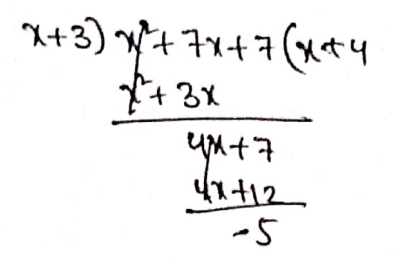
Class 8 Maths Algebra Chapter 2 Multiplication And Division Of Polynomials Division of x+4

∴ \(\left(x^2+7 x+7\right) \div(x+3)=(x+4)-\frac{5}{x+3}\)

So the statement is true.

Question 11. Fill in the blanks:

1. (2x3-5x2-9x-8)=(x-4) = ______.

Solution:
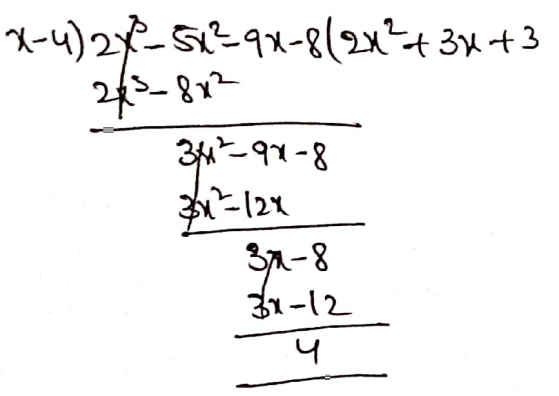
Class 8 Maths Algebra Chapter 2 Multiplication And Division Of Polynomials Division of 2x2+3x+3

∴ \(\left(2 x^3-5 x^2-9 x-8\right) \div(x-4)=2 x^2+3 x+3+\frac{4}{x-4}\)

2. -3r2t(4+r45+2rt3) = __________

Solution:

∴ -3r2t(4+r4t5+2r3) = -12r6t6-6r3t4

3. (x2+xy+y2)(x-4)= __________

Solution:

(x2+xy+y2) (x-y)

(x2+xy+y2) (x-y) = x2(x-y)+xy(x-y) + y2 (x-y)

(x2+xy+y2) (x-y) = x3-x2y+x2y-xy2+xy2-y3

(x2+xy+y2) (x-y) = x3-y3

Haryana Board Class 8 Maths Algebra Chapter 7 cubes

Cubes

Question 1. If P = 999, then find the volume of P (p2+3p+3).

Solution:

Given P = 999

= P(P2+3843)

= 999 (1999)2+3 (999)+3)
= 999(99800142997+3)

= 999 (1001001)

= 999,999,999

The volume of P (p2+3p+3) = 999,999,999

Question 2. Find the Cube of:

1. 1001

Solution:

Given: 1001

= (1001)3

– (1001)2(1001)

= 1002001 (1001)

= 1,003,003,001

(1001)3 = 1,003,003,001

2. 998

Solution:

Given: 998

= (998)3

= (998)2(992)

= 996004 (998)

= 994,001,1992

(998)3 = 994,001,1992

Haryana Board Class 8 Maths Cubes and Cube Roots Solutions

3. 5a-4b

Solution:

Given 5a-4b

= (5a-4b)3 [∵ (a-b)2 = a3-3ab+3ab2+b3]

= (5a)3 – 3(5a)24b + 3(5a)(4b)2-(4b)3

= 125a3 – 300a2b + 240ab2 – 64b3

(5a-4b)3  = 125a3 – 300a2b + 240ab2 – 64b3

4. 3a-b+4c

Solution:

= 3a-b+4c

= (3a-b+4c)3 [(∵(a+b+c)3 = a3 + b3 + c2 + 3 (a+b) (b+c) (c+a)]

= (3a)3 + (-b)3 + (4c)3 + 3(3a-b)(-b+4c) (4c+3a)

= 27a3 – b3 + 64c3 + 3((3a-b) (-4bc – 3ab + 16c2 + 12ac)

= 27a3-b3 + 64c3 +3[-12abc – 9a2b + 48ac2 + 362c + 4b2c + 3ab2 – 16bc2 = 12abc]

= 27a3-b3 + 64c3 – 36abc – 27a2b + 144ac2 + 108a2C +12b2c + 9ab2 – 48bc2 – 36abc

= 27a3 – b3 + 64c3 – 27a2b + 9a2 + 108a2c – 72abc + 12b2c +144ac2 – 48bc2

(3a-b+4c)3= 27a3 – b3 + 64c3 – 27a2b + 9a2 + 108a2c – 72abc + 12b2c +144ac2 – 48bc2

Class 8 Maths Chapter 7 Cubes Haryana Board

Question 3. Simplify:

1. 3.2 x 3.2 x 3.2 – 3 x 3.2 x 3-2 x 1.2 + 3 x 3.2 × 1.2 x 1.2 −1·2 x 1.2 x 1.2

Solution:

Given:

= 3.2 x 32 x 3.2 – 3 x 3.2 x 3.2 x 1.2 + 3 x 3.2 x 1.2 x 1.2-1.2 x 1.2 x 1.2

= (3.2)3-3 (3-2)2 x 1-2 + 3 x 3.2 x (1.2)2 -(1.2)3

= 32.768 – 36.864 + 13.824 – 1.728

= 8

3.2 x 32 x 3.2 – 3 x 3.2 x 3.2 x 1.2 + 3 x 3.2 x 1.2 x 1.2-1.2 x 1.2 x 1.2 = 8

2. (a-b+c)3 + (a+b-c)3 + 6a [a2-(b-c)2]

Solution

Given:

= (a-b+c)3 + (a+b-c)3 + 6a [a2-(b-c)2]

= a3 – b3 + c3 + 3(a-b)(-b+ c)(c+a) + a3 + b2 – c3 + 3(a+b)(b-c)(-c+a) + 6a [a2– b2 + c2 + 2bc]

= a3 – b3 + c3 + 3(a-b)(-bc-ba+c2+ca) + a3 + b3 – c3 + 3(a+b)(-bc+ba+c2-ca) + 6a [a2-b2+c2+2bc]

= a3 – b3 + c3 + 3 (-abc – a2b + ac2 + a2c + b2c + b2a – bc2 – abc) + a3 + b3 – c3 + 3(-abc + a2b + ac2 – a2c -b2c + b2a + bc2 – abc)+ 6a3 – 6ab2 + 6ac2 + 12abc

= a3– b3 + c3 – 3abc – 3a2b + 3ac2+ 3a2c + 3b2C + 3b2a – 3bc2 – 3abc + a3 + b3 – c3 – 3abc + 3a2b + 3ac2 – 3a2c – 3b2c + 3b2a + 3bc2 – 3abc + 6ab3 – 6ab2 + 6ac2 + 12abc

= a3 – 3abc + 3ac2 + 3b2a – 3abc – 3abc + 3ac2 + 3b2a – 3abc + 6a3 – 6ab2 + 6ac2 + 12abc

= 8a3 – 12abc + 6ac2 + 6ab2 – 6ab2 – 6ac2 + 12abc

= 8a3

(a-b+c)3 + (a+b-c)3 + 6a [a2-(b-c)2] = 8a3

Haryana Board 8th Class Maths Cube and Cube Root Questions and Answers

Question 4. If a-b = 8 then find the value of (a3-b3-24ab)

Solution:

Given: a-b=8

= a3-b3-24ab

= (a)3 – (b)3 -24ab

= (a-b)3 + 3 x a x b(a-b)- 24ab

= (8)3 +3ab (8)-24ab

= 512 + 24ab – 24ab

= 512

The value of (a3-b3-24ab) = 512

Question 5. Find the value of 8x3-36x2+54x-30 lf x=-5

Solution:

Given: X=-5

= 8x3-36x2+54x – 30

= 8(-5)3 – 36(-5)2 + 54(-5)-30

= 8(-125)-36(25)-270-30

= -1000-900-270-30

= 1900+300

= 2200

The value of 8x3-36x2+54x-30 = 2200

Chapter 7 Cubes Class 8 Solutions in Hindi Haryana Board

Question 6. Find the product of the following:

1. (x-3)(x2+3x+9)

Solution:

Given: (x-3)(x2+3x+9)

= x3 + 3x2 + 9x – 3x2 – 9x – 27

= x3-27

(x-3)(x2+3x+9) = x3-27

2. (a2+b2)(a4-a2b2+b4)

Solution:

Given (a2+b2)(a4-a2b2+b4)

= (a2+b2)(a4-a2b2+b4)

= a2(a4-a2b2+b4) + b2(a4-a2b2+b4)

= a6 – a4b2 + a2b4 + b2á4 – a2b4+ b6

= a6+b6

(a2+b2)(a4-a2b2+b4) = a6+b6

Haryana Board Class 8 Maths Exercise 7.1 Solutions

3. (4a2-9b2) (4a2+6ab+9b2) (4a2-6ab+9b2)

Solution:

Given: (4a2-9b2) (4a2+6ab+9b2) (4a2-6ab+9b2)

= (4a2(4a2+6ab+9b2)-9b2(4a2+6ab+9b2))(4a2-6ab+9b2)

= (16a4 + 24a3b + 36a2b2 – 36a2b2 – 54ab3 – 81(b4)(4a2-6ab+9b2)

= 64a6 + 96a5b – 216a3b3 – 324a2b4 – 96a5b – 144a4b2 + 324a2b4 + 486ab5 + 144a4b2 + 216a3b3 – 486ab5 – 729b6

= 64a6 – 729b6

(4a2-9b2) (4a2+6ab+9b2) (4a2-6ab+9b2) = 64a6 – 729b6

Question 7. Resolve into factors:

1. \(a^3-9 b^3-3 a b(a-b)\)

Solution:

Given: \(a^3-9 b^3-3 a b(a-b)\)

= \(a^3-9 b^3-3 a b(a-b)\)

= \(a^3-b^3-3 a b(a-b)-8 b^3\)

= \((a-b)^3-(2 b)^3\)

= \((a-b-2 b)\left\{(a-b)^2+(a-b) \cdot 2 b+(2 b)^2\right\}\)

= \((a-3 b)\left(a^2-2 a b+b^2+2 a b-2 b^2+4 b^2\right)\)

= \((a-3 b)\left(a^2+3 b^2\right)\)

\(a^3-9 b^3-3 a b(a-b)\) = \((a-3 b)\left(a^2+3 b^2\right)\)

Important Questions for Class 8 Maths Chapter 7 Haryana Board

2. a12 – b12

Solution:

Given a12 – b12

= (a6)2 – (b6)2

= \(\left(a^6+b^6\right)\left(a^6-b^6\right)\)

= \(\left\{\left(a^2\right)^3+\left(b^2\right)^3\right\}\left\{\left(a^3\right)^2-\left(b^3\right)^2\right\}\)

= \(\left(a^2+b^2\right)\left\{\left(a^2\right)^2-a^2 b^2+\left(b^2\right)^2\right\}\left(a^3+b^3\right)\left(a^3-b^3\right)\)

= \(\left(a^2+b^2\right)\left(a^4-a^2 b^2+b^4\right)(a+b)\left(a^2-a b+b^2\right)(a-b)\left(a^2+a b+b^2\right)\)

= \((a+b)(a-b)\left(a^2+b^2\right)\left(a^2+a b+b^2\right)\left(a^2-a b+b^2\right)\left(a^4-a^2 b^2+b^4\right)\)

a12 – b12 = \((a+b)(a-b)\left(a^2+b^2\right)\left(a^2+a b+b^2\right)\left(a^2-a b+b^2\right)\left(a^4-a^2 b^2+b^4\right)\)

Question 8. Choose the Correct answer:

1. The Cube of 99 is

  1. 972099
  2. 970299
  3. 979029
  4. 972909

Solution:

=(99)3

= (99)2 99

= 9801 x 99

= 970299

(99)3 = 970299

The Correct answer is (2).

Step-by-Step Solutions for Cubes Class 8 Haryana Board

2. If a+b+c=0, then a3+b3+c3 = ?

  1. 3abc
  2. abc
  3. c
  4. none of these

Solution:

= a3 + b3 + c3

= (a+b)3 -3ab (a+b) + c3

= (-c)3-3ab (-c) +c3 [a+b+c=0)

= -c3+3abc+c3

= 3abc

a3 + b3 + c3 = 3abc

So the Correct answer is (1).

3. If a-b=1 and a3-b3=61, then the Value of ab is

  1. 10
  2. 20
  3. 30
  4. none of these

Solution:

= a3-b3=61

= (a-b)3 + 3ab (a-b) = 61

= (1)3 + 3ab(1) = 61

= 3ab = 61-1

= 3ab = 60

= ab = \(\frac{60}{3}\)

= ab = 20

So, the Correct answer is (2).

Question 9. write ‘True’ or ‘False”.

1. 216 is not a perfect Cube.

Solution:

216 = 36×6

216= 6x6x6

216=(6)3

The statement is False.

2. 1729 is a Hardy Ramanujam number.

Solution: The statement is true.

3. p3q3+1 = (pq-1)(p2q2 + pq + 1)

Solution:

p3q3 + 1 = (pq)3 + (1)3

p3q3 + 1= (pq+1){(pq)2 – pq.1 + (1)2}

p3q3 + 1= (pq+1) (p2q2 – pq+1)

Statement is False.

Question 10. Fill in the blanks.

1. The Cube root of Single digit number may also be a _________ digit number.

Solution: Single.

2. a3+b3 = ___________ x (a2-ab+b2)

Solution: a3 + b3 = (a+b) (a2-ab+b2)

3. (a+b)3 = a2 + b3 + __________.

Solution: (a+b)3 = a3 + b3 + 3ab(a+b)

Haryana Board Class 8 Maths Algebra Chapter 14 Factorisation

Factorisation Of Algebraic Expressions

Question 1. Resolve into factors:

1. x2 – 22x + 120

Solution:

Given: x2 – 22x + 120

= x2-10x-12x-120

= x(x-10)-12(x-10)

= (x-10) (x-12)

x2 – 22x + 120 = (x-10) (x-12)

2. 40+3x-x2

Solution:

Given: 40+3x-x2

= 40+8x-5x-x2

= 8(5+x)-x(5+x)

= (8-x)(5+x)

40+3x-x2 = (8-x)(5+x)

Haryana Board Class 8 Maths Factorisation Solutions

3. (a2-a)2-8(a2-a)+12

Solution:

Given: (a2-a)2-8(a2-a)+12

= (a2-a)2 – 6(a2-a)-2(a2-a)+12

= (a2−a)((a2-a)−6)-2((a2-a)-6)

= (a2-a-2) (a2-a-6)

= (a2+a-2a-2)(a23a+2a-6)

= (a(a+1)-2(a+1))(a(a-3)+2(9-3))

= (a+1) (a-2) (a+2) (a-3)

(a2-a)2-8(a2-a)+12 = (a+1) (a-2) (a+2) (a-3)

4. x2-√3x-6

Solution:

Given: x2-√3x-6

= x2-2√3x+√3x-6

= x(x-2√3)+ √3(x-2√3)

= (x+√3)(x-2√3)

x2-√3x-6 = (x+√3)(x-2√3)

Class 8 Maths Chapter 14 Factorisation Haryana Board

5. (x+1)(x+3)(x-4)(x-6)+13

Solution:

Given (x+1)(x+3)(x-4)(x-6)+ 13

= (x2+3x+x+3)(x2-6x-4x+24)+13

= (x2+4x+3)(x2-10x+24)+13

= x4-10x3+24x2+4x340x2+96x+3x2 = 30x+72+13

= x4-6x3-13x2-66+85

= x4-3x3-3x3-17x2+9x2– 5x2+51x+15x+85

= x4-3x3-17x2-3x3+9x2+51x-5x2+15x+85

= x2(x2-3x-17)-3x(x2-3x-17)-5(x2-3x-17)

= (x2-3x-5)(x2-3x-17)

(x+1)(x+3)(x-4)(x-6)+ 13 = (x2-3x-5)(x2-3x-17)

6. 21x2 + 40xy – 21y2

Solution:

Given: 21x2+40xy-21y2

= 21x2 – 9xy + 49xy – 21y2

= 3x(7x-3y) + 7y(7x-3y)

= (3x+7y)(7x-3y)

21x2+40xy-21y2 = (3x+7y)(7x-3y)

Haryana Board 8th Class Maths Factorisation Questions and Answers

7. 4(2a-3)2 -3(2a-3) (a-1)-7(a-1)2

Solution:

Given: 4(2a-3)2-3(2a-3) (a-1)-7(a-1)2

= 4(4a2-(2a+9)-3(2a2-2a-3a+3)-7(a2+1-2a)

= 16a2 – 48a + 36 – 6a2 + 6a + 9a – 9 – 7a2 – 7 + 14

= 3a2 – 19a + 20

= 3a2 – 15a – 4a +20

= 3(a-5)-4(a-5)

4(2a-3)2-3(2a-3) (a-1)-7(a-1)2 = (3a-4) (a-5)

8. (a+7) (a-10) + 16

Solution:

Given: (a+7)(a-10)+16

= a2-10a+7a-70+16

= a2-3a-54

= a-9a+6a-54

= a(a-9)+6(a-9)

=(a+6)(a-9)

(a+7)(a-10)+16 =(a+6)(a-9)

Chapter 14 Factorisation Class 8 Solutions in Hindi Haryana Board

9. (a2+4a)2+21(a2+4a)+98

Solution:

Given: (a2+4a)2+21(a2+4a)+98

= a4 + 8a3 + 16a2 + 2(a2+4a)+ 98

= a4 + 8a3 + 37a2 +84a +98

= a4+4a3+14a2+4a3+16a2+56a+7a2+28+98

= a2 (a2+4a+14)+4a(a2+4a+14) +7(a2+4a+14)

= (a2+4a+7) (a2 + 4a + 14)

(a2+4a)2+21(a2+4a)+98 = (a2+4a+7) (a2 + 4a + 14)

10. (2a2+ 5a) (2a2 + 5a-19) +84

Solution:

Given: (2a2+ 5a) (2a2 + 5a-19) +84

= 4a4 + 10a3 – 38a2 + 10a3 + 25a2 – 95a + 84

= 4a4 + 20a3 – 13a2 – 95a + 84

= 4a4 + 8a3 – 21a2 + 12a3 + 24a2 – 63a -16a2 – 32a + 84

= a2(4a2+8a-21)+3a(4a2+8a-21)-4(4a2+8a-21)

= (a2+3a-4) (4a2 +8a-21)

= (a2+4a-a-4) (4a2 + 14a-6a-21)

= ((a+4)a-1(a+4)) (2a(2a+7)-3(2a+7))

= (a-1) (a+4) (2a-3)(2a+7)

(2a2+ 5a) (2a2 + 5a-19) +84 = (a-1) (a+4) (2a-3)(2a+7)

11. 8x4+2x2-45

Solution:

Given: 8x4+2x2-45

= 8x2 + 20x2 – 18x2 – 45

= 4x2 (2x2+5)-9(2x2+5)

= (2x2+5)(4x2-9)

= (2x+5) (4x2-6x+6x-9)

= (2x2+5) (2x(2x-3)+3(2x-3))

= (2x2+5)(2x+3)(2x-3)

8x4+2x2-45 = (2x2+5)(2x+3)(2x-3)

Haryana Board Class 8 Maths Exercise 14.1 Solutions

12. xv-x-(a-3)(a-2)

Solution:

Given: x2-x-(a-3)(a-2)

= x2-x-(a2-2a-3a+6)

= x2-x-a2+5a-6

= x2-3x+2x-a2+ax-ax+3a+2a-6

= x2+ax-3x-ax-a2+3a+2x+2a-6

= x(x+a-3)-a(x+a-3)+2(x+a-3)

=(x-a+2)(x+a-3)

x2-x-(a-3)(a-2) =(x-a+2)(x+a-3)

13. 99x2-20xy+99y2

Solution:

Given: 99x2-20xy+99y2

= 99x2-81xy-121xy+99y2

= 9x (11x-9y)-11y (11x-94)

= (9x-114) (11x-94)

99x2-20xy+99y= (9x-114) (11x-94)

Question 2. Resolve the following expressions into factors by expressing them as the diffence of two Squares:

1. x2-5x-6

Solution:

Given: x2-5x-6

= x2-6x+x-6

= x(x-6)+1(x-6)

= (x+1)(x-6)

x2-5x-6 = (x+1)(x-6)

2. 3+x-10x2

Solution:

Given: 3+x-10x2

= 3+6x-5x-10x2

= 3(1+2x)-5x(1+2x)

= (3-5x) (1+2x)

3+x-10x2 = (3-5x) (1+2x)

3. 8x-3-4x2

Solution:

Given: 8x-3-4x2

= 6x+2x-3-4x2

= 6x-3+2x-4x2

= 3(2x-1)-2x(2x-1)

= (3-2x) (2x-1)

8x-3-4x2= (3-2x) (2x-1)

4. 6(a+b)2+5(a2-b2)-6 (a-b)2

Solution:

Given: 6(a+b)2+5(a2-b2)-6(a-b)2

= 6(a2+b2+2ab)+5a2-5b2-6(a2+b2-2ab)

= 6a2+6b2+ 12ab+ 5a2-5b2-6a2-6b2 +12ab

= 5a2+24ab-5b2

= 5a2 +25ab-ab-5b2

= 5a(a+5b)-b(a+5b)

= (5a-b)(a+5b)

6(a+b)2+5(a2-b2)-6(a-b)2 = (5a-b)(a+5b)

5. 6x2-13x+6

Solution:

Given: 6x2-13x+6

= 6x2-9x-4x+6

= 3x(2x-3)-2(2x-3)

=(3x-2)(2x-3)

6x2-13x+6 =(3x-2)(2x-3)

Question 3. Choose the Correct answer:

1. x2-3x-28 = ?

  1. (x+4)(x+7)
  2. (x+4)(x-7)
  3. (x-4)(x+7)
  4. (x-4)(x-7)

Solution:

x2-3x-28

= x2-7x+4x-28

= x(x-7)+4(x-7)

= (x+4) (x-7)

x2-3x-28 = (x+4) (x-7)

The Correct answer is (2)

Important Questions for Class 8 Maths Chapter 14 Haryana Board

2) If (5x2-4x-9) = (x+1)(5x+P), then the value of P is

  1. 9
  2. 5
  3. -9
  4. none of these

Solution:

= 5x2-4x-9

= 5x2-9x+5x-9 = x(5x-9)+1(5x-9)

= (5x-9)(x+1)

= (x+1)(5x+P)= (x+1) (5x-9)

= 5x + P = 5x-9

⇒ P = -9

The value of P = -9

The Correct answer is (3).

3. 2a2+b2-c2+3ab+ac = ?

  1. (a+b+c)(2a+b+c)
  2. (a+b+c)(2a+b-c)
  3. (a+b+c) (2a-b-c)
  4. none of these

Solution:

2a2+b2-c2+3ab+ac

= 2a2+ab-ac+2ab+b2-bc+2ac + bc-c2

= a(2a+b-c)+b(2a+b-c) + C(2a+b-c)

= (a+b+c) (2a+b-c)

2a2+b2-c2+3ab+ac = (a+b+c) (2a+b-c)

The Correct answer is (2).

Question 4. write ‘True’ or ‘False’:

1. The Factors of (x2-xy-30y2) is (x+5y)(x-64).

Solution:

x2-xy-30y2 = x2-6xy+5xy-30y2

= x(x-6y) +5y(x-6y) = (x-6y) (x+5y)

The statement is true.

Step-by-Step Solutions for Factorisation Class 8 Haryana Board

2. a3-b3-a(a2-b2)+b(a-b)2=ab(a-b)

Solution:

a3-b3-a(a2-b2)+b(a-b)2=ab(a-b)

= a3-b3-a3+ab2+b(a2+b2-2ab)

= -b3+ab2+ba2+b3-2ab2

= a2b-ab2 = ab(a-b)

The statement is true.

3.(x-1)(x+9)+21=(x+6)(x-2)

Solution:

(x-1)(x+9)+21

= x2+9x-x-9+21

= x2+8x+12

= x2+6x+2x+12

= x(x+6)+2(x+6)

= (x+2)(x+6)

The statement is false.

Question 5. Fill in the blanks:

1. (x+a)(x+b) = x2+(a+b)x + _______.

Solution:

(x+9)(x+6) = x(x+b)+a(x+b)

= x2+bx+ax+ab = x2+(a+b)x+ab

2. (a+b+c)3 = a3 + b2 + c2 + __________.

Solution:

3(a+b)(b+c)(c+a).

Haryana Board Class 8 Maths Solutions

  • Chapter 1 Rational Numbers
  • Chapter 2 Linear Equation in One Variable
  • Chapter 3 Understanding Quadrilaterals
  • Chapter 4 Practical Geometry
  • Chapter 5 Data Handling
  • Chapter 6 Square and Square Roots
  • Chapter 7 Cube and Cube Roots
  • Chapter 8 Comparing Quantities
  • Chapter 9 Algebraic Expressions and Identities
  • Chapter 10 Visualising Solid Shapes
  • Chapter 11 Mensuration
  • Chapter 12 Exponents and Powers
  • Chapter 13 Direct and Indirect Proportions
  • Chapter 14 Factorisation
  • Chapter 15 Introduction to Graphs
  • Chapter 16 Playing with Numbers