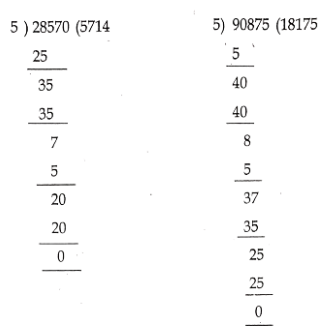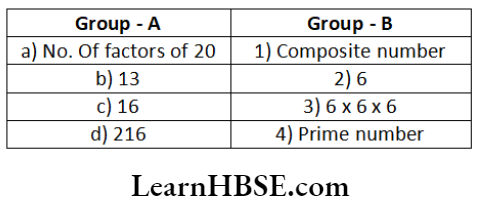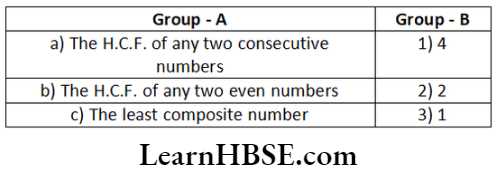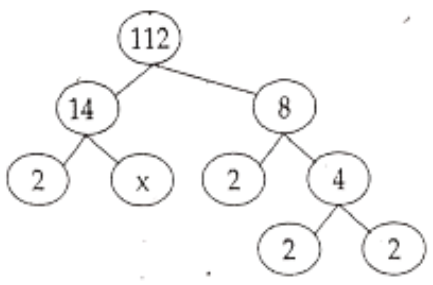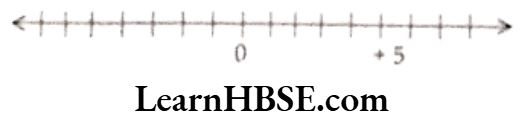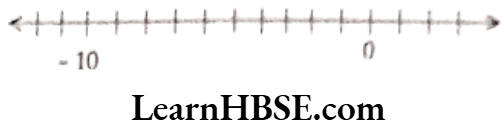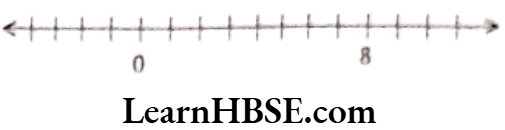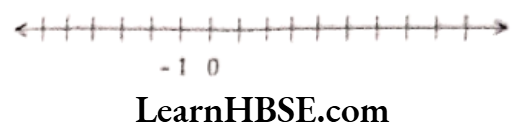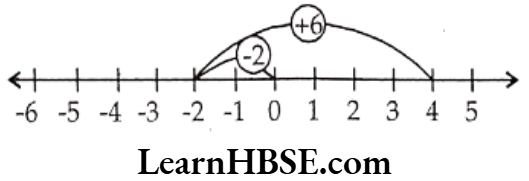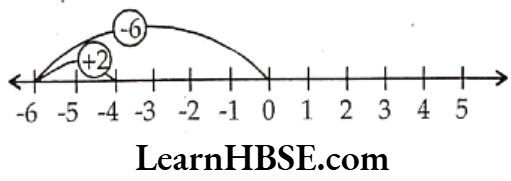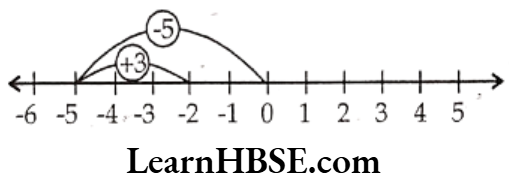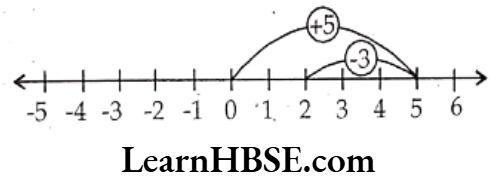
Haryana Board Class 9 Maths Solutions For Chapter 4 Linear Equations In Two Variables

Haryana Board Class 9 Maths Solutions For Chapter 4 Linear Equations In Two Variables

  • Equation: An equation is a statement in which one expression equals to another expression.
    Eg: 2x + 3 = 7y
    5m – 9 = 0
    3 + 6 = 9
    3\(x^2\)-5x+6=0
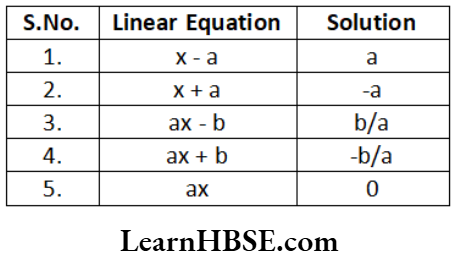
  • Linear equation in one variable: An equation with only one variable of degree one is called linear equation in one variable. (or) An equation of the form ax + b = 0, where a, and b are real numbers such that a ≠ 0, is called a linear equation in one variable.
    Eg: 5x + 6 = 7; 3p = -7
  • Standard form: ax + b = 0, where a and b ∈ R and a ≠ 0.
  • Solution: A linear equation in one variable has a number that can satisfy the equation. This numbers are called the solution of the linear equation in one ” variable.
    • Linear equation has unique solution.

Class 9 Maths Chapter 4 Linear Equations In Two Variables Linear Equation

  • Linear equation in two variables
    • An equation with two variables both of degree one is called linear equation in two variables. (or) An equation of the form ax + by + c = 0, where a, b and c are real numbers such that a ≠ 0 and b ≠ 0, is called a linear equation in two variables.
      Eg: 7a + 3b = 12
      2x = 3y – 5
    • Standard form: ax + by + c = 0, where a, b, c ∈ R and a, b ≠ 0.
  • Solution of linear equation in two variables:
    A linear equation in two variables has a pair of numbers that can satisfy the equations. This pair of numbers is called the solution of the linear equation in two variables.

    • There are infinitely many solutions for a single linear equation in two variables.
    • The process of finding solution(s) is called solving an equation.
    • The solution of a linear equation is not affected when
      • the same number is added to (subtracted from) both sides of the equation.
      • both sides of the equation are mutiplied or divided by the same non-zero number.
  • Graphical representation of linear equations:
    • Any linear equation in the standard form ax + by + c = 0 has a pair of solutions (x,y), that can be represented in the coordinate plane.
    • The graph of every linear equation in two variables (ax + by + c = 0) is a straight line.
    • Every point on the graph of a linear equation in two variables is a solution of the linear equation.
    • Every solution of the linear equation is a point on the graph of the linear equation.
    • The linear equation with constant value zero (in ax + by + c = 0, c = 0) passes through origin.
    • An equation of the type y = mx represents a straight line passing through the origin. Certain linear equations exist such that their solution is (0,0).
  • Steps to draw the graph of linear equations in two variables:
    • Step 1: Let the given equation be ax + by + c = 0.
    • Step 2: Make the y as subject. i.e., y = \(-\left(\frac{a x+c}{b}\right)\)
    • Step 3: Take any 2 values (Most probably integrals) to x and calculate the values of y to obtain solutions (ordered pairs).
    • Step 4: Plot the ordered pairs on the graph paper on a suitable
    • Step 5: Draw the line passing through plotted points.
      Now the obtained line represents the equation: ax + by + c = 0.
      Note: We can take more than 2 values to x to get more solutions to check the correctness of the graph.
  • Equations of the lines parallel to the coordinate axes:
    • The equation of the X-axis: y = 0.
    • The equation of the Y-axis: x = 0.
    • The equation of the straight line parallel to X-axis: y = k. It lies at k units from X-axis and passes through (0,k).
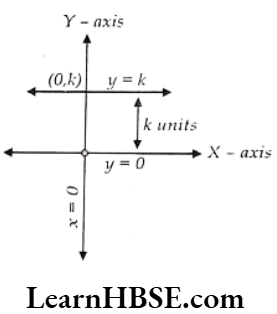
Class 9 Maths Chapter 4 Linear Equations In Two Variables Lines Parallel to the coordinate axes

    • The equation of straight line parallel to Y-axis: x = k. It lies at k units from Y-axis and passes through (k, 0).
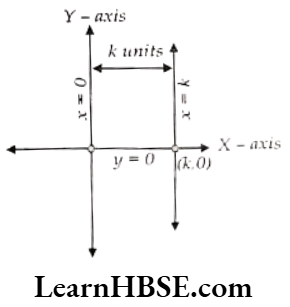
Class 9 Maths Chapter 4 Linear Equations In Two Variables Straight line parallel

Haryana Board Class 9 Maths Chapter 4 Solutions

Haryana Board Class 9 Maths Solutions For Chapter 4 Linear Equations In Two Variables Exercise – 4.1

Question 1. The cost of a notebook is twice the cost of a pen. Write a linear equation in two variables to represent this statement.

Solution. Let the cost of a notebook = ₹ x

Let the cost of a pen = ₹ y

The cost of a notebook is twice the cost of a pen.

Cost of a notebook = 2 × cost of a pen

⇒ x = 2xy

⇒ x = 2y

⇒ x – 2y = 0

∴ Required equation

Question 2. Express the following linear equations in the form ax + by + c = 0 and indicate the values of a, b and c in each case:

Solution. (1) 2x + 3y = 9.35

Given equation: 2x + 3y = 9.35

⇒ 2x + 3y – 9.35 = 0

⇒ 2x + 3y + (-9.35) = 0

On comparing with ax + by + c = 0,

We get, a = 2,b = 3,c = -9.35

(2) Given equation: x – \(\frac{y}{5}\) – 10 = 0

⇒ \(x+\left(-\frac{1}{5}\right) y+(-10)=0\)

On comparing with ax + by + c = 0,

We get, a = 1, b = [latex-\frac{1}{5}[/latex], c = -10

(3) Given equation: -2x + 3y = 6

⇒ -2x + 3y – 6 = 0

On comparing with ax + by + c = 0,

We get, a = -2, b = 3, c = -6

(4) Given equation: x = 3y

⇒ x – 3y = 0

⇒ x + (-3)y + 0 = 0

On Comparing with ax + by + c = 0,

We get, a = 1, b = -3, c = 0

(5) Given equation: 2x = -5y

⇒ 2x + 5y = 0

⇒ 2x + 5y + 0 = 0

On comparing with ax + by + c = 0,

We get, a = 2, b = 5, c = 2.

(6) Given equation: x = 3y

⇒ x – 3y = 0

⇒ x + (-3)y + 0 = 0

On comparing with ax + by + c = 0,

We get, a = 1, b = -3, c = 0.

(5) Given equation : 2x = -5y

⇒ 2x + 5y = 0

⇒ 2x + 5y + 0 = 0

On comparing with ax + by + c = 0,

We get, a = 2, b = 5, c = 0.

(6) Given equation: 3x + 2 = 0

⇒ 3x + (0)y + 2 = 0

On comparing with ax + by + c = 0,

We get, a = 3, b = 0, c = 2.

(7) Given equation: y – 2 = 0

⇒ 0(x) – 1(y) – 2 = 0

On comparing with ax + by + c = 0,

We get, a = 0,b = 1, c = -2.

(8) Given equation: 5 = 2x

⇒ 2x – 5 = 0

⇒ 2x + (0)y + (-5) = 0

On comparing with ax + by + c = 0,

We get, a = 2, b = 0, c = -5.

Class 9 Maths Chapter 4 Important Questions Haryana Board

Haryana Board Class 9 Maths Solutions For Chapter 4 Linear Equations In Two Variables Exercise – 4.2

Question 1. Which one of the following options is true, and why?

(1) A unique solution

(2) Only two solutions

(3) Infinitely many solutions

Solution. A linear equation in two variables has infinitely many solutions.

So, y = 3x + 5 has infinitely many solutions. So, option (3) is correct.

Question 2. Write four solutions for each of the following equations:

(1) 2x + y = 7

Solution. Given equation: 2x + y = 7

⇒ y = 7 – 2x

(a) Let x = 0 ⇒ y = 7 – 2(0) = 7 – 0 = 7.

Here solution = (0,7).

(b) Let x = 1 ⇒ y = 7 – 2(1) = 7 – 2 = 5.

Here solution = (1,5)

(c) Let x = -1 ⇒ y = 7 – 2(-1) = 7 + 2 = 9.

Here solution = (-1,9).

(d) Let x = 2 ⇒ y = 7 – 2(2) = 7 – 4 = 3.

Here solution = (2, 3).

∴ The solutions are (0,7), (1, 5), (-1, 9), (2, 3).

(2) πx + y = 9

Solution. Given equation: πx + y = 9

⇒ y = 9 – πx

(a) Let x = 0 ⇒ y = 9 – π(0) = 9 – 0 = 9.

Here solution = (0,9)

(b) Let x = 1 ⇒ y = 9 – π(1) = 9 – π

Here solution = (1, 9 – π)

(c) Let x = -1 ⇒ y = 9 – π(-1) = 9 + π

Here solution = (-1, 9 + π)

(d) Let x = 2 ⇒ y = 9 – π(2) = 9 – 2π

Here solution = (2, 9 – 2π)

∴ The solutions are (0,9), (1, 9 – π), (-1, 9 + π), (2, 9 – 2π)

(3) x = 4y

Solution. Given equation: x = 4y

⇒ y = \(\frac{x}{4}\)

(a) Let x = 0 ⇒ y = \(\frac{0}{4}\) = 0

Here solution = (0,0).

(b) Let x = 1 ⇒ y = \(\frac{1}{4}\)

Here solution = (1,7).

(c) Let x = 4 ⇒ y = \(\frac{4}{4}\) = 1

Here solution (4, 1).

(d) Let x = 2 ⇒ y = \(\frac{2}{4}\) = \(\frac{1}{2}\)

Here solution = (2, \(\frac{1}{2}\))

∴ The solutions are (0,0), (1, \(\frac{1}{4}\)), (4,1), (2,\(\frac{1}{2}\)).

Step-by-step Solutions for Class 9 Maths Chapter 4 Haryana Board

Question 3. Check which of the following are solutions of the equation x – 2y = 4 and which are not:

(1)(0, 2)

(2) (2,0)

(3) (4,0)

(4) (√2,4√2)

(5) (1,1)

Given equation: x – 2y = 4

Solution. (1) (0,2)

Substitute x = 0 and y = 2

LHS = x – 2y = 0 – 2(2) = 0 – 4 = -4 ≠ RHS

∴ (0, 2) is not a solution of the given equation.

(2) (2, 0)

Substitute x = 2 and y = 0

LHS = x – 2y = 2 – 2(0) = 2 – 0 = 2 ≠ RHS

∴ (2, 0) is not a solution of the given equation.

(3) (4,0)

Substitute x = 4 and y = 0

LHS = x – 2y = 4 – 2(0) = 4 – 0 = 4 = RHS

∴ (4,0) is a solution of the given equation.

(4) (√2,4√2)

Substitute x = √2 and y = 4√2

LHS = x – 2y = √2 – 2(4√2)

= √2 – 8√2 = -7√2 ≠ RHS

∴ (√2, 4√2) is not a solution of the given equation.

(5) (1,1)

Substitute x = 1 and y = 1

LHS = x – 2y = 1 – 2(1) = 1 – 2 = -1 ≠ RHS

∴ (1, 1) is not a solution of the given equation.

Question 4. Find the value of K, if x = 2, y = 1 is a solution of the equation 2x + 3y = K.

Solution. Given equation 2x + 3y = K.

x = 2, y = 1 is a solution.

on substituting x = 2 and y = 1.

⇒ 2(2) + 3(1) = K

4 + 3 = K

7 = K

∴ K = 7

Haryana Board Class 9 Maths Solutions For Chapter 4 Linear Equations In Two Variables Very Short Answer Type Questions

Question 1. Define linear equation in two variables.

Solution. An equation of the form ax + by + c = 0, where a, b and c are real numbers such that a ≠ 0 and b ≠ 0, is called a linear equation in two variables.

Question 2. Panth and Pandya scored 125 runs together. Express the information in the form of an equation.

Solution. Let the runs scored by Panth = x

Let the runs scored by Pandya = y

Total runs = 125

⇒ x + y = 125

Graphical Method of Solving Linear Equations Class 9 Haryana Board

Question 3. Express each of the equation y = 3 in the form of ax + by + c = 0 and write the values of a, b and c.

Solution. Given equation : y = 3

⇒ 0.x + y + (-3) = 0

On comparing with ax + by + c = 0,

We get, a = 0, b = 1, c = -3.

Question 4. Express each of the equation x – 5 = √3y in the form of ax + by + c = 0 and write the values of a, b and c.

Solution. Given equation: x – 5 = √3y

⇒ x – √3y – 5 = 0

⇒ x +(-√3)y + (-5) = 0

On comparing with ax + by + c = 0,

We get, a = 1, b = -√3,c = -5.

Question 5. How many solutions does a linear equation in two variables have?

Solution. A linear equation in two variables has infinitely many solutions.

Question 6. How many linear equations in two variables exist for which (2, 4) is a solution?

Solution. There are infinitely many linear equations in two variables exist for which (2, 4) is a solution.

Example: x + y = 6; x – y = -2; y = 2x.

Question 7. Write any two linear equations in two variables whose solution is (6,2).

Solution. Given solution: (6,2)

Sum of x-coordinate and y coordinate = 8 ⇒ x + y = 8

Difference of x-coordinate and y coordinate ⇒ 4x – y = 4

Question 8. Check whether (2, -5) is a solution of equation 2x + 5y = 2 or not.

Solution. Given equation : 2x + 5y = 2

Substitute x = 2 and y = -5

LHS = 2x + 5y = 2(2) + 5(-5)

= 4 – 25 = -21 ≠ RHS

∴ (2,-5) is not a solution of the given equation.

Question 9. Check whether (5, 0) is a solution of equation x + 3y = 5 or not.

Solution. Given equation: x + 3y = 5

Substitute x = 5 and y = 0

LHS = x + 3y = 5 + 3(0)

= 5 + 0 = 5 = RHS

∴ (5, 0) is a solution of the given

Question 10. Find 2 different solutions of x + y = 9

Solution. Given equation: x + y = 9

⇒ y = 9 – x

(a) Let x = 0 ⇒ y = 9 – 0 = 9.

Here solution = (0,9).

(b) Let x = 2 ⇒ y = 9 – 2 = 7.

Here solution = (2,7).

Question 11. Find two different solutions of 4x + y = 3.

Solution. Given equation: 4x + y = 3

⇒ y = 3 – 4x

(a) Let x = 0 ⇒ y = 3 – 4(0) = 3-0 = 3.

Here solution = (0,3).

(b) Let x = 2 ⇒ y = 3 – 4(2) = 3 – 8 = -5

Here solution = (2,-5).

Question 12. Which type of graph of a linear equation ax + by + c = 0 (Here a, b and c ∈ R & a ≠ 0, b ≠ 0) represents?

Solution. The graph of every linear equation in two variables (ax + by + c = 0) is a straight line.

Question 13. If (2, 0) is a solution of the linear equation 5x – 4y = k, then find the value of k.

Solution. Given equation: 5x – 4y = k

(2, 0) is a solution.

On substituting, x = 2 and y = 0.

⇒ 5(2) – 4(0) = k

⇒ 10 – 0 = k

⇒ 10 = k

∴ k = 10

Question 14. Write the equations of coordinate axes x and y.

Solution. The equation of the X-axis: x = 0

The equation of the Y-axis: y = 0

Question 15. Linear equation x – 2 = 0 is parallel to which axis?

Solution. Given equation: x – 2 = 0 ⇒ x = 2.

It is in the form of x = k.

∴ It is parallel to Y-axis.

Question 16. Write the equation of the line parallel to y-axis and passing through the point (-7,3).

Solution. The equation of the straight line parallel to Y-axis: x = k

Required equation: x = -7

⇒ x + 7 = 0

Question 17. Write the equation of the line parallel to X-axis and passing through the point (-2,-4)

Solution. The equation of the straight line parallel to X-axis: y = k

∴ Required equation: y = -4

⇒ y + 4 = 0

Question 18. Write the equation of three lines that are parallel to X-axis

Solution. The equation of three lines that are parallel to X-axis:

(1) y = 2

(2) y + 9 = 0

(3) 2y = 3

Question 19. Write the equation of three lines that are parallel to Y-axis

Solution. The equation of three lines that are parallel to X-axis:

(1) x = -2

(2)x – 9 = 0

(3) 5x = -3

Question 20. Find the distance between the graph of x – 5 = 0 and the Y-axis.

Solution. Given equation: x – 5 = 0 ⇒ x = 5

The graph of x = k is a straight line parallel to Y-axis. It lies at k units from Y-axis.

∴ The distance between the graph of x – 5 = 0 and the Y-axis is 5 units.

Question 21. Find the distance between the graph of 2y – 5 = 0 and the X-axis.

Solution. Given equation: 2y – 5 = 0 ⇒ x = 2.5

The graph of y k is a straight line parallel to X-axis. It lies at k units from X-axis.

∴ The distance between the graph of 2y – 5 = 0 and the Y-axis is 2.5 units.

Haryana Board Class 9 Maths Solutions For Chapter 4 Linear Equations In Two Variables Short Answer Type Questions

Question 22. Bhargavi got 10 more marks than double of the marks of Sindhu. Express the information in the form of an equation.

Solution. Let marks got by Bhargavi = x

Let marks got by Sindhu = y

Given that Bhargavi got 10 more marks than double of the marks Sindhu

∴ x = 10 + 2y

⇒ x – 2y – 10 = 0

Question 23. A number is 27 more than the number obtained by reversing its digits. If its units and tens digits are x and y respectively, write the linear equation representing the above statement.

Solution. Let the digit in units place = x

Let the digit in tens place = y

The number = 10y + x

If we reverse the digits, then the new number = 10x + y

From problem,

(Two-digit number) – (number formed by reversing the digits) = 27.

i.e., 10y + x – (10x + y) = 27

⇒ 10y + x – 10x – y – 27 = 0

⇒ 9y – 9x – 27 = 0

⇒ y – x – 3 = 0

⇒ x – y + 3 = 0

Haryana Board 9th Class Maths Chapter 4 Exercise Solutions

Question 24. The cost of a ball pen is 5 less than half the cost of a fountain pen. Write a linear equation in two variables to rep- resent this statement.

Solution. Let the cost of fountain pen = ₹ x

Let the cost of ball pen = ₹ y

Given that the cost of a ball pen is 5 less than half the cost of a fountain pen.

⇒ y = \(\frac{x}{2}\) – 5

⇒ 2y = x – 10

⇒ x – 2y = 10

Question 25. If x = 2k + 1 and y = k is a solution of the equation 5x + 3y – 7 = 0, find the value of k.

Solution. Given equation: 5x + 3y – 7 = 0

x = 2k + 1 and y = k is a solution of the equation.

On substituting, x = 2k + 1 and y = k.

⇒ 5(2k+1) – 3(k) – 7 = 0

⇒ 10k + 5 – 3k – 7 = 0

⇒ 7k – 2 = 0

⇒ 7k = 2

⇒ k = \(\frac{2}{7}\)

Question 26. Find 4 different solutions of 5x + y = 3

Solution. Given equation: 5x + y = 3

⇒ y = 3 – 5x

(a) Let x = 0 ⇒ y = 3 – 5(0) = 3 – 0 = 3.

Here solution = (0,3).

(b) Let x = 1 ⇒ y = 3 – 5(1) = 3 – 5 = -2.

Here solution = (1,-2).

(c) Let x = -1 ⇒ y = 3 – 5(-1) = 3 + 5 = 8.

Here solution = (-1, 8).

(d) Let x = 2 ⇒ y = 3 – 5(2) = 3 – 10 = -7

Here solution (2, -7).

(e) ∴ The solutions are

(0,3), (1, -2), (-1, 8), (2, -7).

Question 27. At which point the graph of the linear equation 2x – 3y = 6 cuts the Y-axis.

Solution. Given equation: 2x – 3y = 6

The x-coordinate of any point on the y-axis is zero.

Let the point of the line cuts the y-axis is (0, a).

On substituting, x = 0 and y = a.

⇒ 2(0) – 3(a) = 6

⇒ 0 – 3a = 6

⇒ -3a = 6

⇒ a = \(-\frac{6}{3}\)

⇒ a = -2

∴ The required point = (0, -2).

Haryana Board Class 9 Maths Solutions For Chapter 4 Linear Equations In Two Variables Long Answer Type Questions

Question 28. If (0, a) and (b, 0) are the solutions of the following linear equation 2x – 3y = 6. Find ‘a’ and ‘b’.

Solution. Given equation: 2x – 3y = 6.

(0, a) is one of the solutions of equation.

On substituting, x=0 and y = a.

⇒ 2(0) – 3(a) = 6

⇒ 0 – 3n = 6

⇒ -3a = 6

⇒ a = \(-\frac{6}{3}\)

⇒ a = -2

(b, 0) is another solution of equation.

On substituting, x = b and y = 0.

⇒ 2(b) – 3(0) = 6

⇒ 2b – 0 = 6

⇒ 2b = 6

⇒ b = \(\frac{6}{2}\)

⇒ b = 3

∴ a = -2 and b = 3

Haryana Board Class 9 Maths Solutions For Chapter 4 Linear Equations In Two Variables Objective Type Questions

Multiple Choice Questions:

Question 1. Which of the following is an equation?

  1. 2x + 3 ≠ 4
  2. 3x + y – 3
  3. 7x – 7
  4. 3m2+ m = 1

Answer. 4. 3m2 + m = 1

Question 2. General form of linear equation in two variables is where a, b, c ∈ R and a and b ≠ 0.

  1. ax + b = c
  2. ax + by = cz
  3. ax + by + c = 0
  4. ay + bx = c

Answer. 3. ax + by + c = 0

Question 3. Sankar and Sanvi collected 100 together. Suitable equation for this information is

  1. x + y + 100 = 0
  2. x + y = 100
  3. x – y = 100
  4. x – y = -100

Answer. 2. x + y = 100

MCQ Questions on Linear Equations in Two Variables Class 9 Haryana Board

Question 4. On comparing 4x – y = 0 with ax + by + c = 0, we get c =

  1. 4
  2. -1
  3. 0
  4. -4

Answer. 3. 0

Question 5. On comparing -y = 0 with ax + by + c = 0, we get a + b + c =.

  1. -1
  2. 0
  3. -2
  4. 3

Answer. 1. -1

Question 6. The linear equation 2x+5 has _______ solution(s).

  1. Unique
  2. two
  3. No
  4. Infinitely many

Answer. 1. Unique

Question 7. The linear equation 2x + y = 5 has _______ solution(s).

  1. Unique
  2. two
  3. No
  4. Infinitely many

Answer. 4. Infinitely many

Question 8. The linear equation x + y = 5 has _______ natural solution(s).

  1. Unique
  2. two
  3. No
  4. Infinitely many

Answer. 1. Unique

Question 9. The solution of equation x – 2y = 4 are

(1)(0-2)

(2) (8.0)

(3)(6, 1)

(4) (-2,3)

  1. (1) only
  2. (1) & (3) only
  3. (2) & (4) only
  4. (4) only

Answer. 2. (1) & (3) only

Question 10. Number of linear equations in x and y can be satisfied by x=1 and y = 2 is

  1. one
  2. two
  3. zero
  4. Infinitely many

Answer. 4. Infinitely many

Question 11. If (2, 0) is a solution of the linear equation 2x + 3y = k, then the value of k is:

  1. 4
  2. -4
  3. 3
  4. 5

Answer. 1. 4

Question 12. x = 9, y = 4 is a solution of the linear equation

  1. x + y + 13 = 0
  2. x – y = 5
  3. x – y + 5 = 0
  4. x + y = -5

Answer. 2. x – y = 5

Question 13. (3,1) is the solution of the equation

  1. 2x – y = 7
  2. x – 2y = -7
  3. 2x + y = 7
  4. x – 2y = 7

Answer. 3. 2x + y = 7

Question 14. (2,-1) is the solution of the equation

(1) 3x + y = 5

(2) 2x – y = 5

(3) x + y + 1 = 0

(4) x + 2y = 1

  1. (1) & (2) only
  2. (1) & (3) only
  3. (3) & (4) only
  4. (4) only

Answer. 1. (1) & (2) only

Question 15. If x = -2 and y = 3 is the solution of equation x + 2y = k, then k=

  1. 4
  2. -4
  3. 3
  4. 5

Answer. 1. 4

Question 16. The geometrical representation of linear equation in two variables is

  1. Straight line
  2. Circle
  3. Parabola
  4. Triangle

Answer. 1. Straight line

Class 9 Maths Chapter 4 Theorems and Formulas Haryana Board

Question 17. For the equation 5x – 7y = 35, if y = 5, then the value of ‘x’ is

  1. -14
  2. 0
  3. 14
  4. 10

Answer. 3. 14

Question 18. The straight line passing through the points (0,0), (-1, 1) and (1, -1) has the equation

  1. x – y = 0
  2. x + y = 0
  3. x + y = -1
  4. x – y = 1

Answer. 2. x + y = 0

Question 19. Any point of the form (a, a) always lies on the graph of the equation

  1. x – y = 0
  2. x + y = 0
  3. x + y = -1
  4. x – y = 1

Answer. 1. x – y = 0

Question 20. Which of the following is not a solution of 2x – y + 3 = 0?

  1. (3,9)
  2. (0,3)
  3. (-1,1)
  4. (-1,-2)

Answer. 4. (-1,-2)

Question 21. The graph of the equation 2x + 3y = 6 cuts the X-axis at the point

  1. (3,0)
  2. (0,-3)
  3. (-2,0)
  4. (0,2)

Answer. 1. (3,0)

Question 22. The graph of linear equation x + 2y = 2, cuts the Y-axis at the point

  1. (1,0)
  2. (0,-3)
  3. (-2,0)
  4. (0,1)

Answer. 4. (0,1)

Question 23. Which of the following is true?

  1. The line y = 2 parallel to Y-axis.
  2. The line y – 3 = 0 parallel to X-axis.
  3. The line y = 2 passes through (2,0)
  4. The line y – 3 = 0 passes through (-3,0)

Answer. 2. The line y – 3 = 0 parallel to X-axis.

Question 24. Which of the following is not a solution of 3x – y = 6?

  1. (0, -6)
  2. (2, 0)
  3. (-1,9)
  4. (1,-3)

Answer. 3. (-1,9)

Question 25. The value of k if x = 2, y = 1 is a solution of equation 2x – k = -3y is

  1. 7
  2. 6
  3. -6
  4. -7

Answer. 1. 7

Question 26. Which of the following lines pass through origin?

(1) √3x + 3y = 0

(2) 4y = 3

(3) 5x = 2

(4) 4y = 3y

  1. (1) & (2) only
  2. (2) & (3) only
  3. (3) & (4) only
  4. (1) & (4) only

Answer. 4. (1) & (4) only

Question 27. The equation 2x+5y= 7 has a unique solution, if x, y are _______ numbers.

  1. natural
  2. integers
  3. rational
  4. real

Answer. 1. natural

Linear Equations in Two Variables Word Problems Class 9 Haryana Board

Question 28. A linear equation in two variables is of the form ax + by + c = 0 where

(1) a ≠ 0

(2) b ≠ 0

(3) c ≠ 0

(4) c = 0

  1. (1) & (2) only
  2. (2) & (3) only
  3. (3) & (4) only
  4. (4) only

Answer. 1. (1) & (2) only

Question 29. A linear equation in two variables is of the form ax + by + c = 0 passes through origin if

(1) a = 0

(2) b ≠ 0

(3) c ≠ 0

(4) c = 0

  1. (1) & (2) only
  2. (2) & (3) only
  3. (3) & (4) only
  4. (4) only

Answer. 4. (4) only

Question 30. The number of linear equations in 2 variables passes through 2 distinct points is

  1. one
  2. two
  3. zero
  4. Infinitely many

Answer. 1. one

Question 31. The positive solutions of the equation ax + by + c = 0 always lie in

  1. 1st Quadrant
  2. 2nd Quadrant
  3. 3rd Quadrant
  4. 4th Quadrant

Answer. 1. 1st Quadrant

Question 32. If we multiply or divide both sides of a linear equation with a non-zero number, then the solution of the linear equation

  1. Changes
  2. Remains the same
  3. Changes in case of multiplication only
  4. Changes in case of division only

Answer. 2. Remains the same

Question 33. Which of the following equation has graph parallel to Y-axis?

  1. x = 3
  2. y = 5
  3. 2x + 3y = 0
  4. 2x = 3y

Answer. 1. x = 3

Question 34. Which of the following equation has graph parallel to X-axis ?

  1. 4x = 3
  2. y + 6 = 0
  3. 2x – y = 0
  4. 2x + 4y = 8

Answer. 2. y + 6 = 0

Question 35. The equation of the line parallel to X-axis and passing through the point

  1. y – 3 = 0
  2. y + 3 = 0
  3. y + 2 = 0
  4. y – 2 = 0

Answer. 2. y + 3 = 0

36-40: Direction: There are two statements are given in each question. Select the options as the following.

1) Both statements are true

2) Statement A is true, statement B is false.

3) Both statements are false

4) Statement A is false, statement B is true.

Question 36. Statement A: The linear equation 2x – 5y = 7 has infinitely many solutions.

Statement B: Only one linear equation in x and y can be satisfied by x = 1 and y = 2.

Answer. 2. Statement A is true, statement B is false.

Question 37. Statement A: (1, -4) is one of the solution of equation x – 2y = 9.

Statement B: The equation x + y = 5 has only one pair of natural number solutions.

Answer. 1. Both statements are true

Question 38. Statement A: Equation of Y-axis is : y = 0.

Statement B: y = 2 line parallel to y axis.

Answer. 3. Both statements are false

Question 39. Statement A: The line 3x + 5y = 0 passes through origin.

Statement B: The y = x passes through (4,4).

Answer. 1. Both statements are true

Question 40. Statement A: The line parallel to the Y-axis at a distance 4 units to the left of Y-axis is x = -4.

Statement B: The equation of X-axis is of the form y = 0.

Answer. 4. Statement A is false, statement B is true.

41-50: Assertion and Reasoning questions

Direction: In each of the following questions, a statement of Assertion is given followed by a corresponding statement of Reason just below it. Of the statements, mark the correct answer as

1) Both assertion and reason are true and reason is the correct explanation of assertion.

2) Both assertion and reason are true but reason is not the correct explanation of assertion.

3) Assertion is true but reason is false.

4) Assertion is false but reason is true.

Question 41. Assertion: There are infinite number of lines which passes through (-3,5)

Reason: A linear equation in two variables has infinitely many solutions.

Answer. 1. Both assertion and reason are true and reason is the correct explanation of assertion.

Question 42. Assertion: The graph of the equation 3x + y = 0 is a line passing through the origin.

Reason: An equation of the form ax + by + c = 0, where a, b, c R and a0, b0 is a linear equation in x and y.

Answer. 1. Both assertion and reason are ture and reason is the correct explanation of assertion.

Question 43. Assertion: The point (0, 3) lies on the graph of the linear equation 3x + 4y = 12.

Reason: (0, 3) satisfies the equation 3x + 4y = 12.

Answer. 2. Both assertion and reason are true but reason is not the correct explanation of assertion.

Question 44. Assertion The graph of the linear equation x – 2y = 1 passes through the point (-1, -1)

Reason: The linear equation x – 2y = 1 has unique solution.

Answer. 3. Assertion is true but reason is false.

Question 45. Assertion: The point (2, 2) lies on the line y = x

Reason: Any point on the line y = x is of the form (a, a)

Answer. 1. Both assertion and reason are true and reason is the correct explanation of assertion.

Question 46. Assertion: A linear equation 2x + 3y = 5 has a unique solution.

Reason: There are infinitely many solutions for a linear equation in two variables.

Answer. 4. Assertion is false but reason is true.

Question 47. Assertion: The graph of a line 3x – 4y + 12 = 0 intersects Y-axis at (0,3).

Reason: The line ax + by + c = 0 intesects X-axis at (\(-\frac{c}{a}\),0).

Answer. 2. Both assertion and reason are true but reason is not the correct explanation of assertion.

Question 48. Assertion: All the points (0, 0), (0,5), (0,3) and (0, 6) lie on the Y-axis.

Reason: Equation of the Y-axis is x = 0.

Answer. 1. Both assertion and reason are true and reason is the correct explanation of assertion.

Question 49. Assertion: The line y = 5x passes through origin..

Reason: The linear equation y = mx + c (c+0) passes through origin.

Answer. 3. Assertion is true but reason is false.

Question 50. Assertion: The geometric representation of x = -2 meets the X-axis at (0, -2).

Reason: The line y = k is parallel to X-axis and passes through the point (0, k).

Answer. 4. Assertion is false but reason is true.

Haryana Board Class 9 Maths Solutions For Chapter 4 Linear Equations In Two Variables Match the following:

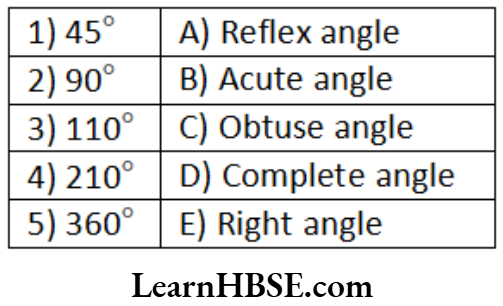
Question 51. Match the following linear equations and points on those lines.
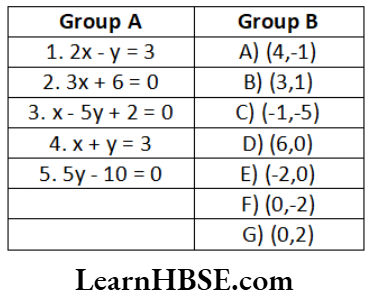
Class 9 Maths Chapter 4 Linear Equations In Two Variables Match the following Question 51

Answer. 1 – C, 2 – E, 3 – B, 4 – A, 5 – G.

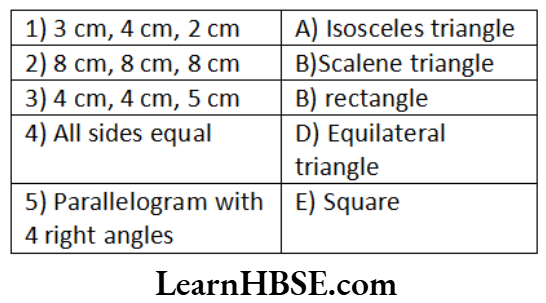
Question 52. Match the following with suitable equations
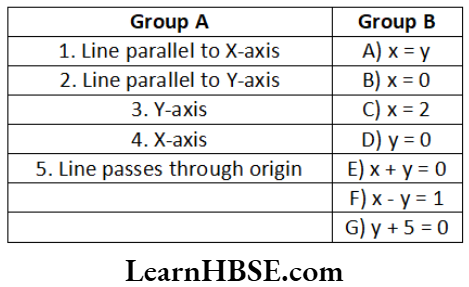
Class 9 Maths Chapter 4 Linear Equations In Two Variables Match the following Question 52

Answer. 1 – G, 2 – C,3 – B, 4 – D, 5 – A.

Question 53. Match the following general form of points with their equations. (Here a ≠ 0)
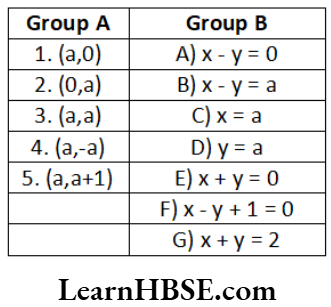
Class 9 Maths Chapter 4 Linear Equations In Two Variables Match the following Question 53

Answer. 1 – C, 2 – D, 3 – A, 4 – E, 5 – F.

Haryana Board Class 9 Maths Solutions For Chapter 4 Linear Equations In Two VariablesTrue or False Questions

Question 54. Any equation which can be put in the form ax + by + c = 0, where a, b and c are real numbers, and a and b are not both zero is called a linear equation in two variables

Answer. True

Question 55. 5x – 3 = 2x is a linear equation in one variable

Answer. True.

Question 56. 3x – y2 = 5 is a linear equation in two variables

Answer. False

Question 57. ax2 + by + c = 0 where a, b and c are real numbers, is a linear equation in two variables.

Answer. False

Question 58. There are infinitely many solutions for a given linear equation in two variables

Answer. True

Question 59. 3x + 5 = 0 has a unique solution

Answer. True

Question 60. The linear equation 2x + 5y = 7 has unique natural solutions.

Answer. True

Question 61. The linear equation 2x – 3y = 4 has unique solution.

Answer. False

Question 62. The point of the form (a,a) always lies on X-axis

Answer. False

Question 63. The graph of every linear equation in two variables need not be a line

Answer. False

Question 64. (0,2) is a solution for x – 2y = 4

Answer. False

Question 65. The point (0,-3) lies on the graph of the linear equation 3x + 4y = 12

Answer. True

Question 66. The graph of the linear equation x + 2y = 7 passes through the point (0,7)

Answer. False

Question 67. The graph of linear equation 2x – 3y = 0 is a line parallel to X-axis

Answer. False

Question 68. The line x – y = 4 intersects X-axis at (4,0)

Answer. True

Question 69. The line ax + by + c = 0 intersects Y-axis at (0, \(-\frac{c}{a}\))

Answer. False

Question 70. The line ax + by + c = 0 passes through origin if c = 0.

Answer. True

Question 71. (3, -3) lies on x + y = 3.

Answer. False

Question 72. The line passes through (4,7) and parallel to X-axis is y = 7.

Answer. True

Question 73. The line passes through (-3,7) and parallel to Y-axis is x – 3 = 0

Answer. False

Question 74. The line y = -3 intersects Y-axis at (0,-3)

Answer. True

Question 75. The line x + 2 = 0 intersects Y-axis at (0,-2)

Answer. False

Question 76. The line y = mx passes through origin.

Answer. True

Question 77. x = 0 is the equation of the X-axis.

Answer. False

Question 78. The linear equation 3x + 2 = 0 represents a line parallel to Y-axis.

Answer. True

Question 79. The graph of y = 6 is a line parallel to X-axis at a distance 6 units from the X-axis

Answer. True

Haryana Board Class 9 Maths Solutions For Chapter 4 Linear Equations In Two Variables Fill in the Blanks:

Question 80. A statement in which one expression equals to another expression is _______

Answer. equation

Question 81. An equation with only one variable of degree one is called as _______ equation in one variable.

Answer. linear

Question 82. General form of linear equation in one variable is _______

Answer. ax + b = 0

Question 83. Solution of linear equation ax + b = 0 is _______

Answer. –\(\frac{b}{a}\)

Question 84. An equation with two variables both of degree one is called as _______ equation in _______ variables.

Answer. linear, 2

Question 85. General form of linear equation in two variables is _______

Answer. ax + by + c = 0

Question 86. The number of solutions of linear equations in two variables is _______

Answer. infinite

Question 87. The graph of every linear equation in two variables (ax + bt + c = 0) is a _______

Answer. line

Question 88. If x = 1 and y = 1 is one of the solutions of x – y = k then k = _______

Answer. 0

Question 89. All the points (2,0), (-3,0), and (5,0) lie on the _______ axis.

Answer. x

Question 90. All the points (0,3), (0,0), (0,-4) and (0,7) lie on the _______ axis.

Answer. y

Question 91. Abscissa of all points on the Y-axis is _______

Answer. 0

Question 92. The negative solutions of the equation ax + by + c = 0 always lie in the _______ quadrant.

Answer. 3rd

Question 93. The positive solutions of the equation ax + by + c = 0 always lie in the _______ quadrant.

Answer. 1st

Question 94. If the point (3,4) lies on the graph of 3y = ax + 7, then the value of a = _______

Answer. \(\frac{5}{3}\)

Question 95. The line ax + by + c = 0 intersects X-axis at _______

Answer. (-\(\frac{c}{a}\), 0)

Question 96. The graph of the linear equation 2x + 3y = 6 is a line which meets the X-axis at _______

Answer. (3,0)

Question 97. The graph of the linear equation 3x – 4y – 12 = 0 is a line which meets the Y-axis at _______

Answer. (0,-3)

Question 98. The value of y if x = 2 in the linear equation 3x – 4y – 12 = 0 is _______

Answer. 3

Question 99. The value of x for which y = -4 is a solution of the linear equation 5x – 8y = 40 is _______

Answer. \(\frac{8}{5}\)

Question 100. An ordered pair that satisfy an equation in two variables is called its _______

Answer. solution

Question 101. If x = 1 and y = 0 is the solution of equation 2x + y = 3a, then the value of a _______

Answer. \(\frac{2}{3}\)

Question 102. If (3,-2) is a solution of the equation 3x – py – 7 = 0, then the value of p is _______

Answer. -1.

Question 103. If 7x – 3y = k passes through origin, then k = _______

Answer. 0

Question 104. The point of the form (a,a) always lies on _______

Answer. x = y

Question 105. The equation x = 7, in two variables, can be written as _______

Answer. 1.x + 0.y – 7 = 0

Question 106. If (a,1) lies on the graph of 3x – 2y + 4 = 0, then a = _______

Answer. –\(\frac{2}{3}\)

Question 107. The area of a triangle formed by coordinate axes and line x + y = 4 is _______

Answer. 8 sq. units

Question 108. The area of a rectangle formed by coordinate axes, line x = 2 and y = 6 is _______

Answer. 12 sq. units

Question 109. The line passes through (0,p) and parallel to X-axis is _______

Answer. y = p

Question 110. The linear equation such that each point on its graph has an ordinate 3 times its abscissa _______

Answer. y = 3x

Question 111. The line y = mx passes through _______

Answer. origin

Question 112. The equation of the X-axis is _______

Answer. y = 0

Question 113. The line parallel to the Y-axis at a distance 4 units to the left of Y-axis is given by the equation _______

Answer. x + 4 = 0

Question 114. The graph of y = 6 is a line parallel to _______ axis.

Answer. x

Question 115. The line x + 3 = 0 passes through _______ and _______ quadrants.

Answer. 2nd, 3rd

Question 116. The line passes through (-6,-5) and parallel to Y-axis is _______

Answer. x + 6 = 0

Question 117. The line passes through (-2,-3) and parallel to X-axis is _______

Answer. y + 3 = 0

Question 118. The line x + 2 = 0 intersects X-axis at _______

Answer. (-2,0)

Question 119. The line y = 2 intersects Y-axis at _______

Answer. (0,2)
Haryana Board Class 6 Maths Solutions For Chapter 3 Playing With Numbers

Haryana Board Class 6 Maths Solutions For  Chapter 3 Playing With Numbers

  • Divisibility Rule:
    The process of checking whether a number is divisible by a given number or not with actual division is called ‘Divisibility rule’ for that number.
  • A number is completely divisible by another number when it leaves zero as remainder.
  • A number is divisible by 2 if it has the digits 0, 2, 4, 6 or 8 in its ones place.
  • If the sum of the digits in a number is a mul- tiple of 3 then the number is divisible by 3.
  • If a number is divisible by both 2 and 3 then it is also divisible by 6.
  • A number is divisible by 9, if the sum of the digits of the number is divisible by 9.
  • A number is divisible by 5, if and only if its last digit is either 5 or 0.
  • A number is divisible by 10, if and only if its last digit is 0.
  • If the number formed by the last two digits of the given number is divisible by 4, then the given number is divisible by 4.
  • If the number formed by the last three digits of the given number is divisible by 8, then the given number is divisible by 8.
  • A number is divisible by 11 if and only if the difference of the numbers obtained on adding the alternate digits of the number is either O or divisible by 11.
    Factors:
  • A number which divides the other number without remainder is called a ‘factor’.
  • 1 is factor of every number and is the smallest of all factors.
  • Every number is a factor of itself and is the greatest of its factors.
  • Every factor is less than or equal to the given number.
  • Number of factors of a given number are countable.
  • Every number is a multiple of itself.
  • Every number is multiple of each of its factors.
  • Every multiple of a given number is greater than or equal to that number.
  • The number other than 1, with only factors namely 1 and the number itself is called a “Prime number”.
  • Numbers that have more than two factors are called “Composite numbers”.
  • ‘1’ is neither prime nor composite.
  • Finding prime numbers, easy method was given by the Greek Mathematician “Eratosthenes”.
  • The smallest even prime number is 2.
  • Every prime number other than 2 is odd.
  • The numbers which have only 1 as the common factor are called “Co-primes” or “relatively prime”.
  • Only two primes are co-primes but all the co-primes need not be primes.
  • “Twin primes” are prime numbers that differ from each other by two.
  • A number divisible by two coprime numbers is divisible by their product also.
  • If a number is divisible by another number then it is divisible by each of the factors of that number.
  • When a number is expressed as a product of its factors we say that the number has been factorized. The process of finding the factors is called ‘factorization’.
  • Methods of prime factorization :
    • Division Method
    • Factor Tree Method.
  • “Common factors” are those numbers which are factors of all the given numbers.
  • HCF – Highest Common Factor
  • GCD – Greatest Common Divisor
  • The Highest Common Factor (HCF) of two or more given numbers is the highest (or greatest) of their common factors. It is also called Greatest Common Divisor (GCD).
  • Methods for finding HCF:
    • Prime Factorization Method
    • Continued Division Method.
  • The method of division was invented by the famous Greek Mathematician “Euclid”.
  • Continued division method is useful to find the HCF of large numbers.
  • LCM – Lowest Common Multiple
  • The Lowest Common Multiple (LCM) of two or more given numbers is the lowest of their common multiples.
  • Methods for finding LCM:
    • Prime Factorization Method
    • Division Method
  • If one of the two given numbers is a multiple of the other, then the greater number will be their LCM.
  • Relation between LCM and HCF : Product of LCM and HCF of the two numbers Product of the two numbers.
  • 1221 is a “Palindrome number”.
  • If two numbers are divisible by a number then their sum and difference are also divisible by that number.
  • A factor of a number is an exact divisor of that number.
  • The number of multiples of a given number are infinite.
  • Every number is a multiple of itself.
  • A number for which sum of all its factors is equal to twice the number is called a perfect number.
  • The least perfect number is 6.
  • The numbers 2, 4, 6, 8, 10, ………… are called even numbers.
  • The numbers 1, 3, 5, 7, numbers ……. are called odd

Find the possible factors of 45, 30 and 36.

Solution. Factors of 45 are 1, 3, 5, 9, 15, 45.

Factors of 30 are 1, 2, 3, 5, 6, 10, 15, 30.

Factors of 36 are 1, 2, 3, 4, 6, 9, 12, 18, 36.

Haryana Board Class 6 Maths Solutions For  Chapter 3 Playing With Numbers Exercise-3.1

Question 1. Write all the factors of the following numbers:

Solution. a) 24

24 = 1 × 24

24 = 2 × 12

24 = 3 x 8

24 = 4 × 6

Factors of 24 are 1, 2, 3, 4, 6, 8, 12, 24.

Haryana Board Class 6 Maths Playing With Numbers solutions

b) 15

15 = 1 × 15

15 = 3 × 5

Factors of 15 are 1, 3, 5, 15.

Factors of 36 are 1, 2, 3, 4, 6, 9, 12, 18

c) 21

21 = 1 × 21

21 = 3 × 7

Factors of 21 are 1, 3, 7 and 21.

d) 27

27 = 1 × 27

27 = 3 × 9

Factors of 27 are 1, 3, 9 and 27.

e) 12

12 = 1 × 12

12 = 2 × 6

12 = 3 × 4

Factors of 12 are 1, 2, 3, 4, 6 and 12.

f) 20

20 = 1 × 20

20 = 2 x 10

20 = 4 x 5

Factors of 20 are 1, 2, 4, 5,10 and 20.

g) 18

18 = 1 x 18

18 = 2 x 9

18 = 3 x 6

Factors of 18 are 1, 2, 3, 6, 9 and 18.

h) 23

23 = 1x 23

Factors of 23 are 1 and 23.

i) 36

36 = 1 x 36

36 = 2 x 18

36 = 3 x 12

36 = 4 x 9

36 = 6 x 6

Factors of 36 are 1, 2, 3, 4, 6, 9, 12, 18 and 36.

Question 2. Write first five multiples of:

a) 5

Solution. The first five multiples of 5 are 5, 10, 15, 20, 25.

b) 8

Solution. The first five multiples of 8 are 8, 16, 24, 32 and 40.

c) 9

Solution. The first five multiples of 9 are 9, 18, 27, 36 and 45.

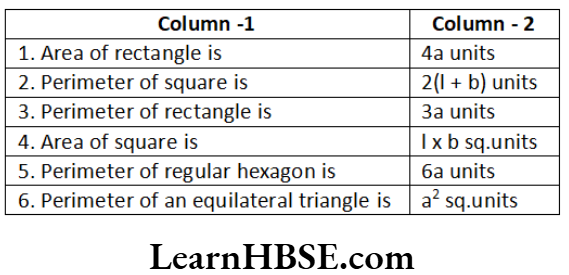
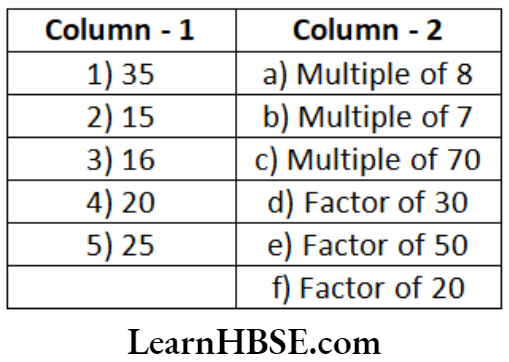
Question 3. Match the items in column – 1 with the items in column – 2

Class 6 Maths Chapter 3 Playing With Numbers Question 3

Solution. 1-b, 2-d, 3-a, 4-f, 5-e.

Question 4. Find all the multiples of 9 upto 100.

Solution. The multiples of 9 upto 100 are, 9, 18, 27, 36, 45,54, 63, 72, 81, 90 and 99.

Question 5. Observe that 2 x 3 + 1 = 7 is a prime number. Here, 1 has been added to a multiple of 2 to get a prime number. Can you find some more numbers of this type?

Solution. 2 × 5 + 1 = 10 + 1 = 11, Prime number

2 x 6 + 1 = 12 + 1 = 13, Prime number

2 x 8 + 1 = 16 + 1 = 17, Prime number

2 × 9 + 1 = 18 + 1 = 19, Prime number

2 x 11 + 1 = 22 + 1 = 23, Prime number

Haryana Board Class 6 Maths Solutions For  Chapter 3 Playing With Numbers Exercise 3.2

Question 1. What is the Sum of any two

a) Odd numbers

Solution. The sum of any two odd numbers is an even number.

b) Even numbers

Solution. The sum of any two even numbers is an even number.

Question 2. State whether the following statements are True (T) or False (F).

a) The sum of three odd numbers is even.

Solution. False. [For eg: 3 +5 +9 = 17 is an odd number.]

b) The sum of two odd numbers and one even number is even..

Solution. True.

c) The product of three odd numbers is odd.

Solution. True.

d) If an even number is divided by 2, the quotient is always odd.

Solution. False. [Even numbers are those which are divided by 2. The quotient need not always be odd.]

e) All prime numers are odd.

Solution. False [The prime number 2 is an even number]

f) Prime numbers do not have any factors.

Solution. False.

HCF and LCM Class 6 HBSE Maths

g) Sum of two prime numbers is always even.

Solution. False. [For eg. The total of two prime numbers 2 and 3 is not an even number.]

h) 2 is the only even prime number.

Solution. True.

i) All even numbers are composite numbers.

Solution. False.

j) The porduct of two even numbers is always even.

Solution. True.

Question 3. The numbers 13 and 31 are prime numbers. Both these numbers have same digits 1 and 3. Find such pairs of prime numbers upto 100.

Solution. 17, 71; 37,73; 79,97.

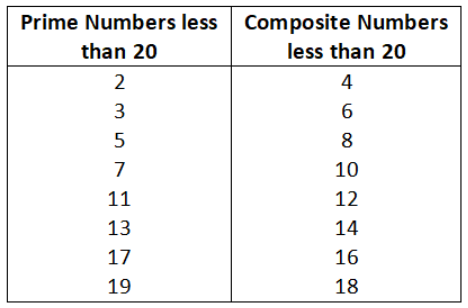
Question 4. Write down separately the prime and composite numbers less than 20.

Solution.

Class 6 Maths Chapter 3 Playing With Numbers Question 4

Question 5. What is the greatest prime number between 1 and 10?

Solution. The greatest prime number between 1 and 10 is 7.

Question 6. Express the following as the sum of two odd primes.

a) 44

Solution. 44 = 7 + 37

b) 36

Solution. 36 = 7 + 29

c) 24

Solution. 24 = 5 + 19

d) 18

Solution. 18 = 5 + 13 and 7 + 11

Question 7. Give three pairs of prime numbers whose difference is 2. (Remark: Two prime numbers whose difference is 2 are called twin primes)

Solution. The three pairs of prime numbers whose difference is 2 are. 3, 5; 5, 7:11, 13.

Question 8. Which of the following numbers are prime?

a) 23

b) 51

c) 37

d) 26

Solution. 23, 37 are prime numbers.

Question 9. Write seven consecutive composite numbers less than 100 so that there is no prime number between them.

Solution. 90, 91, 92, 93, 94, 95, 96.

Question 10. Express each of the following numbers as the sum of three odd primes:

a) 21

b) 31

c) 53

d) 61

Solution.

a) 21 = 3 + 7 + 11

b) 31 = 7 + 11 + 13

c) 53 = 11 + 13 + 29

d) 61 = 11 + 13 + 37

Question 11. Write five pairs of prime numbers less than 20 whose sum is divisible by 5.

(Hint: 3 + 7 = 10)

Solution. 2. 3; 2, 13: 3, 7:3, 17; 11, 19.

Question 12. Fill in the blanks:

a) A number which has only two factors is called a …

Answer. Prime Number

b) A number which has more than two factors is called a

Answer. Composite Number

c) 1 is neither………nor………….

Answer. Prime, Composite

d) The smallest prime number is….

Answer. 2

e) The smallest composite number is

Answer. 4

f) The smallest even number is…

Answer. 2

Haryana Board Class 6 Maths Solutions For  Chapter 3 Playing With Numbers Exercise-3.3

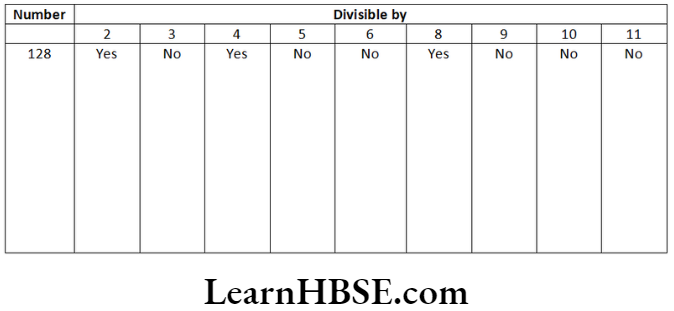
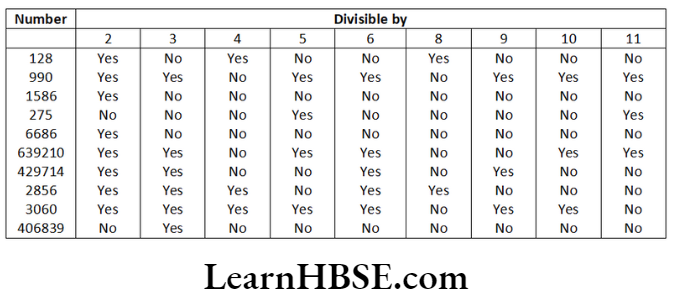
Question 1. Using divisibility tests, determine which of the following numbers are divisible by 2, by 3, by 4, by 5, by 6, by 8, by 9, by 10, by 11 (say: yes or no)

Class 6 Maths Chapter 3 Playing With Numbers Exercise 3.3 Question 1


Solution.

Class 6 Maths Chapter 3 Playing With Numbers Exercise 3.3 Question 1 Solution

Question 2. Using divisibility tests, determine which of the following numbers are divisible by 4; by 8:

a) 572

b) 726352

c) 5500

d) 6000

e) 12159

f) 14560

g) 21084

h) 31795072

i) 1700

j) 2150

Solution. a) 572

1) Test for divisibility by 4:

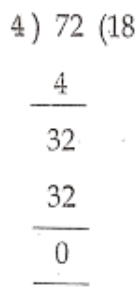
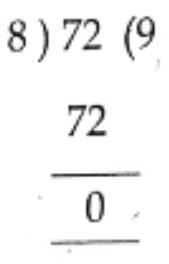
Number with last two digits = 72

Class 6 Maths Chapter 3 Playing With Numbers Question 2.1

∴ 72 is divisible by 4.

∴ 572 is divisible by 4.

Last two digits are divisible by 4, givne number is divisible by 4.

2) Test for divisibility by 8
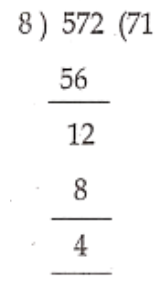
Number with last three digits = 572

Class 6 Maths Chapter 3 Playing With Numbers Question 2.2

Remainder is not zero.

∴ 572 is not divisible by 8.

Last three digits are divisible by 8. So given number is divisible by 8.

b) 726352
1) Test for divisibility by 4:

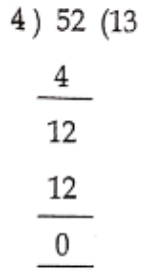
Number with last two digits = 52

Class 6 Maths Chapter 3 Playing With Numbers Question 2.3

The remainder is zero.

∴ 52 is divisible by 4

∴ 726352 is divisible by 4.

2) Test for divisibility by 8:
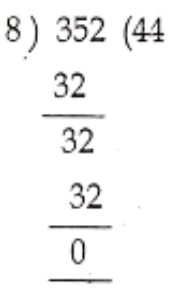
Number with last three digits = 352

Class 6 Maths Chapter 3 Playing With Numbers Question 2.4

The remainder is 0, 352 is divisible by 8.

∴ 726352 is divisible by 8.

Prime and composite numbers Class 6 HBSE

c) 5500
1) Test for divisibility by 4:

As the last two digits are ‘0’ and.

‘0’ is divisible by 4

∴ 5500 is divisible by 4.

2) Test for divisibility by 8:

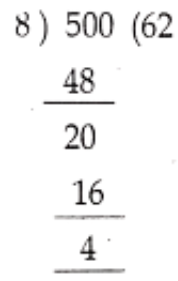
Number with last three digits = 500

Class 6 Maths Chapter 3 Playing With Numbers Question 2.5

The remainder is not zero.

∴ 500 is not divisible by 8

∴ 5500 is not divisible by 8.

d) 6000

1) Test for divisibility by 4:

The number with last two digits is 00, always divisible by 4.

∴ 6000 is divisible by 4.

2) Test for divisibility by 8:

The number with last three digits is 000, always divisible by 8.

∴ 6000 is divisible by 8.

e) 12159

1) Test for divisibility by 4:

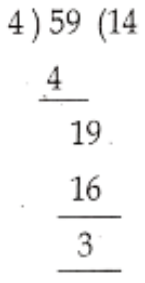
The number with last two digits = 59

Class 6 Maths Chapter 3 Playing With Numbers Question 2.6

The remainder is not zero.

∴ 59 is not divisible by 4.

∴ 12159 is not divisible by 4.

2) Test for divisibility by 8:

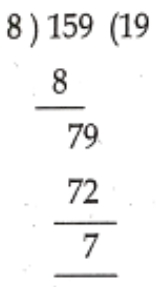
The number with last three digits = 159

Class 6 Maths Chapter 3 Playing With Numbers Question 2.7

Remainder is zero.

∴ 159 is divisible by 8.

∴ 12159 is divisible by 8.

f) 14560

1) Test for divisibility by 4:

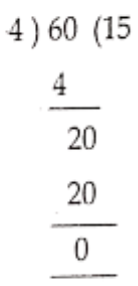
The number with last two digits = 60

Class 6 Maths Chapter 3 Playing With Numbers Question 2.8

The remainder is zero.

∴ 60 is divisible by 4.

∴ 14560 is divisible by 4.

2) Test for divisibility by 8:

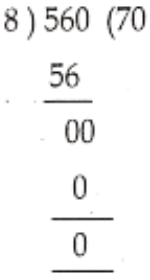
The number with last three digits = 560

Class 6 Maths Chapter 3 Playing With Numbers Question 2.9

Remainder is not zero.

∴ 560 is not divisible by 8.

∴ 14560 is not divisible by 8.

g) 21084

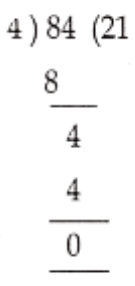
1) Test for divisibility by 4:

The number with last two digits = 84

Class 6 Maths Chapter 3 Playing With Numbers Question 2.10

The remainder is zero.

∴ 84 is divisible by 4.1

∴ 21084 is divisible by 4.

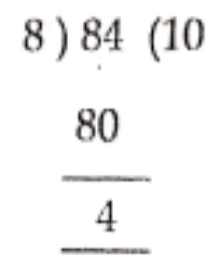
2) Test for divisibility by 8:

The number with last two digits = 084.

Class 6 Maths Chapter 3 Playing With Numbers Question 2.11

Remainder is not zero.

∴ 84 is not divisible by 8.

∴ 21084 is not divisible by 8.

h) 31795072

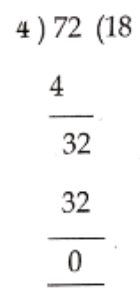
1) Test for divisibility by 4:

The number with last two digits = 50

Class 6 Maths Chapter 3 Playing With Numbers Question 2.12

Remainder is zero.

∴ 72 is divisible by 4.

∴ 31795072 is divisible by 4.

2) Test for divisibility by 8:

The number with last three digits = 072

Class 6 Maths Chapter 3 Playing With Numbers Question 2.13

Remainder is zero.

∴ 72 is divisible by 8

∴ 31795072 is divisible by 8.

i) 1700

1) Test for divisibility by 4:

The number formed with last two digits = 00, which is always divisible by 4.

∴ 1700 is divisible by 4.

2) Test for divisibility by 8:

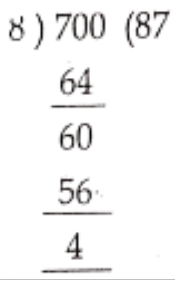
The number with last three digits = 700

Class 6 Maths Chapter 3 Playing With Numbers Question 2.14

Remainder is not zero.

∴ 700 is not divisible by 8

∴ 1700 is not divisible by 8.

j) 2150

1) Test for divisibility by 4:

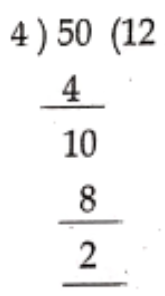
The number with last two digits = 50

Class 6 Maths Chapter 3 Playing With Numbers Question 2.15

Remainder is not zero.

∴ 50 is not divisible by 4.

∴ 2150 is not divisible by 4.

2) Test for divisibility by 8:

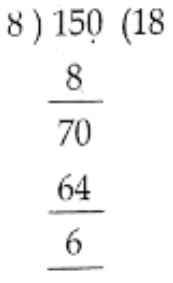
The number with last three digits = 150

Class 6 Maths Chapter 3 Playing With Numbers Question 2.16

Remainder is not zero.

∴ 150 is not divisible by 8

∴ 2150 is not divisible by 8.

Divisibility rules Class 6 Haryana Board

Question 3. Using divisiblity tests, determine. which of the following numbers are divisible by 6:

Solution. 6 is divisible by 2, 3

a) 297144

1) Test for divisibility by 2: Units digit = 4 is divisible by 2.

∴ 297144 is divisible by 2.

2) Test for divisibility by 3:

Sum of digits = 2 + 9 + 7 + 1 + 4 + 4 = 27

27 is divisible by 3

∴ 297144 is divisible by 3.

Since 297144 is divisible by both 2 and 3, it is divisible by 6.

b) 1258

1) Test for divisibility by 2:

Units digit = 8 is divisible by 2.

∴ 1258 is divisible by 2.

2) Test for divisibility by 3:

Sum of digits = 1 + 2 + 5 + 8 = 16

16 is not divisible by 3

∴ 1258 is not divisible by 3.

∴ 1258 is not divisible by 3 but divisible by 2, So it is not divisible by 6.

c) 4335

1) Test for divisibility by 2:

Units digit = 5 is not divisible by 2.

∴ 4335 is not divisible by 2.

∴ 4335 is not divisible by 6.

d) 61233

1) Test for divisibility by 2:

Units digit = 3 is not divisible by 2.

∴ 61233 is not divisible by 2.

∴ 61233 is not divisible by 6.

e) 901352

1) Test for divisibility by 2:

Units digit = 2.

∴ 901352 is divisible by 2.

2) Test for divisibility by 3: Sum of the digits = 9 + 0 + 1 + 3 + 5 + 2 = 20.

20 is not divisible by 3

∴ 901352 is not divisible by 3.

∴ 901352 is not divisible by 6.

f) 438750

1) Test for divisibility by 2:

Units digit = 0 is always divisible by 2

∴ 438750 is divisible by 2.

2) Test for divisibility by 3:

Sum of digits = 4 + 3 + 8 + 7 + 5 + 0 = 27.

27 is divisible by 3

∴ 438750 is divisible by 3.

∴ 438750 is divisible by 2 and 3.

∴ 438750 is divisible by 6.

g) 1790184

1) Test for divisibility by 2:

Units digit = 4 is divisible by 2.

∴ 1790184 is divisible by 2.

2) Test for divisibility by 3:

Sum of the digits = 1 + 7 + 9 + 0 + 1 + 8 + 4 = 30

30 is divisible by 3

∴ 1790184 is divisible by 3.

1790184 is divisible by both 2 and 3.

∴ 1790184 is divisible by 6.

h) 12583

1) Test for divisibility by 2:

Units digit = 3 is not divisible by 2.

∴ 12583 is not divisible by 2.

∴ 12583 is not divisible by 6.

i) 639210

1) Test for divisibility by 2:

Units digit = 0

∴ 639210 is divisible by 2.

2) Test for divisibility by 3:

Sum of the digits = 6 + 3 + 9 + 2 + 1 + 0 = 21.

21 is divisible by 3

∴ 639210 is divisible by 3.

∴ 639210 is divisible by 2 and 3.

∴ 639210 is divisible by 6.

j) 17852

1) Test for divisibility by 2:

Units digit = 2

∴ 17852 is divisible by 2.

2) Test for divisible by 3:

Sum of the digits = 1 + 7 + 8 + 5 + 2 = 23

23 is not divisible by 3

∴ 17852 is divisible by 3.

∴ 17852 is not divisible by 6.

Question 4. Using divisibility tests, determine which of the following numbers are divisible by 11:

a) 5445

b) 10824

c) 7138965

d) 70169308

e) 10000001

f) 901153

Solution. a) 5445

Sum of the digits at odd places from the right = 5 + 4 = 9

Sum of the digits at even places from the right = 4 + 5 = 9

Difference = 9 – 9 = 0

‘0’ is divisible by 11.

∴ 5445 is divisible by 11.

b) 10824

Sum of the digits at odd places from the right = 4 + 8 + 1 = 13

Sum of the digits at even places from the right = 2 + 0 = 2

Difference = 13 – 2 = 11 divisible by 11

∴ 10824 is divisble by 11.

c) 7138965

Sum of the digits at odd places from the right = 5 + 9 + 3 + 7 = 24

Sum of the digits at even places from the right = 6 + 8 + 1 = 15

Difference = 24 – 15 = 9, not divisible by 11

∴ 7138965 is not divisible by 11.

d) 70169308

Sum of the digits at odd places from the right = 8 + 3 + 6 + 0 = 17

Sum of the digits at even places from the right = 0 + 9 + 1 + 7 = 17

Difference 17 – 17 = 0

‘0’ is divisible by 11

∴ 70169308 is divisible by 11.

e) 10000001

Sum of the digits at odd places from the right = 1 + 0 + 0 + 0 = 1

Sum of the digits at even places = 0 + 0 + 0 + 1 = 1

Difference = 1 – 1 = 0

‘0’ is divisible by 11.

∴ 10000001 is divisible by 11.

f) 901153

Sum of the digits at odd places from the right = 3 + 1 + 0 = 4

Sum of the digits at even places from the right = 5 + 1 + 9 = 15

Difference = 15 – 4 = 11

∴ 11 is divisible by 11

∴ 901153 is divisible by 11.

Question 5. Write the smallest digit and the greatest digit in the blank space of each of the following numbers so that the number formed is divisible by 3.

Solution. a) _6724

1) Smallest digit

Sum of the digits = 6 + 7 + 2 + 4 = 19

19 is not divisible by 3.

21 is the nearest number to 19 which is divisible by 3.

So, 2 is the smallest number that fills the blank.

∴ Smallest number is 2 i.e. 26724.

2) Largest digit

The largest digit is 8 (19 + 8 = 27)

b) 4765_2

Sum of the given digits

= 4 + 7 + 6 + 5 + 2 = 24

24 is divisible by 3

∴ Smallest digit is 0

Largest digit is 9.

Question 6. Write the digit in the blank space of each of the following numbers so that the number formed is divisible by 11:

a) 92_389

b) 8_9484

Solution. a) 92_389

The sum of digits at odd places from the right = 9 + 3 + 2 = 14

Sum of the digits at even places from the right = 8 + 9 = 17

Difference = 17 – 14 = 3

To make the difference divisible by 11, we have to add 8 to 3.

∴ Blank space must be 8.

∴ Required number-928389.

b) 8_9484

Sum of the digits at odd places from the right = 4 + 4 = 8

Sum of the digits at even places from the right = 8 + 9 + 8 = 25

Difference 25 – 8 = 17

To make the difference divisible by. 11, we have to deduct 6 from 17.

∴ Digit in the blank space = 6

∴ Required number = 869484.

Question 7. Find the common factors of

a) 8, 20

b) 9, 15

Solution. a) Factors of 8 are 1, 2, 4, 8.

Factors of 20 are 1, 2, 4, 5, 10, 20.

Common factors are 1, 2, 4.

b) Factors of 9 are 1, 3, 9.

Factors of 15 are 1, 3, 5, 15.

Common factors are 1, 3.

Chapter 3 Playing With Numbers Exercise 3.4

Question 1. Find the common factors of:

a) 20 and 28

b) 15 and 25

c) 35 and 50

d) 56 and 120.

Solution. a) 20 and 28.

Factors of 20 are 1, 2, 4, 5, 10 and 20.

Factors of 28 are 1, 2, 4, 7, 14 and 28.

Common factors are 1, 2, 4.

b) 15 and 25

Factors of 15 are 1, 3, 5 and 15.

Factors of 25 are 1, 5 and 25:

Common factors are 1,5.

c) 35 and 50

Factors of 35 are 1, 5, 7 and 35.

Factors of 50 are 1, 2, 5, 10, 25 and 50.

Common factors are 1, 5.

d) 56 and 120

Factors of 56 are 1, 2, 4, 7, 8, 14, 28, 56.

Factors of 120 are 1, 2, 3, 4, 5, 6, 10, 12, 20, 24, 30, 40, 60, 120.

Common factors are 1, 2, 4.

Question 2. Find the common factors of:

a) 4, 8 and 12

b) 5, 15 and 25

Solution. a) 4, 8 and 12

Factors of 4 are 1, 2, 4.

Factors of 8 are 1, 2, 4 and 8.

Factors of 12 are 1, 2, 3, 4, 6, 12.

Common factors are 1, 2 and 4.

b) 5, 15 and 25

Factors of 5 are 1 and 5.

Factors of 15 are 1, 3, 5 and 15.

Factors of 25 are 1,5 and 25.

Common factors are 1, 5.

Question 3. Find first three common multiples of:

a) 6 and 8

b) 12 and 18

Solution. a) 6 and 8

Multiples of 6 are 6, 12, 18, 24, 30, 30, 36, 42, 48, 54, 60, 66, 72, 78, ……….

Multiples of 8 are 8, 16, 24, 32, 40, 48, 56, 64, 72,…….

First three common multiples are 24, 48 and 72.

b) 12 and 18

Multiples of 12 are 12, 24, 36, 48, 60, 72, 84, 96, 108, 120, ………

Multiples of 18 are 18, 36, 54, 72, 90, 108, 126 …….

First three common multiples are 36, 72, 108.

Question 4. Write all the numbers less than 100 which are common multiples of 3 and 4.

Solution. The multiples of 3 are 3, 6, 9, 12, 15, 18, 21, 24, 27, 30, 33, 36, 39, 42, 45, 48, 51, 54, 57, 60, 63, 66, 69, 72, 75, 78, 81, 84, 87, 90, 93, 96, 99, 102, 105…..

Multiples of 4 are 4, 8, 12, 16, 20, 24, 28, 32, 36, 40, 44, 48, 52, 56, 60, 64, 68, 72, 76, 80, 84, 88, 92, 96, 100…..

Common multipies of 3 and 4 are 12, 24, 36, 48, 60,72, 84, 96, 108……

∴ Common multiples less than 100 are 12, 24, 36, 48, 60, 72, 84, 96

Question 5. Which of the following numbers are co-prime?

a) 18 and 35

b) 15 and 37

c) 30 and 415

d) 17 and 68

e) 216 and 215

f) 81 and 16

Solution. Two numbers having 1 as a common factor are called co-prime numbers.

a) 18 and 35

Factors of 18 are 1, 2, 3, 6, 9 and 18.

Factors of 35 are 1, 5, 7 and 35.

Common factor is 1.

∴ 18 and 35 are co-prime numbers.

b) 15 and 37

Factors of 15 are 1, 3, 5 and 15.

Factors of 37 are 1 and 37.

Common factor is 1.

∴ 15 and 37 are co-prime numbers.

c) 30 and 415

Factors of 30 are 1, 2, 3, 5, 6, 10, 15. and 30.

Factors of 415 are 1, 5, 83 and 415

Common factors are 1 and 5

∴ 30 and 415 are not co-primes.

d) 17 and 68

Factors of 17 are 1 and 17.

Factors of 68 are 1, 2, 4, 17, 34 and 68.

Common factors are 1 and 17.

∴ 17 and 68 are not co-prime numbers.

e) 216 and 215

Factors of 216 are 1, 2, 3, 4, 6, 8, 9, 12, 18, 24, 27, 36, 54, 72, 108 and 216.

Factors of 215 are 1, 5, 43, and 215.

Common factors is 1 only.

∴ 216 and 215 are co-prime numbers.

f) 81 and 16

Factors of 81 are 1, 3, 9, 27 and 81

Factors of 16 are 1, 2, 4, 8 and 16.

Common factor is 1.

∴ 81 and 16 are co-prime numbers.

Question 6. A number is divisible by both 5 and 12. By which other number will that number be always divisible?

Solution. The number divisible by both 5 and 12 is 60(12 × 5). The other number by which 60 is always divisible is 15. (15 × 4 = 60)

Question 7. A number is divisible by 12. By what other numbers will that number be divisible?

Solution. Factors of 12 are 1, 2, 3, 4, 6 and 12.

∴ The number is also divisible by 1, 2, 3, 4 and 6 also.

Question 8. Write the prime factorisation of 16, 28, 38.

Solution. 16 = 2 x 2 x 2 x 2

28 = 2 × 2 × 7

38 = 2 × 19

Haryana Board Class 6 Maths Solutions For  Chapter 3 Playing With Numbers Exercise 3.5

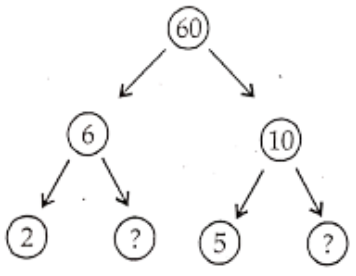
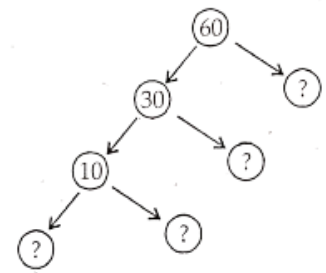
Question 1. Here are two different factor trees for 60. Write the missing numbers.

a)

Class 6 Maths Chapter 3 Playing With Numbers Exercise 3.5 Question 1

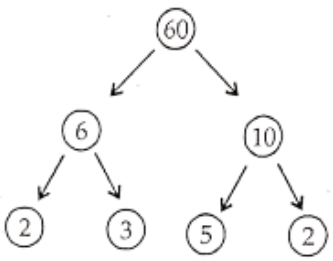
Solution.

Class 6 Maths Chapter 3 Playing With Numbers Exercise 3.5 Question 1 Solution

b)

Class 6 Maths Chapter 3 Playing With Numbers Exercise 3.5 Question 2

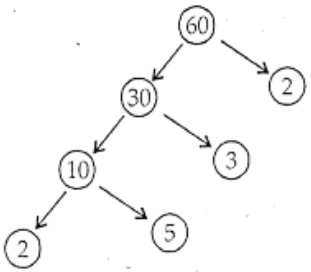
Solution.

Class 6 Maths Chapter 3 Playing With Numbers Exercise 3.5 Question 2 Solution

Question 2. Which factors are not included in the prime factorisation of a composite number?

Solution. 1 and composite factors are not included in the prime factorisation of a composite number.

Question 3. Write the greatest four digit number and express it in terms of its prime factors.

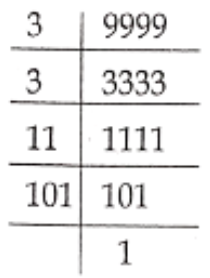
Solution. The greatest four digit number is 9999.

Class 6 Maths Chapter 3 Playing With Numbers Exercise 3.5 Question 3

∴ 99993 x 3 x 11 x 101 x 1

Factors and multiples Class 6 HBSE

Question 4. Write the smallest five digit number and express it into the form of prime factors.

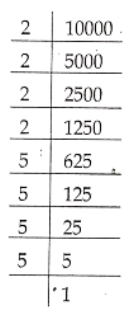
Solution. The smallest five digit number is 10000

Class 6 Maths Chapter 3 Playing With Numbers Exercise 3.5 Question 4

10000 = 2 x 2 x 2 x 2 x 5 x 5 x 5 x 5 x 1.

Question 5. Find all the prime factors of 1729 and arrange them in ascending order. Now state the relation, if any; between two consecutive prime factors.

Solution.

1729 = 7 x 13 × 19 × 1

All the prime factors of 1729 are 7, 13 and 19.

The ascending order is 7, 13, 19.

We, observe that the difference is the same between two consecutive prime factors.

13 – 7 = 6

19 – 13 = 6

Question 6. The product of three consecutive number is always divisible by 6. Verify this statement with the help of some examples.

Solution. Example 1:

Let us take three consecutive numbers be 21, 22 and 23.

21 is divisible by 3

22 is divisible by 2

∴ 21 x 22 is divisible by 6.

∴ 21 x 22 x 23 is divisible by 6.

Example 2:

Let the three consecutive numbers be 47, 48 and 49.

48 is divisible by both 2 and 3.

(2 x 3 = 6)

∴ 47 x 48 x 49 is divisible by 6.

Question 7. The sum of two consecutive odd num- ber is divisible by 4. Verify this statement with the help of some examples.

Solution. Example 1:

Let us take two consecutive odd numbers 13 and 15

Sum of the number = 13 + 15 = 28.

∴ 28 is divisible by 4.

Example 2:

Let the two consecutive odd numbers be 17 and 19

Sum of the numbers = 17 + 19 = 36

∴ 36 is divisible by 4.

Example 3:

Let the two consecutive odd numbers be 25 and 27.

Sum of the numbers = 25 + 27 = 52

∴ 52 is divisible by 4.

Question 8. In which of the following expressions, prime factorisation has been done?

a) 24 = 2 x 3 x 4

b) 56 = 7 x 2 x 2 x 2

c) 70 = 2 x 5 x 7

d) 54 = 2 × 3 × 9

Solution. a) Prime factorisation has been done.

b) Prime factorisation has not been done.

c) Prime factorisation has been done.

d) Prime factorisation has not been done.

Question 9. 18 is divisible by both 2 and 3. It is also divisible by 2 × 3 = 6. Similarly, a number is divisible by both 4 and 6. Can we say that the number must also be divisible by 4 × 6 = 24? If not, give an example to justify your answer.

Solution. No! we cannot conclude that the number will be divisible by 4 × 6 = 24 if it is divisible by both 4 and 6 because 4 and 6 are not co-prime numbers they have two common factors 1 and 2.

Example: 36 is divisible by 4 and 6 but 36 is not divisible by 24.

Question 10. I am the smallest number, having four different prime factors. Can you find me?

Solution. The four different prime factors = 2, 3, 5,7.

To find out the smallest number, we have to write them in their ascending order and multiply 2 × 3 × 5 × 7 = 210.

210 is the smallest number, having four different prime factors 2,3,5 and 7.

Question 11. Find the HCF of the following:

1) 24 and 36

2) 15, 25 and 30

3) 8 and 12

4) 12, 16 and 28.

Solution. 1) 24 and 36

Factors of 24 are 1, 2, 3, 4, 6, 8, 12 and 24.

Factors of 36 are 1, 2, 3, 4, 6, 9, 12, 18 and 36.

Highest common factor is 12.

∴ HCF of 24 and 36 is 12.

2) 15, 25 and 30

Factors of 15 are 1, 3, 5 and 15

Factors of 25 are 1,5 and 25

Factors of 30 are 1, 2, 3, 5, 6, 10, 15 and 30.

∴ HCF of 15, 25 and 30 is 5.

3) 8 and 12

Factors of 8 are 1, 2, 4 and 8

Factors of 12 are 1, 2, 3, 4, 6 and 12

HCF of 8 and 12 is 4.

4) 12, 16 and 28

Factors of 12 are 1, 2, 3, 4, 6 and 12

Factors of 16 are 1, 2, 4, 8 and 16

Factors of 28 are 1, 2, 4, 7, 14 and 28.

HCF of 12, 16 and 28 is 4.

Haryana Board Class 6 Maths Solutions For  Chapter 3 Playing With Numbers Exercise 3.6

Question 1. Find the HCF of the following numbers:

a) 18, 48

b) 30,42

c) 18, 60

d) 27,63

e) 36,84

f) 34, 102

g) 70, 105, 175

h) 91, 112, 49

j) 12, 45, 75

i) 18, 54, 81

Solution. a) 18, 48

Factors of 18 are 1, 2, 3, 6, 9 and 18.

Factors of 48 are 1, 2, 3, 4, 6, 8, 12, 16, 24 and 48.

Common factors are 1, 2, 3 and 6.

∴ HCF of 18 and 48 is 6.

b) 30, 42

Factors of 30 are 1, 2, 3, 5, 6, 10, 15, and 30.

Factors of 42 are 1, 2, 3, 6, 7, 14, 21 and 42.

Common factors are 1, 2, 3 and 6.

∴ HCF of 30 and 42 is 6.

c) 18, 60

Factors of 18 are 1, 2, 3, 6, 9 and 18.

Factors of 60 are 1, 2, 3, 4, 5, 6, 10, 12, 15, 20, 30 and 60.

Common factors are 1, 2, 3, and 6.

∴ HCF of 18 and 60 is 6.

d) 27, 63

Factors of 27 are 1, 3, 9 and 27.

Factors of 63 are 1,3,7,9, 21 and 63.

Common factors are 1, 3 and 9.

∴ HCF of 27 and 63 is 9.

e) 36, 84

Factors of 36 are 1,2,3,4,6,9, 12, 18 and 36.

Factors of 84 are 1, 2, 3, 4, 7, 12, 14, 21, 42 and 84.

Common factors are 1, 2, 3, 4 and 12.

∴ HCF of 36 and 84 is 12.

f) 34, 102

Factors of 34 are 1, 2, 17 and 34.

Factors of 102 are 1, 2, 3, 6, 17, 34, 51 and 102.

Common factors are 1, 2, 17 and 34.

∴ HCF of 34 and 102 is 34.

g) 70, 105, 175

Factors of 70 are 1, 2, 5, 7, 10, 14, 35 and 70.

Factors of 105 are 1, 3, 5, 7, 15, 21, 35 and 105:

Factors of 175 are 1, 5, 7, 25, 35 and 175.

Common factors are 1, 5 and 35.

∴ HCF of 70, 105 and 175 is 35.

h) 91, 112, 49

Factors of 91 are 1, 7, 13 and 91.

Factors of 112 are 1, 2, 4, 7, 8, 14, 16, 28, 56 and 112.

Factors of 49 are 1, 7 and 49.

Common factors are 1 and 7.

∴ HCF of 91, 112, 49 is 7.

i) 18, 54, 81

Factors of 18 are 1, 2, 3, 6, 9 and 18.

Factors of 54 are 1, 2, 3, 6, 9, 18, 27 and 54.

Factors of 81 are 1, 3, 9, 27 and 81.

Common factors are 1, 3, 9.

∴ HCF of 18, 54, 81 is 9.

j) 12, 45, 75

Factors of 12 are 1, 2, 3, 4, 6 and 12.

Factors of 45 are 1,3,5,9, 15 and 45.

Factors of 75 are 1, 3, 5, 15, 25 and 75.

Common factors are 1 and 3.

∴ HCF of 12, 45 and 75 is 3.

Question 2. What is the HCF of two consecutive.

a) Numbers ?

b) Even numbers?

c) Odd numbers?

Solution. a) Numbers

HCF of two consecutive numbers is 1.

b) Even numbers

HCF of two consecutive even number is 2.

c) Odd numbers

HCF of two consecutive odd numbers is 1.

Question 3. HCF of co-prime numbers 4 and 15 was found as follows by factorisation : 4 = 2 × 2 and 15 = 3 x 5 since there is no common prime factor, so HCF of 4 and 15 is 0. Is the answer correct? If not, what is the correct HCF?

Solution. No, the answer is not correct.

The HCF of 4 and 15 is 1.

Haryana Board Class 6 Maths Solutions For  Chapter 3 Playing With Numbers Exercise – 3.7

Question 1. Renu purchases two bags of fertiliser of weights 75 kg and 69 kg. Find the maximum value of weight which can measure the weight of the fertiliser exact number of times.

Solution. Factors of 75 are 1, 3, 5, 15, 25 and 75

Factors of 69 are 1, 3, 23 and 69.

Common factors are 1 and 3.

HCF of 75 and 69 is 3.

The maximum capacity of weight which can measure the weight of the fertiliser exact number of times is 3 kg.

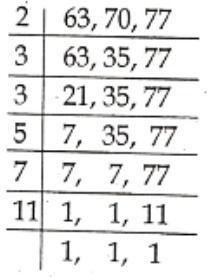
Question 2. Three boys step off together from the same spot. Their steps measure 63 cm, 70 cm and 77 cm respectively. What is the minimum distance each should cover so that all can cover the distance in complete steps?

Solution.

Class 6 Maths Chapter 3 Playing With Numbers Exercise 3.7 Question 2

LCM of 63, 70 and 77

= 2 x 3 x 3 x 5 x 7 x 11 = 6930

The minimum distance each should cover so that all cover the distance in complete steps is 6930 cm. or 69 m 30 cm.

Word problems on HCF and LCM for Class 6 HBSE

Question 3. The length, breadth and height of a room are 825 cm, 675 cm and 450 cm respectively. Find the longest tape which can measure the three dimen- sions of the room exactly.

Solution. Factors of 825 are 1, 3, 5, 11, 15, 25, 33, 55, 75, 165, 275 and 825.

Factors of 450 are 1, 2, 3, 5, 6, 9, 10, 15, 18,25,30,45,50, 75, 90, 150, 225 and 450.

Common factors are 1, 3, 5, 15, 25 and 75.

HCF = 75

The length of largest tape which can measure the three dimensions of the room exactly is 75 cm.

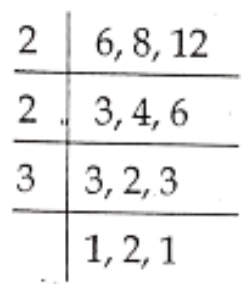
Question 4. Determine the smallest 3-digit number which is exactly divisible by 6, 8 and 12.

Solution.

Class 6 Maths Chapter 3 Playing With Numbers Exercise 3.7 Question 4

L.C.M = 2 x 2 x 3 x 1 x 2 x 1 = 24

Multiples of 24 are 24, 48, 72, 96, 120, 144……

The smallest 3-digit number which is exactly divisible by 6, 8 and 12 is 120.

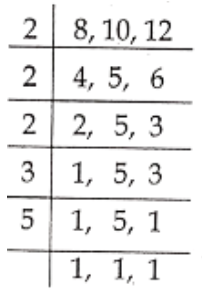
Question 5. Determine the greatest 3-digit num- ber exactly divisible by 8, 10 and 12.

Solution.

Class 6 Maths Chapter 3 Playing With Numbers Exercise 3.7 Question 5

LCM = 2 × 2 × 2 × 3 × 5 = 120

Multiples of 120 are 120, 240, 360, 480, 600, 720, 840, 960, 1080 ……….

∴ The largest 3-digit number exactly divisible by 8, 10 and 12 is 960.

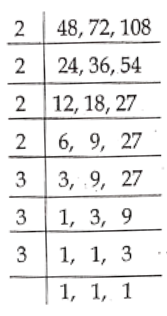
Question 6. The traffic lights at three different road crossings change after every 48 seconds, 72 seconds and 108 seconds respectively. If they change simultaneously at 7 a.m. at what time will they change simultaneously again?

Solution.

Class 6 Maths Chapter 3 Playing With Numbers Exercise 3.7 Question 6

L.C.M. = 2 x 2 x 2 x 2 x 3 x 3 x 3 = 432

432 seconds = \(\frac{432}{60}\) = 7 min. 12 seconds.

(1 minute = 60 secs)

∴ They will change simultaneously again at 7 min. 12 seconds after 7 am:.

Question 7. Three tankers contain 403 litres, 434 litres and 465 litres of diesel respectively. Find the maximum capacity of a container that can measure the diesel of the three containers exact number of times.

Solution. Factors of 403 are 1, 13, 31 and 403.

Factors of 465 are 1, 3, 5, 15, 31, 93, 155 and 465.

Factors of 434 are 1, 2, 7, 14, 31, 62, 217 and 434.

Common factors are 1 and 31. HCF = 31 The maximum capacity of the container that can measure the diesel of the three containers exact number of times is 31 litres.

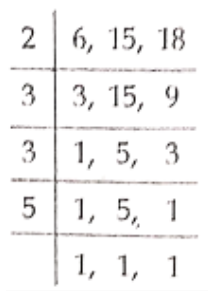
Question 8. Find the least number which when divided by 6, 15 and 18 leave remainder 5 in each case.

Solution.

Class 6 Maths Chapter 3 Playing With Numbers Exercise 3.7 Question 8

LCM = 2 x 3 x 3 x 5 = 90

∴ Required number = 90 + 5 = 95.

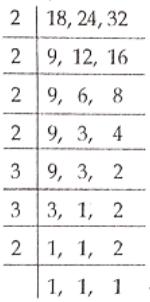
Question 9. Find the smallest four digit number which is divisible by 18, 24 and 32.

Solution.

Class 6 Maths Chapter 3 Playing With Numbers Exercise 3.7 Question 9

LCM = 2 × 2 × 2 x 2 x 3 x 3 x 2 = 288

Multiples of 288 are 288 × 1

288 × 1 = 288

288 x 2 = 576

288 × 3 = 864

288 x 4 = 1152

∴ The smallest 4-digit number which is divisible by 18, 24 & 32 is 1152.

Question 10. Find the LCM of the following numbers:

a) 9 and 4

b) 12 and 5

c) 6 and 5

d) 15 and 4.

Solution. a) 9 and 4

LCM of 9 and 4 is 9 x 4 = 36

b) 12 and 5

LCM of 12 and 5 is 12 x 5 = 60

c) 6 and 5

LCM of 6 and 5 is 6 x 5 = 30

d) 15 and 4

LCM of 15 and 4 is 15 x 4 = 60

We observe a common property in the obtained LCM’s that the LCM is the product of two numbers in each case and also the LCM is always a multiple of 3.

Question 11. Find the LCM of the following numbers in which one number is the factor of the other.

a) 5,20

b) 6, 18

c) 12,48

d) 9,45

What do you observe in the results obtained?

Solution. a) 5, 20

5 = 5 x 1

20 = 2 × 2 × 5

LCM of 5 and 20 = 2 x 2 x 5 = 20

b) 6,18

6 = 2 × 3

18 = 2 x 3 x 3

LCM of 6 and 18 is 2 × 3 × 3 = 18

c) 12, 48

12 = 2 × 2 × 3

48 = 2 x 2 x 2 × 2 × 3

LCM of 12 and 48

= 2 × 2 × 2 × 2 × 3 = 48.

d) 9, 45

9 = 3 × 3

45 = 3 × 3 × 5

LCM of 9 and 45 = 3 x 3 x 5 = 45

In the results obtained, we observe that the LCM of the two numbers in which one number is a factor of the other is the greater number.

Haryana Board Class 6 Maths Solutions For  Chapter 3 Playing With Numbers Very Short Answer Questions

Question 1. Are the numbers 452, 673, 259, 356 divisible by 2? Verify.

Solution. A number is divisible by 2, if it has any of the digits 0, 2, 4, 6 and 8 in its ones place.

∴ The numbers 452 and 356 have 2 and 6 in their ones place and the other num- bers does not have.

∴ 452 and 356 are divisible by 2.

Question 2. Is 8430 divisible by 6? Why?

Solution. If a number is divisible by both 2 and 3 then it is also divisible by 6.

The ones place of 8430 is 0, so it is divisible by 2.

The sum of digits of 8430 is 8 + 4 + 3 + 0 = 15.

15 is multiple of 3. So 8430 is divisible by 3.

∴ The number 8430 is divisible by both 2 and 3. It is divisible by ‘6’.

Question 3. Test whether 6669 is divisible by 9.

Solution. The sum of digits of 6669

= 6 + 6 + 6 + 9 = 27

It is a multiple of 9. So the number 6669 is divisible by 9.

Question 4. Without actual division, find whether 8989794 is divisible by 9.

Solution. The sum of digits of 8989794

= 8 + 9 + 8 + 9 + 7 + 9 + 4 = 54

It is a multiple of 9. So the number 8989794 is divisible by 9.

Question 5. Find the smallest number that must be added to 128, so that it becomes exactly divisible by 5.

Solution. Given number is 128

If the number is exactly divisible by 5, its ones place should have the digits 5 or 0.

∴ The nearest number to 128 which is having 0 or 5 in one’s place is 130.

∴ The smallest number that must be added is 130 – 128 = 2

Question 6. What is the smallest prime number?

Solution. 2 is the smallest prime number.

Question 7. What is the smallest composite number?

Solution. 4 is the smallest composite number.

Question 8. What is the smallest odd prime number?

Solution. 3 is the smallest odd prime number.

Question 9. What is the smallest odd composite number?

Solution. 9 is the smallest odd composite number.

Question 10. Write 10 odd and 10 even composite numbers.

Solution. 10 odd composite numbers = 9, 15, 21, 25, 27, 33, 35, 39, 45, 49.

10 even composite numbers = 4, 6, 8, 10, 12, 14, 16, 18, 20, 22.

Haryana Board Class 6 Maths Solutions For  Chapter 3 Playing With Numbers Short Answer Questions

Question 11. Are the numbers 28570, 90875 divisible by 5? Verify by actual division also.

Solution. The number with zero or five at ones place is divisible by 5.

In the numbers 28570 and 90875; the digits at ones place are 0 and 5. So these numbers are divisible by 5.

Verifying by actual division:

Class 6 Maths Chapter 3 Playing With Numbers Short Answer Question 11

Question 12. Find the smallest number that has to be subtracted from 276 so that it becomes exactly divisible by 10.

Solution. Given number is 276

The digit in ones place is 6.

For the number exactly divisible by 10, the digit in ones place must be ‘0’

∴ The smallest number that has to be subtracted = 276 – 6 = 270

∴ The smallest number that has to be subtracted is 6.

Question 13. Write the greatest four digit number which is divisible by 9. Is it divisible by 3? What do you notice? 

Solution. The greatest four digit number which is divisible by 9 is 9999.

∴ The sum of digits = 9 + 9 + 9 + 9 = 36

36 is divisible by 3.

∴ 9999 is divisible by 3.

∴ Yes, the greatest four digit number which is divisible by 9 is also divisible by 3.

∴ We noticed that the numbers which are divisible by 9 are also divisible by 3.

Question 14. Write the nearest number to 12345 which is divisible by 4.

Solution. A number is divisible by 4 if the number formed by the last two digits is divisible by 4.

Given number is 12345.

Number formed by last two digits is 45.

If 1 is subtracted from it.

45 – 1 = 44 is divisible by 4.

So the nearest number to 12345 divisible by 4 is 12344.

Question 15. Find the factors of 60.

Solution. Factors of 60 = 1 × 60

= 2 x 30

= 3 x 20

= 4 x 15

= 5 x 12

= 6 x 10.

= 10 x 6

= 12 x 5

= 15 x 4

= 20 x 3

= 30 x 2

= 60 × 1

∴ The factors of 60 are = 1, 2, 3, 4, 5, 6, 10, 12, 15, 20, 30 and 60.

Chapter 3 Playing With Numbers Long Answer Questions

Question 16. Take any three 4 digit numbers and check whether they are divisible by 6.

Solution. Let us take three four digits numbers.

1) 3420 2) 7942 3) 6036

1) 3420

The ones place of 3420 is 0. So it is divisible by 2.

The sum of digits = 3 + 4 + 2 + 0 = 9.

It is divisible by 3.

∴ The number 3420 is divisible by both 2 and 3. So it is divisible by 6 also.

2) 7942

The ones place of 7942 is 2. So it is divisible by 2.

The sum of digits = 7 + 9 + 4 + 2 = 22.

It is not divisible by 3.

∴ The number 7942 is divisible by 2 but not divisible by 3. So it is not divisible by 6.

3) 6036

The ones place of 6036 is 6. So it is divisible by 2.

The sum of digits = 6 + 0 + 3 + 6 = 15.

It is divisible by 3.

∴ The number 6036 is divisible by both 2 and 3. So it is divisible by 6 also.

Question 17. Check whether the numbers 598, 864, 4782 and 8976 are divisible by 4. Use divisibility rule and verify by ac- tual division.

Solution. Divisibility rule of 4:

A number is divisible by 4 if the number formed by its last two digits. (i.e., ones and tens) is divisible by 4.

1) 598

The number formed by last two digits is 98.

98 is not divisible by 4.

∴ 598 is not divisible by 4.

2) 864

The number formed by last two digits is 64.

64 is divisible by 4.

∴ 864 is divisible by 4.

3) 4782

The number formed by last two digits is 82.

82 is not divisible by 4.

∴ 4782 is not divisible by 4.

4) 8976

The number formed by last two digits is 76.

76 is divisible by 4.

∴ 8976 is divisible by 4.

Question 18. Determine which of the following numbers are divisible by 5 and by 10.

25, 125, 250, 1250, 10205, 70985, 45880.

Check whether the numbers that are divisible by 10 are divisible by 2 and 5.

Solution. 25, 125, 10205, 70985, 250, 1250, 45880

These numbers are having ‘5’ or ‘0’ in the ones place.

∴ These numbers are divisible by 5

250, 1250, 45880

These numbers having ‘0’ in the ones place

∴ These numbers are divisible by 10

These numbers are divisible by ‘5’

these numbers are having ‘0’ in the ones place,

These numbers are also divisible by 2

∴ The numbers which are divisible by 10 are divisible by 2 and 5 also.

Difference between factors and multiples Class 6

Question 19. Write all the numbers between 100 and 200 which are divisible by 6.

Solution. The numbers divisible by 2 and 3 are divisible by 6.

The numbers divisible by 2 between 100 and 200 are = 102, 104, 106, 108, 110, 112, 114, 116, 118, 120, 122, 124 ………… 196, 198

The numbers divisible by 3 between 100 and 200 are = 102, 105, 108, 111, 114, 117, 120, 123, 126 …….. 195,198

The numbers which are divisible by both 2 and 3 are = 102, 108, 114, 120, 126, 132, 138, 144, 150, 156, 162, 168, 174, 180, 186, 192, 198

So all these numbers are divisible by 6.

Question 20. Using divisibility rules, determine which of the following numbers are divisible by 11.

1) 6446

2) 10934

3) 7138965

4) 726352

Solution. A number is divisible by 11, if the difference between the sum of the digits at odd places and the sum of the digits at even places (from the right) is either ‘0’ or multiple of 11.

1) 6446

The sum of digits at odd places = 6 + 4 = 10

The sum of digits at even places = 4 + 6 = 10

∴ Their difference = 10 – 10 = 0

So 6446 is divisible by 11.

2) 10934

The sum of digits at odd places = 4 + 9 + 1 = 14

The sum of digits at even places = 3 + 0 = 3

∴ Their difference = 14 3 = 11

It is a multiple of 11.

So 10934 is divisible by 11.

3) 7138965

The sum of digits at odd places = 5 + 9 + 3 + 7 = 24

The sum of digits at even places = 6 + 8 + 1 = 15

∴ Their difference = 24 – 15 = 9

It is not a multiple of 11.

So 7138965 is not divisible by 11.

4) 726352

The sum of digits at odd places = 2 + 3 + 2 = 7

The sum of digits at even places = 6 + 8 + 1 = 15

∴ Their difference = 18 – 7 = 1

It is a multiple of 11.

So 726352 is divisible by 11.

Haryana Board Class 6 Maths Solutions For  Chapter 3 Playing With Numbers Objective Type Questions

Choose the correct answer :

Question 1. In the following which is a composite number?

  1. 0
  2. 1
  3. 2
  4. 4

Answer. 4. 4

Question 2. Is 107 a prime number?

  1. yes
  2. no
  3. can’t say
  4. infinite

Answer. 1. yes

Question 3. Divide 29 by 4 it gives quotient

  1. 1
  2. 7
  3. 6
  4. 4

Answer. 2. 7

Question 4. A number is completely divisible by another number it leaves a remainder

  1. 1
  2. 2
  3. 3
  4. 0

Answer. 4. 0

Question 5. Which of the following numbers is divisible by 9?

  1. 197235
  2. 726352
  3. 988975
  4. 345880

Answer. 1. 197235

Question 6. Factors of 12 are

  1. 2,3
  2. 1,2,3
  3. 1,2,3,4,6
  4. 1, 2, 3, 4, 6, 12

Answer. 4. 1, 2, 3, 4, 6, 12

Question 7. The HCF of two consecutive numbers is

  1. 1
  2. The smallest number
  3. The greatest number
  4. 0

Answer. 1. 1

Question 8. The greatest two digit prime number.

  1. 77
  2. 79
  3. 97
  4. 99

Answer. 3. 97

Question 9. The number of factors of 80

  1. 8
  2. 10
  3. 11
  4. 12

Answer. 2. 10

Question 10. The another name for GCD

  1. LCM
  2. HCF
  3. GCM
  4. LCF

Answer. 2. HCF

Question 11. The number divisible by 4

  1. 200094
  2. 249874
  3. 249884
  4. 249854

Answer. 3. 249884

Question 12. The least two digit prime number

  1. 11
  2. 10
  3. 12
  4. 13

Answer. 1. 11

Question 13. 512215 is divisible by …..

  1. 2
  2. 4
  3. 11
  4. 6

Answer. 3. 11

Question 14. Example for twin prime numbers.

  1. (41,43)
  2. (42, 44)
  3. (43,45)
  4. (44, 46)

Answer. 1. (41,43)

Question 15. Number of common factors of 12 and 18 is

  1. 3
  2. 4
  3. 6
  4. 8

Answer. 2. 4

Question 16. The least prime number is

  1. 2
  2. 3
  3. 4
  4. 1

Answer. 1. 2

Question 17. 51225 is divisible by.

  1. 51
  2. 2
  3. 4
  4. 5

Answer. 4. 5

Question 18. HCF of 3, 4 is.

  1. 0.5
  2. 1
  3. 2
  4. 3

Answer. 2. 1

Question 19. Choose the correct matching.

Class 6 Maths Chapter 3 Playing With Numbers Choose the correct answer Question 19

  1. a-4, b-2, c-3, d-1
  2. a-1, b-4, c-2, d-3
  3. a-4, b-2, c-1, d-3
  4. a-2, b-4, c-1, d-3

Answer. 4. a-2, b-4, c-1, d-3

Question 20. Which of the following is not divisible by 2?

  1. 11150
  2. 63874
  3. 81111
  4. 1496

Answer. 3. 81111

Question 21. Greatest factor of 120 is………….

  1. 8
  2. 15
  3. 120
  4. 12

Answer. 3. 120

Question 22………… is neither prime nor composite.

  1. 4
  2. 3
  3. 1
  4. 2

Answer. 3. 1

Question 23. LCM of 8 and 12 is…………….

  1. 11
  2. 13
  3. 12
  4. 24

Answer. 4. 24

Question 24. HCF of 40, 56 and 60 is…………….

  1. 8
  2. 4
  3. 60
  4. 16

Answer. 2. 4

Question 25. How many prime numbers less than 100 are there?

  1. 15
  2. 25
  3. 30
  4. 26

Answer. 2. 25

Question 26. 42 = ……………..

  1. 7 × 3 × 2
  2. 7 × 7 x 9
  3. 2 × 21 × 3
  4. 7 × 6 × 4

Answer. 1. 7 x 3 x 2

Question 27. Identify a palindrome number.

  1. 1225
  2. 1331
  3. 11452
  4. 31119

Answer. 2. 1331

Question 28. 2 x 2 × 3 × 7 = ……….

  1. 84
  2. 62
  3. 81
  4. 22

Answer. 1. 84

Question 29. Number of factors of 36 is ………

  1. 6
  2. 11
  3. 10
  4. 9

Answer. 9

Question 30. The smallest odd composite number is …..

  1. 17
  2. 15
  3. 9
  4. 16

Answer. 3. 9

Question 31. Identify the correct statement from the following:

  1. 733 is divisible by 3
  2. The greatest prime number after 20 is 23
  3. 4, 6, 8, 10, 12 are even composite numbers
  4. 7221 is a factor of 11

Answer. 3. 4, 6, 8, 10, 12 are even composite numbers

Question 32. Factors of 115 are.

  1. 5
  2. 23
  3. 115
  4. All the above

Answer. All the above

Question 33. How many prime numbers are there in between 10 and 30?

  1. 9
  2. 6
  3. 8
  4. 19

Answer. 2. 6

Question 34. 9846 is not divisible by …….

  1. 9
  2. 3 only
  3. 2 only
  4. 5

Answer. 5

Question 35. Sum of the digits of 36129 is

  1. 16
  2. 3
  3. 21
  4. 8

Answer. 3. 21

Question 36. How many twin primes are below 20?

  1. 5
  2. 6
  3. 3
  4. 4

Answer. 4. 4

Question 37. 53 = …………..

  1. 13 + 17 + 20
  2. 13 + 17 + 23
  3. 18 + 10 + 16
  4. 17 + 13 + 33

Answer. 2. 13 + 17 + 23

Question 38. HCF of 28, 35 is ………

  1. 6
  2. 9
  3. 7
  4. 8

Answer. 7

Question 39. LCM of 10 and 11 is ……..

  1. 119
  2. 122
  3. 111
  4. 110

Answer. 4. 110

Question 40. LCM of a and b if HCF of a, b = 1.

  1. \(\frac{a}{b}\)
  2. a+b
  3. ab
  4. a-b

Answer. 3. ab

Question 41. Two prime numbers are said to be twin primes, if they differ each other by

  1. 0
  2. 1
  3. 2
  4. None

Answer. 3. 2

Question 42. Choose the correct matching.

Class 6 Maths Chapter 3 Playing With Numbers Choose the correct answer Question 42

  1. a-1, b-2, c-3
  2. a-3, b-2, c-1
  3. a-1, b-3, c-2
  4. a-2, b-3, c-1

Answer. 2. a-3, b-2, c-1

Question 43. The numbers which have 1 as the common factor are called…….

  1. co-prime
  2. relatively prime
  3. Both A & B
  4. None

Answer. 3. Both A & B

Question 44. The H.C.F. of any two twin primes is………….

  1. 0
  2. 1
  3. 2
  4. None

Answer. 2. 1

Question 45. The product of L.C.M and H.C.F of two numbers =

  1. Sum of two numbers
  2. Difference of two numbers
  3. Both A & B
  4. Product of two numbers

Answer. 4. Product of two numbers

Question 46. A number which divides the other number with out remainder is called

  1. factor
  2. multiple
  3. prime number
  4. composite number

Answer. 1. factor

Question 47. The number which is divisible by 1 and itself is called

  1. factor
  2. multiple
  3. prime number
  4. composite number

Answer. 3. Prime number

Question 48. If the L.C.M of 8 and 12 is 24 then their H.C.F. is

  1. 3
  2. 4
  3. 16
  4. 96

Answer. 2. 4

Question 49. If the H.C.F. of 18 and 27 is 9 then their L.C.M is

  1. 9
  2. 486
  3. 54
  4. None

Answer. 3. 54

Question 50. ……………. is a factor of 12.

  1. 7
  2. 9
  3. 4
  4. 18

Answer. 3. 4

Question 51. ……………… is a factor of every number.

  1. 3
  2. 12
  3. 0
  4. 1

Answer. 4. 1

Question 52. The fifth multiple of 6 is.

  1. 30
  2. 35
  3. 40
  4. 45

Answer. 1. 30

Question 53. Every prime number except ………. is odd.

  1. 3
  2. 4
  3. 1
  4. 2

Answer. 4. 2

Question 54. 128 is divisible by

  1. 4
  2. 3
  3. 5
  4. 9

Answer. 1. 4

Question 55. 2 x 2 x 2 x 2 = ……….

  1. 18
  2. 8
  3. 12
  4. 16

Answer. 4. 16

Question 56. HCF of 24 and 36 is ….

  1. 14
  2. 36
  3. 12
  4. 24

Answer. 3. 12

Question 57. LCM of 24 and 90 is …..

  1. 360
  2. 300
  3. 460
  4. 306

Answer. 1. 360

Question 58. Which of the following number is divisible by 2?

  1. 133
  2. 124
  3. 135
  4. 111

Answer. 2. 124

Question 59. Two numbers having only 1 as a common factor are called …………..numbers.

  1. co-prime
  2. prime
  3. odd
  4. even

Answer. 1. co-prime

Question 60. Which of the following number is not divisible by 5?

  1. 140
  2. 222
  3. 1000
  4. 110
  5. Answer. 2. 222

Haryana Board Class 6 Maths Solutions For  Chapter 3 Playing With Numbers Fill In The Blanks:

Question 61. HCF of 2021 and 2022 is

Answer. 1

Question 62. The least composite number is ………..

Answer. 4

Question 63. Number of primes below 98 is ………..

Answer. 25

Question 64. LCM of 2, 4, 6 ………………..

Answer. 12

Question 65. HCF of 3, 5, 19 is …………

Answer. 1

Question 66.

Class 6 Maths Chapter 3 Playing With Numbers Fill In The Blanks Question 66

In the above factor tree of 112 the value of x = ………..

Answer. 7

Question 67. HCF of 30 and 48 is ……………

Answer. 6

Question 68. HCF of two consecutive even numbers is ………….

Answer. 2

Question 69. Express 44 as sum of two odd primes ………….

Answer. 13 + 31

Question 70. Number of factors of 80 is …………..

Answer. 10

Question 71. 2, 4, 6, 8 are examples of ………….numbers.

Answer. even

Question 72. 2 × 3 + 1 = …………

Answer. 7

Question 73. …………….. is neither a prime nor a composite number

Answer. 1

Question 74. 4 × 17 = ……………..

Answer. 68

Question 75. Number of factors of a given number are.

Answer. finite

Question 76. Every number is a factor of ………..

Answer. itself

Question 77. 1, 2, 4 are called …………………..

Answer. factors

Question 78. Sum of the digits of a number is divisible by 3, then it is divisible by

Answer. 3

Question 79. LCM of 8 and 12 is. ……….

Answer. 24

Question 80. HCF of any two consecutive numbers is ………..

Answer. 1

Question 81. LCM means ………….

Answer. Least Common Multiple

Haryana Board Class 6 Maths Solutions For Chapter 10 Mensuration

Haryana Board Class 6 Maths Solutions For Chapter 10 Mensuration

  • Perimeter is the distance covered along the boundary forming a closed figure when you go round the figure once.
  • The length of the boundary of a closed figure is called its ‘Perimeter’ (Or) Sum of all the lengths of a polygon is called its ‘Perimeter’.
  • The perimeter of a rectangle = 2 [length + breadth]
  • Perimeter of a square = 4 x [length of its side]
  • Perimeter of a equilateral triangle = 3 x length of the side.
  • Circumference [Perimeter] of a circle = πd (Or) 2πr
  • The place occupied by an object is called area of the object. Area is measured in square units.
  • Area of a rectangle = length x breadth
  • Area of a square = side x side

Question 1. Meera went to a park 150 m long and 80m wide. She took one complete round on its boundary. What is the distance covered by her?

Solution.

Class 6 Maths Chapter 10 Mensuration Question 3

Distance covered by Meera

= AB + BC + DC + DA

= (150 + 80 + 150 + 80) m

= 460 m

Haryana Board Class 6 Maths Mensuration solutions

Question 2. Find the perimeter of the following figures:

Solution. a)

Class 6 Maths Chapter 10 Mensuration Question 4.1

Perimeter

= AB + BC + CD + DA

= 40 m + 10 m + 40 m + 10m

= 100 m

b)

Class 6 Maths Chapter 10 Mensuration Question 4.2

Perimeter

= AB + BC + CD + AD

= 5m + 5m + 5m + 5m

= 20 m

c)

Class 6 Maths Chapter 10 Mensuration Question 4.3

Perimeter

= AB + BC + CD + DE + EF + FG + GH + HI + IJ + JK + KL + LA

= 1 cm + 3 cm + 3 cm + 1 cm + 3 cm + 3cm + 1 cm + 3 cm + 3 cm + 1 cm + 3 cm + 3 cm

= 28 cm

Perimeter and area formulas for Class 6 HBSE Maths

d)

Class 6 Maths Chapter 10 Mensuration Question 4.4

Perimeter

= AB + BC + CD + DE + EF + FA

= 100 m + 120 m + 90m + 45m + 60 m + 80 m

= 495 m

Question 3. Find the perimeter of the following rectangles:

Class 6 Maths Chapter 10 Mensuration Question 5

Solution. 1) Perimeter = 2(1 + b) = 2 (0.5 m + 0.25 m)

= 2(0.75) m = 1.5 m

Perimeter by adding all the sides

= 0.5 + 0.25 + 0.5 + 0.25

= 1.5 m

2) Perimeter = 2(1 + b)= 2(18 cm + 15 cm) = 66 cm.

Perimeter by adding all the sides

= 18 + 15 + 18 + 15 = 66 cm.

3) Perimeter = 2(1 + b)

= 2 (10.5 cm + 8.5 cm)

= 2 (19 cm) = 38 cm.

Perimeter by adding all the sides

= 10.5 + 8.5 + 10.5 + 8.5

= 38 cm.

Volume of cube and cuboid Class 6 HBSE Maths

Question 4. Find various objects from your surroundings which have regular shapes and find their perimeters.

1) Square:

Solution. 1) A square has four equal sides.

2) Let’s assume the length of one side is 5 cm.

3) The perimeter of a square is calculated by multiplying the length of one side by 4.

4) Therefore, the perimeter of the square would be 5 cm x 4 = 20 cm.

2) Rectangle:

Solution. 1) A rectangle has two pairs of equal sides (opposite sides)

2) Let’s assume the length of one side is 6 cm and the length of the adjacent side is 8 cm.

3) The perimeter of a rectangle is calculated by adding the lengths of all four sides.

4) Therefore, the perimeter of the rectangle would be (6 cm + 8 cm) x 2 = 28 cm..

3) Circle:

Solution. 1) A circle is a curved shape with a constant radius.

2) Let’s assume the radius of a circle is 3 cm.

3) The perimeter of a circle is called its circumference and is calculated using the formula: 2 × π × radius.

4) Therefore, the perimeter (circumference) of the circle would be

2 x 3.14 x 3 cm = 18.84 cm.

Please note that these are just examples, and the actual objects around you may have different dimensions and perimeters.

Haryana Board Class 6 Maths Solutions For Chapter 10 Mensuration Exercise 10.1

Question 1. Find the perimeter of each of the following figures:

Class 6 Maths Chapter 10 Mensuration Exercise 10.1 Question 1

Solution. a) Perimeter

5 cm + 1 cm + 2 cm + 4 cm

= 12 cm

b) Perimeter

= 40 cm + 35 cm + 23 cm + 35 cm

= 133 cm

c) Perimeter =

= 15 cm + 15 cm + 15 cm + 15 cm

= 60 cm

d) Perimeter = 4 cm + 4 cm + 4 cm + 4 cm + 4 cm = 20 cm

e) Perimeter = 1 cm + 4 cm + 0.5 cm + 2.5 cm + 2.5 cm + 0.5cm + 4cm = 15cm

f) Perimeter = 1 cm + 3 cm + 2 cm + 3 cm + 4 cm + 1 cm + 3 cm + 2 cm + 3 cm + 4 cm + 1 cm, + 3 cm + 2 cm + 3 cm + 4 cm + 1 cm + 3 cm + 2 cm + 3 cm + 4 cm = 52 cm

Circumference and area of a circle Class 6 Haryana Board

Question 2. The lid of a rectangular box of sides 40 cm by 10 cm is sealed all round with tape. What is the length of the tape required?

Solution. Length of rectangular box = 40 cm

Breadth of rectangular box = 10 cm

Length of the tape required

= 2 (length + breadth)

= 2(40 cm + 10 cm)

= 2 × 50 cm

= 100 cm

= 1 m

Question 3. A table top measures 2 m 25 cm by 1 m 50 cm. What is the perimeter of the table-top?

Solution. Length = 2 m 25 cm = 2.25 m

Breadth = 1 m 50 cm = 1.5 m

Perimeter of top of the table

= 2(length + breadth)

= 2(2.25 + 1.5) m.

= 2(3.75 m)

= 7.5 m.

Question 4. What is the length of the wooden strip required to frame a photograph of length and breadth 32 cm and 21 cm respectively?

Solution. Length = 32 cm

Breadth = 21 cm

Length of wooden strip required

= 2(length + breadth)

= 2(32 + 21) cm

= 2 x 53 cm

= 106 cm.

Question 5. A rectangular piece of land measures 0.7 km by 0.5 km. Each side is to be fenced with 4 rows of wires. What is the length of the wire needed?

Solution. Length = 0.7 km

Breadth = 0.5 km

Perimeter of a rectangle

= 2 (length + breadth)

= 2 (0.7 km + 0.5 km)

= 2.4 km.

Length of wire needed

= 4 × perimeter

= 4 × 2.4 km

= 9.6 km.

Mensuration Class 6 HBSE important questions

Question 6. Find the perimeter of each of the following shapes.

a) A triangle of sides 3 cm, 4 cm, and 5 cm.

Solution. Perimeter of the triangle

= 3 cm + 4 cm + 5 cm

= 12 cm

b) An equilateral triangle of side 9 cm.

Solution. Perimeter = 9 cm + 9 cm + 9 cm

= 27 cm

c) An isosceles triangle with equal sides 8 cm each and third side 6 cm.

Solution. Perimeter of an isosceles triangle

= 8 cm + 8 cm + 6 cm

= 22 cm

Question 7. Find the perimeter of a triangle with sides measuring 10 cm, 14 cm and 15 cm.

Solution. Perimeter of the triangle

= Sum of the lengths of sides

= 10 cm + 14 cm + 15 cm

= 39 cm.

Question 8. Find the perimeter of a regular hexagon with each side measuring 8 m.

Solution. Perimeter of regular hexagon

= 6 x length of side

= 6 × 8 m

= 48 m.

Question 9. Find the side of the square whose perimeter is 20 m.

Solution. Perimeter of square = 20 m

4 x length of the side = 20 m

Length of the side = \(\frac{20 \mathrm{~m}}{4}=5 \mathrm{~m}\)

Question 10. The perimeter of a regular pentagon is 100 cm. How long is its each side?

Solution. Perimeter of regular pentagon = 100 cm

5 x length of the side = 100 cm

Length of the side = \(\frac{100 \mathrm{~cm}}{5}=20 \mathrm{~cm} .\)

Question 11. A piece of string is 30 cm long. What will be the length of each side if the string is used to form:

a) a square?

b) an equilateral triangle ?

c) a regular hexagon?

Solution. a) Perimeter of a square = 30 cm

4 × length of side = 30 cm

length of side = \(\frac{30 \mathrm{~cm}}{4}=7.5 \mathrm{~cm}\)

b) Perimeter of equilateral triangle = 30 cm.

3 x length of side = 30 cm

Length of side = \(\frac{30 \mathrm{~cm}^{\prime}}{3}=10 \mathrm{~cm} .\)

c) Perimeter of regular hexagon = 30 cm

6 x length of side = 30 cm

Length of side = \(\frac{30 \mathrm{~cm}}{6}=5 \mathrm{~cm} .\)

Question 12. Two sides of a triangle are 12 cm and 14 cm. The perimeter of the triangle is 36 cm. What is the third side?

Solution. Perimeter of a triangle = Sum of the lengths of 3 sides

36 cm = 12 cm + 14 cm + length of third side

36cm = 26 cm + length of third side

∴ length of third side

= 36 cm – 26 cm = 10 cm

Question 13. Find the cost of fencing a square park of side 250 m at the rate of ₹ 20 per metre.

Solution. Perimeter of square park

= 4 x length of one side.

= 4 x 250 m

= 1000 m

∴ Cost of fencing at the rate of ₹ 20 per metre.

= ₹ 1000 x ₹ 20

= ₹ 20,000

Question 14. Find the cost of fencing a rectangular park of length 175 m and breadth 125 m at the rate of ₹ 12 per metre.

Solution. Perimeter of a rectangular park

= 2(length + breadth)

= 2(175 + 125)m

= 2(300)m

= 600 m

∴ Cost of fencing the rectangular park at the rate of ₹ 12 per metre.

= ₹ 12 × ₹ 600

= ₹ 7200

Question 15. Sweety runs around a square park of side 75 m. Bulbul runs around a rectangular park with length 60 m and breadth 45m. Who covers less distance?

Solution. Perimeter of a square park

= 4 x length of one side

= 4 x 75 m.

= 300 m.

Perimeter of a rectangular park

= 2(1 + b)

= 2 (60 m + 45 m)

= 2 (105 m)

= 210 m

here 300 m > 210 m

∴ Bulbul covers less distance.

Question 16. What is the perimeter of each of the following figure? What do you infer from the answers?

Class 6 Maths Chapter 10 Mensuration Exercise 10.1 Question 16.1

Solution. a) Perimeter = 25 cm + 25 cm + 25 cm +25 cm 100 cm.

b) Perimeter = 30 cm + 20 cm + 30 cm + 20 cm = 100 cm

c) Perimeter = 40 cm + 10 cm + 40 cm +10 cm = 100 cm

d) Perimeter = 40 cm + 30 cm + 30 cm = 100 cm

Inference: The perimeter of all the fig- ures is 100 cm.

Question 17. Avneet buys 9 square paving slabs, each with a side of \(\frac{1}{2}\) m. He lays them in the form of a square.

Class 6 Maths Chapter 10 Mensuration Exercise 10.1 Question 17

a) What is the perimeter of his arrangement in the above figure (1)?

b) Shari does not like his arrangement. She gets him to lay them out like a cross. What is the perimeter of her arrangement in the above figure (2)?

c) Which has greater perimeter?

d) Avneet wonders if there is a way of getting an even greater perimeter. Can you find a way of doing this? (The paving slabs must meet along complete edges i.e. they can- not be broken.)

Solution. a) Perimeter of the figure(1) = 4 x side

Length of the side of the square

= 3 x square

Slabs x length of each side

= 3 x 0.5 m = 1.5 m(each side = \(\frac{1}{2}\)m)

Perimeter of Avneet’s arrangement

= 4 x 1.5m = 6m.

b) Peimeter of the figure (2)

= 5 x length of each side

= 5 x 0.5 = 2.5 m (each side = \(\frac{1}{2}\)m)

Perimeter of the cross = 4 x figure

= 4 x 2.5 = 10 m

c) Shari’s arrangement has greater perimeter.

d) No, but we can achieve the same perimeter as shari’s arrangement by arranging all the squares in a row.

Haryana Board Class 6 Maths Solutions For Chapter 10 Mensuration Exercise 10.2

Question 1. Find the areas of the following figures by counting squares.

Class 6 Maths Chapter 10 Mensuration Exercise 10.2 Question 1.1

Solution. a)

Class 6 Maths Chapter 10 Mensuration Exercise 10.2 Question 1.2

b)

Class 6 Maths Chapter 10 Mensuration Exercise 10.2 Question 1.3

∴ Total area of the figure = 5 sq.cm

c) Fully-filled squares = 2

Half-filled squares = 4

Area covered by fully squares = 2 × 1 = 2 sq. cm

Area covered by half squared = 4 x \(\frac{1}{2}\) = 2 sq. cm

Total area = 4 sq.cm.

d) Fully-filled squares = 8

∴ Total area = Area covered by full squares

=8 × 1 sq.cm

= 8 sq. cm

e) Fully filled squares = 10

∴ Total area = Area covered by full squares

= 10 × 1 sq cm.

= 10 sq.cm.

f) Fully-filled squares = 2

Half-filled squares = 4

Area covered by fully squares = 2 x 1 sq.cm

= 2 sq.cm

Area covered by half squares = 4 x \(\frac{1}{2}\) sq.cm

= 2 sq. cm.

∴ Total area = 2 sq.cm + 2 sq.cm

= 4 sq.cm

g) Fully-filled squares = 4

Half-filled squares = 4

Area covered by full squares

= 4 x 1 sq. cm = 4 sq. cm

Area covered by half squares

= 4 x \(\frac{1}{2}\) sq. cm = 2 sq. cm

∴ Total area 4 sq. cm + 2 sq. cm

= 6 sq. cm.

h) Fully-filled squares = 5

∴ Total area = Area covered by full squares

= 8 x 1 sq. cm = 5 sq. cm

i) Fully-filled squares = 9

∴ Total area = Area covered by full squares

= 9 × 1 sq. cm

= 9 sq. cm

j) Fully-filled squares = 2

Half filled squares = 4

Area covered by full squares

= 2 x 1 sq. cm

= 2 sq. cm

Area covered by half squares

= 4 x \(\frac{1}{2}\) sq.cm = 2 sq.cm

∴ Total area 2 sq. cm + 2 sq. cm

= 4 sq. cm

k) Fully filled squares = 4

Half filled squares = 2

Area covered by full squares

= 4 × 1 sq. cm

= 4 sq. cm

Area covered by half squares

= 2 x \(\frac{1}{2}\) sq.cm

= 1 sq. cm

∴ Total area = 4 sq. cm + 1 sq. cm

= 5 sq. cm

1) Fully-filled squares = 4 = 4 sq.cm

Half-filled squares

= 2 = 2 x \(\frac{1}{2}\) = 1 sq.cm

More than half filled squares

= 3 = 3 x 1 sq cm = 3 sq.cm

∴ Total area

= 4 sq. cm + 3 sq. cm

= 7 sq.cm

m) Fully filled squares = 7 x 1 sq.cm

= 7 sq.cm

Half-filled squares = More than half filled squares

= 7 x 1 sq.cm = 7 sq.cm

Less than half filled squares = 4

Total area = 7 sq. cm + 7sq.cm

= 14 cm.

n) Fully filled squares = 9 x 1 = 9 sq.cm

Half-filled squares

More than half filled squares

= 9 x 1 = 9 sq.cm

Total area = 9 sq. cm + 9 sq.cm

= 18 sq.cm

Question 2. Find the area of the floor of your classroom.

Solution. Let’s assume the length of the classroom is 10 meters and the width is 8 meters.

Area = 10 meters x 8 meters = 80 sq.m.

So, the area of the floor of the classroom would be 80 sq m.

Question 3. Find the area of any one door in your house.

Solution. The most common standard door size is 80 inches (6.67) feet) in height and 36 inches (3 feet) in width area of door

= Height x Width

Area of door = 80 inches x 36 inches = 2880 sq. inches.

To convert square inches to square feet, divide the area by 144 (since there are 144 square inches in a square foot):

Area of door (in square feet) = 2880 square inches/144 = 20 square feet.

There fore, the approximate area of standard -size door in a house is around 20 square feet.

Haryana Board Class 6 Maths Solutions For Chapter 10 Mensuration Exercise 10.3

Question 1. Find the areas of the rectangles whose sides are:

a) 3 cm and 4 cm

b) 12 m and 21 m

c) 2 km and 3 km

d) 2 m and 70 cm

Solution. a) 1 = 4 cm, b = 3 cm

Area of rectangle = 1 x b

= 4 x 3

= 12 sq. cm.

b) 1 = 21 m, b = 12 m

Area of rectangle = 1 x b

= 21 × 12

= 252 sq.m.

c) 1 = 3 km, b = 2 km

Area of rectangle = 1x b

= 3 × 2

= 16 sq.km.

d) 1 = 2 m, b = 70 cm = 0.7 m

Area of rectangle = 1 x b

= 2 × 0.7

= 1.4 sq.m.

Question 2. Find the areas of the squares whose sides are:

a) 10 cm

b) 14 cm

c) 5 m

Solution. a) a = 10 cm

Area of the square a2 sq. cm

= 102 sq. cm

= 100 sq. cm

b) a = 14 cm

Area of the square = a2 sq. cm

= 142 sq. cm

= 196 sq. cm

c) a = 5 m

Area of the square = a2

= 52 sq.cm

= 25 sq.cm

Question 3. The length and breadth of three rectangles are as given below:

a)9 m and 6 m

b) 17 m and 3 m

c) 4 m and 14 m

Which one has the largest area and which one has the smallest ?

Solution. a) 1 = 9 m, b = 6m

Area of rectangle = l x b

= 9 x 6

= 54 sq.m.

b) 1 = 17 m, b = 3 m

Area of rectangle = 1 x b

= 17 × 3

= 51 sq. m.

c) 1 = 14 m, b = 4m

Area of rectangle

= 1 x b

= 14 × 4

= 56 sq.m

The rectangle(c) has the largest area and the rectangle (b) has the smallest area.

Word problems on Mensuration for Class 6 HBSE

Question 4. The area of a rectangular garden 50 m long is 300 sq.m. Find the width of the garden.

Solution. Area of a rectangular garden = 300 sq.m.

length = 50 m.

1 x b = 300

50 x b = 300

b = \(\frac{300}{50}\) m

b = 6m

∴ Width of the garden = 6m

Question 5. What is the cost of tiling a rectangular plot of land 500 m long and 200 m wide at the rate of 8 per hundred sq. m.?

Solution. Length of a rectangular piece of land = 500 m

Breadth of a rectangular piece of land = 200 m

Area = length x breadth

= 500 m × 200 m

= 1,00,000 sq.m.

Cost of tiling per 100sq. m = ₹ 8

Cost of tiling 1,00,000 sq. m

= \(₹ \frac{8}{100} \times 100000\)

= ₹ 8000

Question 6. A table-top measures 2 m by 1 m 50 cm. What is its area in square metres?

Solution. Length of the table = 2 m

Breadth of the table = 1 m 50 cm = 1.5 m

Area of the table = length x breadth

= 2 × 15 sq.m

= 3 sq.m.

Question 7. A room is 4m long and 3 m 50 cm wide. How many square metres of carpet is needed to cover the floor of the room?

Solution. Length of the room = 4 m = 4 m

Breadth of the room = 3 m 50 cm

= 3.50 m

∴ Area of the room

= length x breadth

= 4m x 3.50 m

= 14 sq.m.

∴ 14 sq. m of carpet is needed to cover the floor.

Question 8. A floor is 5m long and 4 m wide. A square carpet of sides 3 m is laid on the floor. Find the area of the floor that is not carpeted.

Solution. Length of the floor = 5 m

Breadth of the floor = 4 m

Area of the floor = length x breadth

= 5 x 4 sq. m

= 20 sq.m

Area of the square carpet = a2

= (3)2 sq. m

= 9 sq. m.

Area of the floor that is not carpeted

= 20 sq.m. – 9 sq.m

= 11 sq.m.

Question 9. Five square flower beds each of sides 1 m are dug on a piece of land 5 m long and 4 m wide. What is the area of the remaining part of land?

Solution. Area of square flower bed = a2 sq. m

=(1)2sq. m

= 1 sq. m

∴ Area of 5 square flower beds

= 1 x 5 sq. m

= 5 sq. m

Length of the piece of land = 5 m

Breadth of the piece of land

= length x breadth

= 4 x 5 sq. cm

= 20 sq. m

Area of remaining part of land

= 20 sq. m – 5 sq. m

= 15 sq. m

Question 10. By splitting the following figures into rectangles find their areas.

(The measures are given in centimetres)

Class 6 Maths Chapter 10 Mensuration Exercise 10.2 Question 10.1

Solution. a) Area of the figure

= (3 x 3) + (1 x 2) + (3 x 3) + (4 × 2) sq. cm

= 9 + 2 + 9 + 8 sq.cm

= 28 sq. cm

b) Area of the figure

= (3 x 1 + 3 x 1 + 3 x 1) sq. m

Class 6 Maths Chapter 10 Mensuration Exercise 10.2 Question 10.2

= 3 + 3 + 3 sq. cm

= 9 sq. cm

Question 11. Split the following shapes into rectangles and find their areas. (The measures are given in centimetres)

Solution. a)

Class 6 Maths Chapter 10 Mensuration Exercise 10.2 Question 11.1

Area of the shape

= (8 x 2 + 12 x 2) sq. cm

= 16 + 24 sq. cm

= 40 sq. cm

b)

Class 6 Maths Chapter 10 Mensuration Exercise 10.2 Question 11.2

Area of the shape

= (7×7) + (7×7) + (7×7) + (7×7) + (7×7) sq.m

=(49 + 49 + 49 + 49 + 49) sq. m

= 245 sq. cm

c)

Class 6 Maths Chapter 10 Mensuration Exercise 10.2 Question 11.3

Area of the shape

= (5 x 1)+(4 x 1) sq. cm

= (5 + 4) sq. cm

= 9 sq. cm

Question 12. How many tiles whose length and breadth are 12 cm and 15 cm respectively will be needed to fit in a rectangular region whose length and breadth are respectively.

a) 100 cm and 144 cm

Solution. 1 = 144 cm, b = 100 cm

Area of rectangle = 1 x b

= 144 × 100

= 14400 sq.cm

Length of the tile = 5 cm

Breadth of the tile = 12 cm

Area of rectangle = 1 x b

= 5 x 12 sq.cm

= 60 sq.cm

∴ Number of tiles needed to fit the

region = \(\frac{\text { Area of theregion }}{\text { Area of tile }}\)

= \(\frac{14400}{60}\) = 240.

b) 70 cm and 36 cm

Solution. 1 = 70 cm, b = 36 cm

Area of the region = 70 × 36 sq.cm = 2520 sq.cm

Area of the tile = 60 sq.cm

Number of tiles needed = \(\frac{2520}{60}\)

= 42 sq.cm

A challenge!

On a centimetre squared paper, make as many rectangles as you can, such that the area of the rectangle is 16 sq cm (consider only natural number lengths).

a) Which rectangle has the greatest perimeter?

b) Which rectangle has the least perimeter? If you take a rectangle of area 24 sq cm, what will be your answers? Given any area, is it possible to predict the shape of the rectangle with thegreatest perimeter? With the least perimeter? Give example and reason.

Solution. Three rectangles can be made as follows:

1) Sides 16 cm and 1 cm

Perimeter = 2(1 + b)

= 2(16 + 1) = 34 cm

2) Sides 8 cm and 2 cm

Perimeter = 2(l + b)

= 2(8 + 2) = 20 cm

3) Sides 4 cm and 4 cm

Perimeter = 2(l + b)

= 2(4 + 4) = 16 cm

a) The rectangle (1) has the greatest perimeter.

b) The rectangle (3) has the least perimeter. If the area is 24 sq. cm. Four rectangles can be made as follows.

1) Sides 24 cm and 1 cm

Perimeter = 2(1 + b)

= 2(24 + 1) = 50 cm

2) Sides 4 cm and 6 cm

Perimeter = 2(1 + b)

= 2(4 + 6) = 20 cm

3) Sides 8 cm and 3 cm

Perimeter = 2 (1 + b)

= 2(8 + 3) = 22 cm

4) Sides 12 cm and 2 cm

Perimeter = 2(l + b)

= 2(12 + 2) = 28 cm

Yes! it is possible to predict the shape of the rectangle with the (1) greatest perimeter. 2) least perimeter.

Difference between perimeter and area Class 6

Haryana Board Class 6 Maths Solutions For Chapter 10 Mensuration Very Short Answer Questions

Question 1. Find the perimeters of the given figures.

Class 6 Maths Chapter 10 Mensuration Very Short Answer Question 1

In the above figures (1) and (2), find the perimeter of ΔKLM, ΔKMN and ▢KLMN.

Solution. 1) Perimeter of ΔKLM

= KL + LM + KM

= 2 + 2.6 + 3.8 = 8.4 cm

Perimeter of ΔKMN

= KM + MN + KN

= 3.8 + 2 + 2.6 = 8.4 cm

2) Perimeter of ▢KLMN

= KL + LM + MN + KN

= 2 + 2.6 + 2 + 2.6 = 9.2 cm

Question 2. Find the perimeters of the following figures.

Class 6 Maths Chapter 10 Mensuration Very Short Answer Question 2

Solution. Perimeter of AXYZ

= XY + YZ + XZ

= 2 + 2 + 2 = 6 cm

2) Perimeter of a square ABCD

= AB + BC + CD + AD

= 3 + 3 + 3 + 3 = 12 cm

3) Perimeter of ▢PQRS

= PQ + QR + RS + PS

= 2 + 2 + 2 + 2 = 8 cm

Question 3. Find the area of a square with side 16 cm.

Solution.

Class 6 Maths Chapter 10 Mensuration Very Short Answer Question 3

Length of the side of a square = 16 cm

Area of a square = side x side

= 16 x 16 = 256 cm2

Question 4. Length and breadth of a rectangle are 16 cm and 12 cm respectively. Find its

Solution.

Class 6 Maths Chapter 10 Mensuration Very Short Answer Question 4

Length of a rectangle l = 16 cm

Its breadth = b = 12 cm

Area of a rectangle

= 1 x b

= 16 × 12

= 192 cm2

Question 5. Find the area of the rectangle of measurements 15cm and 8cm as length and breadth respectively.

Solution.

Class 6 Maths Chapter 10 Mensuration Very Short Answer Question 5

Length of a rectangle = 1 = 15 cm

Its breadth = b = 8 cm

Area of a rectangle = l x b

= 15 x 8

= 120 cm2

Question 6. Find the area of a square whose perimeter is 64m.

Solution. Perimeter of a square = 64 m

Perimeter of a square

= 4 x side(s)

= 4 x s = 64

s = \(\frac{64}{4}\) = 16

Class 6 Maths Chapter 10 Mensuration Very Short Answer Question 6

Side of a square(s) = 16 m

∴ Area of a square = s x s

= 16 x 16 = 256 m2

Question 7. Ritu went to a park 130 m long and 90 m wide. She took one complete round of it. What distance did she cover?

Solution.


Class 6 Maths Chapter 10 Mensuration Very Short Answer Question 7

Total distance covered by Ritu = Perimeter of the park ABCD

= AB + BC + CD + DA

= 130 + 90 + 130 + 90

= 440 m.

Question 8. Find the perimeter of given shape.

Solution.

Class 6 Maths Chapter 10 Mensuration Very Short Answer Question 8

IJ = DC = 3 cm; EF = HG = 2 cm

AB = LK = 4 cm; FG = KJ = CB = 1 cm

AL = BC + DE + FG + HI + JK

= 1 + 2 + 1 + 2 + 1 = 7 cm.

Perimeter

= AB + BC + CD + DE + EF + FG + GH + HI + IJ + JK + KL + LA

= 4 + 1 + 3 + 2 + 2 + 1 + 2 + 2 + 3 + 1 + 4 + 7 = 32 cm.

Question 9. Length and breadth of a rectangle are 15 cm. and 10 cm. Find the perimeter.

Solution. Length of the rectangle = 15 cm.

Breadth = 10 cm.

Perimeter of the rectangle

= 2 (length + breadth)

= 2 (15 + 10)

= 2 x 25 = 50 cm.

Question 10. Find the perimeter of a rectangular field which is 36 m. long and 24 m. wide.

Solution. Length of the rectangle field (1) = 36 m.

Breadth of the field (b) = 24 m.

∴ Perimeter of the field = 2(1 + b)

= 2(36 + 24)

= 2 x 60 = 120 m.

Haryana Board Class 6 Maths Solutions For Chapter 10 Mensuration Short Answer Questions

Question 11. Find the perimeter of

1) An equilateral triangle whose side is 3.5 cm.

Solution.

Class 6 Maths Chapter 10 Mensuration Short Answer Question 11.1

The length of the side of an equilateral triangle = 3.5 cm

Perimeter of an equilateral triangle

= 3 x length of the side

= 3 x 3.5 – 10.5 cm

2) A square whose side is 4.8 cm.

Solution.

Class 6 Maths Chapter 10 Mensuration Short Answer Question 11.2

The length of the side of a square = s = 4.8 cm

Perimeter of square

= 4 x length of the side

= 4 x 4.8 = 19.2 cm

Question 12. Length and breadth of top of one table is 160cm and 90cm respectively. Find how much length of beading is required for each table.

Solution.

Class 6 Maths Chapter 10 Mensuration Short Answer Question 12

A table is in the shape of a rectangle.

Length of a table = l = 160 cm

Its breadth = b = 90 cm

∴ The length of beading is required for each table

= Perimeter of the rectangular table.

= 2[1 + b]

= 2[160 + 90] = 2 × 250 = 500 cm

Question 13. Find the perimeter and area of a square of side 4 cm. Are these same? Give some examples to support your answer.

Solution. Length of the side of a square = 4 cm Perimeter of a square

= 4 x side = 4 x 4 = 16 cm

Area of a square = s2 = 42 = 16 cm2

In this condition perimeter and area of a square are equal.

For example length of the side be 6 cm.

Perimeter of a square

= 4 x s = 4 x 6 = 24 cm

Area of a square = s x s

= 6 × 6 = 36 cm

∴ Perimeter and area of a square need not be equal for all conditions.

Question 14. Find the area of the square whose perimeter is 48cm.

Solution. Perimeter of a square = 48 cm

Perimeter of a square = 4 × side

∴ 4 × side = 48

Side = \(\frac{48}{4}\) = 12

∴ Side of the square (s) = 12 cm

∴ Area of the square = s x s

= 12 x 12 = 144cm2

Haryana Board Class 6 Maths Solutions For Chapter 10 Mensuration Long Answer Questions

Question 15. Measurements of two rectangular fields are 50m x 30m and 60m x 40m. Find their perimeters. Check whether the perimeters are 2 x length + 2 x breadth.

Solution. Measurements of rectangle ABCD:

Length (l) Breadth (b)

Breadth (b)= 30 m

Class 6 Maths Chapter 10 Mensuration Long Answer Question 15.1

Perimeter of ▢ABCD

= AB + BC + CD + AD

= 50 + 30 + 50 + 30

= 160 m

Perimeter of ▢ABCD

=2 x length + 2 x breadth

= 2 (50) + 2 (30)

= 100 + 60

= 160 m

Yes, it is true.

Class 6 Maths Chapter 10 Mensuration Long Answer Question 15.2

Length of rectangle PQRS = l = 60 m

Breadth (b) = 40 m

Perimeter of ▢PQRS

= PQ + QR + RS + PS

= 60 + 40 + 60 + 40

= 200 m

Perimeter of ▢PQRS

= 2 x length + 2 x breadth

=2 x 60 + 2 x 40

= 120 + 80.

= 200 m

Yes, it is true.

Question 16. Manasa has 24 cm of metallic wire with her. She wanted to make some polygons with equal sides whose sides are integral without milling into pieces values. Find how many such polygons she can make with the metallic wire?

Solution. The length of the wire that Manasa has = 24 cm

She has to make some polygons with equal sides i.e., [squares] whose sides are integral without milling into pieces values.

∴ The smallest length of the side of a polygon [square],

she wants to make is (s) = 1 cm

Perimeter of one polygon [square]

= 4 x side

= 4 x 1 = 4 cm

∴ Number of polygons [square] that she can make with the length of 24 cm metallic wire

= \(\frac{\text { Length of the wire }}{\text { Perimeter of } 1 \text { square }}=\frac{24}{4}=6\)

Question 17. Find the perimeter of the following figures (1) and (2).

Class 6 Maths Chapter 10 Mensuration Long Answer Question 17.1

Solution. The perimeter of figure (1) ABCDEFGHIJKL

= AB + BC + CD + DE + EF + FG + GH + HI + IJ + JK + KL + AL

= 5 + 3 + 1 + 2 + 1 + 1 + 1 + 1 + 1 + 2 + 1 + 3 = 22 cm

Class 6 Maths Chapter 10 Mensuration Long Answer Question 17.2


The perimeter of figure (2) MNOPQRSTUVWX

= MN + NO + OP + PQ + QR + RS + ST + TU + UV + VW + WX + MX

= 1 + 2 + 1 + 1 + 1 + 1 + 1 + 2 + 1 + 1 + 5 + 1 = 18 cm

Question 18. If the length of a rectangle is 14cm and its perimeter is 3 times of its length. Find its area.

Solution. Length of a rectangle = 1 = 14cm

Its perimeter = 3 x length of a rectangle

= 3 x 14 = 42 cm

∴ Perimeter of a rectangle = 2 [1 + b]

= 2[14 + b] cm.

∴ By the problem 2[14 + b] = 42

14 + b = \(\frac{42}{2}\)

14+ b = 21

b = 21 – 14 = 7

∴ Breadth of a rectangle = b = 7 cm

∴ Area of a rectangle = 1 x b

= 14 x 7 = 98 cm2

Question 19. 14cm and 12cm are the length and breadth of a rectangle. If the breadth is increased by 6cm and length is decreased by 6cm, find the difference in areas.

Solution. Length of a rectangle = l = 14cm

Its breadth = b = 12 cm

Area of a rectangle = l x b

= 14 x 12 = 168 cm2

If the breadth is increased by 6 cm and length is decreased by 6 cm then so formed.

Length = l = (l – 6) cm;

breadth = b = (b + 6) cm = 14 – 6 = 8 cm

∴ Area of so formed rectangle

= l x b

12 + 6 = 18 cm

Area of new rectangle = 1 x b

= 8 × 18

= 144 cm2

∴ Difference in areas

= 168 cm2 – 144 cm2

= 24 cm2

Haryana Board Class 6 Maths Solutions For Chapter 10 Mensuration Objective Type Questions

Choose the correct answer:

Question 1. Perimeter of an equilateral triangle of side ‘s’ is

  1. 4s
  2. 2s
  3. 3s
  4. 6s

Answer. 3. 3s

Question 2. Perimeter of a regular hexagon of side 2 cm is

  1. 12 cm
  2. 10 cm
  3. 8 cm
  4. 12 sq.cm.

Answer. 1. 12 cm

Question 3. The space occupied by a closed figure is called its

  1. area
  2. perimeter
  3. segment
  4. point

Answer. 1. area

Question 4. The perimeter of triangle with sides \(\overline{A B}\), \(\overline{B C}\), \(\overline{C A}\)

  1. \(\overline{A B}\) + \(\overline{B C}\)
  2. \(\overline{A B}\) + \(\overline{B C}\) + \(\overline{C A}\)
  3. \(\overline{B C}\) + \(\overline{C A}\)
  4. A + B + C

Answer. 2. \(\overline{A B}\) + \(\overline{B C}\) + \(\overline{C A}\)

Question 5. The number of sides of a octagon is

  1. 6
  2. 7
  3. 10
  4. 8

Answer. 4. 8

Question 6. If length and breadth of a rectangle is 12 cm and 8 cm respectively, then its perimeter is ….

  1. 20 cm
  2. 96 cm
  3. 40 sq.m.
  4. 40 cm

Answer. 4. 40 cm

Question 7. Area of a rectangle

  1. l x b
  2. 2(l + b)
  3. 4s
  4. s2

Answer. 1. l x b

Question 8. A = s2 is the formula for

  1. Area of a rectangle
  2. Area of a square
  3. Perimeter of a square
  4. Perimeter of a rectangle

Answer. 2. Area of a square

Question 9. The sum of all the lengths of a polygon is called ………..

  1. area
  2. perimeter
  3. volume
  4. none

Answer. 2. perimeter

Question 10. How many sides are there in a pentagon?

  1. 2
  2. 9
  3. 6
  4. 5

Answer. 4. 5

Question 11. In a rectangle l = 3 cm, b = 0.9 cm then A = …… cm2

  1. 9
  2. 27
  3. 2.7
  4. 3

Answer. 3. 2.7

Question 12. Side of an equilateral triangle is 3 cm then its perimeter is ………. cm.

  1. 3.5
  2. 11
  3. 12
  4. 9

Answer. 4. 9

Question 13. Perimeter of rectangle is …..

  1. \(\frac{2}{3}\)(l + b)
  2. \(\frac{l+b}{2}\)
  3. 2(l + b)
  4. \(l+\frac{\mathrm{b}}{2}\)

Answer. 3. 2(l + b)

Question 14. Perimeter of a square is 20 cm then its side is ………. cm.

  1. 10
  2. 5
  3. 4
  4. 7

Answer. 2. 5

Question 15. Identify the odd one from the following

  1. length
  2. breadth
  3. area
  4. perimeter

Answer. 3. area

Question 16. P = 2(l + b) then l = ……

  1. \(\frac{\mathrm{P}}{2}+\mathrm{b}\)
  2. \(\frac{P}{2}-l\)
  3. \(\frac{P}{2}-b\)
  4. \(\frac{P}{2}-2b\)

Answer. 3. \(\frac{P}{2}-b\)

Question 17. Formula to find area of square of side ‘a’ units is ………unit2.

  1. a
  2. 2a
  3. \(\frac{a}{2}\)
  4. a2

Answer. 4. a2

Question 18. The perimeter of regular hexagon of side 6 cm is ……….. cm.

  1. 20
  2. 36
  3. 15
  4. 16

Answer. 2. 36

Question 19. 1 m = ………. cm.

  1. 50
  2. 60
  3. 70
  4. 100

Answer. 4. 100

Question 20. The cost of fencing a square park of side 150 m at the rate of ₹ 10 per meter is

  1. 6000
  2. 5000
  3. 1100
  4. 1700

Answer. 1. 6000

Question 21. In a rectangle l = 36 m, b = 24 m, then P = …..m.

  1. 114
  2. 103
  3. 120
  4. 110

Answer. 3. 120

Question 22. Side of a square is 17 cm then its area is ……… cm2.

  1. 423
  2. 324
  3. 189
  4. 289

Answer. 4. 2889

Question 23. The area of a rectangle is 1,125 cm2. If its breadth is 25 cm then length = ….. cm.

  1. 25
  2. 40
  3. 15
  4. 45

Answer. 4. 45

Question 24. Perimeter of a regular pentagon of side 8 cm is ….. cm.

  1. 60
  2. 40
  3. 80
  4. 70

Answer. 2. 40

Question 25. ……… are the simple closed plane figures bounded by line segments.

  1. Area
  2. Perimeter
  3. Square
  4. Polygons

Answer. 4. Polygons

Question 26. The perimeter of a triangle is 30 cm. Sum of its two sides is 21 cm, then the length of 3rd side is …….. cm.

  1. 13
  2. 12
  3. 9
  4. 11

Answer. 3. 9

Question 27. Area measured in ……….units.

  1. square
  2. cubic
  3. Both A & B
  4. none

Answer. 1. square

Question 28. If the perimeter of a square is 48 cm then its side

  1. 12 cm
  2. 24 cm
  3. 6 cm
  4. 144 cm

Answer. 1. 12 cm

Question 29. If the area of a square is 144 cm2 then its perimeter is

  1. 12 cm
  2. 48 cm
  3. 24 cm
  4. 36 cm

Answer. 2. 48 cm

Question 30. If the side of a square is doubled then its area will be increased by

  1. doubled
  2. 3 times
  3. 4 times
  4. None

Answer. 3. 4 times

Question 31. If the side of a square is halved then its area will be

  1. same as original area
  2. halved
  3. 4 times increases
  4. \(\frac{1}{4}\) of original area

Answer. 4. \(\frac{1}{4}\) of original area

Question 32. If the length and breadth of rectangle are doubled then its area will be

  1. same as original area
  2. halved
  3. doubled
  4. increased by 4 times

Answer. 4. increased by 4 times

Question 33. If the length is doubled and breadth is tripled then its area will be

  1. doubled
  2. increased by 3 times
  3. increased by 6 times
  4. same as original area

Answer. 3. increased by 6 times

Question 34. A rectangular plot of land is 240 m by 200 m. The cost of fencing per meter is ₹ 10. What is the cost of fencing the entire field?

  1. ₹ 8800
  2. ₹ 8000
  3. ₹ 4800
  4. ₹ 8880

Answer. 1. ₹ 8800

Question 35. A piece of wire is 60 cm long. What will be the length of each side if the string is used to form and equilateral triangle

  1. 10 cm
  2. 15 cm
  3. 20 cm
  4. 30 cm

Answer. 3. 20 cm

Question 36. The perimeter of a rectangle whose lengths is ‘l’ meters and breadth is ‘b’ meters is ………… meters.

  1. l + b
  2. lb
  3. 2(l + b)
  4. 2l + b

Answer. 3. 2(l + b)

Question 37. The perimeter of a rectangle whose sides are 18 cm and 15 cm is ….. cm.

  1. 38
  2. 60
  3. 66
  4. 36

Answer. 3. 66

Question 38. A farmer has to cover three times the perimeter of field. The length is 10 m and the breadth is 8 m then total distance travelled by him is …… m.

  1. 108
  2. 100
  3. 18
  4. 36

Answer. 1. 108

Question 39. Perimeter of a square whose side is ‘a’ meters is ………… meters.

  1. a4
  2. 4 + a
  3. 2a
  4. 4a

Answer. 4. 4a

Question 40. The perimeter of a regular pentagon whose side is 5 cm is …… cm.

  1. 28
  2. 25
  3. 20
  4. 29

Answer. 2. 25

Question 41. The area of rectangle whose sides are 3 m and 4 m is …….. sq.m.

  1. 12
  2. 13
  3. 34
  4. 7

Answer. 1. 12

Question 42. The area of a square whose side is 4 cm is …….. sq.cm.

  1. 4
  2. 16
  3. 24
  4. 8

Answer. 2. 16

Question 43. The area of rectangle is 20 sq.cm and the length is 4 cm then the breadth is ….. cm.

  1. 10
  2. 4
  3. 3
  4. 5

Answer. 4. 5

Question 44. The area of rectangle whose measurements are given by length = 3 m and breadth = 40 cm is ……. sq.m.

  1. 340
  2. 120
  3. 1.2
  4. 12

Answer. 3. 1.2

Chapter 10 Mensuration Fill in the blanks:

Question 45. The perimeter of a square whose length is 4.5 cm ………..cm

Answer. 18

Question 46. The perimeter of an equilateral triangle is 30 cm then its side is ……..cm

Answer. 10

Question 47. The area of square is 12544 cm2 then its side is……cm

Answer. 112

Question 48. The perimeter of a rectangle is 48 cm, its length is 20 cm then its breadth = …………..cm.

Answer. 4

Question 49. The area of adjacent rectangle PQRS is ……………cm2.

Class 6 Maths Chapter 10 Mensuration Fill in the Blanks Question 51

Answer. 36

Question 50. The cost of fencing a square park of side 250 m. at the rate of 20 per meter is.

Answer. 20,000

Question 51. The area of a square is 144 cm2 then its perimeter is ………..cm

Answer. 48

Question 52. The perimeter of given figure is………cm

Class 6 Maths Chapter 10 Mensuration Fill in the Blanks Question 54

Answer. 8.4

Question 53. The perimeter of a square is 40 cm., then its side is.

Answer. 10 cm.

Question 54. The length of the boundary of closed figure is called its

Answer. perimeter

Question 55. Area of a rectangle is 100 cm2 its length and breadth are equal then its perimeter is………..

Answer. 40 cm.

Question 56. The perimeter of a square is 24 cm., then its area is …….

Answer. 36 cm2.

Question 57. The perimeter of a regular hexagon of side 8 cm., is……..

Answer. 48 cm.

Question 58. Which is different among 15 cm., 16 cm., 19 cm.2, 18 cm.

Answer. 19 cm2.

Question 59. The side of a square is 6 cm. The length and breadth of rectangle are 7 cm. and 5 cm. respectively. Which has less area?………..

Answer. rectangle

Question 60. Which is different among “length, breadth, side, perimeter, area”………

Answer. area

Question 61. 2(1+b) P is the formula for …………….

Answer. perimeter of a rectangle

Question 62. Which is different among 16 cm2, 17 cm2, 18 cm2, 20 cm2 ……

Answer. 18 cm.

Question 63. The sum of the lengths of line segments of the polygon is ………..

Answer. perimeter of the polygon

Question 64. If the area of a rectangular field is 1350 m2 and its length is 50 m then its breadth is ………

Answer. 27 m.

Question 65. If the length of the side of a square is 10 m. Then 100 square mts is its …….

Answer. area

Question 66.

Class 6 Maths Chapter 10 Mensuration Fill in the Blanks Question 68

What is the relationship between these shapes?

Answer. perimeters are equal.

Question 67. The amount of surface enclosed by a closed figure is called its ……

Answer. area

Question 68. The perimeter of the regular hexagon is 18 cm then side is ……. cm.

Answer. 3

Question 69. The area of square whose side is 4 cm. is…………………….cm.

Answer. 16

Question 70. The area in square metre of a piece of cloth 1 m 25 cm wide and 2.m long is …….cm2.

Answer. 25

Question 71. The perimeter of an equilateral triangle whose side is 4 cm is…….cm.

Answer. 12

Question 72. The perimeter of a triangle whose sides are 3 cm, 4 m and 6 cm is ………….. cm.

Answer. 13

Question 73. The perimeter of the rectangle given in the figure is ………. cm

Class 6 Maths Chapter 10 Mensuration Fill in the Blanks Question 75

Answer. 12

Haryana Board Class 6 Maths Solutions For Chapter 10 Mensuration Match The Following:

Question 74.

Class 6 Maths Chapter 10 Mensuration Match the following Question 76

Answer. 1 – D, 2 – A, 3 – B, 4 – F, 5 – E, 6 – C.

Haryana Board Class 6 Maths Solutions For Chapter 9 Data Handling

Haryana Board Class 6 Maths Solutions For Chapter 9 Data Handling

  • ‘Data’ is a collection of numbers gathered to give some information.
  • ‘Information’ is either in the form of numbers or words.
  • To get a particular information from the given data quickly, the data can be arranged in a tabular form using tally marks.
  • Data that has been organised and presented in ‘frequency distribution tables’ can also be represented using ‘pictographs’ and ‘bar graphs’.
  • Representation of the data in the form of pictures, objects or parts of objects is called ‘pictograph’ or ‘pictogram’.
  • A pictograph uses pictures or symbols to represent the frequency of the data.
  • In pictograph the size of all pictures should be the same and should represent the same number of items of the data.
  • We use tally marks for recording and organisation of data.
  • Representation of data can be done in the following ways (1) Pictographs (2) Bar graphs.
  • The pictographs represents the representation of the data through pictures.
  • “P.C. Mahalanobis” is known as father of Indian Statistics.

Haryana Board Class 6 Maths Solutions For Chapter 9 Data Handling Exercise 9.1

Question 1. In a Mathematics test, the following marks were obtained by 40 students. Arrange these marks in a table using tally marks.

Class 6 Maths Chapter 9 Data Handling Exercise 9.1 Question 1.1

a) Find how many students obtained marks equal to or more-than 7.

b) How many students obtained marks below 4?

Solution.

Class 6 Maths Chapter 9 Data Handling Exercise 9.1 Question 1.2

a) 5 + 4 + 3 = 12 students obtained marks equal to or more than

7 (7 marks – 5 students, 8 marks – 4 students; 9 marks – 3 students)

b) 3 + 3 + 2 = 8 students obtained marks below 4.

Haryana Board Class 6 Maths Data Handling solutions

Question 2. Following is the choice of sweets of 30 students of Class VI: Ladoo, Barfi, Ladoo, Jalebi, Ladoo, Rasgulla, Jalebi, Ladoo, Barfi, Rasgulla, Ladoo, Jalebi, Jalebi, Rasgulla, Ladoo, Rasgulla, Jalebi, Ladoo, Rasgulla, Ladoo, Ladoo, Barfi, Rasgulla, Rasgulla, Jalebi, Rasgulla, Ladoo, Rasgulla, Jalebi, Ladoo.

a) Arrange the names of sweets in a table using tally marks.

b) Which sweet is preferred by most of the students?

Solution. a)

Class 6 Maths Chapter 9 Data Handling Exercise 9.1 Question 2

b) Ladoo is preferred by most of the students.

Question 3. Catherine threw a dice 40 times and noted the number appearing each time as shown below:

Class 6 Maths Chapter 9 Data Handling Exercise 9.1 Question 3.1

Make a table and enter the data using tally marks. Find the numbers that appeared:

a) The minimum number of times.

b) The maximum number of times.

c) Find those numbers that appear an equal number of times.

Solution.

Class 6 Maths Chapter 9 Data Handling Exercise 9.1 Question 3.2

a) Number 4 appeared minimum number of times.

b) Number 5 appeared maximum number of times.

c) Number 1.and 6 appeared equal number of times.

Question 4. Following pictograph shows the number of tractors in five villages.

Class 6 Maths Chapter 9 Data Handling Exercise 9.1 Question 4

Observe the pictograph and answer the following questions.

1) Which village has the minimum number of tractors?

Solution. Village D has the minimum number of tractors – 3.

2) Which village has the maximum number of tractors?

Solution. Village C has the maximum number of tractors – 8.

3) How many more tractors village C has as compared to village B ?

Solution. Village C has 8 – 5 = 3 more tractors as compared to village B.

4) What is the total number of tractors in all the five villages?

Solution. Total number of tractors in all the five villages = 6 + 5 + 8 + 3 + 6 = 28.

Question 5. The number of girl students in each class of a co-educational middle school is depicted by the pictograph.

Class 6 Maths Chapter 9 Data Handling Exercise 9.1 Question 5

Observe this pictograph and answer the following questions:

a) Which class has the minimum number of girl students?

Solution. Class VIII has the minimum no. of girl students (6).

b) Is the number of girls in class VI less than the number of girls in Class V ?

Solution. No, the number of girls (16) in class VI is not less than the number of girls (10) in class V.

c) How many girls are there in class VII?

Solution. Number of girls in class VII = 3 x 4 = 12.

How to draw a pictograph Class 6 HBSE

Question 6. The sale of electric bulbs on different days of a week is shown below:

Class 6 Maths Chapter 9 Data Handling Exercise 9.1 Question 6

Observe the pictograph and answer the following questions:

a) How many bulbs were sold on Friday.

Solution. 14 bulbs were sold on Friday.

b) On which day were maximum number of bulbs sold?

Solution. Maximum bulbs were sold on Sunday.

c) On which of the days same number of bulbs were sold?

Solution. Equal no. of bulbs were sold on Wednesday and Saturday.

d) On which of the days minimum number of bulbs were sold?

Solution. Minimum bulbs were sold on Wednesday and Saturday.

e) If one big carton can hold 9 bulbs. How many cartons were needed in the givenweek?

Solution. No. of bulbs can hold in one big carton = 9

No.of cartons were need = 86 ÷ 9

= 10 (Approx)

Question 7. In a village six fruit merchants sold the following number of fruit baskets in a particular season:

Class 6 Maths Chapter 9 Data Handling Exercise 9.1 Question 7

Observe this pictograph and answer the following questions:

a) Which merchant sold the maximum number of baskets?

Solution. Martin sold the maximum number of baskets – 950.

b) How many fruit baskets were sold by Anwar?

Solution. 7 x 100 = 700 fruit baskets were sold by Anwar.

c) The merchants who have sold 600 or more number of baskets are planning to buy a godown for the next season. Can you name them?

Solution. Anwar, Martin and Ranjit Singh are planning to buy a godown for the next season.

Haryana Board Class 6 Maths Solutions For Chapter 9 Data Handling Very Short Answer Questions

Question 1. Give two examples of data in numerical figures.

Solution. Example: 1

The number of students in each class in a school:

Class 6 Maths Chapter 9 Data Handling Very Short Answer Question 1.1

Example: 2

The details of number of cricket bats sold in a week:

Class 6 Maths Chapter 9 Data Handling Very Short Answer Question 1.2

Question 2. Give two examples of data in words.

Solution. Example: 1

Days of a week

MON, TUE, WED, THU, FRI, SAT, SUN.

Example: 2

Important cities in Andhra Pradesh.

Vijayawada, Guntur, Tirupathi, Visakhapatnam, Machilipatnam, Nellore, Kakinada.

Question 3. Vehicles that crossed a checkpost between 10 AM and 11 AM are as follows:

car, lorry, bus, lorry, auto, lorry, lorry, bus, auto, bike, bus, lorry, lorry, zeep, lorry, bus, zeep, car, bike, bus, car, lorry, bus, lorry, bus, bike, car, zeep, bus, lorry, lorry, bus, car, car, bike, auto.

Represent the data in a frequency distribution table using tally marks.

Solution.

Class 6 Maths Chapter 9 Data Handling Very Short Answer Question 3

Frequency table and data interpretation Class 6

Question 4. The following pictograph shows the number of students use cycles, in five classes of a school.

Class 6 Maths Chapter 9 Data Handling Very Short Answer Question 4

Answer the following questions based on the pictograph given above –

1) Which class students have the maximum number of cycles?

2) Which class students have the minimum number of cycles?

3) Which class students have 9 cycles?

4) What is the total number of cycles in all the five classes?

Solution. 1) IX class students have the maximum number of cycles.

2) VI class students have the minimum number of cycles.

3) VIII class students have 9 cycles.

4) Total number of cycles in all the five classes:

VI      5

VII     10

VIII     9

IX       12

X         7

Total   43

Question 5. A book-shelf has books of different subjects. The number of books of each subject is represented as a pictograph given below. Observe them.

Class 6 Maths Chapter 9 Data Handling Very Short Answer Question 5

Answer the following questions:

1) Which books are more in number?

Solution. Maths

2) Which books are least in number?

Solution. English

3) How many total books are there ?

Solution.

Telugu      4

English     3

Hindi        4

Maths       6

Science     5

Social        4

Total         26

Question 6. 26 students in a class got the following marks in an assignment – 5, 6, 7, 5, 4, 2, 2, 9, 10, 2, 4, 7, 4, 6, 9, 5, 5, 4, 3, 7, 9, 5, 2, 4, 5, 7. The assignment was for 10 marks.

1) Organise the data and represent in the form of a frequency distribution table using tally marks.

2) Find out the marks obtained by maximum number of students.

3) Find out how many students received least marks.

4) How many students got 8 marks?

Solution. 1)

Class 6 Maths Chapter 9 Data Handling Very Short Answer Question 6

2) Maximum number of students (6) got 5 marks.,

3) Least mark (2) was obtained by 4 students.

4) No student in the class got 8 marks.

How to create a bar graph Class 6 Haryana Board

Question 7. In a class of 25, students like various games. The details are shown in the following pictograph. (No student plays more than one game).

Class 6 Maths Chapter 9 Data Handling Very Short Answer Question 7

1) How many students play badminton?

2) Which game is played by most number of students ?

3) What is the game in which least number of students are interested?

4) How many students do not play any game?

Solution. 1) 5 students play badminton.

2) Kabaddi is played by most number of students i.e., 7.

3) Tennikoit is played by least number of students i.e., 4.

4) Total number of players = 7 + 4 + 5 + 6 = 22

Number of students in the classroom = 25.

Thus, the number of students who do not play any game = 25 – 22 = 3

Question 8. Give two examples of data in numerical figures.

Solution. 1) The population of Andhra Pradesh in (2011) – 4,96,34,314

2) The cost of I phone 11 pro-1,21,889.

Question 9. Give two examples of data in words.

Solution. 1) The cost of Maruti Brezza [Z x 1] price on road in India – Nine lakh ten thousand rupees only.

2) The population of India according to census 2011 – One hundred and twenty one crore eight lakhs fifty four thousand nine hundred and seventy seven.

Haryana Board Class 6 Maths Solutions For Chapter 9 Data Handling Short Answer Questions

Question 10. A child’s Kiddy bank is opened and the coins collected are in the following denomination.

Class 6 Maths Chapter 9 Data Handling Short Answer Question 10.1

Represent the data in a frequency distribution table using tally marks.

Solution.

Class 6 Maths Chapter 9 Data Handling Short Answer Question 10.2

Question 11. The favourite colours of 25 students in a class are given below:

Blue, Red, Green, White, Blue, Green, White, Red, Orange, Green, Blue, White, Blue, Orange, Blue, Blue, White, Red, White, White, Red, Green, Blue, Blue, White.

Write a frequency distribution table using tally marks for the data. Which is the least favourite colour for the students ?

Solution.

Class 6 Maths Chapter 9 Data Handling Short Answer Question 11

colour for the students = 2 (Orange)

Question 12. A TV channel invited a SMS poll on ‘Ban of Liquor’ giving options:-

A – Complete ban

B – Partial ban

C – Continue sales

They received the following SMS, in the first hour-

Class 6 Maths Chapter 9 Data Handling Short Answer Question 12.1

Represent the data in a frequency distribution table using tally marks.

Solution.

Class 6 Maths Chapter 9 Data Handling Short Answer Question 12.2

Question 13. The number of wrist watches manufactured by a factory in a week are as follows:

Class 6 Maths Chapter 9 Data Handling Short Answer Question 13.1

Represent the data using a pictograph. Choose a suitable scale.

Solution. = 50 watches.

Class 6 Maths Chapter 9 Data Handling Short Answer Question 13.2

Question 14. Votes polled for various candidates in a sarpanch election are shown below, against their symbols in the following table.

Class 6 Maths Chapter 9 Data Handling Short Answer Question 14.1

Represent the data using a pictograph. Choose a suitable scale.

Answer the following questions:

1) Which symbol got least votes?

2) Which symbol candidate won in the election?

Solution. Each represents 50 votes

Class 6 Maths Chapter 9 Data Handling Short Answer Question 14.2

1) Watch symbol got least votes.

2) Pot symbol candidate won in the election.

Question 15. The sale of television sets of different companies on a day is shown in the pictograph given below. Scale: = 5 televisions

Class 6 Maths Chapter 9 Data Handling Short Answer Question 15

Answer the following questions:

1) How many TVs of company A were sold?

2) Which company’s TVs are people more crazy about?

3) Which company sold 15 TV sets?

4) Which company had the least sale?

Solution. 1) Number of TV’s sold by company A = 5 x 5 = 25

2) People more crazy about the TV company ‘C’.

3) Company ‘E’ sold 15 TV sets.

4) Company ‘D’ sold least sale.

Haryana Board Class 6 Maths Solutions For Chapter 9 Data Handling Long Answer Questions

Question 16. Given below are the ages of 20 Students of Class VI in a School.

13, 10, 11, 12, 10, 11, 11, 13, 12, 11, 10, 11, 12, 11, 13, 11, 10, 13, 10, 12

1) Organise the data and represent in the form of a frequency distribution table using tally marks.

Solution.

Class 6 Maths Chapter 9 Data Handling Long Answer Question 17

2) Find out the age having more number of students

Solution. More number of students having the age is 11 years.

3) How many students are there in 10 Years age?

Solution. 5 students

4) Find out number of students who are having more age?

Solution. Number of students who are having more age 13 years is 4.

Question 17. A die was thrown 30 times and following scores were obtained

5 3 4 6 2 3

6 2 2 3 15

2 5 4 6 2 1

4 5 1 6 2 1

3 1 3 3 4 6

Word problems on pictographs and bar graphs Class 6

1) Prepare a frequency table of the scores.

Solution.

Class 6 Maths Chapter 9 Data Handling Long Answer Question 18

2) Which number obtained more times?

Solution. The numbers 2 and 3 obtained more times ie., 6.

3) How many times was a score greater than 4 obtained?

Solution. The number of times a score greater than 4 obtained was 4 + 5 = 9

4) Find the total number of times an odd number obtained.

Solution. Total number of times an odd number obtained is = 5 + 6 + 4

= 15 [1, 3 and 5 are faces of a dice]

Haryana Board Class 6 Maths Solutions For Chapter 9 Data Handling Objective Type Questions

Choose the correct answer:

Question 1. The information collected in terms of numbers

theorem

data

mean

range

Answer. 2. data

Question 2. Representing the data in terms of pictures is

Bar graphs

Bar charts

Pictographs

Pie charts

Answer. 3. Pictographs

Question 3. While drawing pictures in a pictograph all ………… must be equal.

lengths

sizes

breadths

bases

Answer. 2. sizes

Question 4. five || indicates ….
7

6

3

5

Answer. 1. 7

Question 5. If a * represents 3 cars, how many * are required to indicate 18 cars?

3

6

8

12

Answer. 2. 6

Question 6. If 6 cm represent 9 lakh people then the scale is ………..

1 cm = 1,50,000

2 cm = 1,00,000

1 cm = 2,00,000

1 cm = 1,20,000

Answer. 1. 1 cm = 1,50,000

Question 7. In a data maximum value = 30 and the minimum value is 10. Then the range is

31

12

20

16

Answer. 3. 20

Question 8. 13 can be represented by tally marks as

fivefive

fivefive|||

five||

fivefivefive|

Answer. 2. fivefive|||

Question 9. According to the scale \(\frac{1}{2}\) cm = 15 students then 45 students = …… cm

8

4

7

\(\frac{3}{2}\)

Answer. 4. \(\frac{3}{2}\)

Question 10. ………. are used in preparing frequency table

Symbols

Tally marks

Data

Scale

Answer. 2. Tally marks

Data Handling examples for Class 6 HBSE Maths

Question 11. Which of the following indicates ‘5’

|||||

five

|||

fivefive

Answer. 2. Diagram

Question 12. Average of 1, 2, 3 is

  1. 2
  2. 3
  3. 8
  4. 3.5

Answer. 1. 2

Question 13. Statement – a: A table showing the frequency or count of various items is called a frequency distribution.

Statement – b: To get a particular information from the given data quickly, the data can be arranged in a tabular form using tally marks.

  1. both a & b are true
  2. a is true b is false
  3. a is false, b is true
  4. both a & b are false

Answer. 1. both a & b are true

Question 14. Father of Indian Statistics

  1. Ramanujan
  2. Aryabhata
  3. P.C.Mahalanobis
  4. Bhaskaracharya

Answer. 3. P.C.Mahalanobis

Question 15. If represents = 10 books then represent = …….books.

  1. 10
  2. 20
  3. 30
  4. 40

Answer. 4. 40

Answer the questions [16-19] from the information given below.

Class 6 Maths Chapter 9 Data Handling Choose the correct answer 15

Question 16. How many marks obtained by maximum number of students?

  1. 5
  2. 6
  3. 2
  4. 10

Answer. 1. 5

Question 17. How many students received least marks?

  1. 1
  2. 2
  3. 4
  4. 10

Answer. 3. 4

Question 18. How many students got 8 marks?

  1. 1
  2. 4
  3. 21
  4. 0

Answer. 4. 0

Question 19. How many students got more than 8 marks?

  1. 3
  2. 4
  3. 8
  4. 21

Answer. 2. 4

Question 20. If represents 5 eggs, then how many eggs do represent?

  1. 20
  2. 25
  3. 100
  4. 30

Answer. 2. 25

Question 21. If represents 5 balloons, then the number of symbols to be drawn to represent 70 balloons is

  1. 12
  2. 10
  3. 15
  4. 14

Answer. 4. 14

Question 22. The number of members in 20 families in a village is given as 6, 8, 6, 3, 2, 5, 7, 8, 6, 5, 5, 7, 7, 8, 6, 6, 7, 7, 6, 5.

How many families are of the largest size?

  1. 4
  2. 3
  3. 5
  4. 6

Answer. 2. 3

Question 23. The number of times an observation occurs is called

  1. frequency
  2. data
  3. tallymarks
  4. none

Answer. 1. frequency

Haryana Board Class 6 Maths Solutions For Chapter 9 Data Handling Fill in the blanks:

Question 24. Diagram represents ……

Answer. 5

Question 25. 1 + 3 + 4 + 5 + 6 + 7 + 8 + 10 = ……….

Answer. 44

Question 26. ……………… collection of numbers gathered to give some information.

Answer. Data

Question 27. Average of -2, -1, 0, 1, 2, … ………….

Answer. 0

Question 28. According to a scale \(\frac{1}{2}\) cm = 20 students then 60 students

Answer. 3/2

Question 29. Range of first 10 whole numbers is ………

Answer. 9

Question 30. Range of first 100 even natural numbers is = …….

Answer. 98

Question 31. Show 12 as tally mark…………….

Answer. fivefive||

Question 32. Collection of certain information is called …….

Answer. data

Question 33. Representing the data in the form of pictures is called ………

Answer. pictograph

Question 34. If Diagram represents 150 then Diagram represent …….

Answer. 750

Question 35. If 100 books = Diagram then 150 books are represented by ……….

Answer. ▢▢ ▢

Question 36. The tally marks fivefive ||| represent ………..

Answer. 13

Question 37. Which are used in preparing frequency table are ……..

Answer. Tally marks

Question 38. The tally marks to represent 16……………..

Answer. fivefivefive|

Haryana Board Class 6 Maths Solutions For Chapter 6 Integers

Haryana Board Class 6 Maths Solutions For  Chapter 6 Integers

  • The collection of all positive numbers, zero and negative numbers together are called ‘Integers’.
    The set of Integers is denoted by the symbol Z. Z = {………….. -4, -3, -2, -1, 0, 1, 2, 3, 4 …}
  • The number without any sign is considered positive number only.
    Eg: 3 is considered + 3
  • Brahmagupta (598 AD-670 AD) first used a special sign (-) for negative numbers and stated the rules for dealing with positive and negative quantities.
  • The letter “Z” was first used by the Germans because the word for Integers in the Ger- man language is “Zehlen”, which means “Number”.
  • Natural numbers, (1,2,3,4,…) are also called positive integers and Whole numbers. {0,1,2,3,4,…) are also called non-negative integers.
    Negative numbers are important to represent just opposite numbers for positive numbers.
  • Every integer can be represented on a number line horizontally or vertically.
  • Addition and subtraction of integers can be done on number line.
  • Every negative integer is always lesser than zero.
  • The smallest and the biggest positive integers are +1 and positive infinite (+∞).
  • The smallest and the biggest negative integers are negative infinite (-∞) and -1
  • The sum of two negative integers is always a negative integer. Eg: -2 + (-3) = -5
  • The sum of two positive integers is always a positive integer. Eg: 5 + 7 = 12
  • The sum of two integers, one of which is positive and the other is negative, then the sum may be either positive, negative or zero.
    Eg: 12 + (-9) = 3;-12 + 9 = -3;-3 + 3 = 0
  • For any integer a, -(-a) = a
  • We add the opposite of an integer (additive inverse) to an integer in subtraction.
  • Integers are widely used in our daily life i.e., business, engineering, games, temperatures, medicine etc……
  • Integers are closed under addition and sub- traction.
  • Integers are commutative and associative under addition.
  • Integers are not commutative and associative under subtraction.
  • We use negative numbers to represent debit, temperature below the 0°C, past periods of time depth below sea level.
  • Number Line:

Class 6 Maths Chapter 6 Integers Number Line

  • The numbers on the left side of zero (i.e., less than zero) are called ‘negative numbers’.
  • The numbers on the right side of zero (i.e., greater than zero) are called ‘positive numbers’.
  • We can show the addition and subtraction of integers on the number line.
  • ‘O’ is neither positive nor negative.
  • Any two distinct numbers that give zero when added to each other are additive inverse of each other.
    Eg. : 3 and -3
    3 + (-3) = 0
  • The subtraction of integers is the same as the addition of their additive inverse.
    Eg. The additive inverse of 7 is -7
    The additive inverse of -8 is 8
  • Numbers with a negtative sign are called negative numbers. They are less than zero.
  • If we add ‘1’ (one) to a given number we get successor.
  • If we subtract ‘one’ from a given number we get predecessor.
  • If we move right side of a given number on a number line the value of the number increases and to the left the value decreases.
  • If we add a positive number and a negative number we must do subtraction and put the sign of the bigger number.
  • The addition of two integers is zero then each one is called additive inverse of the other.

Suppose David and Mohan have started walking from zero position in opposite directions. Let the steps to the right of zero be represented by ‘+’ sign and to the left of zero represented by “” sign. If Mohan moves 5 steps to the right of zero it can be represented as +5 and if David moves 5 steps to the left of zero it can be represented as -5. Now represent the following positions with +or – sign:

a) 8 steps to the left of zero.

Answer. -8

b) 7 steps to the right of zero.

Answer. +7

c) 11 steps to the right of zero.

Answer. +11

d) 6 steps to the left of zero.

Answer. -6

Write the succeeding number of the following:

Class 6 Maths Chapter 6 Integers Successor

Write the preceeding number of the following:

Class 6 Maths Chapter 6 Integers Predecessor

Write the following numbers with appropriate signs:

a. 100 m below sea level.

Solution. -100 m

b. 25°C above 0°C temperature.

Solution. + 25°C

c. 15°C below 0°C temperature.

Solution. -15°C.

d. Five numbers less than 0.

Solution. -1, -2, -3, -4, -5

Mark 3, 7,-4,-8,- 1 and 3 on the number line.

Solution.

Class 6 Maths Chapter 6 Integers Mark Number LIne

Compare the following pairs of numbers using > or <.

0 _ 8

-1 _ -15

5 _ -5

11 _ 15

0 _ 6

– 20 _ 2

Solution.

0 > 8

-1 > -15

5 > -5

11 < 15

0 < 6

-20 < 2

Haryana Board Class 6 Maths Solutions For  Chapter 6 Integers Exercise – 6.1

Question 1. Write the opposites of the following:

a) Increase in weight

b) 30 km north

c) 80 m east

d) Loss of Rs. 700

e) 100 m above sea level

Solution. a) decrease in weight

b) 30 km south

c) 80 m west

d) Profit of Rs. 700

e) 100 m below sea level

Haryana Board Class 6 Maths Integers solutions

Question 2. Represent the following numbers as integers with appropriate signs.

a) An aeroplane is flying at a height, two thousand metre above the ground.

Solution. +2000 metre

b) A submarine is moving at a depth, eight hundred metre below the sea level.

Solution. -800 metere

c) A deposit of rupees two hundred.

Solution. +Rs. 200

d) Withdrawal of rupees seven hundred.

Solution. -Rs. 700

Question 3. Represent the following numbers on a number line.

a) +5

Class 6 Maths Chapter 6 Integers +5

b) -10

Class 6 Maths Chapter 6 Integers -10

c) +8

Class 6 Maths Chapter 6 Integers +8

d) -1

Class 6 Maths Chapter 6 Integers -1

e) -6


Class 6 Maths Chapter 6 Integers -6

Addition and subtraction of integers Class 6 HBSE

Question 4. Adjacent figure is a vertical number line, representing integers. Observe it and locate the following points:

Class 6 Maths Chapter 6 Integers Exercise 6.1 Question 4

a. If the point D is + 8, then which point is -8?

Solution. Point F.

b. Is point G is a negative integer or a positive integer?

Solution. It is a negative integer.

c. Write integers for points B and E.

Solution. Integer for point B = +4

Integer for point E = -10.

d. Which point marked on this number line has the least value?

Solution. Point E.

e. Arrange all the points in decreasing order of value.

Solution. D, C, B, A, O, H, G, F, E.

Question 5. Following is the list of temperatures of five places in India, on a particular day of the

Class 6 Maths Chapter 6 Integers Exercise 6.1 Question 5

a) Write the temperatures of these places in the form of integers in blank column.

Solution.


Class 6 Maths Chapter 6 Integers Exercise 6.1 Question 5.1

b) Following is the number line representing the temperature in degree celsius.

Plot the name of the city against its temperature.

Class 6 Maths Chapter 6 Integers Exercise 6.1 Question 5.2

c) Which is the coolest place?

Solution. Siachin is the coolest place.

d) Write the names of the places where temperatures are above 10° C.

Solution. Delhi and Ahmedabad.

Question 6. In each of the following pairs, which number is to the right of the other on the number line?

a) 2,9

Solution. The number 9 is to the right of the number 2.

b) -3, -8

Solution. The number -3 is to the right of the number -8.

c) 0,-1

Solution. The number ‘0’(zero) is to the right of the number -1.

d) -11, 10

Solution. The number 10 is to the right of the number -11.

e) -6,6

Solution. The number 6 is to the right of the number -6.

f) 1, -100

Solution. The number 1 is to the right of the

Multiplication and division of integers Class 6

Question 7. Write all the integers between the given pairs (write them in the increasing or

a. 0 and -7.

Solution. -6,-5,-4,-3,-2 and -1.

b. -4 and 4.

Solution. -3, -2, -1, 0, 1, 2 and 3.

C. -8 and -15.

Solution. -14,13,12,-11,-10 and -9.

d. 30 and -23.

Solution. -29,-28,-27,-26,-25 and -24.

Question 8. a. Write four negative integers greater than 20.

Solution. 19, -18,-17 and – 16..

b. Write four negative integers less than -10.

Solution. 11, 12, 13, and – 14.

Question 9. For the following statements, write True (T) or False (F). If the statement is false, correct the statement.

a. -8 is to the right of -10 on a number line.

Solution. True (T)

b. -100 is to the right of -50 on a number line.

Solution. False (F)

c. Smallest negative integer is -1.

Solution. False (F)

d. -26 is greater than -25.

Solution. False (F)

Question 10. Draw a number line and answer the following:

a. Which number will we reach if we move 4 numbers to the right of – 2?

Solution. We reach the number ‘2’.

b. Which number will we reach if we move 5 numbers to the left of 1?

Solution. We reach the number – 4.

c. If we are at 8 on the number line, in which direction should we move to reach – 13?

Solution. We should move in the left direction.

d. If we are at 6 on the number line, in which direction should we move to reach – 1?

Solution. We should move in the right direction.

Question 11. Draw a figure on the ground in the form of a horizontal number line as shown below. Frame questions as given in the said example and ask your friends.

Class 6 Maths Chapter 6 Integers Question 1

1) Which is greater (-2) or (-1)?

Solution. 1.

2) Which is smaller among – 6 and 3?

Solution. -6.

3) Which is the nearest positive integer to zero ?

Solution. 1.

4) Which integer is neither positive nor negative ?

Solution. ‘O’ is neither positive nor negative.

5) How many negative numbers you will find on left side of zero?

Solution. Infinite

6) Write three integers greater than -2.

Solution. -1,0,1.

7) Write five integers lesser than -1.

Solution. -2,-3,-4,-5, -6.

8) Which is the nearest positive integer to -1?

Solution. +1.

Integer number line Class 6 Haryana Board

Question 12. Take two different coloured buttons like white and black. Let us denote one white button by (+1) and one black button by (-1). A pair of one white button (+1) and black button (-1) will denoted zero i.e. [1 + (-1) = 0]

In the following table, integers are shown with the help of coloured buttons.

Class 6 Maths Chapter 6 Integers Question 2

Let us perform additions with the help of the coloured buttons. Observe the following table and complete it.

Class 6 Maths Chapter 6 Integers Question 2.1

Question 13. Find the answers of the following additions:

a. (-11)+(-12)

Solution. (-11) + (-12)

= -11 – 12 = -23.

b. (+10) + (+4)

Solution. 10 + 4 = 14.

c. (32) + (-25)

Solution. -32 + (-25)

= -32 – 25 = -57.

d. (+23) + (+40)

Solution. 23 + 40 = 63.

Question 14. Find the solution of the following:

a. (-7) + (+8)

Solution. -7 + (+8)

= -7 + 7 + 1 = 1.

b. (-9) + (+13)

Solution. (-9) + (+13)

= -9 + 9 + 4 = 4.

c. (+7) + (-10)

Solution. +7 + (-10) = +7 – 10

[∴ -10 = -7 – 3]

= 7 – 7 – 3 = -3.

d. (+12) + (-7)

Solution. (+12) + (-7) = 12 – 7

[∴ 12 = 5 + 7]

= 5 + 7 – 7 = 5.

Question 15. Find the solution of the following additions using a number line:

a) (-2) + 6

Solution.

Class 6 Maths Chapter 6 Integers (-2) + 6

∴ 2 + 6 = 4

b. (-6) + 2

Solution.

Class 6 Maths Chapter 6 Integers (-6) + 2

∴ -6 + 2 = -4

Question 16. Make two such questions and solve them using the number line.

Solution. 1) (-5) + 3

Class 6 Maths Chapter 6 Integers (-5) + 3

∴ 5 + 3 = -2

2) -3 + 5

Class 6 Maths Chapter 6 Integers -3 + 5

Question 17. Find the solution of the following without using number line.

a) (+7) + (-11)

Solution. 7 – 11 = -4

b) (-13) + (+10)

Solution. 13 + 10 = -3.

c) (-7)+(+9)

Solution. -7 + 9 = 2.

d) (+10)+(-5)

Solution. 10 – 5 = 5.

Make five such questions and solve them.

Question 18. Find the solution of (-7) + (+3) without using the number line.

Solution. (-7) + (+3) = (-4)

Question 2. Find the solution of (+15) + (-9) without using the number line.

Solution. (+15) + (-9) = (+6)

Question 3. Find the solution of (-20) + (+20) without using the number line.

Solution. (-20) + (+20) = 0

Question 4. Find the solution of (+11) + (-11) without using the number line.

Solution. (11) + (-11) = 0

Question 5. Find the solution of (-5) + (+7) without using the number line.

Solution. (-5) + (+7) = (+2)

Haryana Board Class 6 Maths Solutions For  Chapter 6 Integers Exercise 6.2

Question 1. Using the number line write the integer which is:

a) 3 more than 5.

Solution.

Class 6 Maths Chapter 6 Integers Exercise 6.2 Question 1.1

∴ 3 more than 5 is 8.

Word problems on integers for Class 6 HBSE

b) 5 more than -5.

Solution.

Class 6 Maths Chapter 6 Integers Exercise 6.2 Question 1.2

∴ 5 more than -5 is ‘0’.

c) 6 less than 2.

Solution.

Class 6 Maths Chapter 6 Integers Exercise 6.2 Question 1.3

∴ 6 less than 2 is -4.

d) 3 less than -2.

Solution.

Class 6 Maths Chapter 6 Integers Exercise 6.2 Question 1.4

∴ 3 less than 2 is -5.

Question 2. Use number line and add the following integers :

a) 9 + (-6)

Solution.

Class 6 Maths Chapter 6 Integers Exercise 6.2 Question 2.1

∴ 9 – 6 = 3

b) 5 + (-11)

Solution.

Class 6 Maths Chapter 6 Integers Exercise 6.2 Question 2.2

∴ 5 – 11 = -6.

c) (-1) + (-7)

Solution.

Class 6 Maths Chapter 6 Integers Exercise 6.2 Question 2.3

∴ -1 – 7 = -8.

d) -5 + 10

Solution.

Class 6 Maths Chapter 6 Integers Exercise 6.2 Question 2.4

∴ -5 + 10 =5 .

e) (-1) + (-2) + (-3)

Solution.

Class 6 Maths Chapter 6 Integers Exercise 6.2 Question 2.5

∴ -1 – 2 – 3 = -6.

f) (-2) + 8 + (-4)

Solution.

Class 6 Maths Chapter 6 Integers Exercise 6.2 Question 2.6

∴ – 2 + 8 – 4 = 8 – 6 = 2.

Question 3. Add without using number line:

a) 11 + (-7).

Solution. 11 + (-7)

= 11 – 7

= 4 + 7 – 7 [∴ 11 = 4 + 7]

= 4 + 0 = 4

b) (-13) + (+18)

Solution. (-13) + (+18)

= -13 + 18

= -13 + 13 + 5

[∴ 18 = 13 + 5]

= 0 + 5

= 5

c) (-10) + (+19)

Solution. (-10) + (+19) = -10 + 19

= -10 + 10 + 9

= 0 + 9

= 9

d) (-250) + (+150)

Solution. -250 + 150 = -150 – 100 + 150

[∴ – 250 = -150 – 100]

= -150 + 150 – 100

= 0 – 100

= -100

e) (-380) + (-270)

Solution. (-380) + (-270)

= -380 – 270

= -650

f) (-217)+(-100)

Solution. (-217) + (-100)

= -217 – 100

= -317

Question 4. Find the sum of:

a) 137 and -354

Solution. 137 + (-354) = 137 – 137 – 217

[∴ -354 = -137 – 127]

= 0 – 217

= – 217

b) -52 and 52

Solution. -52 + 52 = 0

c) -312, 39 and 192.

Solution. -312, 39 and 192.

= -300 – 12 + 39 + 192

[∴ -312 – 300 – 12]

= -300 – 12 + 39 + 180 + 12

= -300 + 219 – 81.

d) -50 – 200 + 300

Solution. -50 – 200 + 300

= -250 + 300

= -250 + 250 + 50

[∴ 300 = 250 + 50]

= +50

= 50

Question 5. Find the sum?

a) (-7) + (-9) + 4 + 16

Solution. (-7) + (-9) + 4 + 16

= -16 + 20

= -16 + 16 + 4 (20 = 16 + 4)

= 0 + 4 – 4

b) (37) + (-2) + (-65) + (-8)

Solution. 37 + (-2) + (-65) + (-8) = 37 – 75

= 37 – 75

= -38

Chapter 6 Integers Exercise 6.3

Question 1. Find:

a) 35-(20)

Solution. 35 – 20 = 15 + 20 – 20 (35 = 15 + 20)

= 15 + 0

= 15

b) 72 – (90)

Solution. 72 – 90

= 72 – 72 – 18 [∴ -90 = -72 – 18]

=0 – 18

= -18

c) (-15) – (-18)

Solution. -15 – (-18)

= -15 + 18

= -15 + 15 + 3 [∴ 18 = 15 + 3]

= 0 + 3

= 3

d) (-20)-(13)

Solution. -20 – 13

= -33

e) 23 (12)

Solution. 23 – (-12)

= 23 + 12 = 35 [∴ – x – = +]

f)(-32) – (-40)

Solution. (-32) – (-40)

= -32 + 40

= -32 + 32 + 8

[∴ 40 = 32 + 8]

= 0 + 8

= 8.

Question 2. Fill in the blanks with >, < or = sign.

a) (-3)+(-6) ____ (-3)-(-6)

Solution. L.H.S. = -3 – 6 = -9

R.H.S. = -3 – (-6)

= -3 + 6 = 3

∴ (-3) + (-6) < (-3) – (-6)

b) (-21) – (-10) ____ (31) + (-11)

Solution. L.H.S. = -21 – (-10) = -21 + 10 = -11

R.H.S. = -31 + (-11) = -31 – 11 = -42

= (-21) – (-10) > (-31) + (-11)

c) (45)-(-11) ____ 57 + (-4).

Solution. L.H.S. = 45 – (-11) = 45 + 11 = 56

R.H.S. = 57 + (-4) = 57 – 4 = 53

= 45 – (-11) > 57 + (-4)

d) (-25)-(-42) ____ (-42)-(-25)

Solution. L.H.S. = -25 – (-42) = -25 + 42.

= -25 + 25 + 17

= 0 + 17 = 17

R.H.S. = (-42)-(-25) = -42 + 25

= -17 – 25 + 25

= -17 – 0 = -17

∴ (-25) – (-42) > (-42) – (-25)

Question 3. Fill in the blanks:

a) (-8) + ____ = 0

Solution. (-8) + 8= 0

b) 13 + ____ = 0

Solution. 13 + (-13) = 0

c) 12 + (-12) = ____

Solution. 12 + (-12) = 0

d) (-4) + ____ = -12

Solution. (-4) + (-8) = -12.

e) ____ -15 = -10

Solution. (+5) – 15 – 10

Question 4. Find:

a) (-7) – 8 – (-25)

Solution. (-7) -8 -(-25) = 7 – 8 + 25

= -7 – 8 + 7 + 18 [∴ 25 = 7 + 18]

= -8 + 18

= -8 + 8 + 10

= 0 + 10 = 10

b) (-13) + 32 – 8 – 1

Solution. (-13) + 32 – 8 – 1

= -13 + 32 – 9

= -13 + 23 + 9 – 9 [∴ 32 = 23 + 9]

= -13 + 23

= -13 + 13 + 10

= 0 + 10

= 10

c) (-7)+(-8)+(-90)

Solution. (-7) + (-8) + (-90)

= -7 – 8 – 90

= -15 – 90

= -105

d) 50 (-40)-(-2).

Solution. 50 – (-40) – (-2)

50 + 40 + 2 = 90 + 2

= 92

Haryana Board Class 6 Maths Solutions For  Chapter 6 Integers Very Short Answer Questions

Question 1. Put appropriate symbol > or < in the boxes given between the two integers.

1) – 1………. 0

Solution. -1 < 0

2) -3 …….. -7

Solution. -3 > -7

3)-10 ……. +10

Solution. -10 < +10

Question 2. The temperature recorded in Shimla is -4° c and in Kufri is -6°c on the same day. Which place is colder on that day? Why?

Solution. Temperature recorded in Shimla = -4°C;

Kufri = -6°C

Class 6 Maths Chapter 6 Integers Very Short Answer Question 2

Comparing these: -6 < -4

∴ Kufri is colder than Shimla.

Question 3. Find the sum of:

1) 120 and -274

Solution. The sum of 120 and -274 is

= 120 + (-274)

= -154

2) -68 and 28

Solution. The sum of -68 and 28 is

= -68 + 28

= -40

Question 4. Simplify

1) (-6) + (-10) + 5 + 17

Solution. -6 + (-10) + 5 + 17 = -16 + 22

= 6

2) 30 + (-30) = (-60) + (-18)

Solution. 30 + (-30) + (-60) + (-18)

= [30+(-30)] + [(-60)+(-18)]

= 0 + (-78)

= -78

Question 5. Fill in boxes with <, > or = sign.

1) (-4) + (-5) ____ (-5) – (-4)

Solution.-9 < -1

2) (-16)-(-23) ____ (-6) + (-12)

Solution. 7 > -18

3) 44-(-10) ____ 47+ (-3)

Solution. 54 > 44

Question 6. Fill in the blanks:

1) (-13) + …… = 0

Solution. (-13) + 13 = 0

2) (-16) + 16 =

Solution. (-16) + 16 = 0

3) (-5) + …………. = -14

Solution. (-5) + (-9) = -14

4) ……..+ (2 – 16) = -22

Solution. -8 + (2 – 16) = -22 [∴ 2 – 16 = -14]

Question 7. Arrange the following integers in ascending order and descending order. -1000, 10,-1,-100, 0, 1000, 1, -10

Solution. Ascending order: -1000, -100, -10, -1, 0, 10, 1000 (From smallest to greatest)

Descending order: 1000, 10, 0, 1-, -10, – 100,-1000 (From greatest to smallest)

Question 8. The temperature in Nainital is -5° C and in Shimla is -10° C. In which place is the temperature higher ?

Solution.

Class 6 Maths Chapter 6 Integers Very Short Answer Question 8

The temperature in Nainital is -5°C and temperature in Shimla is -10°C – 5°C is greaterthan -10°C.

∴ The temperature in Nainital is higher than the temperature in Shimla.

Question 9. Simplify (-7)+(-12)+5+12

Solution. (-7) + (-12) + 5 + 12 = [-7 – 12] + [5 + 12]

= -19 + 17

= -2

Question 10. Find 25 + (-21) + (-20) + 17 + (-1).

Solution. 25 + (-21) + (-20) + 17 + (-1)

= 25 + 17 + [-21 – 20 – 1]

= 42 + [-42]

= 42 – 42 = 0

Haryana Board Class 6 Maths Solutions For  Chapter 6 Integers Short Answer Questions

Question 11. Represent the integers on a number line as given below.

1) Integers lie between -7 and -2.

2) Integers lie between -2 and 5.

Solution. 1) The integers lie between -7 and -2 are -6, -5, -4, -3

Class 6 Maths Chapter 6 Integers Short Answer Question 11.1

2) The integers lie between -2 and 5 are -1, 0, 1, 2, 3, 4

Class 6 Maths Chapter 6 Integers Short Answer Question 11.2

Question 12. Write the following integers in increasing and decreasing order:

1) -7,5,-3

Solution. Increasing order: -7,-3,5

Decreasing order: 5, -3, -7

2) -1,3,0

Solution. Increasing order: -1,0,3

Decreasing order: 3, 0, -1

3) 1,3, -6

Solution. Increasing order: -6, 1, 3

Decreasing order: 3, 1, -6

4) -5, -3, -1

Solution. Increasing order: -5, -3, -1

Decreasing order: -1, -3, -5

Question 13. Write True or False, Correct those that are false:

1) Zero is on the right of -3

Solution. True

2) -12 and +12 represent the same integer on the number line.

Solution. False; Correct answer : -12 is a negative integer and +12 is a positive integer.

3) Every positive integer is greater than zero.

Solution. True

4) (-100) > (+100)

Solution. False; Correct answer: -100 < +100.

Question 14. Find the value of the following using a numberline.

1) (-3) + 5

2) (-5) + 3

Make your own two new questions and solve them using the number line.

Solution. 1) (-3) + 5

Class 6 Maths Chapter 6 Integers Short Answer Question 14.1

First move 3 steps to the left of 0 reach – 3 and then from that point we move 5 steps to the right. We reach the number.

∴ (-3) + 5 = 2

Solution. 2) (-5) + 3

Class 6 Maths Chapter 6 Integers Short Answer Question 14.2

First move 5 steps to the left of 0 reach – 5 and then from that point we move 3 steps to the right. We reach the number – 2.

∴ (-5) + 3 = -2.

Question 15. Add without using number line.

1) 10 + (-3)

2) (-10) + (+16)

3) (-8) + (+8)

Solution.

1) 10+ (-3)

= (7 + 3) + (-3)

= 7 + [3+(-3)]

= 7 + 0 = 7

2) (-10) + (+16)

= (-10) + 10 + 6

= [-10 + 10] + 6

= 0 + 6 = 6

3) (-8) + (+8) = 0

Chapter 6 Integers Long Answer Questions

Question 16. Find all integers which lie between the given two integers. Represent them on number line.

1) -1 and 1

2) -5 and 0

3) -6 and -8

4) 0 and -3

1) -1 and 1

Solution. The integer between -1 and 1 is 0.

Class 6 Maths Chapter 6 Integers Long Answer Question 16.1

2) -5 and 0

Solution. The integers between -5 and 0 are -4, -3, -2, -1.

Class 6 Maths Chapter 6 Integers Long Answer Question 16.2

3) -6 and -8

Solution. The integer between -6 and -8 is -7.

Class 6 Maths Chapter 6 Integers Long Answer Question 16.3

4) 0 and -3

Solution. The integers between 0 and -3 are -1, -2

Class 6 Maths Chapter 6 Integers Long Answer Question 16.4

Properties of integers Class 6 HBSE Maths

Question 17. Add the following integers using number line.

(1) 7 + (-6)

(2) (-8) + (-2)

(3) (-6)+(-5)+(+2)

1) 7 + (-6)

Solution.

Class 6 Maths Chapter 6 Integers Long Answer Question 17.1

First move to the right of 0 by 7 steps to each 7, then move 6 steps to the left of 7 we reach 1.

∴ 7 + (-6) = 1

2) (-8) + (-2)

Solution.

Class 6 Maths Chapter 6 Integers Long Answer Question 17.2

First move to the left of 0 by 8 steps to reach -8, then again move 2 steps to the left of -8 we reach -10.

3) (-6)+(-5) + (+2)

Solution.

Class 6 Maths Chapter 6 Integers Long Answer Question 17.3

First move to the left of 0 by 6 steps to reach – 6.

Again move 5 steps to the left of -6 we reach -11.

Now move 2 steps to the right of -11 we reach -9.

∴ (-6) + (-5) + (+2) = -9.

Question 18. In a quiz competition,where negative score for wrong answer is taken,Team A scored +10, -10, 0, -10, 10,-10 and Team B scored 10,10, -10,0,0,10 in 6 rounds successively. Which team wins the competition? How?

Solution. In a quiz, the score made by team A are +10, -10, 0, -10, 10, -10-

The total score made by team A

= 10 + (-10) + 0 + (-10) + 10 + (-10) = -10

The score made by team B are 10, 10, -10, 0, 0, 10

The total score made by team B

= 10 + 10 + (-10) + 0 + 0 + 10 = 20
Team B scored more than team A.

∴ Team B wins the quiz competition.

Question 19. Find the values of (1) (-3)+(-8)+(-5); (2) (-1)+7+ (-3) using number line.

1) (-3) + (-8) + (-5)

Solution.

Class 6 Maths Chapter 6 Integers Long Answer Question 19.1

First move to the left of 0 by 3 steps to reach – 3.

Again move 8 steps to the left of -3 we reach -11.

Now move 5 steps to the left of -11 we reach -16.

∴ (-3) + (-8) + (-5) = -16

2) (-1) + (7) + (-3)

Solution.

Class 6 Maths Chapter 6 Integers Long Answer Question 19.2

First move to the left of 0 by 1 steps to reach – 1.

Again move 7 steps to the right of -1 we reach 6.

Now move 3 steps to the left of -6 we reach 3.

∴ (-1) + 7 + (-3) = 3

Question 20. Represent the following statements using signs of integers :

1) An aeroplane is flying at a height of 3000 meters.

Solution. +3000 meters (height)

2) The fish is 10 meters below the water surface.

Solution. -10 meters (depth)

3) The temperature in Vijayawada is 35°C above 0°C.

Solution. +35° C (+ more),

4) Water freezes at 0°C temperature.

Solution. 0° C (neither ‘+’ nor ‘-‘)

5) The average temperature at the mount Everest in January is 36°C below zero degree.

Solution. -36° C (less)

6) The submarine is 500 meters below the surface of the sea.

Solution. -500 meters (below)

7) The average temperature at Darjeeling in July is 19°C below zero degree.

Solution. -19° C (less)

8) The average low temperature in Vishakapatnam during January is 18°C.

Solution. -18° C (more)

Haryana Board Class 6 Maths Solutions For  Chapter 6 Integers Objective Type Questions

Choose the correct answer :

Question 1. Set of integers is denoted by

  1. N
  2. Z
  3. W
  4. Q

Answer. 2. Z

Question 2. Write all the integers lie between 0 and -3

  1. 1, 2
  2. -4, -5
  3. -1, -2
  4. 4, 5

Answer. 3. -1, -2

Question 3. The sum of two negative integers is always

  1. negative
  2. positive
  3. 0
  4. None of these

Answer. 1. negative

Question 4. The sum of two integers one of which is positive and the other is negative then the sum may be

  1. positive
  2. negative
  3. zero
  4. any one of the above

Answer. 4. any one of the above

Question 5. Subtract +5 from (-5)

  1. 0
  2. 10
  3. -10
  4. 5

Answer. 3. -10

Question 6. 18 – 18 + 1 = …..

  1. -4
  2. -1
  3. 3
  4. 1

Answer. 4. 1

Question 7. -2 … 1

  1. =
  2. <
  3. >

Answer. 3. <

Question 8. Sum of 10 and -16 is …….

  1. -6
  2. 6
  3. 12
  4. -26

Answer. 1. -6

Question 9. Choose the correct matching:

Class 6 Maths Chapter 6 Integers Choose The Correct Answer Question 9

  1. 1 – d, 2 – b, 3 – c, 4 – a
  2. 1 – b, 2 – d, 3 – a, 4 – c
  3. 1 – b, 2 – d, 3 – c, 4 – a
  4. 1 – a, 2 – d, 3 – b, 4 – c

Answer. 2. 1 – b, 2 – d, 3 – a, 4 – c

Question 10. The lest negative integer is

  1. 1
  2. -1
  3. -7
  4. does not exist

Answer. 4. does not exist

Question 11. Subract -8 from 8

  1. 19
  2. 0
  3. 11
  4. 16

Answer. 4. 16

Question 12. -4 – 4 + (-4) + (-4) =

  1. -16
  2. -12
  3. 13
  4. 84

Answer. 1. -16

Question 13. Additive inver of 7 – 3 is

  1. 4
  2. -4
  3. 8
  4. -7

Answer. 2. -4

Question 14. -20 – 82 = …

  1. 111
  2. -200
  3. 100
  4. -102

Answer. 4. -102

Question 15. Integer between -1 and + 1

  1. 1
  2. 2
  3. 0
  4. 4

Answer. 3. 0

Question 16. -131 + ……… = 0

  1. -13
  2. 131
  3. 117
  4. 814

Answer. 2. 131

Question 17. 38 – (-40) = …….

  1. 31
  2. 2
  3. 16
  4. 78

Answer. 4. 78

Question 18. -3 – (-3) = ………

  1. -9
  2. 0
  3. 1
  4. -2

Answer. 2. 0

Question 19. -8 + (-9) + (+17) =

  1. -3
  2. 11
  3. -1
  4. 0

Answer. 4. 0

Question 20. The smallest among -7, 0, 1, 5 is

  1. 1
  2. 5
  3. 0
  4. -7

Answer. 4. -7

Question 21. The greater negative integer in the following is

  1. -1
  2. -4
  3. -7
  4. -6

Answer. 1. -1

Question 22. …… is neither positive nor negative.

  1. 3
  2. 1
  3. 7
  4. 0

Answer. 4. 0

Question 23. Identify true statement from the following

  1. -7 is to the left of 0
  2. -3 is to the right of 1
  3. -7 – 3 = -6
  4. -1, -2, -3, -4 ….. are positive integers.

Answer. 1. -7 is to the left of 0

Question 24. The fish is 20 meters below the water surface can be denoted as

  1. 21 m
  2. -10 m
  3. -20 m
  4. 20 m

Answer. 3. -20 m

Question 25. Number of integers between 2017 and 2018 is

  1. 0
  2. 1
  3. 3
  4. does not exist

Answer. 1. 0

Question 26. -6 – 13 + 19 = …….

  1. 10
  2. -11
  3. 0
  4. 8

Answer. 3. 0

Question 27. ….. + (-16) = 20

  1. 36
  2. 20
  3. 10
  4. 12

Answer. 1. 36

Question 28. The profit of Rs 200/- is represented as

  1. +200
  2. -200
  3. Both A & B
  4. None

Answer. 1. +200

Question 29. 4° C below 0° is represented as

  1. +4° C
  2. -4° C
  3. Both A & B
  4. None

Answer. 2. -4° C

Question 30. Positive integers are

  1. Whole numbers
  2. Natural numbers
  3. Both A & B
  4. None

Answer. 2. Natural numbers

Question 31. Non negative integers are

  1. Natural numbers
  2. Either natural numbers or whole numbers
  3. Whole numbers
  4. Both B & C

Answer. 2. Either natural numbers or whole numbers

Question 32. Number of integers between -5 and 5

  1. 10
  2. 8
  3. 9
  4. 11

Answer. 3. 9

Question 33. Identify the false statement from the following

  1. Zero is the right side of -3
  2. Every positive integer is greater than zero
  3. There are infinite integers in the number system
  4. All integers are whole numbers

Answer. 4. All integers are whole numbers.

Question 34. The sum of two positive numbers is always

  1. Positive
  2. Negative
  3. Either positive nor negative
  4. Neither positive nor negative

Answer. 1. Positive

Question 35. The sum of two negative numbers is always

  1. Positive
  2. Negative
  3. Either positive or negative
  4. Neither positive nor negative

Answer. 1. Positive

Question 36. The sum of a positive and a negative number is

  1. Positive
  2. Negative
  3. Either positive or negative
  4. All above

Answer. 2. Negative

Question 37. a – (-a) =

  1. a
  2. 2a
  3. 0
  4. \(a^2\)

Answer. 2. 2a

Question 38. The biggest among -6, 0, 7, 1, -7, -9 is

  1. -9
  2. -7
  3. 7
  4. 0

Answer. 3. 7

Question 39. Add (-5) + (-5) + (-5) + 0

  1. 15
  2. -5
  3. 0
  4. -15

Answer. 4. -15

Question 40. Add the number 5 to additive inverse of -8 is

  1. 11
  2. -1
  3. 1
  4. 0

Answer. 2. -1

Question 41. Subtract 7 from additive inverse of -8 is

  1. -1
  2. 15
  3. 1
  4. -15

Answer. 3. 1

Question 42. Add additive inverse of 6 and additive inverse of -5

  1. 1
  2. -1
  3. 11
  4. -11

Answer. 2. -1

Question 43. Simplify 30 + (-30) + (-70) + 70 + 0

  1. 100
  2. 200
  3. 0
  4. 10

Answer. 3. 200

Question 44. Successor of -7 is ………

  1. -4
  2. -9
  3. -2
  4. -6

Answer. 4. -6

Question 45. Predecessor of 12 is ……

  1. 1
  2. 11
  3. 13
  4. 10

Answer. 2. 11

Question 46. Five numbers less than ‘0’ is ……

  1. -1
  2. -3
  3. -4
  4. -5

Answer. 4. -5

Question 47. The opposite of 2 km south is ………

  1. 2 km south
  2. 2 km east
  3. 2 km north
  4. none

Answer. 3. 2 km east

Question 48. 12 + ……… = 12

  1. 0
  2. 1
  3. 4
  4. 3

Answer. 1. 0

Question 49. (-4) + (+3) = …….

  1. 7
  2. 3
  3. -1
  4. 1

Answer. 3. -1

Question 50. -11 + (-12) = ……

  1. -23
  2. 23
  3. 4
  4. 1

Answer. 1. -23

Question 51. (-1) + (0) = ……

  1. 4
  2. 1
  3. 0
  4. -1

Answer. 4. -1

Question 52. (-9) + (+4) + (-6) + (+3) = ………

  1. 6
  2. -8
  3. -7
  4. 0

Answer. 2. -8

Question 53. -8 – (-10) = ……….

  1. 2
  2. -2
  3. 10
  4. 8

Answer. 1. 2

Haryana Board Class 6 Maths Solutions For  Chapter 6 Integers Fill in the blanks:

Question 54. 3 – 4 – 10 = ……….

Answer. -17

Question 55. a + (-a) ……….

Answer. 0

Question 56. 6 + (-10) + 5 + 17 = ………..

Answer. +6

Question 57. -16 – (-23)…. -6 + (-12) (Use >, < or =)

Answer. >

Question 58. …….. + (-51) = 100

Answer. 151

Question 59. Number of integers lying between-3 and 3 is ………

Answer. 5

Question 60. By arranging the following numbers in descending order, the middle integer is 7,8,0,-6,-5,-4,3 …………

Answer. 0

Question 61. Subtract-10 from – 10, we get ……….

Answer. 0

Question 62. Additive inverse of 17 is ……

Answer. +17

Question 63. ………. is neither positive nor negative integer.

Answer. 0

Question 64. (-4) + 6 …….(7-1) (use > or <)

Answer. <

Question 65. 35 – (20) …………

Answer. 15

Question 66. 12 + (-7) = …………….

Answer. 5

Question 67. (-6) + (-2) = ……….

Answer. -8

Question 68. 5 + (12) + 0 = ……….

Answer. 17

Question 69. ……………… is the successor of 7.

Answer. 8

Question 70. The predecessor of -2 is ………

Answer. -3

Question 71. 0. ………. 8 (use < or >)

Answer. <

Question 72. The collection of numbers 1, 2, 3, 4, …. are called …… numbers.
Answer. natural

Question 73. The sum of 137 and -137 is …………..

Answer. 0

Question 74. (-7) + (-3) + (+3) + (+7) = ……….
Answer. 0
Question 75. The loss of 200 in a business is represented as ……..

Answer. -200

Question 76. At a particular place morning temperature is 30°C. It has increased by 6°C by lunch time. At lunch time the temperature. ……………

Answer. 36°C

Question 77. The temperature recorded in Jammu at 6 o’ clock was 7°C. Every one hour the tempera- ture decreases by 2°C. At 10 o’ clock the temperature is …..

Answer. -1°C

Question 78. 5 + (-2) + (-1)= …….

Answer. 2

Question 79. The nearest positive integer to zero is ……..

Answer. +1

Question 80. Which is greater (-2) or (-1) ……….

Answer. -1

Question 81. Which is smaller 3 and -5 ………

Answer. -5

Question 82. The additive inverse of (-9) is ………

Answer. 9

Question 83. The depth below the sea level is denoted by ……. numbers.

Answer. negative

Question 84. Write the number between the least positive integer and the greatest negative integer is ……..

Answer. 0

Question 85. Use > or < in the box (-4) ……… (-10)

Answer. >

86. The subtraction of integers is the same as the addition of their ………

Answer. additive inverse

Haryana Board Class 6 Maths Solutions For  Chapter 6 Integers Match the following:

Question 87.

Class 6 Maths Chapter 6 Integers Match the Following

Answer. 1-E, 2-D, 3-A, 4-B, 5-C

Haryana Board Class 6 Maths Solutions For Chapter 11 Algebra

Haryana Board Class 6 Maths Solutions For  Chapter 11 Algebra

  • The branch of mathematics in which we study numbers is arithmetic.
  • The branch of mathematics in which we study shapes is geometry.
  • ‘n’ is an example of a variable. Its value is not fixed. It can take any value 1,2,3,4…
  • The main feature of algebra is the use of letters or alphabet to represent numbers.
  • We can make different patterns and shapes using match sticks. The relation between the patterns and number of sticks used is observed to frame rules.
  • Number of matchsticks required = 3x No. of triangles to be formed.
  • We may use any letter (small case alphabet) a, b, m, n, p, q, x, y, z etc…… to represent a variable.
  • An expression is made up of variables and constants using different operations.
    Eg: 2x, 3m – 1, 3s + 7, 8p, \(\frac{y}{3}\) etc..
  • Variables allow us to express many common rules of geometry and arithmetic in a more general way.
  • A mathematical statement consisting of an equal symbol between two algebraic expressions that have the same value is called ‘Algebraic Equation’.
    Eg: 3m = 12, 2x + 1 = 10, 3p + 5 = 2p + 6….. etc.,
  • Algebra is a powerful tool for solving ‘puzzles’, ‘riddles’ and problems in our daily life.

Haryana Board Class 6 Maths Solutions For  Chapter 11 Algebra Exercise 11.1

Question 1. Find the rule which gives the number of matchsticks required to make the following matchstick patterns. Use a variable to write the rule.

a) A pattern of letter T as T

b) A pattern of letter Z as Z

c) A pattern of letter U as U

d) A pattern of letter V as V

e) A pattern of letter E as E

f) A pattern of letter S as S

g) A pattern of letter A as A

Solution. a) Number of matchsticks required = 2n

b) Number of matchsticks required = 3n

c) Number of matchsticks required =3n

d) Number of matchsticks required = 2n

e) Number of matchsticks required = 5n

f) Number of matchsticks required = 5n

g) Number of matchsticks required = 6n

Haryana Board Class 6 Maths Algebra Solutions

Question 2. We already know the rules for the pat- tern of letters L, C and F. Some of the letters from Q. 1 (given above) give us the same rule as that given by L. Which are these? Why does this happen?

Solution. The letters T and V that has pattern 2n, since 2 match sticks are used in all these letters.

Question 3. Cadets are marching in a parade. There are 5 cadets in a row. What is the rule which gives the number of cadets, given the number of rows? (Use ‘n’ for the number of rows.)

Solution. Number of cadets = 5n

Question 4. If there are 50 mangoes in a box, how will you write the total number of mangoes in terms of the number of boxes? (Use ‘b’ for number of boxes.)

Solution. Total number of mangoes = 50 b.

Question 5. The teacher distributes 5 pencils per student. Can you tell how many pencils are needed, given the number of students? (Use’s ‘for the number of students.)

Solution. Number of pencils needed = 5 s.

Question 6. A bird flies 1 kilometer in one minute. Can you express the distance covered by the bird in terms of its flying time in minutes. (Use t’ for flying time in minutes)

Solution. Distance covered by the bird in t minutes = t kilometres.

Question 7. Radha is drawing a dot Rangoli (a beautiful pattern of lines joining dots with chalk powder. She has 9 dots in a row. How many dots will her Rangoli have for r rows? How many dots are there if there are 8 rows? If there are 10 rows?

Solution. Number of dots her Rangoli will have for ‘r’ rows = 9r.

Number of dots if there are 8 rows = 8 x 9 = 72.

Number of dots if there are 10 rows = 10 × 9 = 90.

Class 6 HBSE Maths Chapter 11 Algebra Important Questions

Question 8. Leela is Radha’s younger sister. Leela is 4 years younger than Radha. Can you write Leela’s age in terms of Radha’s age? Take Radha’s age to be x years.

Solution. Radha’s age = x years.

Leela’s age = (x – 4) years

Question 9. Mother has made laddus. She gives some laddus to guests and family members; still 5 laddus remain. If the number of laddus mother gave away is 1, how many laddus did she make?

Solution. Number of laddus she made l + 5.

Question 10. Oranges are to be transferred from larger boxes into smaller boxes. When a large box is emptied, the oranges from it fill two smaller boxes and still 10 oranges remain outside. If the number of oranges in a small box are taken to be x, what is the number of oranges in the larger box?

Solution. Number of oranges in the larger box = 2x + 10.

Question 11. a) Look at the following matchstick pattern of squares. The squares are not separate. Two neighbouring squares have a common matchstick. Observe the patterns and find the rule that gives the number of matchsticks in terms of the number of squares.

(Hint: If you remove the vertical stick at the and you will get a pattern of CS)

Class 6 Maths Chapter 11 Algebra Question 11.1

b) Gives a matchstick pattern of triangles. As in Exercise 11 (a) above, find the general rule that gives the number of matchsticks in terms of the number of triangles.

Class 6 Maths Chapter 11 Algebra Question 11.2

Solution. a) Number of matchsticks = 3n + 1, n= number of squares.

b) Number of matchsticks = 2n + 1, n = number of triangles.

Haryana Board Class 6 Maths Solutions For  Chapter 11 Algebra Very Short Answer Questions

Question 1. Make a rule between the number of blades required and the number of fans (say n) in a hall?

Solution. A rule between the number of blades required and number of fans (say n) in a hall is 3n.

Question 2. Harshini says that she has 5 biscuits more than Padma has. How can you express the relationship using the variable ‘y’?

Solution. Let the number of biscuits that Padma has = ‘y’.

Harshini says that she has 5 biscuits morethan Padma has.

∴ Number of biscuits that Harshini has = y + 5

Solving Simple Equations Class 6 Haryana Board

Question 3. Prabhakar has ‘p’ number of balls. Number of balls with Devi is 3 times the balls with Prabhakar. Write this as an expression.

Solution. Number of balls that Prabhakar has = p Devi has 3 times of the balls with Prabhakar

∴ The required expression is = 3 x p = 3p

Question 4. Find the general rule for the perimeter of a rectangle. Use variables ‘l’ and ‘b’ for length and breadth of the rectangle respectively.

Solution. Length of the rectangle = 1 units

Breadth = b units

Perimeter = 1 + b + 1 + b

= 21 + 2b

= 2(1 + b) units

Question 5. Find the general rule for the area of a square by using the variable ‘s’ for the side of a square.

Solution. Side of a square = s units

Area of a square = side x side = s x s

= s2 square units

Class 6 Maths Chapter 11 Algebra Very Short Answer Question 5.1

Class 6 Maths Chapter 11 Algebra Very Short Answer Question 5.2

Algebraic Expressions Class 6 HBSE Notes

Haryana Board Class 6 Maths Solutions For  Chapter 11 Algebra Short Answer Questions

Question 1. Arrange 2 matchsticks to form the shape

Continue the same shape for 2 times, 3 times and 4 times. Frame the rule for repeating the pattern.

Class 6 Maths Chapter 11 Algebra Short Answer Question 1

Solution.

Number of matchsticks required for shape – 1 is 2 = 2 × 1 = 2 × 1 times

Number of matchsticks required for shape – 2 is 4 = 2 x 2 = 2 × 2 times

Number of matchsticks required for shape – 3 is 6= 2 × 3 = 2 × 3 times

Number of matchsticks required for shape – 4 is 8.2 x 4 = 2 × 4 times

∴ The rule for number of matchsticks required for n times for the shape is = [2 x n] times.

Question 2. A line of shapes is constructed using matchsticks.

Class 6 Maths Chapter 11 Algebra Short Answer Question 2.1

Basic Algebra Problems For Class 6 With Solutions

1) Find the rule that shows how many sticks are needed to make a line of such shapes.

Solution.

Class 6 Maths Chapter 11 Algebra Short Answer Question 2.2

∴ Number of matchsticks = 2 x (Number of shapes) + 1

Let s = Number of shapes

m = Number of matchsticks

∴ Number of matchsticks = m = 2s + 1

2) How many matchsticks are needed to form shape 12 ?

Solution. Number of matchsticks needed to form shape 12

= 2 × 12 + 1

= 24 + 1 = 25

Question 3. Find the rule which gives the number of matchsticks required to make the following matchstick patterns.

1) A pattern of letter ‘T’

2) A pattern of letter ‘E’

3) A pattern of letter ‘Z’

Solution. 1)

Class 6 Maths Chapter 11 Algebra Short Answer Question 3.1

Number of matchsticks required to make a pattern of letter ‘T’ is 3

∴ The rule is 3 m.

2)

Class 6 Maths Chapter 11 Algebra Short Answer Question 3.2

Number of matchsticks required to make a

pattern of letter ‘E’ is 4

∴ The rule is 4m

Word Problems On Algebra For Class 6 Haryana Board

3)

Class 6 Maths Chapter 11 Algebra Short Answer Question 3.3


Number of matchsticks required to make a

pattern of letter ‘Z’ is 3

∴ The rule is 3m

Question 4. Find a rule for the following pattern between number of shapes formed and number of matchsticks required.

Class 6 Maths Chapter 11 Algebra Short Answer Question 4

Solution. a) Number of match sticks used for this pattern is 2, 4, 6, ……… Rule is – 2n

b) Number of match sticks used for this pattern is 3, 6, 9, …… Rule is – 3n

Question 5. 1) How many match sticks are required to form a triangle?

Solution. To make a triangle 3 match sticks are required.

2) Complete the following table: Write the rule.

Class 6 Maths Chapter 11 Algebra Short Answer Question 5

Solution. The rule is “number of matchsticks required = 3 times the number of triangles to be formed.”

Question 6. 1) How many matchsticks are required to form a square?

Solution. To make a square 4 matchsticks are required..

2) Complete the following table: Write the rule.

Class 6 Maths Chapter 11 Algebra Short Answer Question 6

Solution. The rule is “Number of matchsticks required = 4 times number of squares to be formed”.

Haryana Board Class 6 Maths Solutions For  Chapter 11 Algebra Long Answer Questions

Question 1. Rita took matchsticks to form the shape

She repeated the pattern and gave a rule

Class 6 Maths Chapter 11 Algebra Long Answer Question 1

Number of matchsticks needed = 6.y, where y is the number of shapes to be formed.

Is it correct? Explain.

What is the number of sticks needed to form 5 such shapes?

Solution.

Class 6 Maths Chapter 11 Algebra Long Answer Question 1.1

Number of match sticks required for shape – 1 is 6 = 6 × 1 times

Number of match sticks required for shape – 2 is 12 = 6 x 2 times

Number of match sticks required for shape – 3 is 18 = 6 x 3 times

Number of match sticks required for shape – 4 is 24 = 6 × 4 times

Number of match sticks required for shape 5 is 30 = 6 x 5 times

∴ Number of match sticks needed for the shape y is = 6 x y

[Where y is the number of shapes to be formed]

Yes, Rita is correct.

Number of match sticks needed to form 5 shapes = 6 x 5 = 30

Question 2. Find the nth term in the following sequences

(1),3,6,9,12,…

(2) 2,5,8,11,…

(3) 1, 4, 9, 16,…

Solution. 1) 3,6,9,12.

3 = 3 × 1

6 = 3 × 2

9 = 3 × 3

12 = 3 × 4

nth term of the sequence = 3 x n

[∴ n is a natural number]

2) 2,5,8,11

2 = 3 x 1 – 1

5 = 3 × 2 – 1

8 = 3 × 3 – 1

11 = 3 x 4 – 1

nth term of the sequence = 3 x n – 1

[∴ n is a natural number]

3) 1, 4, 9, 16……………….

1 = \(\mathrm{1}^2\)

4 = \(\mathrm{2}^2\)

9 = \(\mathrm{3}^2\)

16 = \(\mathrm{4}^2\)

nth term of the sequence = \(\mathrm{n}^2\)

[∴ n is a natural number]

Haryana Board Class 6 Maths Solutions For  Chapter 11 Objective Type Questions

Choose the correct answer :

Question 1. The symbol used in equation is

  1. >
  2. =
  3. <

Answer. 2. =

Question 2. How many sticks are needed to prepare the letter Z?

  1. 6
  2. 7
  3. 2
  4. 3

Answer. 4. 3

Question 3. 2, 4, 6, ……… nth term is …………

  1. \(\frac{n}{2}\)
  2. 2n
  3. 4n
  4. \(\mathrm{n}^2\)

Answer. 2. 2n

Class 6 Maths Variables And Constants Explained

Question 4. Statement – A: An expression is made up of variables and constants using different operations.

Statement – B: A mathematical statement consisting of an equal symbol between two algebraic expressions is called ‘Algebraic equation’

  1. Both A & B are true
  2. A is true, B is false
  3. A is false, B is true
  4. Both A & B are false

Answer. 1. Both A & B are true

Question 5. Write the statement for the expression 3m + 11

  1. 11 more than three times of m
  2. 11 is added to thrice the m
  3. 11 times more than thrice them
  4. Both A & B

Answer. 4. Both A & B

Question 6. Statement – A: Solution of an equation is the value of the variable for which LHS and RHS are equal.

Statement – B: The solution is also called root of the equation.

  1. Both A & B are true
  2. A is true, B is false
  3. A is false, B is true
  4. Both A & B are false

Answer. 1. Both A & B are true

Question 7. 3, 6, 9, 12 ………. nth term is

  1. 2n
  2. n + 3
  3. 3n
  4. \(\frac{n}{3}\)

Answer. 3. 3n

Question 8. The nth term of 2, 5, 8, 11 …….

  1. 3n
  2. 3n – 1
  3. 3n + 1
  4. 2n + 1

Answer. 2. 3n – 1

Question 9. The nth term of 1, 4, 9, 16 ……..

  1. \(\mathrm{n}^2\)
  2. 2n
  3. 2n – 1
  4. n + 2

Answer. 1. \(\mathrm{n}^2\)

Haryana Board Class 6 Maths Solutions For  Chapter 11 Algebra Fill in the blanks:

Question 10. 1, 4, 9, 16. nth term is ……..

Answer. \(\mathrm{n}^2\)

Question 11. The cost of one book is 101 then the cost of p such books is ………

Answer. ₹ 101p

Haryana Board Class 6 Maths Solutions For Chapter 4 Basic Geometrical Ideas

Haryana Board Class 6 Maths Solutions For  Chapter 4 Basic Geometrical Ideas

  • The term ‘GEOMETRY’ is derived from the Greek word ‘GEOMETRON’.
  • ‘Geo’ means earth and ‘metron’ means ‘measurement’.
  • ‘Euclid’ is known as ‘Father of Geometry’. He introduced geometry in a logical order in the book ‘The Elements’..
  • The ancient Indian Mathematician Aryabhata and Brahmagupta contributed their works in geometry.
  • A ‘point’ determines a location. It is usually denoted by capital letters in English.
  • A ‘line segment’ is formed by joining two points. It has a fixed length. A line segment has negligible thickness. It has two end points.

Class 6 Maths Chapter 4 Basic Geometrical Ideas Line Segment

  • A ‘line’ is obtained when a line segment extends on both sides indefinitely. It is denoted by small letters such as l, m, n etc.

Class 6 Maths Chapter 4 Basic Geometrical Ideas Line Segment

  • It has no end points.
  • A’ray’ is a portion of a line starting at a point and goes in one direction endlessly.

Class 6 Maths Chapter 4 Basic Geometrical Ideas Ray

  • Eg: Ray \(\overrightarrow{\mathrm{AB}}\) Ray \(\overrightarrow{\mathrm{CA}}\)
  • By using divider and scale, we can measure the length of line segment.
  • A figure drawn without lifting a pencil is called a ‘curve’. In this sense, a line is also a curve.
  • Parallel Lines: The lines in a plane that never meet even if they are extended any further are called Parallel lines. Eg: The lines in your ruled book are parallel lines.

Class 6 Maths Chapter 4 Basic Geometrical Ideas Parallel Lines

  • If line l is parallel to line ‘m’, then it is denoted by l || m. It can be read as “l is Parallel to m”.
  • Intersecting Lines: The lines that cross one another are called intersecting lines and the point at which they intersect is called intersecting point.

Class 6 Maths Chapter 4 Basic Geometrical Ideas Intersecting Lines

Haryana Board Class 6 Maths Basic Geometrical Ideas solutions

  • Here ‘O’ is the intersecting point.
  • Concurrent Lines: Three or more lines passing through the same point are called concurrent lines. The point is called point of concurrency.

Class 6 Maths Chapter 4 Basic Geometrical Ideas Concurrent Lines

  • Perpendicular Lines: The angle between any two lines is 90° are called ‘perpendicular lines’: It is denoted by ⊥ (perpendicular).
  • If line l is perpendicular to the line m then it is denoted by l ⊥ m and read as ‘I is perpendicular to m’.

Class 6 Maths Chapter 4 Basic Geometrical Ideas Perpendicular Lines

  • Angle: An angle in a figure formed by two rays with a common end point. The common end point is called ‘vertex’. The rays are the ‘sides or arms’ of the angle. It is denoted by ‘∠AOB’ read as angle АОВ.

Class 6 Maths Chapter 4 Basic Geometrical Ideas Angle

Types of angles.

Class 6 Maths Chapter 4 Basic Geometrical Ideas Types of angles

  • We use a tool called “Protractor” to measure the given angle.
  • Two rays with a common initial make two regions.
  • The interior of an angle is the group of all the points between the rays of the angle.
  • The exterior of an angle is the group of all points outside the rays of the angle.

Class 6 Maths Chapter 4 Basic Geometrical Ideas Exterior angle

  • The simple closed figure formed by three line segments is called a triangle.
  • The line segments are called sides.
  • A triangle has three vertices, three sides and three angles.
  • In triangle ABC

Class 6 Maths Chapter 4 Basic Geometrical Ideas Triangle

A, B, C are three vertices \(\overline{A B}, \overline{B C}, \overline{C A}\) are three sides ∠BAC, ∠ABC, ∠ACB are three angles. The triangle ABC is denoted by ΔABC.

  • A triangle divides a plane into three parts
    1. Interior of the triangle
    2. Boundary of the triangle
    3. Exterior of the triangle

Class 6 Maths Chapter 4 Basic Geometrical Ideas Triangle in a plane

Eg. PQR is a triangle.

The points 0, B, S are interior of the tri- angle.

The points A, C are on the Boundary of the trianlge.

The points T, U, V are exterior of the tri- angle.

  • A ‘simple curve’ is one that does not cross itself.
  • Curves are of 2 types – open curve; closed curve

Class 6 Maths Chapter 4 Basic Geometrical Ideas Curve

  • A figure is a ‘polygon’ if it is a simple closed figure made up definite number of line segments
  • A closed figure separates the plane into three parts.
    1. Interior (inside) of the figure.
    2. Boundary of the figure.
    3. Exterior (outside) of the figure.
  • The interior of the figure together with its boundary is its ‘region’.

Class 6 Maths Chapter 4 Basic Geometrical Ideas Interior

Eg. : ABCD is a closed figure formed by 4 line segments AB, BC, CD and DA.

Points P, Q are Interior of the figure, points R, S are on the Boundary line, points T, U are on the exterior of the figure.

  • The interior of the figure together with its boundary is its region

Question 1. A Star in the sky also gives us an idea of a point. Identify at least five such situations in your daily life.

Solution. Five situations giving an idea of a point are:

  1. Sharp tip of pencil.
  2. Tip of a pen
  3. Tip of the compass
  4. Pointed end of the needle
  5. Dot on the paper

Question 2. Name the line segments in the figure 4.2. Is A, the end point of each line segment?

Solution.

Class 6 Maths Chapter 4 Basic Geometrical Ideas Question 1

The line segments in the given figure are

\(\overline{\mathrm{AB}}\) (or \(\overline{\mathrm{BA}}\)) and \(\overline{\mathrm{AC}}\) (or \(\overline{\mathrm{CA}}\))

Yes! A is the end point of each line segment.

Points, lines, and angles Class 6 HBSE Maths

Question 3. 1. Name the rays given in this picture.

2. Is T a starting point of each of these rays?

Solution. 1) \(\overrightarrow{\mathrm{TA}}, \overrightarrow{\mathrm{TN}}, \overrightarrow{\mathrm{~TB}}, \overrightarrow{\mathrm{NB}}\)

2) No! T is not a starting point of each of these rays.

Class 6 Maths Chapter 4 Basic Geometrical Ideas Question 2

Haryana Board Class 6 Maths Solutions For  Chapter 4 Basic Geometrical Ideas Exercise 4.1

Question 1. Use the figure to name :

a) Five points

b) A line

c) Four rays

d) Five line segments

Class 6 Maths Chapter 4 Basic Geometrical Ideas Exercise 4.1 Question 1

Solution. a) O, B, C, D, E

b) DB

c) \(\overrightarrow{O B}, \overrightarrow{O C}, \overrightarrow{O E}, \overrightarrow{O D}\)

d) \(\overline{O B}, \overline{O C}, \overline{O E}, \overline{O D}, \overline{E D}\)

Question 2. Name the line given in all possible (twelve) ways, choosing only two letters at a time from the four given.

Solution. Let the four points be A, B, C and D.

Class 6 Maths Chapter 4 Basic Geometrical Ideas Exercise 4.1 Question 2

AB, AC, AD, BA, BC, BD, CA, CB, CD, DA, DB, DC.

Question 3. Use the figure to name:

a) Line containing point E.

b) Line passing through A.

c) Line on which O lies.

d) Two pairs of intersecting lines.

Class 6 Maths Chapter 4 Basic Geometrical Ideas Exercise 4.1 Question 3

Solution.

a) EF

b) AE

c) OC

d) AE and CO; AE and EF.

Question 4. How many lines can pass through

a) one given point?

b) two given points?

Solution. a) Infinitely many lines can pass through one given point.

b) One and only one line can pass through two given points.

Question 5. Draw a rough figure and label suitably in each of the following cases:

a) Point Plies on \(\overleftrightarrow{\mathrm{AB}}\)

b) \(\overleftrightarrow{\mathrm{XY}}\) and \(\overleftrightarrow{\mathrm{PQ}}\) intersect at M.

c) Line I contains É and F but not D.

d) \(\overleftrightarrow{\mathrm{OP}}\) and \(\overleftrightarrow{\mathrm{OQ}}\) meet at O.

Solution.

Class 6 Maths Chapter 4 Basic Geometrical Ideas Exercise 4.1 Question 5

Question 6. Consider the following figure of line \(\overline{\mathbf{M N}}\). Say whether following statements are true or false in context of the given figure.

Class 6 Maths Chapter 4 Basic Geometrical Ideas Exercise 4.1 Question 6

a. Q, M, O, N, P are points on the line \(\overline{\mathbf{M N}}\)

Solution. True.

b. M, O, N are points on a line segment \(\overline{\mathbf{M N}}\)

Solution. True

c. M and N are end points of line segment \(\overline{\mathbf{M N}}\)

Solution. True

d. O and N are end points of line segment \(\overrightarrow{\mathrm{OP}}\)

Solution. False.

e. M is one of the end points of the line segment \(\overline{\mathbf{Q O}}\)

Solution. False.

f. M is point on ray \(\overrightarrow{\mathrm{OP}}\).

Solution. False.

g. Ray \(\overrightarrow{\mathrm{OP}}\) is different from ray \(\overrightarrow{\mathrm{QP}}\).

Solution. True.

h. Ray \(\overrightarrow{\mathrm{OP}}\) is same as ray \(\overrightarrow{\mathrm{OM}}\).

Solution. False.

i. Ray \(\overrightarrow{\mathrm{OM}}\) is not opposite to ray \(\overrightarrow{\mathrm{OP}}\).

Solution. False.

j. ‘O’ is not an initial point of ray \(\overrightarrow{\mathrm{OP}}\).

Solution. False.

k. N is the initial point of \(\overrightarrow{\mathrm{NP}} \text { and } \overrightarrow{\mathrm{NM}}\).

Solution. True

Haryana Board Class 6 Maths Solutions For  Chapter 4 Basic Geometrical Ideas Exercise – 4.2

Question 1. Classify the following curves as

(1) Open or

(2) Closed.

Class 6 Maths Chapter 4 Basic Geometrical Ideas Exercise 4.2 Question 1

Solution. (1) a, c – open curves

(2) b, d, e – closed curves.

Question 2. Draw rough diagrams to illustrate the following:

(a) Open curve

(b) Closed curve

Solution.

Class 6 Maths Chapter 4 Basic Geometrical Ideas Exercise 4.2 Question 2

Types of angles in geometry Class 6 Haryana Board

Question 3. Draw any polygon and shade its interior.

Solution.

Class 6 Maths Chapter 4 Basic Geometrical Ideas Exercise 4.2 Question 3

Question 4. Consider the given figure and answer the questions:

a) Is it a curve?

b) Is it closed?

Class 6 Maths Chapter 4 Basic Geometrical Ideas Exercise 4.2 Question 4

Solution. a) Yes! it is a curve.

b) Yes! it is closed.

Question 5. Illustrate, if possible, each one of the following with a rough diagram:

Solution. a) A closed curve that is not a polygon.

Class 6 Maths Chapter 4 Basic Geometrical Ideas Exercise 4.2 Question 5.1

b) An open curve made up entirely of line segments.

Class 6 Maths Chapter 4 Basic Geometrical Ideas Exercise 4.2 Question 5.2

c) A polygon with two sides.

Not Possible.

A: A polygon is a closed plane figure with three or more sides that are all straight. Therefore, A polygon with two side cannot be drawn.

Haryana Board Class 6 Maths Solutions For  Chapter 4 Basic Geometrical Ideas Exercise – 4.3

Question 1. Name the angles in the given figure.

Solution. ∠ABC, ∠BCD, ∠CDA, ∠DAB

Class 6 Maths Chapter 4 Basic Geometrical Ideas Exercise 4.3 Question 1

Question 2. In the given diagram, name the point(s)

a) In the interior of DOE

b) In the exterior of ZEOF

c) On ∠EOF

Answer. a) A

b) C, A, D

c) O, B, E, F

Class 6 Maths Chapter 4 Basic Geometrical Ideas Exercise 4.3 Question 2

Polygons and their properties Class 6 HBSE Maths

Question 3. Draw rough diagrams of two angles such that they have

a. One point in common

Solution.

Class 6 Maths Chapter 4 Basic Geometrical Ideas Exercise 4.3 Question 3

∠AOB and ∠BOC have one point ‘O’ in common.

b. Two points in common.

Solution. ∠AOB and ∠OBC have two points O and B in common.

Class 6 Maths Chapter 4 Basic Geometrical Ideas Exercise 4.3 Question 3.1

c. Three points in common.

Solution. Not possible

d. Four points in common.

Solution. Not possible

e. One ray in common.

Solution. ∠AOB and ∠BOC have one ray OB in common.

Class 6 Maths Chapter 4 Basic Geometrical Ideas Exercise 4.3 Question 3.2

Chapter 4 Basic Geometrical Ideas Very Short Answer Questions

Question 1. Draw a line, ray and a line segment.

Solution.

Class 6 Maths Chapter 4 Basic Geometrical Ideas Very Short Answer Question 1

Question 2. Mark two points X and Y. Also mark three more points between them and another three points that are not in between those two points.

Class 6 Maths Chapter 4 Basic Geometrical Ideas Very Short Answer Question 2

Solution. X, Y are any two points.

P, Q, R are three points between X and Y.

A, B, C are three points not between X and Y.

Question 3. Define a triangle. Write the parts in it.

Solution. A simple colsed figure formed by three line segments is called a triangle. It has 3 sides, 3 vertices and 3 angles.

Question 4. Join the points given below. Name the line segments so formed in the figure.

Class 6 Maths Chapter 4 Basic Geometrical Ideas Very Short Answer Question 4.1

Class 6 Maths Chapter 4 Basic Geometrical Ideas Very Short Answer Question 4.2

Solution. 1)

Class 6 Maths Chapter 4 Basic Geometrical Ideas Very Short Answer Question 4.3

Line segments so formed are: \(\overline{\mathrm{AB}}, \overline{\mathrm{BC}}, \overline{\mathrm{CA}}\)

2)

Class 6 Maths Chapter 4 Basic Geometrical Ideas Very Short Answer Question 4.4

Line segments so formed are: \(\overline{\mathrm{PQ}}, \overline{\mathrm{QR}}, \overline{\mathrm{RS}}, \overline{\mathrm{ST}}, \overline{\mathrm{TP}}\)

Parts of a circle Class 6 HBSE Maths

Question 5. Which of the following has a definite length?

1) Line

2) Point

3) Line segment

4) Ray

Solution. Line segment. Because it has two end points.We can measure it.

Question 6. Tell which letter is an example of simple curve.

Solution. The letter O is an example of simple curve.

Question 7. What is the least no. of sticks needed to form a closed figure?

Class 6 Maths Chapter 4 Basic Geometrical Ideas Very Short Answer Question 7

Solution. Three sticks are needed to form a closed figure.

Haryana Board Class 6 Maths Solutions For  Chapter 4 Basic Geometrical Ideas Short Answer Questions

Question 1. From the adjacent figure, write down

1) The sides of the triangle

2) The angles of the triangle

3) The vertices of the triangle.

Class 6 Maths Chapter 4 Basic Geometrical Ideas Short Answer Question 1

Solution. 1) The sides of the triangle – \(\overline{\mathrm{MN}}, \overline{\mathrm{NH}}, \overline{\mathrm{HM}}\)

2) The angles of the triangle – ∠HMN, ∠MNH, ∠NHM

3) The vertices of the triangle – H, M, N

Question 2. Write the set of parallel lines and perpendicular lines in the given figure by using symbols.

Class 6 Maths Chapter 4 Basic Geometrical Ideas Short Answer Question 2

Solution. Parallel lines: \(\overline{\mathrm{AB}} \text { and } \overline{\mathrm{DC}} ; \overline{\mathrm{AB}} \| \overline{\mathrm{DC}} ; \overline{\mathrm{AQ}} \text { and } \overline{\mathrm{PC}} ; \overline{\mathrm{AQ}} \| \overline{\mathrm{PC}}\)

Perpendicular lines: \(\overline{\mathrm{AD}} \perp \mathrm{AB} \text { and } \overline{\mathrm{AD}} \perp \mathrm{DC}\)

Question 3. Draw

1) Intersecting lines

2) Parallel lines

3) Perpendicular lines.

Solution.

1) Intersecting lines

Class 6 Maths Chapter 4 Basic Geometrical Ideas Short Answer Question 3.1

2) Parallel lines

Class 6 Maths Chapter 4 Basic Geometrical Ideas Short Answer Question 3.2

3) Perpendicular lines

Class 6 Maths Chapter 4 Basic Geometrical Ideas Short Answer Question 3.3

Question 4. Name the following from the figure.

Class 6 Maths Chapter 4 Basic Geometrical Ideas Short Answer Question 4

1) Any five points : A, B, C, D, O

2) Any five line segments : \(\overline{\mathrm{AB}}, \overline{\mathrm{BC}}, \overline{\mathrm{CD}}, \overline{\mathrm{DA}}\)

3) Any three rays : \(\overrightarrow{\mathrm{OA}}, \overrightarrow{\mathrm{OB}}, \overrightarrow{\mathrm{OC}}\)

4) Any two lines : \(\overrightarrow{\mathrm{AC}}, \overrightarrow{\mathrm{BD}}\)

Question 5. Move your pencil along the following english letters and state which are open and which are closed.

Class 6 Maths Chapter 4 Basic Geometrical Ideas Short Answer Question 5

Solution. (i), (iii), (iv) are open, (ii) is closed.

Question 6. Tick the figures which are simple curves.

Class 6 Maths Chapter 4 Basic Geometrical Ideas Short Answer Question 6

Solution. Simple curves: (i), (ii), (iv)

Question 7. State which curves are open and which are closed.

Class 6 Maths Chapter 4 Basic Geometrical Ideas Short Answer Question 7

Solution. Open curves: (i), (v)

Closed curves: (ii), (iii), (iv)

Question 8. Mark the points in the figure which satisfy all the three conditions.

1) A, B in the interior of ∠DOF

2) A, C in the exterior of ∠EOF

3) B is on ∠DOE

Solution.

Class 6 Maths Chapter 4 Basic Geometrical Ideas Short Answer Question 8

Question 9. Identify simple closed and open figures from the figures given here under.

Class 6 Maths Chapter 4 Basic Geometrical Ideas Short Answer Question 9

Solution. Simple closed figures – a, c, d;

Simple open figure – b

Question 10. Identify simple curved figures.

Class 6 Maths Chapter 4 Basic Geometrical Ideas Short Answer Question 10

Solution. (ii), (iii), (vi) are simple curved figures.

Haryana Board Class 6 Maths Solutions For  Chapter 4 Basic Geometrical Ideas Long Answer Questions

Question 1. Write the names of the angles, their vertices and arms.

Class 6 Maths Chapter 4 Basic Geometrical Ideas Long Answer Question 1.1

Solution.

Class 6 Maths Chapter 4 Basic Geometrical Ideas Long Answer Question 1.2

Question 2. From the adjacent figure write the points that belongs to

1) the angle

2) the interior of the angle

3) the exterior of the angle

Solution. The points that belongs to

1) The angle – B, R, E, O, C, A

2) The interior of the angle – D, F, Q

3) The exterior of the angle – M,L, N

Class 6 Maths Chapter 4 Basic Geometrical Ideas Long Answer Question 2

Question 3. From the adjacent figure write

1) Interior points of the triangle.

2) Exterior points of the triangle.

3) Points on the boundary of the triangle.

4) Vertices of the triangle.

Class 6 Maths Chapter 4 Basic Geometrical Ideas Long Answer Question 3

Solution. 1) Interior points of the triangle – B, M

2) Exterior points of the triangle – A, C, N

3) Points on the boundary of the triangle – P, Q, R, D, L

4) Vertices of the triangle-P, Q, R

Question 4. Write ‘True’ or ‘False”.

1) A line has no end points.

True

2) Ray is a part of a line.

True

3) A line segment has no definite length.

False

4) A line segment has only one end point.

False

5) We can draw many lines through a point.

True

Question 5. Identify which are simple curves and which are not?

Class 6 Maths Chapter 4 Basic Geometrical Ideas Long Answer Question 5

Solution. If a curve does not cross itself then it is a simple curve.

(i), (ii), (iv) are simple curves.

(iii) The curve crosses it self so it is not a simple curve.

Question 6. Name the points that lie in the interior, on boundary and in the exterior of the figure.

Class 6 Maths Chapter 4 Basic Geometrical Ideas Long Answer Question 6

Solution. The points that lie

1) Interior – A, B, E, G, I;

2) Boundary – K, F, C;

3) Exterior – J, D

Question 7. Draw three simple closed figures:

1) By straight lines only.

Solution.

Class 6 Maths Chapter 4 Basic Geometrical Ideas Long Answer Question 7.1

2) By straight lines and curved lines both.

Solution.

Class 6 Maths Chapter 4 Basic Geometrical Ideas Long Answer Question 7.2

Question 8. Name the angles, vertex and arms of the angles from the figure.

Class 6 Maths Chapter 4 Basic Geometrical Ideas Long Answer Question 8

Class 6 Maths Chapter 4 Basic Geometrical Ideas Long Answer Question 8.1

Difference between line and line segment Class 6

Question 9. In the figure given below, Identify which points lie

1) in the interior,

2) in the exterior,

3) on the boundary.

Class 6 Maths Chapter 4 Basic Geometrical Ideas Long Answer Question 9

Solution. 1) Interior points – A, T, Q, I

2) Exterior points – B, D, L, K

3) On the boundary-C, E

Question 10. Observe the adjacent figure. Write answers for the following.

Class 6 Maths Chapter 4 Basic Geometrical Ideas Long Answer Question 10

Solution. 1) Name : PQRS Quadrilateral

2) Vertices : P, Q, R, S

3) Sides : \(\overline{\mathrm{PQ}}, \overline{\mathrm{QR}}, \overline{\mathrm{RS}}, \overline{\mathrm{SP}}\)

4) Angles : ∠SPQ, ∠PQR, ∠QRS, ∠RSP

5) Opposite sides : \(\overline{\mathrm{PQ}}, \overline{\mathrm{RS}} ; \overline{\mathrm{QR}}, \overline{\mathrm{PS}}\)

6)Opposite angles : ∠SPQ, ∠QRS; ∠PQR, ∠RSP

7) Adjacent angles : ∠SPQ, ∠PQR, ∠QRS, ∠RSP, ∠SPQ

Haryana Board Class 6 Maths Solutions For  Chapter 4 Basic Geometrical Ideas Objective Type Questions

Choose the correct answer:

Question 1. How many end points does a line have?

  1. Infinite
  2. 2
  3. 0
  4. 1

Answer. 4. 1

Question 2. How many end points does a line have?

  1. No end points
  2. 2
  3. Infinite
  4. 1

Answer. 1. No end points

Question 3. The closed figure formed by more line segments is called

  1. square
  2. polygon
  3. triangle
  4. circle

Answer. 2. polygon

Question 4. We denote line AB as

  1. \(\overrightarrow{\mathrm{AB}}\)
  2. \(\overline{\mathrm{AB}}\)
  3. \(\overleftrightarrow{\mathrm{AB}}\)
  4. \(\widehat{\mathrm{AB}}\)

Answer. 3. \(\overleftrightarrow{\mathrm{AB}}\)

Question 5. Number of points on a line

  1. 3
  2. 2
  3. 4
  4. Infinite

Answer. 4. Infinite

Question 6. There are …… vertices in a triangle.

  1. 4
  2. 3
  3. 2
  4. 8

Answer. 2. 3

Question 7. In the figure vertex of the angle is …..

Class 6 Maths Chapter 4 Basic Geometrical Ideas Choose the correct answer 10

  1. P
  2. O
  3. R
  4. \(\overrightarrow{\mathrm{OP}}\)

Answer. 2. O

Observe the following figure and answer the following questions from 8 to 10.

Class 6 Maths Chapter 4 Basic Geometrical Ideas Choose the correct answer 11

Word problems on basic geometrical ideas for Class 6 HBSE

Question 8. Interior point

  1. X
  2. L
  3. P
  4. Z

Answer. 3. P

Question 9. Exterior points

  1. X,L
  2. Z,L
  3. O,P
  4. X,Z

Answer. 2. Z,L

Question 10. Points on the ray \(\overrightarrow{\mathrm{OB}}\)

  1. X
  2. Z
  3. P
  4. O

Answer. 1. X

Question 11. Number of vertices of a square is ……..

  1. 3
  2. 4
  3. 8
  4. 13

Answer. 2. 4

Question 12. Triangle PQR can be denoted by …….

  1. PΔQR
  2. ΔPQR
  3. QRPΔ
  4. PQR

Answer. 2. ΔPQR

Question 13. How many lines can be drawn through a point in a plane?

  1. 16
  2. 12
  3. 3
  4. Infinite

Answer. 4. Infinite

Question 14. The symbol of perpendicular is

  1. |
  2. X
  3. T

Answer. 3. ⊥

Question 15. The symbol of parallel is

  1. X
  2. T

Answer. 2. ∥

Question 16. Which of the following are intersecting lines?

  1. X
  2. *

Answer. 2. X

Question 17. Two adjacent edges of blackboard are example for …… lines.

  1. parallel
  2. concurrent
  3. perpendicular
  4. all above

Answer. 3. perpendicular

Question 18. Two opposite edges of a paper is example for …….. lines.

  1. intersecting
  2. perpendicular
  3. parallel
  4. concurrent

Answer. 3. parallel

Question 19. To measure the angle we use

  1. divider
  2. ruler
  3. setsquare
  4. protractor

Answer. 4. protractor

Question 20. How many right angles can make a complete angle?

  1. 1
  2. 2
  3. 3
  4. 4

Answer. 4. 4

Question 21. End points of a line segment are

  1. 0
  2. 1
  3. 2
  4. Infinite

Answer. 3. 2

Question 22. How many lines can be drawn through two points?

  1. 0
  2. 1
  3. 2
  4. Infinite

Answer. 2. 1

Question 23. How many line segments lie in the given line?

Class 6 Maths Chapter 4 Basic Geometrical Ideas Choose the correct answer 26

  1. 4
  2. 5
  3. 6
  4. 7

Answer. 3. 6

Question 24. Father of Geometry

  1. Phythagoras
  2. Ramanujan
  3. Euclid
  4. Thales

Answer. 3. Euclid

Question 25. The word Geometry is derived from ……. language.

  1. Greek
  2. Latin
  3. Italian
  4. Indian

Answer. 1. Greek

Question 26. If two lines cross one another that lines are called

  1. Parallel lines
  2. Intersecting lines
  3. Concurrent lines
  4. Perpendicular lines

Answer. 2. Intersecting lines

Question 27. If three or more lines passing through the same point are …….. lines.

  1. parallel
  2. intersecting
  3. concurrent
  4. perpendicular

Answer. 3. concurrent

Question 28. The angle between two lines are 90° then they are …… lines.

  1. parallel
  2. intersecting
  3. concurrent
  4. perpendicular

Answer. 4. perpendicular

Question 29. If two lines does not meet at any where are ….. lines.

  1. parallel
  2. intersecting
  3. concurrent
  4. perpendicular

Answer. 1. intersecting

Question 30. The lines in your ruled book are example of …… lines.

  1. intersecting
  2. parallel
  3. perpendicular
  4. concurrent

Answer. 2. parallel

Question 31. Straight angle =

  1. 90°
  2. 180°
  3. 360°

Answer. 3. 180°

Question 32. Complete angle =

  1. 90°
  2. 180°
  3. 360°

Answer. 4. 360°

Question 33. Reflexive angle =

  1. 190°
  2. 210°
  3. 315°
  4. all the above

Answer. 4. 315°

Question 34. Flag pole on the earth is an example for …… lines.

  1. perpendicular
  2. parallel
  3. concurrent
  4. intersecting

Answer. 1. perpendicular

Question 35. How many common points that parallel lines have

  1. 0
  2. 1
  3. 2
  4. Infinite

Answer. 1. 0

Observe the following figure and answer the questions (36 – 37)

Class 6 Maths Chapter 4 Basic Geometrical Ideas Choose the correct answer 40

Question 36. Identify the perpendicular lines.

  1. l, m, n
  2. p, m
  3. p, n
  4. l, m

Answer. 2. p, m

Question 37. Identify the intersecting lines

  1. p, l
  2. l, m, n
  3. p, n and p, m
  4. None

Answer. 3. p, l

Question 38. The closed figure formed by more line segments is called …..

  1. square
  2. polygon
  3. triangle
  4. circle

Answer. 2. polygon

Question 39. We denote line AB as

  1. \(\overrightarrow{\mathrm{AB}}\)
  2. \(\overline{\mathrm{AB}}\)
  3. \(\overleftrightarrow{\mathrm{AB}}\)
  4. \(\overparen{\mathrm{AB}}\)

Answer. 3. \(\overleftrightarrow{\mathrm{AB}}\)

Question 40. The word ‘Geo means ……

  1. Geometry
  2. Geogre
  3. Earth
  4. Metron

Answer. 3. Earth

Question 41. A point determines a ……….

  1. location
  2. line
  3. object
  4. none

Answer. 1. location

Question 42. Two points determine a …..

  1. circle
  2. line
  3. triangle
  4. sector

Answer. 2. line

Question 43. If two lines l1 and l2 are parallel, then we represent this with …..

  1. l1,l2
  2. l1 ∥ l2
  3. l1/l2
  4. l2 ∥ l1

Answer. 2. l1 ∥ l2

Question 44. A …… is a portion of line.

  1. circle
  2. point
  3. triangle
  4. ray

Answer. 4. ray

Question 45. The line segments forming a polygon are called its …….

  1. vertex
  2. circle
  3. interior
  4. side

Answer. 1. vertex

Question 46. The two rays forming the angle are called ………. of the angle.

  1. segment
  2. common
  3. vertex
  4. arms

Answer. 4. arms

Question 47. The three sided polygon is called …..

  1. quadrilateral
  2. line segment
  3. side
  4. triangle

Answer. 4. triangle

Haryana Board Class 6 Maths Solutions For  Chapter 4 Basic Geometrical Angles Fill in the blanks:

Question 48. 72° is a measure of ……….. angle

Answer. acute

Question 49. A straight angle measures……….

Answer. 180°

Question 50. Your 6th class mathematics text book corner will be taken as a measure of ………

Answer. 90°

Question 51. Half of complete angle. ……………

Answer. 180°

Question 52. Symbolic form of “The line I is parallel to the line m”……….

Answer. 1 || m

Question 53. The angle shown in the figure represents …… angle

Class 6 Maths Chapter 4 Basic Geometrical Ideas Fill in the blanks Question 58

Answer. reflex

Question 54. In the figure x° = …………

Class 6 Maths Chapter 4 Basic Geometrical Ideas Fill in the blanks Question 59

Answer. 90°

Question 55. The union of two rays having same initial point is called …………..

Answer. angle

Question 56. Ray is a part of line (T/F)

Answer. True

Question 57. In the figure p || q, r is a transversal then x° = …………

Class 6 Maths Chapter 4 Basic Geometrical Ideas Fill in the blanks Question 62

Answer. 70°

Question 58………………………… is one that does not cross itself.

Answer. simple curve

Question 59. ……….is the union of two rays with a common point.

Answer. Angle

Question 60. A triangle with its boundary and its interior is called the ………..

Answer. Triangle region

Question 61. Number of end points of a line segment ……….

Answer. 2

Question 62.

Class 6 Maths Chapter 4 Basic Geometrical Ideas Fill in the blanks Question 67

Vertex of this angle ………….

Answer. B

Question 63.

Class 6 Maths Chapter 4 Basic Geometrical Ideas Fill in the blanks Question 68

Number of closed figures in the adjoining diagram……

Answer. 3

Question 64. Mathematical form of a line segment PQ is.

Answer. PQ

Question 65. How we denote triangle ABC?..

Answer. ΔΑΒC

Question 66. Parallel lines never

Answer. Intersect

Question 67. If two lines \(\overleftrightarrow{\mathrm{AB}}\) and \(\overleftrightarrow{\mathrm{CD}}\) are parallel, we write.

Answer. AB ||CD

Question 68. In a closed curve there are……………………… disjoint parts.

Answer. 3

Question 69. The interior of a curve together with its boundary is called …..

Answer. region

Question 70. A polygon with least number of sides is ……..

Answer. triangle

Haryana Board Class 6 Maths Solutions For Chapter 2 Whole Numbers

Haryana Board Class 6 Maths Solutions For Chapter 2 Whole Numbers

  • If we add 1 to a number we get successor of that number.
  • The natural numbers along with zero form the collection of whole numbers.
  • Whole numbers are closed under addition and also under multiplication is called closure property.
  • Division means repeated subtraction.
  • Division of whole number by ‘0’ is not defined.
  • The addition of two numbers can be done in any order.
  • We can multiply two whole numbers in any order.
  • Addition and multiplication are commutative for whole numbers.
  • ‘0’ is the additive identity of whole numbers.
  • ‘1’ is the multiplicative identity for whole numbers.
  • The numbers which we use for counting are known as natural numbers. It is denoted by ‘N’.
    Set of natural numbers N = {1, 2, 3, 4, …………..}
  • The natural numbers along with the zero are called whole numbers. It is denoted by ‘W’.
    Set of whole numbersW= {0, 1, 2, 3, ……………}
  • The number just before any natural number is called the ‘Predecessor’.
  • The next number of any natural number is called the ‘Successor’.
  • Every natural number has a successor. Every natural number except 1 has a predecessor.
  • Every whole number has a successor. Every whole number except zero has a predecessor.
  • All natural numbers are whole numbers and all whole numbers except zero are natural numbers.
  • Whole numbers can be represented on a number line. Operations of addition, subtraction and multiplication can easily be performed on a number line.
  • Addition corresponds to moving to the right on the number line, whereas subtraction corresponds to moving to the left. Multiplication corresponds to making jumps of equal distance from zero.
  • “The sum of any two whole numbers is always a whole number”. This property is known as the closure property under addition for whole numbers.
    Eg: If a, b are two whole numbers then their sum ‘a + b’ is also a whole number.
  • The product of any two whole numbers is always a whole number. This property is known as the ‘closure property under multi- plication for whole numbers’.
    Eg: If a, b are two whole numbers, their product ‘a x b’ is also a whole number.
  • Whole numbers are closed under addition and multiplication. But, whole numbers are not closed under subtraction and division.
  • Division by zero is not defined.
  • If ‘a’ and ‘b’ are two whole numbers then ‘a + b = b + a’ this property is known as ‘Commutative Property’ under addition of whole numbers.
  • If ‘a’ and ‘b’ are two whole numbers then ‘a x b = b x a’ this property is known as ‘Commutative Property’ under multiplication of whole numbers.
  • Addition and multiplication are ‘Commutative’ over whole numbers. But whole. numbers are not commutative under subtraction and division.
  • If a, b and c are three whole numbers then ‘a x (b + c) = (a x b) + (a x c)’ is known as ‘distributive property of multiplication over addition’.
  • Addition and multiplication are ‘Associative’ over whole numbers. But whole numbers not associative under subtraction and division.
  • If a, b and c are three whole numbers then ‘ax (b+c) = (a x b) + (ax c)’ is known as ‘distributive property of multiplication over addition’.
  • Commutativity, associativity and distributivity of whole numbers are useful in simplifying calculations. We often use them without being aware of them.
  • Pattern with numbers are not only interesting but also useful especially for mental calculations. They help us to understand properties of numbers better.

Question 1. Write the predecessor and successor of 19; 1997; 12,000; 49; 1,00,000

Solution.

Class 6 Maths Chapter 2 Whole Numbers Question 1

Question 2. Is there any natural number that has no predecessor ?

Solution. Yes, the natural number 1 has no predecessor.

Question 3. Is there any natural number which has no successor? Is there a last natural number?

Solution. No, there is no natural number which has no successor. No, there is no last natural number..

Question 4. Are all natural numbers also whole numbers ?

Solution. Yes, all natural numbers are also whole numbers.

Question 5. Are all whole numbers also natural numbers ?

Solution. No, because the whole number ‘O’ is not natural number.

Question 6. Which is the greatest whole number?

Solution. There is no greatest whole number.

Haryana Board Class 6 Maths Whole Numbers solutions

Question 7. Find 4 + ; 2 + 6; 3 + 5 and 1 + 6 using the number line.

Solution.

Class 6 Maths Chapter 2 Whole Numbers 4 + 5

∴ 4 + 5 = 9

Class 6 Maths Chapter 2 Whole Numbers 2 + 6

∴ 2 + 6 = 8

Class 6 Maths Chapter 2 Whole Numbers 3 + 5

∴ 3 + 5 = 8

Class 6 Maths Chapter 2 Whole Numbers 1 + 6

∴ 1 + 6 = 7

Question 8. Find 8 – 3; 6 – 2; 9 – 6 using number line.

Solution. 8 – 3

Class 6 Maths Chapter 2 Whole Numbers 8 - 3

∴ 8 – 3 = 5

6 – 2

Class 6 Maths Chapter 2 Whole Numbers 6 - 2

∴ 6 – 2 = 4

9 – 6

Class 6 Maths Chapter 2 Whole Numbers 9 - 6

∴ 9 – 6 = 3

Properties of whole numbers Class 6 HBSE

Question 9. Find 2 x 6; 3 x 3; 4 x 2 using the number line.

Solution.

Class 6 Maths Chapter 2 Whole Numbers 2 x 6

∴ 2 x 6 = 12

Class 6 Maths Chapter 2 Whole Numbers 3 x 3

∴ 3 x 3 = 9

Class 6 Maths Chapter 2 Whole Numbers 4 x 2

∴ 4 × 2 = 8

Chapter 2 Whole Numbers Exercise – 2.1

Question 1. Write the next three natural numbers af- ter 10999.

Solution. The next three natural numbers after 10999 are 11,000, 11,001 and 11,002.

Question 2. Write the three whole numbers occuring just before 10001.

Solution. The three whole numbers occurring just before 10001 are 10000, 9999 and 9998.

Question 3. Which is the smallest whole number?

Solution. The smallest whole number is 0.

Question 4. How many whole numbers are there between 32 and 53 ?

Solution. There are 20 whole numbers between 32 and 53. They are 33, 34, 35, 36, 37, 38, 39, 40, 41, 42, 43, 44, 45, 46, 47, 48, 49, 50, 51 and 52.

Question 5. Write the successor of:

(a) 2440701

(b) 100199

(c) 1099999

(d) 2345670

Solution. a) The successor of 2440701 is 2440701 + 1 = 2440702

b) The successor of 100199 is 100199 + 1 = 100200

c) The successor of 1099999 is 1099999 + 1 = 1100000

d) The successor of 2345670 is 2345670 + 1 = 2345671

Whole numbers and their operations Class 6

Question 6. Write the predecessor of:

(a) 94

(b) 10000

(c) 208090

(d) 7654321

Solution. a) The predecessor of 94 is 94 – 1 = 93

b) The predecessor of 10000 is 10000 – 1 = 9999

c) The predecessor of 208090 is 208090 – 1 = 208089

d) The predecessor of 7654321 is 7654321 – 1 = 7654320

Question 7. In each of the following pairs of numbers, state which whole number is on the left of the other number on the number line. Also write them with the appropriate sign (>, <) between them.

(a) 530,503

(b) 370,307

(c) 98765, 56789

(d) 9830415, 10023001

Solution. a) The whole number 503 is on the left of the whole number 530 on the num- ber line.

∴ 503 < 530.

b) The whole number 307 is on the left of the whole number 370 on the num- ber line.

∴ 307 < 370.

c) The whole number 56789 is on the left” of the whole number 98765 on the number line.

∴ 56789 < 98765

d) The whole number 10023001 is on the right of the whole number 9830415 on the number line.

∴ 10023001 > 9830415.

Question 8. Which of the following statements are true (T) and which are false (F)?

a) Zero is the smallest natural number.

Solution. False (F)

b) 400 is the predecessor of 399.

Solution. False (F)

c) Zero is the smallest whole number.

Solution. True (T)

d) 600 is the successor of 599.

Solution. True (T)

e) All natural numbers are whole numbers.

Solution. True (T)

f) All whole numbers are natural numbers.

Solution. False (F)

Number line representation of whole numbers HBSE

g) The predecessor of a two digit number is never a single digit number.

Solution. False (F)

h) 1 is the smallest whole number.

Solution. False (F)

i) The natural number 1 has no predecessor.

Solution. True (T)

j) The whole number 1 has no predecessor.

Solution. False (F)

k) The whole number 13 lies between 11 and 12.

Solution. False (F)

l) The whole number 0 has no predecessor.

Solution. True (T)

m) The successor of a two digit number is always a two digit number.

Solution. False (F)

Haryana Board Class 6 Maths Solutions For Chapter 2 Whole Numbers Very Short Answer Questions

Question 1. Which is the smallest whole number?

Solution. ‘0’ is the smallest whole number.

Question 2. Are all natural numbers whole numbers ?

Solution. Yes, all natural numbers are whole numbers because all natural numbers along with zero are called whole numbers.

Question 3. Are all whole numbers natural numbers ?

Solution. No, all whole numbers are not natural numbers. Except zero the remaining all whole numbers are natural numbers.

Question 4. How many whole numbers are there in between 27 and 46?

Solution. The whole numbers lie between 27 and 46 are 28, 29, 30, 31, 32, 33, 34, 35, 36, 37, 38, 39, 40, 41, 42, 43, 44, 45.

There are 18 whole numbers in between 27 and 46:

Question 5. Mark the smallest whole number on the number line.

Solution. The smallest whole number is zero (0).

Class 6 Maths Chapter 2 Whole Numbers Very Short Answer Question 5

Distributive property of whole numbers Class 6

Question 6. Choose the appropriate symbol form < or > and place it in the blanks.

1) 8 > 7

2) 5 > 2

3) 0 < 1

4) 10 > 5

Question 7. Present the successor of 11 and predecessor of 5 on the number line.

Solution. The successor of 11 is 12 and the predecessor of 5 is 4.

Class 6 Maths Chapter 2 Whole Numbers Very Short Answer Question 7

Haryana Board Class 6 Maths Solutions For Chapter 2 Whole Numbers Short Answer Questions

Question 8. Which of the statements are true (T) and which are false (F). Correct the false statements.

1) There is a natural number that has no predecessor.

Solution. True.

1 is a natural number that has no predecessor.

2) Zero is the smallest whole number.

Solution. True.

3) A whole number on the left of another number on the number line, is greater than that number.

Solution. False.

A whole number on the left of another number on the number line is smaller than that number.

Question 9. Show (1) 3+4 (2) 7-3 on number line.

1) 3+ 4

Solution. Consider 3 + 4

Class 6 Maths Chapter 2 Whole Numbers Short Answer Question 9.1

Start from 3. We add 4 to three. We make 4 jumps to the right on the number line as shown above then we will reach at 7

∴ 3 + 4 = 7

2) 7 – 3

Solution. Consider 7 – 3

Class 6 Maths Chapter 2 Whole Numbers Short Answer Question 9.2

Start from 7. Since we subtract 3 from 7 we take 3 steps to the left on the number line as shown above then we will reach 4.

∴ 7 – 3 = 4.

Question 10. Show (1) 5 x 2 (2) 4 x 3 on number line.

Solution. Consider 5 x 2 = 2 + 2 + 2 + 2 + 2

Class 6 Maths Chapter 2 Whole Numbers Short Answer Question 10.1

Start from 0. Move 2 units to the right each time, making 5 such moves we reach 10.

So, 5 x 2 = 10

2) 4 × 3

Solution. Consider 4 x 3 = 3 + 3 + 3 + 3

Class 6 Maths Chapter 2 Whole Numbers Short Answer Question 10.2

Start from 0. Move 3 units to the right each time, making 4 such moves we reach 12.

So, 4 x 3 = 12

Question 11. Find the sum of the predecessor of 300 and successor of 427.

Solution. The predecessor of 300 is 299.

The successor of 427 is 428.

∴ The required sum = 299 + 428

= 727

Haryana Board Class 6 Maths Solutions For Chapter 2 Whole Numbers Long Answer Questions

Question 12. Show these on number line:

1) 5+3

Answer.

Class 6 Maths Chapter 2 Whole Numbers Long Answer Question 12.1

5 + 3 = 8

2) 5 – 3

Answer.

Class 6 Maths Chapter 2 Whole Numbers Long Answer Question 12.2

5 – 3 = 2

Word problems on whole numbers for Class 6 HBSE

3) 3 + 5

Answer.

Class 6 Maths Chapter 2 Whole Numbers Long Answer Question 12.3

3 + 5 = 8

4) 10 + 1

Answer.

Class 6 Maths Chapter 2 Whole Numbers Long Answer Question 12.4

10 + 1 = 11

5) 8 – 5

Answer.

Class 6 Maths Chapter 2 Whole Numbers Long Answer Question 12.5

8 – 5 = 3

Question 13. Find the following using number line.

1) 6 + 7 + 7

Solution.

Class 6 Maths Chapter 2 Whole Numbers Long Answer Question 13.1

Start from 0, reach 6; we make 7 jumps from 6 to the right on the number line as shown above. We will reach 13.

Again start from 13, make 7 jumps to the right on the number line as shown above. We will reach 20.

6 + 7 + 7 = 20

2) 18 – 9

Solution.

Class 6 Maths Chapter 2 Whole Numbers Long Answer Question 13.2

Start from 0, reach 18. Since we subtract 9 from 18, Start from 18. We take 9 steps to the left on the number line as shown above. We will reach 9.

18 – 9 = 9

Identity elements in whole numbers Class 6

3) 5 x 3

Solution.

Class 6 Maths Chapter 2 Whole Numbers Long Answer Question 13.3

Start from 0, move 5 units to the right each time making 3 such moves. We will reach 15.

5 x 3 = 15

Haryana Board Class 6 Maths Solutions For Chapter 2 Whole Numbers Objective Type Questions

Choose the correct answer :

Question 1. Natural numbers are represented by

  1. I
  2. W
  3. N
  4. O

Answer. 3. N

Question 2. The successor of 16 is

  1. 17
  2. 15
  3. 18
  4. 16

Answer. 1. 17

Question 3. The predecessor of 25 is

  1. 26
  2. 25
  3. 24
  4. 27

Answer. 3. 24

Question 4. The smallest whole number is

  1. 0
  2. 1
  3. 2
  4. 3

Answer. 1. 0

Question 5. Which number has no predecessor in natural numbers?.

  1. 0
  2. 1
  3. 2
  4. 3

Answer. 2. 1

Question 6. ……. + 25 = 25

  1. 1
  2. 0
  3. 2
  4. 25

Answer. 2. 0

Question 7. The number just before a number is called.

  1. Predecessor
  2. Successor
  3. Both A & B
  4. None

Answer. 1. Predecessor

Question 8. The next number of any natural number is called.

  1. Predecessor
  2. Successor
  3. Both A & B
  4. None

Answer. 2. Successor

Question 9. The predecessor of the smallest natural number

  1. 0
  2. 1
  3. 2
  4. None

Answer. 4. None

Question 10. The successor of the greatest whole number

  1. 0
  2. 1
  3. 100
  4. cannot find

Answer. 4. cannot find

Question 11. Which of the following whole number does not have predecessor

  1. 0
  2. 1
  3. 99
  4. None

Answer. 1. 0

Question 12. Whole numbers are represented by

  1. I
  2. W
  3. N
  4. R

Answer. 2. W

Question 13. Additive identity of whole numbers is

  1. 1
  2. 2
  3. -1
  4. 0

Answer. 4. 0

Question 14. Multiplicative identity of whole numbers is

  1. 1
  2. 2
  3. -1
  4. 0

Answer. 1. 1

Question 15. Taking ‘2 steps four times’ represented by

  1. 2 + 4
  2. 4 + 2
  3. 4 x 2
  4. 2 × 4

Answer. 3. 4 x 2

Question 16. The sum of smallest natural number and smallest whole number is

  1. 0
  2. 1
  3. 2
  4. Not defined

Answer. 2. 1

Question 17. Division by zero is

  1. 0
  2. 1
  3. same number
  4. Not defined

Answer. 4. Not defined

Question 18. The sum of first 5 natural numbers

  1. 14
  2. 15
  3. 16
  4. 10

Answer. 2. 15

Question 19. The sum of first 5 whole numbers

  1. 14
  2. 15
  3. 10
  4. 16

Answer. 3. 10

Question 20. ……..+46 = 46

  1. 1
  2. 0
  3. 46
  4. 2

Answer. 2. 0

Question 21. Set of whole numbers

  1. {1, 2, 3, 4,……}
  2. {0,1,2,3,…………….}
  3. {-3, -2, -1, 0, 1, 2, 3,…….}
  4. None

Answer. 2. {0,1,2,3,…………….}

Question 22. Smallest whole number

  1. 0
  2. 1
  3. -1
  4. Not exist

Answer. 1. 0

Question 23. The predecessor of 1000 is

  1. 1001
  2. 999
  3. 1000
  4. 998

Answer. 2. 999

Question 24. The successor of 9999 is

  1. 9998
  2. 9999
  3. 10000
  4. 10001

Answer. 3. 10000

Question 25. Which number has no predecessor?

  1. 1 in natural numbers
  2. 0 in whole numbers
  3. Both A & B
  4. Neither A nor B

Answer. 3. Both A & B

Question 26. Which of the following represents the given number line?

Class 6 Maths Chapter 2 Whole Numbers Choose The Correct Answer Question 28

4 + 2 = 6

4 x 2 = 8

2 × 4 = 8

10 – 2 = 8

Answer. 2. 4 x 2 = 8

Question 27. The difference of predecessor of 1000 and successor of 998 is……..

1

2

3

0

Answer. 4. 0

Chapter 2 Whole Numbers Fill in the blanks:

Question 28. The numbers 1, 2, 3 ….. which we use for counting are known as …………..

Answer. natural numbers

Question 29. The natural numbers along with the zero form the collection of ……… numbers.

Answer. whole

Question 30. The number just before a number is called the …………..

Answer. predecessor

Question 31. The next number of any natural number is called its …………

Answer. successor

Question 32. 3, 4 relation between these numbers is …………..

Answer. 4 > 3

Question 33. The sum of any two whole numbers is always a ………..

Answer. whole number

Question 34. …… by zero is not defined.

Answer. Division

Question 35. Every whole number has a ………

Answer. Successor

Question 36. We add …….. to a whole number we get the same whole number.

Answer. 0

Question 37. Every number can be arranged as a …………..

Answer. line

Question 38. ………… is the smallest whole number.

Answer. 0

Question 39. The number of whole numbers between 1 and 2 is ……..

Answer. 0

Question 40. 2021 ÷ 0 is ……..

Answer. Not defined

Question 41. ……. is the additive identiy.

Answer. 0

Haryana Board Solutions For Class 7 Maths Chapter 5 Understanding Elementary Shapes

Haryana Board Solutions For Class 7 Maths Chapter 5 Understanding Elementary Shapes

  • A line segment is a part of line with two end points.
  • A triangle is made of three line segments.
  • A quadrilateral is made of four line segments.
  • It is possible to measure a line segment. The measure of each line segment is its ‘length’.
  • We can compare the length of two line segments by a) Simple observation, b) Tracing on a paper and comparing, c) Using instruments.
  • The instruments used to compare and draw line segments are ruler (Scale) and divider in the Geometry box.
  • The unit of measuring length is 1 centimeter (1 cm.) 1 cm = 10 mm.
  • Angle is formed between two rays or two line segments.
  • A protractor is a semi circular curved model with 180 equal divisions used to measure and construct angles.
  • The unit of measuring an angle is a degree (1°). It is \(\frac{1}{360}\)th part of one revolution.
  • Kinds of Angles:
  • An angle whose measure is 90° is called. “Right angle”.
  • An angle whose measure is 180° is called “Straight angle”. (= 180°)
  • An angle is ‘acute’ if its measure is smaller than that of a right angle. (< 90°)
  • An angle is ‘obtuse’ if its measure is more than that of a right angle and less than a straight angle. (>90° and < 180°)
  • A ‘reflex angle’ is more than a straight angle. (>180° and < 360°)…
  • If the angle measure is ‘O’ then it is called ‘Zero angle’.
  • If the measure of the angle is 360° then it is called ‘Complete angle’. (= 360°)
  • Angles where the ray moves in the opposite direction of the hands of a clock are called “Anti clock – wise angles”.
  • Angles where the ray moves in the direction of the hands of a clock are called “clock- wise angles”.
  • Two distinct lines of a plane which have a common point are “intersecting lines”.

Class 6 Maths Chapter 5 Understanding Elementary shapes Intersecting Lines

  • Two intersecting lines are perpendicular if the angle between them is a right angle.

Class 6 Maths Chapter 5 Understanding Elementary shapes Perpendicular

Haryana Board Class 7 Maths Understanding Elementary Shapes solutions

  • If two lines on a plane do not intersect each other at any point, they are called parallel lines.
    l and m are parallel lines.
    We write it as l || m and read it as l is parallel to m.
  • Two parallel lines do not have any common point.
    Symbols:
    || – Parallel
    ⊥ – Perpendicular
  • A ‘polygon’ is a closed figure made up of line segments.
  • A polygon with all equal sides and all equal angles is called a regular polygon.
  • Eg Equilateral triangle, Square & etc.
  • Plane: A plane is the two-dimensional flat surface that extends infinitely far.
    Eg: Wall, blackboard, paper. …….. etc.
  • In ‘polygons’ poly means ‘many’, gons means ‘sides’. Polygons means ‘many sides’.
  • A polygon is a closed figure in the plane with at least three line segments and typically four or more.
    Eg: Triangle, quadrilateral, pentagon, hexagon, heptagon, octagon, nanogon and decagon are some of the polygons.
  • The simple closed figure formed by three line segments is called a triangle. The line segments are called sides.
    A triangle contains three sides, three angles and three vertices. A triangle is denoted by the symbol “A”.

Class 6 Maths Chapter 5 Understanding Elementary shapes Triangle

  • Triangular regions: A triangle divides the points on the plane into three parts.

Class 6 Maths Chapter 5 Understanding Elementary shapes Triangular Regions

    1. Interior points of the triangle – D, E, J
    2. Points on the triangle – G, F, A, B, C
    3. Exterior points of the triangle – H, I, K

Quadrilateral: A polygon with four sides is called a quadrilateral. Quadra means four, lateral means ‘side’. In quadrilateral ABCD, four line segments

Class 6 Maths Chapter 5 Understanding Elementary shapes Quadrilateral

\(\overline{\mathrm{AB}}, \overline{\mathrm{BC}}, \overline{\mathrm{CD}} \text { and } \overline{\mathrm{DA}}\) are called sides and ∠A, ∠B, ∠C and ∠D are its four angles. Points A,B,C and D are its vertices. The line segments AC and BD are called its diagonals

  • 1 mm = 0.1 cm.
  • A triangle having all the three unequal sides is called a scalene triangle.
  • A triangle having two equal sides is called an isosceles triangle.
  • A triangle having three equal sides is called an equilateral triangle.
  • A cuboid has 6 faces, each face has 4 edges. Each face has 4 corners.
  • A polygon with 6 sides is called Hexagon.
  • A polygon with 8 sides is called Octagon. A parallelogram with 4 sides of equal length is called Rhombus.
  • A Rhombus with 4 right angles is called square..
  • Study the table given below and observe the names of various types of polygons.

Class 6 Maths Chapter 5 Understanding Elementary shapes Types of Polygons

Types of angles and triangles Class 7 HBSE Maths

Question 1. Take any post card. Use the above technique to measure its two adjacent. sides.

Solution. Post card length – 14 cm.

Breadth – 9.5 cm.

Yes, all post cards have the same dimensions.

Question 2. Select any three objects having a flat top. Measure all sides of the top using a divider and a ruler.

Solution.

Three objects:

Class 6 Maths Chapter 5 Understanding Elementary shapes Sharpner

Length = 2.7 cm.

Breadth = 2 cm.

Class 6 Maths Chapter 5 Understanding Elementary shapes Pencil

Length = 5.2cm.

Breadth = 1 cm.

3) Eraser

Class 6 Maths Chapter 5 Understanding Elementary shapes Eraser

Length = 2.4 cm.

Breadth = 1 cm.

Haryana Board Solutions For Class 7 Maths Chapter 5 Understanding Elementary Shapes Exercise 5.1

Question 1. What is the disadvantage in comparing line segments by mere observation?

Solution. Sometimes the difference in lengths between two line segments is not obvious with our eyes. So, we are not always sure about the judgement.

Question 2. Why is it better to use a divider than a ruler, while measuring the length of a line segment?

Solution. The errors are due to the thickness of the ruler and angular viewing by using a ruler. These errors are eradicated by using a divider. So, it is better to use a divider, while measuring the length of a line segment.

Question 3. Draw any line segment, say \(\overline{\mathrm{AB}}\). Take any point C lying in between A and B. Measure the lengths of AB, BC and AC. Is AB = AC+ CB?

(Note: If A, B, C are any three points on a line such that AC+ CB= AB, then we can be sure that C lies between A and B.) A

Solution.

Class 6 Maths Chapter 5 Understanding Elementary shapes Exercise 5.1 Question 3

Length of AB = 5 cm

Length of BC = 3 cm

Length of AC = 2 cm.

AC + BC = 2 cm + 3 cm = 5cm = AB

∴ AC + BC = AB

Question 4. If A, B, C are three points on a line such that AB = 5 cm, BC = 3 cm and AC = 8 cm, which one of them lies between the other two?

Class 6 Maths Chapter 5 Understanding Elementary shapes Exercise 5.1 Question 4

Solution. The point B lies between the point A and C.

Question 5. Verify, whether D is the mid point of \(\overline{\mathrm{AG}}\)

Solution.

Class 6 Maths Chapter 5 Understanding Elementary shapes Exercise 5.1 Question 5

Yes! D is the mid point of \(\overline{\mathrm{AG}}\). (A to G = 7)

Question 6. If B is the mid point of \(\overline{\mathrm{AC}}\) and C is the mid point of \(\overline{\mathrm{AC}}\), where A, B, C, D lie on a straight line, say why AB = CD? C D

Solution.

Class 6 Maths Chapter 5 Understanding Elementary shapes Exercise 5.1 Question 6

∴ B is the mid point of \(\overline{\mathrm{AC}}\)

∴ AB = BC. ……(1)

∴ C is the mid point of \(\overline{\mathrm{AC}}\)

∴ BC = CD …….. (2)

From (1) &(2) AB = BC = CD ⇒ AB = CD

Question 7. Draw five triangles and measure their sides. Check in each case, if the sum of the lengths of any two sides is always less than the third side.

Solution.

1)

Class 6 Maths Chapter 5 Understanding Elementary shapes Exercise 5.1 Question 7.1

AB + BC = 6 + 4 = 10 cm is not less than AC = 3 cm

2)

Class 6 Maths Chapter 5 Understanding Elementary shapes Exercise 5.1 Question 7.2

DF + DE = 5 + 7 = 12 cm is not less than EF = 4 cm.

3)

Class 6 Maths Chapter 5 Understanding Elementary shapes Exercise 5.1 Question 7.3

XY + ZY = 4 + 5 = 9 cm is not less than XZ = 3 cm

4)

Class 6 Maths Chapter 5 Understanding Elementary shapes Exercise 5.1 Question 7.4

AB + AC = 3 + 6 = 9 cm is not less than BC = 8 cm.

5)

Class 6 Maths Chapter 5 Understanding Elementary shapes Exercise 5.1 Question 7.5

PQ + PR = 8 + 17 = 25 cm is not less than QR = 15 cm. It is not possible to construct a triangle with one side more than the total of the other two sides.

Question 8. What is the angle name for half a revolution?

Solution. 180°.

Question 9. What is the angle name for one-fourth revolution?

Solution. 90°.

Question 10. Draw five other situations of one-fourth, half and three-fourth revolution on a clock.

Solution.

Class 6 Maths Chapter 5 Understanding Elementary shapes Exercise 5.1 Question 8

Haryana Board Solutions For Class 7 Maths Chapter 5 Understanding Elementary Shapes Exercise – 5.2

Question 1. What fraction of a clock wise revolution does the hour hand of a clock turn through, when it goes from

a) 3 to 9

b) 4 to 7

c) 7 to 10

d) 12 to 9

e) 1 to 10

f) 6 to 3

Solution. a) 1/2 of a revolution.

b) 1/4 of a revolution

c) 1/4 of a revolution

d) 3/4 of a revolution

e) 3/4 of a revolution

f) 3/4 of a revolution

Question 2. Where will the hand of a clock stop if it

a) Starts at 12 and makes 1/2 of a revolution, clockwise?

Solution. 6

b) Starts at 2 and makes 1/2 of a revolution, clockwise?

Solution. 8

c) Starts at 5 and makes 1/4 of a revolution, clockwise?

Solution. 8

d) Starts at 5 and makes 3/4 of a revolution, clockwise?

Solution. 2

Question 3. Which direction will you face if you start facing

a) East and make 1/2 of a revolution

Solution. West

b) East and make 1%, of a revolution clockwise?

Solution. West

c) West and make 3/4 of revolution anti-clock wise?

Solution. North.

d) South and make one full revolution?

Solution. South

(Should we specify clockwise or anti-clockwise for this last question? Why not?)

No, since the result of both types of revolutions is the same.

Question 4. What part of a revolution have you turned through if you stand facing

a) East and turn clockwise to face north?

Solution. 3/4 of a revolution.

b) South and turn clockwise to face east?

Solution. 3/4 of a revolution

c) West and turn clockwise to face east?

Solution. 1/2 of a revolution.

Question 5. Find the number of right angles turned through by the hour hand of a clock when it goes from

a) 3 to 6

Solution. 1 right angle

b) 2 to 8

Solution. 2 right angles

c) 5 to 11

Solution. 2 right angles

d) 10 to 1

Solution. 1 right angle

e) 12 to 9

Solution. 3 right angles

f) 12 to 6

Solution. 2 right angles.

Question 6. How many right angles do you make if you start facing

a) south and turn clockwise to west?

Solution. 1 right angle.

b) north and turn anti-clockwise to east?

Solution. 3 right angles.

c) west and turn to west?

Solution. 4 right angles.

d) south and turn to north?

Solution. 2 right angles.

Question 7. Where will the hours hand of a clock stop if it starts.

a) from 6 and turns through 1 right angle?

Solution. 9

b) from 8 and turns through 2 right angles ?

Solution. 2

c) from 10 and turns through 3 right angles ?

Solution. 7

d) from 7 and turns through 2 straight angles ?

Solution. 1

Question 8. Are there angles smaller than a right angle?

Solution. Yes. Acute angle (<90°)

Question 9. Are there angles greater than a right angle?

Solution. Yes. Obtuse angle (>90° and <180°)

Question 10. The hour hand of a clock moves from 12 to 5.

Is the revolution of the hour hand more than 1 right angle?

Class 6 Maths Chapter 5 Understanding Elementary shapes Question 1

Solution. Yes.

Question 11. What does the angle made by the hour hand of the clock look like when it moves from 5 to 7. Is the angle moved more than 1 right angle?

Class 6 Maths Chapter 5 Understanding Elementary shapes Question 2

Solution. The angle made by the hour hand looks like on acute angle. No, the angle moved by the hour hand is less than 1 right Sol. Opening of a book, roof top, when the angle.

Question 12. Look around you and identify edges meeting at corners to produce angles. List such situations.

Solution. Edge of a book, edge of a wall, edge of a table.

Question 13. List three situations where the angles made are acute.

Solution. Opening of a book, roof top, when the time in a clock is 3 hours 5 min.

Question 14. List three situations where the angles made are right angles.

Solution. The angle between two edges of a table, corners of room, when a pole is placed vertically on the ground.

Question 15. Find three situations where obtuse angles are made.

Solution. House, book reading desk, the angle between two hands of a clock if the time is 2 hours 55 min.

Question 16. List three situations where reflex angles may be seen.

Solution.

1) The angle between two hands of a clock if the time is 12 hours 40 min.

2) The angle made by the sector in the alternate segment at the centre.

3) The angle between two hands of a clock if the time is 5 hours.

Haryana Board Solutions For Class 7 Maths Chapter 5 Understanding Elementary Shapes Exercise – 5.3

Question 1. Classify each one of the following angles as right, straight, acute, obtuse or reflex:

Solution.

Class 6 Maths Chapter 5 Understanding Elementary shapes Exercise 5.3 Question 2

a) Acute b) Obtuse c) Right angle d) Reflex e) Straight f) Acute

Question 2. How many degrees are there in half a revolution? In one right angle? In one straight angle?

Solution. Half a revolution = 180°; Right angle = 90°; Straight angle = 180°

Question 3. How many right angles make 180° ? 360° ?

Solution. 2 right angles make 180° [90° x 2]

4 right angles make 360° [90° 4]

Chapter 5 Understanding Elementary Shapes Exercise – 5.4

Question 1. What is the measure of

(1) a right angle?

(2) a straight angle?

Solution. 1) The measure of a right angle is 90°.

2) The measure of a straight angle is 180°.

Question 2. Say True or False:

a) The measure of an acute angle < 90°.

Solution. True.

b) The measure of an obtuse angle. < 90°.

Solution. False.

c) The measure of a reflex angle > 180°.

Solution. True.

d) The measure of one complete revolution = 360°.

Solution. True.

e) If m∠A = 53° and m∠B = 35° then m∠A > m∠B.

Solution. True.

Question 3. Write down the measures of (a) some acute angles. (b) some obtuse angles.

(give atleast two examples of each.)

Solution. a) 30°, 85°

b) 110°, 170°

Question 4. Measure the angles given below using the Protractor and write down the measure.

Class 6 Maths Chapter 5 Understanding Elementary shapes Exercise 5.4 Question 4

Solution. a) 45°

b) 1280

c).90°

d) 65°

Polygons and their properties Class 7 Haryana Board

Question 5. Which angle has a large measure? First estimate and then measure.

Measure of Angle A =

Class 6 Maths Chapter 5 Understanding Elementary shapes Exercise 5.4 Question 5.1

Measure of Angle B =

Class 6 Maths Chapter 5 Understanding Elementary shapes Exercise 5.4 Question 5.2

Solution. Measure of angle A = 40°

Measure of angle B = 70°

∴ The angle B is a larger measure.

Question 6. From these two angles which has larger measure? Estimate and then confirm by measuring them.

Class 6 Maths Chapter 5 Understanding Elementary shapes Exercise 5.4 Question 6

Solution. Measure of first angle = 45°

Measure of second angle = 60°

Second angle has larger measure.

Question 7. Fill in the blanks with acute, obtuse, right or straight.

a) An angle whose measure is less than that of a right angle is _____

Answer. acute

b) An angle whose measure is greater than that of a right angle is _____

Answer. obtuse

c) An angle whose measure is the sum of the measures of two right angles is _____

Answer. straight

d) When the sum of the measures of two angles is that of a right angle, then each one of them is.

Answer. acute

e) When the sum of the measures of two angles is that of a straight angle and if one of them is acute then the other should be ___________ or ___________

Answer. acute or obtuse

Question 8. Find the measure of the angle shown in each figure (first estimate with your eyes and then find the actual measure with a protractor).

Solution.

Class 6 Maths Chapter 5 Understanding Elementary shapes Exercise 5.4 Question 8

1) 40°

2) 130°

3) 65°

4) 140°

Question 9. Find the angle measure between the hands of the clock in each figure:

Class 6 Maths Chapter 5 Understanding Elementary shapes Exercise 5.4 Question 9

Solution.

(1) 90°

(2) 30°

(3) 180°.

Question 10. Investigate: In the given figure the angle measures 30°. Look at the same figure through a magnifying glass. Does the angle becomes larger? Does the size of the angle change?

Class 6 Maths Chapter 5 Understanding Elementary shapes Exercise 5.4 Question 10

Solution. No.

Question 11. Measure and classify each angle:

Class 6 Maths Chapter 5 Understanding Elementary shapes Exercise 5.4 Question 11

Class 6 Maths Chapter 5 Understanding Elementary shapes Exercise 5.4 Question 11.1

Solution.

Class 6 Maths Chapter 5 Understanding Elementary shapes Exercise 5.4 Question 11.2

Haryana Board Solutions For Class 7 Maths Chapter 5 Understanding Elementary Shapes Exercise – 5.5

Question 1. Which of the following are models for perpendicular lines:

a) The adjacent edges of a table top.

Solution. a) Perpendicular lines

b) The lines of a railway track.

Solution. b) Not perpendicular lines.

c) The line segments forming the letter “L”.

Solution. Perpendicular lines.

d) The letter V.

Solution. Not perpendicular.

Question 2. Let \(\overline{\mathrm{PQ}}\) be the perpendicular to the line segment \(\overline{\mathrm{XY}}\).Let \(\overline{\mathrm{PQ}}\) and \(\overline{\mathrm{XY}}\) intersect in the point A. What is the measure of ∠PAY?

Solution. The point A is placed in \(\overline{\mathrm{XY}}\) such that it is placed in \(\overline{\mathrm{PQ}}\) also.

Measure of ∠PAY is 90°.

Question 3. There are two set squares in your box. What are the measures of the angles that are formed at their corners? Do they have any angle measure that is common?

Solution. The angles are 90°, 30°, 60°, 90°, 45°, 45° Yes, they have angle measure 90° as common.

Question 4. Study the diagram. The line l is perpendicular to line m.

a) Is CE = EG?

Solution. CE = 5 -3 = 2

EG = 7 – 5 = 2

Yes. CE = EG

Class 6 Maths Chapter 5 Understanding Elementary shapes Exercise 5.5 Question 4

b) Does PE bisect CG?

Solution. Yes

c) Identify any two line segments for which PE is the perpendicular bisector.

Solution. \(\overline{P E}\) bisects \(\overline{D F}\)

\(\overline{P E}\) bisects \(\overline{B H}\)

d) Are these true?

1) AC > FG Solution. Yes

2) CD = GH Solution. Yes

3) BC < EH Solution. Yes

Haryana Board Solutions For Class 7 Maths Chapter 5  Understanding Elementary Shapes Exercise – 5.6

Question 1. Name the types of following triangles:

a) Triangle with lengths of sides 7 cm, 8 cm and 9 cm.

Solution. Scalene.

b) ∠ABC with AB = 8.7 cm, AC = 7 cm and BC = 6 cm.

Solution. Scalene.

c) ∠PQR such that PQ = QR = PR=5 cm.

Solution. Equilateral.

d) ΔDEF with m∠D = 90°

Solution. Right angled triangle.

e) ΔXYZ with m∠Y=90° and XY = YZ.

Solution. Isosceles right angled.

f) ALMN with m∠L = 30° and m∠m = 70° and m∠N = 80°.

Solution. Acute

Question 2. Match the following:

Class 6 Maths Chapter 5 Understanding Elementary shapes Exercise 5.6 Question 2

Solution. 1 – e, 2 – g, 3 – a, 4 – f, 5 – d, 6 – c, 7 – b

Question 3. Name each of the following triangles in two different ways: (You may judge the nature

Class 6 Maths Chapter 5 Understanding Elementary shapes Exercise 5.6 Question 3

Solution. a) Isosceles triangle, acute angled triangle.

b) Right angled triangle, scalene triangle.

c) Obtuse angled triangle, isosceles triangle.

d) Right angled isosceles triangle, isosceles triangle.

e) Equilateral triangle, acute angled triangle.

f) Obtuse angled triangle, scalene triangle.

Question 4. Try to construct triangles using match sticks. Some are shown here.

Class 6 Maths Chapter 5 Understanding Elementary shapes Exercise 5.6 Question 4

Can you make a triangle with

a) 3 match sticks?

Solution. Yes

b) 4 match sticks?

Solution. No

c) 5 match sticks?

Solution. Yes

d) 6 match sticks?

Solution. Yes.

  • With 3 match sticks, the triangle so formed is an equilateral triangle.
  • With 5. match sticks, the triangle so formed is an isosceles triangle.
  • With 6 match sticks, the triangle so formed is an equilateral triangle.

3D shapes faces edges and vertices Class 7 HBSE

Question 5. Place a pair of unequal sticks such that they have their end point joined at one end. Now place another such pair meeting the free ends of the first pair.

Class 6 Maths Chapter 5 Understanding Elementary shapes Exercise 5.6 Question 5

What is the figure enclosed

It is a quadrilateral, like the one you see here.

The sides of the quadrilateral are \(\overline{\mathrm{AB}}, \overline{\mathrm{BC}}\)__,__,.

There are 4 angles for this quadrilateral.

They are givenby ∠BAD, ∠ADC, ∠DCB and _____

BD is one diagonal. What is the other? Measure the length of the sides and the diagonals.

Measure all the angles also.

Solution. The enclosed figure is quadrilateral whose sides are \(\overline{\mathrm{AB}}, \overline{\mathrm{BC}}, \overline{\mathrm{CD}}, \overline{\mathrm{DA}}\).

The 4 angles of the quadrialteral are ∠BAD, ∠ADC, ∠DCB, ∠ABC.

\(\overline{\mathrm{BD}}\) is one diagonal. The other diagonal is \(\overline{\mathrm{AC}}\)

The measures of length of the side diagonals and angles are as follows

AB = 2.8 cm

BC = 2 cm

CD = 3.3 cm

DA = 3.9 cm

AC = 3.8 cm

BD = 4 cm

∠ABC = 110°

∠BCD = 100°

∠CAD = 60°

∠DAB = 90°

Question 6. Using four unequal sticks, as you did in the above activity, see if you can form a quadrilateral such that

a) all the four angles is acute.

Solution. No

b) one of the angles is obtuse

Solution. Yes.

c) one of the angles is right angled.

Solution. Yes.

d) two of the angles are obtuse.

Solution. Yes

e) two of the angles are right angled.

Solution. Yes

f) the diagonals are perpendicular to one another.

Solution. Yes.

Haryana Board Solutions For Class 7 Maths Chapter 5  Understanding Elementary Shapes Exercise – 5.7

Question 1. Say True or False:

a) Each angle of a rectangle is a right angle.

Solution. True

b) The opposite sides of a rectangle are equal in length.

Solution. True

c) The diagonals of a square are perpendicular to one another.

Solution. True

d) All the sides of a rhombus are of equal length.

Solution. True

e) All the sides of a parallelogram are of equal length.

Solution. False.

f) The opposite sides of a trapezium are parallel.

Solution. False.

Question 2. Give reasons for the following:

a) A square can be thought of as a special rectangle.

Solution. Yes, because all the sides are equal.

b) A rectangle can be thought of as a special parallelogram.

Solution. Yes, because each angle is 90°.

c) A square can be thought of as a special rhombus.

Solution. Yes, the diagonals are of equal length.

d) Squares, rectangles, parallelograms are all quadrilaterals.

Solution. Yes, because all are of four sides.

e) Square is also a parallelogram.

Solution. Yes, each angle is 90° and all the sides are of equal length.

Question 3. A figure is said to be regular if its sides are equal in length and angles are equal in measure. Can you identify the regular quadrilateral ?

Solution. Square is a regular quadrilateral

Haryana Board Solutions For Class 7 Maths Chapter 5 Understanding Elementary Shapes Exercise – 5.8

Question 1. Examine whether the following are polygons. If any one among them is not, say why?

Class 6 Maths Chapter 5 Understanding Elementary shapes Exercise 5.8 Question 1

Solution. a) Not a polygon.

b) Polygon.

c) Not a polygon.

d) Not a polygon.

Question 2. Name each polygon.

Class 6 Maths Chapter 5 Understanding Elementary shapes Exercise 5.8 Question 2

Solution. a) Quadrilateral.

b) Triangle.

c) Pentagon.

d) Octagon.

Question 3. Draw a rough sketch of a regular hexagon. Connecting any three of its vertices, draw a triangle. Identify the type of the triangle you have drawn.

Solution.

Class 6 Maths Chapter 5 Understanding Elementary shapes Exercise 5.8 Question 3

The triangle drawn is an obtuse angled triangle.

Question 4. Draw a rough sketch of a regular octagon. (Use squared paper if you wish). Draw a rectangle by joining exactly four of the vertices of the octagon.

Solution.

Class 6 Maths Chapter 5 Understanding Elementary shapes Exercise 5.8 Question 4

Question 5. A diagonal is a line segment that joins any two vertices of the polygon and is not a side of the polygon. Draw a rough sketch of a pentagon and draw its diagonals.

Solution.

Class 6 Maths Chapter 5 Understanding Elementary shapes Exercise 5.8 Question 5

Haryana Board Solutions For Class 7 Maths Chapter 5 Understanding Elementary Shapes Very Short Answer Questions

Question 1. In the adjacent figure ∠AOB and ∠AOC are given. Which angle is clock wise and which angle is anti-clock wise?

Think and discuss with your friends

Class 6 Maths Chapter 5 Understanding Elementary shapes Very Short Answer Question 1

Solution. ∠AOB → Clock wise angle.

∠AOC → Anti-clock wise angle.

Question 2. Which are obtuse angles?

Class 6 Maths Chapter 5 Understanding Elementary shapes Very Short Answer Question 2

Solution. Obtuse angles: (1), (3), (5)

Question 3. Draw any two acute and two obtuse

Solution.

Class 6 Maths Chapter 5 Understanding Elementary shapes Very Short Answer Question 3

Question 4. Draw any two separate lines in a plane. Do they intersect at more than one point?

Solution.

Class 6 Maths Chapter 5 Understanding Elementary shapes Very Short Answer Question 4

1, m are two separate lines in a plane. They intersect at only one point ‘P’.

Question 5. If 11m then we can say that ml?

Solution. Yes.

If l ⊥ m then m ⊥ l.

Class 6 Maths Chapter 5 Understanding Elementary shapes Very Short Answer Question 5

Question 6. How many perpendicular lines can be drawn to a given line?

Class 6 Maths Chapter 5 Understanding Elementary shapes Very Short Answer Question 6

Solution. Many lines can be drawn.

l is the given line.

p, q, r, s, t, are perpendicular lines. So we can draw many perpendicular lines to a given line.

Question 7. Which letters in English alphabets possess perpendicularity?

Solution. In English alphabet the letters E, L, H, F,T possess perpendicularity.

Question 8. Make a pair of parallel lines what is the angle formed between them?

Solution.

Class 6 Maths Chapter 5 Understanding Elementary shapes Very Short Answer Question 8

l and m are parallel lines.

Angle between them is 0°.

Question 9. How do you measure the length of a line segment by using a ruler.

Class 6 Maths Chapter 5 Understanding Elementary shapes Very Short Answer Question 9

Solution. Place the zero mark (cm) of the scale or ruler at A. Read the mark against B.

This gives the length of AB line segment.

Length of \(\overline{\mathrm{AB}}\) = 4 cm

Question 10. By observing your class room, write two examples for right angles.

Solution. 1) Angle between floor and walls.

2) Angle between floor and doors.

Question 11. Answer the following questions.

1) What is the measure of the angle made by the seconds hand in 1 minute?

Solution. 360°.

2) What is the measure of the angle made by the hour hand in 1 hour?

Solution. 30°.

Haryana Board Solutions For Class 7 Maths Chapter 5  Understanding Elementary Shapes Short Answer Questions

Question 1. Use the straw angle apparatus and identify the following angles.

Class 6 Maths Chapter 5 Understanding Elementary shapes Short Answer Question 1

Solution. 1) Obtuse angle

2) Right angle

3) Acute angle.

4) Obtuse angle

Question 2. List out five daily life situations where you observe acute angle and obtuse angles.

Solution. 1) Acute angle: Stem of a plant with the leaf, V shaped Grill of a window, ladder with the floor etc.

2) Obtuse angle: Edge of the Glass with the bottom, Edge of the bucket with the bottom, Table with legs, Flame of the Gas stove, Edges of a bowl with the bottom etc.

Question 3. Draw some angles of your choice. Test them by angle apparatus and write which are acute and which are obtuse.

Class 6 Maths Chapter 5 Understanding Elementary shapes Short Answer Question 3

Solution. 1) obtuse angle

2) → acute angle

3) → acute angle

4) → obtuse angle

Word problems on elementary shapes for Class 7 HBSE

Question 4. Which angles in the adjacent figure are acute. Which are obtuse? Check your estimation by measuring them. Write their measures too.

Class 6 Maths Chapter 5 Understanding Elementary shapes Short Answer Question 4

Solution. Acute angles : ∠1 and ∠3

Obtuse angles : ∠2 and ∠4

Measuring :

∠1 = 70°;

∠3=80°

∠2=105°;

∠4=105°

Question 5. Write the type of angle formed between the long hand and short hand of a clock at the given timings.

(Take the small hand as the base)

Solution. 1) At 9 o’clock in the morning – Right angle, 90°

2) At 6 o’ clock in the evening – Straight angle, 180°

3) At 12 noon – Complete angle, 360°

4) At 4 o’ clock in the afternoon – Obtuse angle, 120°

5) At 8 o’clock in the night – Reflex angle, 240°

Question 6. Which of the following are models for parallel lines, perpendicular lines and which are neither of them.

Solution. 1) The vertical window bars : Parallel lines

2) Railway lines : Parallel lines

3) The adjacent edges of doors : Perpendicular lines

4) The letter ‘v’ in English alphabet : Neither of them

5) The opposite edges of Black Board : Parallel lines

Question 7. State the angle between the two hands of a clock, when the time is

Solution. 1) 6 o’clock – 180°

2) 12 o’clock – 0°

3) 3 o’clock – 90°

4) 8 o’ clock – 240°

5) 9 o’clock – 270°

Question 8. Look at the given triangle and answer the following questions.

Class 6 Maths Chapter 5 Understanding Elementary shapes Short Answer Question 8

1) How many angles are there in the triangle? What are they?

Solution. 3 angles: They are ∠MNO, ∠NOM and ∠OMN.

2) What is the angle opposite to \(\overline{\mathrm{MN}}\)?

Solution. ∠NOM.

3) Where is the right angle in the given triangle ?

Solution. Right angle is at vertex ‘O’.

Question 9. Look at the adjacent figure, and answer the following questions.

1) What is the name of the triangle?

2) Write all sides, all angles and all vertices of the triangle.

Class 6 Maths Chapter 5 Understanding Elementary shapes Short Answer Question 9

Solution. 1) ΔPQR

2) Sides : \(\overline{\mathrm{PQ}}, \overline{\mathrm{QR}}, \overline{\mathrm{PR}}\)

Angles : ∠PQR, ∠QRS, ∠RPQ.

Vertices : P, Q, R.

Haryana Board Solutions For Class 7 Maths Chapter 5  Understanding Elementary Shapes Long Answer Questions

Question 1. Classify the following angles into acute, right, obtuse and straight angles : 40°, 140°, 90°, 210°, 44°, 215°, 345°, 125°, 10°, 120°, 89°, 270°, 30°, 115°, 180°

Solution. Acute angles: 40°, 44°, 10°, 89°, 30°

(between 0° and 90°)

Right angles: 90°

Obtuse angles: 140°, 125°, 120°, 115°

(between 90° and 180°)

Reflex angles : 210°, 215°, 345°, 270°

(between 180° and 360°)

Straight angle: 180°

Question 2. Write True or False. Correct all those that are False.

1) An angle smaller than right angle is an acute angle.

True

2) A right angle measures 180°

Correct: A right angle measures 90°

False

3) A straight angle measures 90°

Correct: A straight angle measure 180°

False

4) The measure greater than 180° is a reflex angle.

True

5) A complete angle measures 360°

True

Question 3. Match the following angles with measures their. Draw figures for these as well.

Class 6 Maths Chapter 5 Understanding Elementary shapes Long Answer Question 3

Figures for these:

Class 6 Maths Chapter 5 Understanding Elementary shapes Long Answer Question 3.1

Difference between quadrilaterals and polygons Class 7

Question 4. ABCD is a rectangle. \(\overline{\mathrm{AC}} \text { and } \overline{\mathrm{BD}}\) are diagonals. Write the pairs of parallel lines, perpendicular lines and intersecting lines from the figure in symbolic form.

Class 6 Maths Chapter 5 Understanding Elementary shapes Long Answer Question 4

Solution. ABCD is a rectangle.

\(\overline{\mathrm{AC}} \text { and } \overline{\mathrm{BD}}\) are diagonals.

a) Parallel lines : \(\overline{\mathrm{AB}} \text { and } \overline{\mathrm{CD}} ; \overline{\mathrm{AD}} \text { and } \overline{\mathrm{BC}}\)

Symbolic form : \(\overline{\mathrm{AB}}\|\overline{\mathrm{CD}} ; \overline{\mathrm{AD}}\| \overline{\mathrm{BC}}\)

b) Perpendicular lines : \(\overline{\mathrm{AD}}, \overline{\mathrm{AB}} ; \overline{\mathrm{AB}}, \overline{\mathrm{BC}} ; \overline{\mathrm{BC}}, \overline{\mathrm{CD}} ; \overline{\mathrm{CD}}, \overline{\mathrm{DA}}\)

Symbolic form : \(\overline{\mathrm{AD}} \perp \overline{\mathrm{AB}} ; \overline{\mathrm{AB}} \perp \overline{\mathrm{BC}} ; \overline{\mathrm{BC}} \perp \overline{\mathrm{CD}} ; \overline{\mathrm{CD}} \perp \overline{\mathrm{DA}}\)

c) Pair of intersecting line: \(\overline{A C} \text { and } \overline{B D}\)

Question 5. State to which type of angle do the following belong.

Solution.

Class 6 Maths Chapter 5 Understanding Elementary shapes Long Answer Question 5

Question 6. Some angle measures are given below. State which kind do each belong.

1) 45°

2) 210°

3) 100°

4) 90°

5) 135°

6) 350°

7) 0°

8) 360°

9) 180°

10) 50°

Solution. 1) 45° – Acute angle

2) 210° – Reflex angle

3) 100° – Obtuse angle

4) 90° – Right angle

5) 135° – Obtuse angle

6) 350° – Reflex angle

7) 0° – Zero angle

8) 360° – Complete angle

9) 180° – Straight angle

10) 50° – Acute angle

Question 7. Measure all the line segments in the figure given below and arrange them in the ascending order of their lengths.

Class 6 Maths Chapter 5 Understanding Elementary shapes Long Answer Question 7

Line segments: \(\overline{\mathrm{AB}}, \overline{\mathrm{AC}}, \overline{\mathrm{AD}}, \overline{\mathrm{AE}}, \overline{\mathrm{BC}}, \overline{\mathrm{BD}}, \overline{\mathrm{BE}}, \overline{\mathrm{CD}}, \overline{\mathrm{CE}}, \overline{\mathrm{DE}}\)

Lengths:

\(\overline{\mathrm{AB}}\) = 3 cm

\(\overline{\mathrm{BC}}\) = 4 cm

\(\overline{\mathrm{CD}}\) = 2 cm

\(\overline{\mathrm{AC}}\) = 7 cm

\(\overline{\mathrm{BD}}\) = 6 cm

\(\overline{\mathrm{CE}}\) = 7 cm

\(\overline{\mathrm{AD}}\) = 9 cm

\(\overline{\mathrm{BE}}\) = 11 cm

\(\overline{\mathrm{DE}}\) = 5 cm

\(\overline{\mathrm{AE}}\) = 14 cm

Descending order: \(\overline{\mathrm{AE}}, \overline{\mathrm{BE}}, \overline{\mathrm{AD}}, \overline{\mathrm{AC}}, \overline{\mathrm{CE}}, \overline{\mathrm{BD}}, \overline{\mathrm{DE}}, \overline{\mathrm{BC}}, \overline{\mathrm{AB}}, \overline{\mathrm{CD}}\)

Ascending order: \(\overline{\mathrm{CD}}, \overline{\mathrm{AB}}, \overline{\mathrm{BC}}, \overline{\mathrm{DE}}, \overline{\mathrm{BD}}, \overline{\mathrm{CE}}, \overline{\mathrm{AC}}, \overline{\mathrm{AD}}, \overline{\mathrm{BE}}, \overline{\mathrm{AE}}\)

Question 8. Each of these figures given has many line segments. For the almirah we have shown one line segment along the longer edge. Identify and mark all such line segments in these figures.

Class 6 Maths Chapter 5 Understanding Elementary shapes Long Answer Question 8

Solution. 1) Line segments: \(\overline{\mathrm{AB}}, \overline{\mathrm{BC}}, \overline{\mathrm{CD}}, \overline{\mathrm{DA}}, \overline{\mathrm{DB}}\)

2) Line segments: \(\overline{\mathrm{PQ}}, \overline{\mathrm{QR}}, \overline{\mathrm{RT}}, \overline{\mathrm{TU}}, \overline{\mathrm{UV}}, \overline{\mathrm{VW}}, \overline{\mathrm{SR}}, \overline{\mathrm{SP}}, \overline{\mathrm{SU}}, \overline{\mathrm{WP}}\)

3) Line segments: \(\overline{\mathrm{AB}}, \overline{\mathrm{BC}}, \overline{\mathrm{CD}}, \overline{\mathrm{BE}}, \overline{\mathrm{GH}}, \overline{\mathrm{EF}}, \overline{\mathrm{AF}}, \overline{\mathrm{DE}}\)

Question 9. Look at the adjacent figure. Answer the following questions.

Class 6 Maths Chapter 5 Understanding Elementary shapes Long Answer Question 9

1) How many sides are there in the triangle? What are they?

Solution. 3 sides; They are: \(\overline{\mathrm{PQ}}, \overline{\mathrm{QR}} \text { and } \overline{\mathrm{PR}}\)

2) How many vertices lie on the triangle? What are they?

Solution. 3 vertices: They are P, Q and R.

3) What is the side opposite to the vertex P?

Solution. \(\overline{\mathrm{QR}}\)

4) What is the vertex opposite to \(\overline{\mathrm{PR}}\)?

Solution. Q

Question 10. Look at the given quadrilateral and answer the following questions.

Class 6 Maths Chapter 5 Understanding Elementary shapes Long Answer Question 10

1) What are the sides of the given quadrilateral ?

Solution. Sides are: \(\overline{\mathrm{AB}}, \overline{\mathrm{BC}}, \overline{\mathrm{CD}} \text { and } \overline{\mathrm{DA}}\)

2) What is the opposite side of \(\overline{\mathrm{AB}}\)?

Solution. \(\overline{\mathrm{CD}}\)

3) What is the opposite vertex of B?

Solution. D.

4) How many pairs of adjacent angles are there? What are they?

Solution. Four pairs: They are ∠A and ∠B, ∠B and ∠C; ∠C and ∠D; ∠D and ∠A.

5) How many pairs of opposite angles are there? What are they?

Solution. Two pairs: They are ∠A and ∠C; ∠B and ∠D.

Question 11. Look at the adjacent figure and answer the following questions.

1) Write the name of this polygon.

Class 6 Maths Chapter 5 Understanding Elementary shapes Long Answer Question 11

Solution. Quadrilateral EFGH

2) Write the pairs of adjacent sides and adjacent angles.

Solution. \(\overline{\mathrm{EF}}\) and \(\overline{\mathrm{FG}} ; \overline{\mathrm{FG}}\) and \(\overline{\mathrm{GH}} ; \overline{\mathrm{GH}}\) and \(\overline{\mathrm{HE}}, \overline{\mathrm{HE}} \text { and } \overline{\mathrm{EF}}\) are adjacent sides.

∠E and ∠F; ∠F and ∠G; ∠G and ∠H; ∠H and ∠E are adjacent angles.

3) Write all vertices, pairs of opposite sides and pairs of opposite angles.

Solution. Vertices: E, F, G, H

Pairs of opposite sides: \(\overline{\mathrm{EF}} \text { and } \overline{\mathrm{GH}} ; \overline{\mathrm{EH}} \text { and } \overline{\mathrm{FG}}\)

Pairs of opposite angles: ∠E and ∠G; ∠F and ∠H

Haryana Board Solutions For Class 7 Maths Chapter 5 Understanding Elementary Shapes Multiple Choice Question And Answers


Question 1. The angle above 180° and below 360° are called

  1. right angle
  2. reflex angle
  3. obtuse angle
  4. acute angle

Answer. 2. reflex angle

Question 2. Angle made by the seconds hand in 1 minute in a clock

  1. 30°
  2. 60°
  3. 360°

Answer. 4. 360°

Question 3.

Class 6 Maths Chapter 5 Understanding Elementary shapes Choose the correct answer Question 3

∠AOB is a ……. angle

  1. right
  2. acute
  3. obtuse
  4. zero

Answer. 3. obtuse

Question 4. The lines do not intersect are called

  1. parallel lines
  2. intersecting lines
  3. like lines
  4. unlike lines

Answer. 1. parallel lines

Question 5.

Class 6 Maths Chapter 5 Understanding Elementary shapes Choose the correct answer Question 5

In the figure the right angle is

  1. ∠A
  2. ∠B
  3. ∠C
  4. BC

Answer. 1. ∠A

Question 6. Length of two line segments by

  1. simple observation
  2. tracing on a paper and comparing
  3. using instruments
  4. all the above

Answer. 4. all the above

Question 7. Each centimeter is divided into ………. parts in a scale.

  1. one
  2. ten
  3. hundred
  4. 15

Answer. 2. ten

Question 8. Angles are measured by using an instrument

  1. scale
  2. set squares
  3. divider
  4. protractor

Answer. 4. protractor

Question 9. ‘⊥’ symbol for

  1. perpendicular
  2. parallel
  3. intersecting
  4. none of these

Answer. 1. perpendicular

Question 10. 1 cm = ………… mm

  1. 1
  2. 10
  3. 100
  4. \(\frac{1}{10}\)

Answer. 2. 10

Question 11. Number of line segments of a triangle is ………..

  1. 4
  2. 3
  3. 2
  4. 9

Answer. 2. 3

Question 12. How many sides are three in a pentagon?

  1. 4
  2. 6
  3. 5
  4. 2

Answer. 3. 5

Question 13. Number of sides of a octagon is ……

  1. 3
  2. 6
  3. 8
  4. 7

Answer. 3. 8

Question 14. How many least sides are required to form a polygon?

  1. 1
  2. 2
  3. 3
  4. 4

Answer. 3. 3

Question 15. ………… is a fixed portion of a line

  1. line segment
  2. circle
  3. cone
  4. sphere

Answer. 1. line segment

Question 16. A reflex angle is larger than ………

  1. 180°
  2. 450°
  3. 390°
  4. 400°

Answer. 1. 180°

Question 17. Which of the following is an acute angle?

  1. 162°
  2. 75°
  3. 90°
  4. 110°

Answer. 2. 75°

Question 18. The measure of right angle is ………

  1. 90°
  2. 100°
  3. 190°
  4. 80°

Answer. 1. 90°

Question 19. A triangle having three unequal sides is called …… triangle.

  1. Equilateral
  2. Isosceles
  3. Scalene
  4. None

Answer. 3. Scalene

Question 20. Each angle in equilateral triangle is ……..

  1. 30°
  2. 40°
  3. 80°
  4. 60°

Answer. 4. 60°

Question 21. Polygon with 6 sides is called ………

  1. triangle
  2. hexagon
  3. pentagon
  4. octagon

Answer. 2. hexagon

Chapter 5 Understanding Elementary Shapes Fill in the blanks

Question 22. 175° is a ……… angle

Answer. obtuse

Question 23.

Class 6 Maths Chapter 5 Understanding Elementary shapes Fill in the blanks Question 24

place the 1 mark (cm) of the ruler at A. Then the mark against B is 6.5 cm. the length of \(\overline{\mathrm{AB}}\) ………………….

Answer. 5.5 cm

Question 24. The unit of measuring an angle is a …………

Answer. degree

Question 25. Two …………….lines do not have any common point.

Answer. parallel

Question 26. Among 90°, 180°, 360°, 100° which is different ………..

Answer. 100°

Question 27. Degree is a ………. part of one revolution.

Answer. \(\frac{1}{360}\)th

Question 28. A ……… angle is more than a straight angle.

Answer. reflex

Question 29. The angle between perpendicular lines is ……..

Answer. 90°

Question 30. A protractor is a semi circular curved model with ……… equal divisions.

Answer. 180

Question 31. 359° is a…….

Answer. reflex angle

Question 32. “l and m are parallel lines”. The mathematical form of this statement ……….

Answer. l ∥ m

Question 33. The mathematical notation of the statement “l is perpendicular to m” is …………

Answer. l ⊥ m

Question 34. A ……………. is divided into 15 big parts as marked along one of its edges.

Answer. ruler or scale

Question 35. “Edge of a black board” is an example for ……….

Answer. line segment

Question 36. Hexagon contains ………. sides.

Answer. 6

Question 37. Number of diagonals of rhombus is ……….

Answer. 2

Question 38. A polygon with 8 sides is called …………..

Answer. Octagon

Question 39. A rhombus with 4 right angles is ………….

Answer. Square

Question 40. Two lines are perpendicular if the angle between them is …………

Answer. 90°

Question 41. The angle name for half revolution is ……….

Answer. Straight angle

Question 42. 1 mm …… cm.

Answer. 0.1

Question 43. A triangle is made of ……… line segments.

Answer. three

Question 44. Complete angle means ……..

Answer. 360°

Question 45. 115° is an example of ……. angle.

Answer. obtuse

Question 46. A polygon with 4 sides is called ………

Answer. quadrialteral

Chapter 5 Understanding Elementary Shapes Match the following

Question 47.

Class 6 Maths Chapter 5 Understanding Elementary shapes Match the following Question 48

Answer. 1. 1-B, 2-E, 3-C, 4-A, 5-D

Question 48.

Class 6 Maths Chapter 5 Understanding Elementary shapes Match the following Question 49

Answer. 2. 6-B, 7-D, 8-A, 9-E, 10-C

Haryana Board Class 6 Maths Solutions For Chapter 1 Knowing Our Numbers

Haryana Board Class 6 Maths Solutions For Chapter 1 Knowing Our Numbers

  • Numbers help us to count concrete objects.
  • Numbers help us to say which collection of objects is bigger and arrange things in order first, second, etc.
  • Ascending order: Ascending order means arrangement from the smallest to the greatest.
  • Descending order: Descending order means arrangement from the greatest to the smallest.
  • 99 is the greatest 2 – digit number.
  • The greatest 3 digit number is 999.
  • The next number which comes next to 9999 is 10000, is called ten thousand.
  • The smallest 7 – digit number is ten lakh.
  • The smallest 8 – digit number is one crore.
  • 1 crore = 100 lakhs = 10,000 thousands.
  • 1 billion = 1000 million
  • Number system is backbone to mathematics.
  • 0, 1, 2, 3, 4, 5, 6, 7, 8, 9 are called digits. We write all numbers using these 10 digits.
  • Zero was invented by an ancient Indian mathematician.
  • The term ‘Predecessor’ means the number before a given number. Eg. In the numbers 48, 49, 48 is predecessor.
  • The term ‘Successor’ means the number after a given number. Eg. In the number 48, 49, 49 is the successor.
  • The value of each digit in a given number depends upon its place value of the number, proceeding from right to left, everytime the place value increases by 10 times.
  • To find total number of same digit numbers = Greatest number – Smallest number + 1
  • Methods of numeration are commonly of two types, they are
  • Indian system of numeration (Hindu – Arabic)
  • International system of numeration.
  • The method of representing a number in digits or figures is called notation.
  • The method of expressing a number in words is called numeration.
  • Place value of a digit in a number = Its face value x Position value
  • Place value chart of number in Indian system of numerations is given below.

Indian System Place Value Chart Table

Class 6 Maths Chapter 1 Knowing Our Numbers Indian System Place Value Chart Table

  • Place value chart of numbers in International system of Numerations is given below.

International system place value chart table

Class 6 Maths Chapter 1 Knowing Our Numbers International System Place Value Chart Table


  • Comparison of Indian and International system of numeration.

Class 6 Maths Chapter 1 Knowing Our Numbers Comparison of Indian And International System

    • Note: 1 lakh = 100 thousands
    • 10 lakhs = 1 million
    • 1 crore = 10 millions
    • 10 crores = 100 millions
    • 100 crores = 1 billion
  • To measure water flow we use ‘Cusecs’ and T.M.C.
    • Cusecs = Cubic feet per second
      = Flow of 28.316 litre per second
    • T.M.C = Thousand million cubic feet
      = 283160000000 litres.
  • To measure the weights of products we use grams, kilograms, quintal, tonnes …… etc.
    • 1 kg = 1000 grams
    • 1 quintal = 100 kgs
    • 1 tonne = 1000 kgs
  • To measure the distances we use mm, cm, m, km ….. etc.
  • In order to estimate or round off a number to the nearest
    • a) Tens:
      • If the digit at ones place is less than 5, replace the one’s digit by zero, other digits remain same.
      • If the digit at ones place is greater than or equal to 5, increase tens digit by ‘1’, replace units digit by ‘0’. Other digits remain same.
    • b) Hundreds:
      • Observe the digit at tens place. If it is less than 5, then hundreds place remains same. Put zeroes in tens and units places.
      • If the digit at tens place is greater than or equal to 5 then add ‘1’ to hundreds place. Put zeroes in tens and units places.
  • Observe the following table and fill with the appropriate numbers in the table and write in words.

Class 6 Maths Chapter 1 Knowing Our Numbers Appropriate numbers

Haryana Board Class 6 Maths Knowing Our Numbers Solutions

Question 1. Can you instantly find the greatest and the smallest numbers in each row?

1. 382, 4972, 18, 59785, 750.

Solution. Greatest number is 59785.

Smallest number is 18.

2. 1473, 89423, 100, 5000, 310.

Solution. Greatest number is 89423.

Smallest number is 100.

3. 1834, 75284, 111, 2333, 450

Solution. Greatest number is 75284.

Smallest number 111.

4. 2853, 7691, 9999, 12002, 124

Solution. Greatest number is 12002.

Smallest number is 124.

Was that easy? Why was it easy?

Solution. Yes! it was easy. We just looked at the number of digits and found the answer. The greatest number has the most thousands and smallest is only in hundreds or in tens.

Question 2. Find the greatest and the smallest numbers.

1. 4536, 4892, 4370, 4452

Solution. Greatest number is 4892;

Smallest number is 4370.

2. 15623, 15073, 15189, 15800

Solution. Greatest number is 15800;

Smallest number is 15073.

3. 25286, 25245, 25270, 25210

Solution. Greatest number is 25286;

Smallest number is 25210.

4. 6895, 23787, 24569, 24659

Solution. Greatest number is 24659;

Smallest number is 6895.

Place Value And Face Value Explained Class 6 HBSE

Question 3. Use the given digits without repetition and make the greatest and smallest 4-digit numbers (Hint: 0754 is a 3-digit number.)

a. 2, 8, 7, 4

Solution. Greatest four digit number = 8742;

Smallest four digit number = 2478.

b. 9,7,4,1

Solution. Greatest four digit number = 9741;

Smallest four digit number = 1479.

c. 4, 7, 5,0

Solution. Greatest four digit number = 7540;

Smallest four digit number = 4057.

d. 1,7,6,2

Solution. Greatest four digit number = 7621;

Smallest four digit number = 1267.

e. 5, 4, 0,3

Solution. Greatest four digit number = 5430;

Smallest four digit number = 3045.

Question 4. Now make the greatest and smallest 4-digit numbers by using any one digit twice. (Hint: Think in each case which digit will you use twice.)

a. 3,8,7

Solution. Greatest four digit number=8873;

Smallest four digit number = 3378.

b. 9,0,5

Solution. Greatest four digit number = 9950;

Smallest four digit number = 5009.

c. 0,4,9

Solution. Greatest four digit number = 9940;

Smallest four digit number = 4009.

d. 8,5,1

Solution. Greatest four digit number = 8851;

Smallest four digit number = 1158.

Rounding Off Numbers Class 6 Haryana Board

Question 5. Take two digits, say 2 and 3. Make 4-digit numbers using both the digits equal number of times.

Which is the greatest number?

Which is the smallest number?

How many different numbers can you make in all ?

Solution. Four digit numbers formed by using two digits 2 and 3 equal number of times are given below:

2233, 2323, 2332, 3223, 3232, 3322

The largest number is 3322

The smallest number is 2233

We can make in all 6 different numbers.

Question 6. Think of five more situations where you compare three or more quantities.

  1. Comparing your marks to others
  2. Comparing weight of two wrestlers
  3. Comparing your height to other’s
  4. Comparing the distance and the displacement.,
  5. Comparing prices in the shop and on amazon.

Question 7. Arrange the following numbers in ascending order:

a. 847, 9754, 8320, 571

Solution. 571, 847, 8320, 9754

b. 9801, 25751, 36501, 38802

Solution. 9801, 25751, 36501, 38802

Question 8. Arrange the following numbers in descending order:

a. 5000, 7500, 85400, 7861

Solution. 85400, 7861, 7500, 5000

b. 1971, 45321, 88715, 92547

Solution. 92547, 88715, 45321, 1971

Question 9. Make ten such examples of ascending / descending order and solve them.

Question 1. 331, 198, 4403, 1311

Solution. Ascending Order: 198, 331, 1311, 4403

Descending Order: 4403, 1311, 331, 198

Question 2. 4314, 85222, 13, 4000

Solution. Ascending Order: 13, 4000, 4314, 85222

Descending Order: 85222, 4314, 4000, 13

Question 3. 144, 8520, 3381, 4018

Solution. Ascending Order: 144, 3381, 4018, 8520

Descending Order: 8520, 4018, 3381, 144

Roman Numerals Class 6 HBSE Maths

Question 4. 33, 980, 11384, 99

Solution. Ascending Order: 33, 99, 980, 11384

Descending Order: 11384, 980, 99, 33

Question 5. 304, 1405, 331, 84

Solution. Ascending Order :84, 304, 331, 1405

Descending Order : 1405, 331, 304, 84

Question 6. 247, 1578, 76, 14215

Solution. Ascending Order: 76, 247, 1578, 14215

Descending Order : 14215, 1578, 247, 76

Question 7. 1321, 618, 53, 12125

Solution. Ascending Order: 53, 618, 1321, 12125

Descending Order: 12125, 1321, 618, 53

Question 8. 7328, 14206, 48, 665

Solution. Ascending Order: 48, 665, 7328, 14206

Descending Order: 14206, 7328, 665, 48

Question 9. 536, 88, 11215, 7325

Solution. Ascending Order : 88, 536, 7325, 11215

Descending Order : 11215, 7325, 536, 88

Question 10. 228, 36, 10116, 3426

Solution. Ascending Order :36, 228, 3426, 10116

Descending Order: 10116, 3426, 228, 36

Question 10. Read and expand the numbers wherever there are blanks.

Class 6 Maths Chapter 1 Knowing Our Numbers Expand the numbers

Write five more 5-digit numbers, read them and expand them.

Solution.

Class 6 Maths Chapter 1 Knowing Our Numbers Expand the numbers solution

Question 11. Read and expand the numbers wherever there are blanks.

Class 6 Maths Chapter 1 Knowing Our Numbers Expand the lakh numbers

Solution.

Class 6 Maths Chapter 1 Knowing Our Numbers Expand the lakh numbers Solutions

Question 12. What is 10 – 1 = ?

Solution. 10 – 1 = 9

Question 13. What is 100 – 1 = ?

Solution. 100 – 199

Question 14. What is 10,000 – 1 = ?

Solution. 10,000 – 19,999

Question 15. What is 1,00,000 – 1 = ?

Solution. 1,00,000 – 199,999

Question 16. What is 1,00,00,000 – 1 = ?

Solution. 1,00,00,000 – 1 = 99,99,999

Question 17. Give five examples where the number of things counted would be more than 6-digit number.

Solution.

  1. Number of people in our contry.
  2. Number of copies of Ramayana published each year.
  3. Number of grains in a sack full of wheat.
  4. Number of railway tickets sold in a day at Railway Stations in Capital of India.
  5. Number of saving account holders in Nationalised bank in a region.

Question 18. Starting from the greatest 6-digit number, write the previous five numbers in descending order.

Solution. The largest 6-digit number is 9,99,999. The next 5 numbers are:

10,00,000, 10,00,001, 10,00,002, 10,00,003, 10,00,004

In descending order, the next 5 numbers are:

10,00,004, 10,00,003 10,00,002, 10,00,001, 10,00,000

Question 19. Starting from the smallest 8-digit number, write the next five numbers in ascending order and read them.

Solution. The smallest 8-digit number is 1,00,00,000. The next 5 numbers in ascending order are:

1,00,00,001 one crore and one

1,00,00,002 one crore and two

1,00,00,003 one crore and three

1,00,00,004 one crore and four

1,00,00,005 one crore and five

Question 20. Read these numbers. Write them using placement boxes and then write expanded forms.

1)475320

2) 9847215

3) 97645310

4) 30458094

a) Which is the smallest number?

b) Which is the greatest number?

c) Arrange these numbers in ascending and descending orders?

Solution.

Class 6 Maths Chapter 1 Knowing Our Numbers Question 1 Place value

Class 6 Maths Chapter 1 Knowing Our Numbers Question 1 Expansion

a) The smallest number is 475320

b) The greatest number is 97645310

c) The numbers in ascending order as follows 475320, 9847215, 30458094, 97645310.

The numbers in descending order are as follows: 97645310, 30458094, 9847215, 475320

Question 21. Read these numbers.

1) 527864

2) 95432

3) 18950049

4) 70002509

a) Write these numbers using placement boxes and then using commas in Indian as well as International system of numeration.

b) Arrange these in ascending and descending order.

Solution. a) 1. Using placement boxes:

Class 6 Maths Chapter 1 Knowing Our Numbers Question 2 Place value

Class 6 Maths Chapter 1 Knowing Our Numbers Question 2 Expansion

2. Using commas:

Number             Number using commas

1) 527864             5,27,864
2) 95432               95,432
3) 18950049         1,89,50,049
4) 70002509         7,00,02,509

b) In ascending order, the numbers are 95432, 527864, 18950049, 70002509.

In descending order, the numbers are 18950049, 70002509, 527864, 95432.

Question 22. You have the following digits 4, 5, 6, 0, 7 and 8. Using them, make five numbers each with 6-digits.

a) Put commas for easy reading.

b) Arrange them in ascending and descending order.

Solution. The 5 numbers each with 6 digits using the digits 4, 5, 6, 0, 7 and 8 may be as given below.

876540

867540

876450

876045

867405

a) The above numbers putting commas are as given below.

8,76,540

8,67,540

8,76,450

8,76,045

8,67,405

b) The above numbers arranged in ascending order are as follows:

8,67,405

8,67,540

8,76,045

8,76,450

8,76,540

The above numbers arranged in descending order are as follows:

8,76,540

8,76,450

8,76,045

8,67,540

8,67,405

Question 23. Take the digits 4, 5, 6, 7, 8 and 9. Make any three numbers each with 8 digits. Put commas for easy reading.

Solution. The required numbers may be taken as given below.

9,88,77,456, 9,88,77,465, 9,88,77,654

Question 24. From the digits 3, 0 and 4 make five numbers each with 6 digits. Use commas.

Solution. The required numbers may be taken as given below.

3,00,343, 4,03,403, 4,44,330, 3,43,340, 4,40,340

Chapter 1 Knowing Our Numbers Exercise 1.1

Question 1. Fill in the blanks:

a) 1 lakh = …………………. ten thousand.

b) 1 million = ………………… hundred thousand.

c) 1 crore = …… ten lakh.

d) 1 crore = ……………….. million.

e) 1 million = ……………lakh.

Solution. a) 1 lakh = 10 ten thousand.

b) 1 million = 10 hundred thousand.

c) 1 crore = 10 ten lakh.

d) 1 crore = 10 million.

e) 1 million = 10 lakh.

Question 2. Place commas correctly and write the numerals:

a) Seventy three lakh seventy five thousand three hundred seven.

Solution. 73,75,307.

b) Nine crore five lakh forty one.

Solution. 9,05,00,041.

c) Seven crore fifty two lakh twenty one thousand three hundred two.

Solution. 7,52,21,302.

d) Fifty eight million four hundred twenty three thousand two hundred two.

Solution. 58,423,202.

e) Twenty three lakh thirty thousand ten.

Solution. 23,30,010.

Question 3. Insert commas suitably and write the names accroding to Indian System of Numeration:

a) 87595762

b) 8546283

c) 99900046

d) 98432701

Solution. a) 8,75,95,762 = Eight crores, seventy five lakhs, ninety five thousand, seven hundred and sixty two.

b) 85,46,283 = Eighty five lakhs, forty six thousand, two hundred and eighty three.

c) 9,99,00,046 = Nine crores, ninety-nine lakhs and forty six.

d) 9, 84, 32,701 = Nine crores, eighty four lakhs, thirty two thousand, seven hundred and one.

Question 4. Insert commas suitable and write the names accroding to international system of numeration:

a) 78921092

b) 7452283

c) 99985102

d) 48049831

Solution. a) 78,921,092 = Seventy eight million, nine hundred twenty one thousand ninety two

b) 7,452,283 = Seven million, four hundred fifty two thousand, two hundred eighty three.

c) 99,985,102 = Ninety nine million, nine hundred eighty five thousand, one hundred two.

d) 48,049,831 = Forty eight million, forty nine thousand, eight hundred thirty one.

Question 5. How many centimetres make a kilometre?

Solution. 1,00,000 centimeters = 1 kilometere.

Question 6. How many milligrams make one kilogram?

Solution. 10,00,000 milligrams = 1 kilogram.

Question 7. A box contains 2,00,000 medicine tablets each weighing 20 mg. What is the total weight of all the tablets in the box in grams and in kilograms?

Solution. Total weight of all the tablets in the box

= 2,00,000 x 20 mg. = 40,00,000 mg

= 4000 g [1g = 1000 mg]

= 4 kg

Question 8. A bus started its journey and reached different places with a speed of 60 km/hr. The journey is shown below.

1) Find the total distance covered by the bus from A to D.

2) Find the total distance covered by the bus from D to G.

3) Find the total distance covered by the bus, if it starts from A and returns back to A.

4) Can you find the difference of distances from C to D and D to E?

5) Find out the time taken by the bus to reach

a) A to B

b) C to D

c) E to G

d) Total journey

Solution. 1) Total distance covered by the bus from A to D

= 4170 km + 3410 km + 2160 km

= 9740 km.

Class 6 Maths Chapter 1 Knowing Our Numbers Question 1

2) Total distance covered by the bus from D to G.

= 8140 km + 4830 km + 2550 km

= 15520 km

3) Total distance covered by the bus

= Distance from A to D + Distance from D to G + Distance from G to A

= 9740 km + 15520 km + 1290 km = 26550 km

4) Distance from C to D = 2160 km

Distance from D to E = 8140 km

∴ Difference of distances from C to D and D to E = 8140 km – 2160 km = 5980 km.

5) a) Time taken by the bus to reach A to B.

= \(\frac{4170}{60} \text { hrs. }=\frac{417}{6} \text { hrs }=69 \frac{3}{6} \text { hrs. }\)

= 69 hrs 30 minutes

b) Time taken by the bus to reach C to D

= \(\frac{2160}{60} \mathrm{hrs}=36 \mathrm{hrs}\)

c) Time taken by the bus to reach E to G.

= \(\frac{4830+2550}{60} \mathrm{hrs}=\frac{7380}{60} \mathrm{hrs} .=123 \mathrm{hrs} .\)

d) Time taken by the bus for total journey

= \(\frac{26550}{60} \mathrm{hrs.}=442 \frac{1}{2} \mathrm{hrs.}\)

= 442 hrs. 30 minutes.

Question 9. Raman’s shop

Class 6 Maths Chapter 1 Knowing Our Numbers Raman's shop

The sales during the last year

Class 6 Maths Chapter 1 Knowing Our Numbers The sales during last year

a) Can you find the total weight of apples and oranges Raman sold last year?

Weight of apples: ………. kg

Weight of oranges = ……… kg

Therefore, total weight = ……… kg + ……. kg = …….. kg

Answer – The total weight of oranges and apples = ……. kg.

Solution. Weight of apples sold during the last year = 2457 kg.

Weight of oranges sold during the last year = 3004 kg.

Total weight of apples and oranges Raman sold during the last year.

= 2457 kg + 3004 kg

= 5461 kg.

Use Of Brackets And BODMAS Rule Class 6 HBSE

b) Can you find the total money Raman got by selling apples?

Solution. Total money Raman got by selling apples

= Rs. 2457 x 40

= Rs. 98,280

c) Can you find the total money Raman got by selling apples and oranges together?

Solution. Total money Raman got by selling Oranges

= Rs. 3004 × 30

= Rs. 90,120

∴ Total money Raman got by selling apples and oranges together. = 98,280 + 90, 120 = Rs. 1,88,400

d) Make a table showing how much money Raman received from selling each item. Arrange the entries of amount of money received in descending order. Find the item which brought him the highest amount. How much is this amount?

Solution.

Class 6 Maths Chapter 1 Knowing Our Numbers Question 2

The entries of amount of money received in descending order are as follows. Rs. 2,53,670, Rs. 2,40,012, Rs. 1,60,040, Rs. 98,280, Rs. 90,120, Rs. 68,280, Rs. 38,350 The items which bought him the highest amount is tooth brushes. This highest amount is Rs. 2,53,670.

Chapter 1 Knowing Our Numbers Exercise 1.2

Question 1. A book exhibition was held for four days in a school. The number of tickets sold at the counter on the first, second, third and final day was respectively 1094, 1812, 2050 and 2751. Find the total number of tickets sold on all the four days.

Solution. Number of tickets sold on the first day = 1094

Number of tickets sold on the second day = 1812

Number of tickets sold on the third day = 2050

Number of tickets sold on the final day = 2751

∴ Total number of tickets sold on all the four days 1094 + 1812 + 2050 + 2751 = 7707

Question 2. Shekhar is a famous cricket player. He has so far scored 6980 runs in test matches. He wishes to complete 10,000 runs. How many more runs does he need?

Solution. Runs scored so far = 6,980

Runs wished to be scored = 10,000

∴ Runs needed more = 10,000 – 6,980 = 3,020

Question 3. In an election, the successful candidate registered 5,77,500 votes and his nearest rival secured 3,48,700 votes. By what margin did the successful candidate win the election?

Solution. Votes registered by the successful candidate = 5,77,500

Votes secured by the nearest rival = 3,48,700

Margin by which the successful candidate won the election = 5,77,500 – 3,48,700 = 2,28,800

Question 4. Kirti bookstore sold books worth Rs. 2,85,891 in the first week of June, books worth Rs. 4,00,768 in the second week of the month. How much was the sale for the two weeks together? In which week was the sale greater and by how much?

Solution. Sale of the books in the first week = Rs. 2,85,891

Sale of books in the second week = Rs. 4,00,768

The sale was greater in the second week by

= Rs. 4,00,768 – Rs. 2,85,891

= Rs. 1,14,877

Question 5. Find the difference between the greatest and the least 5-digit number that can be written using the digits 6, 2, 7, 4, 3 each only once.

Solution. Greatest number that can be written using the digits 6, 2, 7, 4, 3 each only once = 76,432.

Least number that can be written using the digits 6, 2, 7, 4, 3 each only once = 23,467.

∴ Difference between the greatest and least numbers that can be written using the digits 6, 2, 7, 4, 3 each only once = 76,432 – 23,467 = 52,965

Question 6. A machine, on an average, manufactures 2,825 screws a day. How many screws did it produce in the month of January 2006 ?

Solution. Number of screws manufactured by the machine a day on an average = 2,825

Number of days in the month of January, 2006 = 31

∴ Number of screws produced by the machine in the month of January, 2006

= 2,825 x 3187,575.

Question 7. A merchant had Rs. 78,592 with her. She placed an order for purchasing 40 radio sets at Rs. 1200 each. How much money will remain with her after the purchase?

Solution. Money which the merchant had = Rs. 78,592

Cost of 40 radio sets = Rs. 1200 x 40 = Rs. 48,000.

∴ Money that will remain with the merchant after the purchase.

= Rs. 78,592 – Rs. 48,000

= Rs. 30,592.

Question 8. A student multiplied 7236 by 65 instead of multiplying by 56. By how much was his answer greater than the correct answer?

(Hint: Do you need to do both the multiplications?)

Solution. Wrong answer = 7236 x 65 = 4,70,340

Correct answer = 7236 × 56 = 4,05,216

∴ Wrong answer was greater than the correct answer by = 4,70,340, – 4,05,216

= 65,124

Question 9. To stitch a shirt, 2 m 15 cm cloth is needed. Out of 40 m cloth, how many shirts can be stitched and how much cloth will remain ?

(Hint: Convert data in cm.)

Solution. 2 m 15 cm = 2 x 100 cm + 15 cm

= 200 cm + 15 cm = 215 cm

40 m = 40 x 100 cm

= 4000 cm

No. of shirts that can be stitched = \(\frac{4000}{215}\) = 18 (approx)

∴ 18 shirts can be stitched and 130 cm cloth will remain.

Question 10. Medicine is packed in boxes, each weighing 4 kg 500 g. How many such boxes can be loaded in a van which cannot carry beyond 800 kg ?

Solution. 4 kg 500 g = 4 × 1000 g + 500 g

= 4000g + 500g = 4500 g.

800 kg = 800 x 1000 g = 800000 g.

Number of boxes loaded = \(\frac{800000}{4500}\) = 178

∴ 178 such boxes can be loaded. (Approximately)

Question 11. The distance between the school and the house of a student’s house is 1 km 875 m. Everyday she walks both ways. Find the total distance covered by her in six days.

Solution. 1 km 875 m = 1 x 1000 m +875 m

= 1000 m + 875 m

= 1875 m

Distance covered by her in a day in walking both ways between school and home.

= 1875 x 2 m

= 3750 m

∴ Total distance covered by her in six days. = 3750 x 6m

3 km 750 m × 6

= 22 km 500 m

∴ Distance covered in 6 days = 22 km 500 m.

Question 12. A vessel has 4 litres and 500 ml of curd. In how many glasses, each of 25 ml capacity, can it be filled?

Solution. 4 litres and 500 ml = 4500 ml. (∴ 1 litre = 1000 ml.)

Capacity of each glass = 25 ml

No. of glasses it can fill = \(\frac{4500}{25}\) = 180

∴ It can be distributed in 180 glasses.

Chapter 1 Knowing Our Numbers Very Short Answer Questions

Question 1. Write the numbers in ascending (increasing) order:

1) 375, 1475, 15951, 4713

Solution. 375, 1,475, 15,951, 4,713

Comparing the digits in thousands place 1, 15, 4

15 is the greatest; 1 is the smallest

Increasing order is 1, 4, 15.

∴ Ascending order: 375, 1475, 4713, 15951

2) 9,347; 19,035; 22,570; 12,300

Solution. 9,347; 19,035; 22,570; 12,300

Comparing the digits in thousands place 9, 19, 22, 12.

Increasing order of these digits – 9, 12, 19, 22.

∴ Ascending order: 9347, 12300, 19035, 22570.

Question 2. Write the numbers in descending (decreasing) order:

1) 1876, 89715, 45321, 89254

Solution. 1,876; 89,715; 45,321; 89,254

Comparing the digits in thousands place 1, 89, 45, 89.

Descending order: 89, 89, 45, 1

In 89,715 and 89,254 the thousands place 89 is same.

Now compare the digit in hundreds place.

Hundreds place digits are 7, 2.

2 is the smallest and 7 is the greatest.

∴ Descending order: 89,715; 89,254; 45,321; 1,876.

Difference Between Indian And International Number System

2) 3000, 8700, 3900, 18500.

Solution. 3,000; 8,700; 3,900; 18,500

Comparing the digits in thousands place 3, 8, 3, 18.

Descending order: 18,8,3,3 In 3000 and 3900, the thousands place 3 is same.

Now compare the digit in hundreds place.

Hundreds place digits are 0, 9. 0 is the smallest and 9 is the greatest.

Descending order: 18,500; 8,700; 3,900; 3,000.

Question 3. Write the numbers in words:

1) 72,642 = Seventy two thousand six hundred and forty two.

2) 55,345 = Fifty five thousand three hundred and forty five.

3) 66,600 = Sixty six thousand six hundred

4) 30,301 = Thirty thousand three hundred and one.

Question 4. Write the numbers in figures:

1) Forty thousand two hundred seventy – 40,270

2) Fourteen thousand sixty four 14,064

3) Nine thousand seven hundred – 9,700

4) Sixty thousand – 60,000

Question 5. Write the numbers.

1) The smallest four digit number?

1,000

2) The greatest four digit number?

9,999

3) The smallest five digit number?

10,000

4) The greatest five digit number?

99.999

Question 6. Write the numbers in short form:

1) 3000 + 400 + 7 = 3407

2) 10000 + 2000 + 300 + 50 + 1 = 12351

3) 30000 + 500 + 20 + 5 = 30525

4) 90000 + 9000 + 900 + 90 + 9 = 99999

Question 7. Write the number in figures:

1) Four lakh fifty seven thousand four hundred.

2) Sixty lakh two thousand seven hundred seventy five.

3) Two crore fifty lakh forty thousand three hundred and three.

4) Sixty crore sixty lakh sixty thousand six hundred.

Solution. 1) 4,57,400

2) 60,02,775

3) 2,50,40,303

4) 60,60,60,600

Question 8. Write the expanded form of the number 315645.

Solution. 3,15,645 = 3 x 1,00,000 + 1 x 10,000 + 5 x 1,000 + 6 x 100 + 4 x 10 + 5 x 1

= 3,00,000 + 10,000 + 5,000 + 600 + 40 + 5

Question 9. Write the numbers 67456, 76547, 15476, 75460 in ascending and descending orders

Solution. Ascending order: 15476, 67456, 75460, 76547

Descending order: 76547, 75460, 67456, 15476

Question 10. Insert commas to separate periods and write the number 8555016916 in words in International system.

Solution. 8,555,016,916: Eight billion five hundred fifty five million sixteen thousand nine hundred and sixteen.

Question 11. Write the number 9030608878 in expanded form in International system.

Solution. Put commas for each period then the given number can be written as 9,030,608,878

9,030,608,878 = 9 x 1,000,000,000 + 3 x 10,000,000 + 6 × 100,000 + 0 x 10,000 + 8 x 1,000 + 8 x 100 + 7 × 10 + 8 × 1

Chapter 1 Knowing Our Numbers Short Answer Questions

Question 1. Write the expanded forms of the numbers:

1) 4348 = 4 x 1000 + 3 x 100 + 4 × 10 + 8 × 1

= 4000 + 300 + 40 + 8

2) 30214 = 3 x 10000+0x1000+2×100 + 1×10 +4×1

= 30000 + 200 + 10 + 4

3) 22222 = 2 × 10000 + 2 × 1000 + 2 x 100 + 2 × 10 + 2 × 1

= 20000 + 2000 + 200 + 20 + 2

4) 75025 = 7 x 10000 + 5 x 1000 + 0 x 100 + 2 x 10 + 5 x 1

= 70000 + 5000 + 20 + 5

Question 2. Write the smallest and greatest of all two digit, three digit, four digit, five digit, six digit, seven digit, eight digit numbers.

Solution.

Class 6 Maths Chapter 1 Knowing Our Numbers Short Answer Question 2

Question 3. Write these numbers in words:

1) 12,36,99,140 – Twelve crores thirty six lakhs ninety nine thousand one hundred and forty.

2) 2,50,00,350 – Two crores fifty lakhs three hundred and fifty.

Question 4. Write the numbers using commas:

1) 11245670

2) 22402151

3) 30608712

4) 190308020

Solution. Using commas:

1) 1,12,45,670

2) 2,24,02,151

3) 3,06,08,712

4) 19,03,08,020

Question 5. Write the numbers in words:

1) 34,025

2) 7,09,115

3) 47,60,00,317

4) 6,18,07,000

Solution. 1) 34,025 = Thirty four thousand and twenty five.

2) 7,09,115 = Seven lakh nine thousand one hundred and fifteen.

3) 47,60,00,317 = Forty seven crore sixty lakh three hundred and seventeen.

4) 6,18,07,000 = Six crore eighteen lakh and seven thousand

Question 6. Write the numbers in expanded form:

1) 6,40,156

2) 63,20,500

3) 1,25,30,275

4) 75,80,19,202

Solution. 1) 6,40,156 = 6 × 1,00,000 + 4 x 10,000 + 0 x 1000 + 1 x 100 + 5 × 10 + 6 × 1

= 6,00,000 + 40,000 + 100 + 50 + 6

2) 63,20,500 = 6 x 10,00,000 + 3 x 1,00,000 + 2 x 10,000 + 0 x 1,000 + 5 × 100 + 0 × 10 + 0 × 1

= 60,00,000 + 3,00,000 + 20,000 + 500

3) 1,25,30,275 = 1 × 1,00,00,000 + 2 x 10,00,000 + 5 × 1,00,000 + 3 x 10,000 + 0 × 1,000 + 2 x 100 + 7 × 10 + 5 × 1

= 1,00,00,000 + 20,00,000 + 5,00,000 + 30,000 + 200 + 70 + 5

4) 75,80,19,202 = 7 × 10,00,00,000 + 5 x 1,00,00,000 + 8 x 10,00,000 + 0x 1,00,000 + 1 × 10,000 + 9 × 1,000 + 2 x 100 + 0 × 10 + 2 × 1.

= 70,00,00,000 + 5,00,00,000 + 80,00,000 + 10,000 + 9,000 + 200 + 2

Question 7. Write the following numbers in short form (Standard notation):

1) 50,00,000 + 4,00,000 + 20,000 + 8,000 + 500 + 20 + 4.

Solution. 54,28,524

2) 6,00,00,000 + 40,00,000 + 3,00,000 + 20,000 + 500 + 1.

Solution. 6, 43, 20, 501

3) 3,00,00,000 + 3,00,000 + 7,000 + 800 + 80 + 1.

Solution. 3, 03, 07, 881

4) 7,00,00,000 + 70,00,000 + 7,000 + 70

Solution. 7,70, 07, 070

Question 8. Write the greatest and smallest number formed by the digits 5, 3, 4, 0 and 7 and find their difference.

Solution. Greatest Number = 75430

Smallest Number = 03457

Difference = 71973

Note: In the problem they didn’t mention the difference between five digit numbers.

Question 9. Write the expanded form of the numbers:

1) 64

2) 325

3) 5078

4) 29500

Solution. 1) 64 = 6 × 10 + 4 × 1

= 60 + 4

2) 325 = 3 x 100 + 2 x 10 + 5 × 1

= 300 + 20 + 5

3) 5078 = 5 × 1000 + 0 x 100 + 7 x 10 + 8 x 1

= 5000 + 70 + 8

4) 29500 = 2 x 10,000 + 9 × 1,000 + 5 x 100 + 0 × 10 + 0 x 1

= 20,000 + 9,000 + 500

Question 10. How many millilitres will make a 1 kilolitre ?

Solution. 1 kilolitre = 1000 litres

= 1000 × 100 centilitres

= 1000 x 100 x 10 millilitres

1 kilolitre = 10,00,000 millilitres

Chapter 1 Knowing Our Numbers Long Answer Questions

Question 1. Write any ten numbers with digits 5 in crores, 2 in lakhs 1 in ten thousands, 6 in tens, 3 in ones place.

Solution. Ten numbers are

5,02, 10,063

5, 32, 16, 463

5, 42, 17,863

5,72, 19, 463

5,92, 12, 763

15, 82, 18, 563

25, 62, 13, 963

5, 22, 15, 663

5, 52, 14, 363

5, 12, 11, 263

Question 2. A box contains 1,00,000 Tablets (medicine) each weighing 20 mg. What is the weight of all the tablets in the box in both grams and kilograms?

Solution. Weight of each tablet = 20 mg

No. of tablets in the box = 1,00,000

∴ Weight of all the tablets in the box = 20 × 1,00,000

= 20,00,000 mg

1kg = 10,00,000 mg

20,00,000 mg = 2 x 10,00,000

= 2 x 1 kg = 2 kg

1 kg = 1000 gms

2 kg = 2 x 1000 = 2000 gms

Question 3. A petrol tanker contain 20,000 litres of petrol. Express the quantity of petrol in kilolitres and millilitres.

Solution. Quantity of petrol in the Tanker = 20,000 litres

1000 litres = 1 kilolitres

20,000 litres 20 x 1000 = 20 x 1 kilolitres

= 20 kilolitres

1 kilolitre = 10,00,000 millilitres

20 kilolitres = 20 × 10,00,000

= 2,00,00,000 millilitres

Class 6 HBSE Maths Chapter 1 Important Questions

Question 4. The cloth required to make a shirt of school uniform for each boy is 1 m 80 cm. How many shirts can tailor stitch using 40 m of cloth ? How much cloth will be left ?

Solution. Cloth required to make a shirt of school uniform for each boy = 1 m 80 cm

= 100 + 80 = 180 cm

Total length of the cloth = 40 m

= 40 x 100 4000 cm

No. of shirts stitched = \(\frac{4000}{180}\)

= 22

Length of the cloth left = 40 cm

Question 5. A hotel has 15 litres milk. 25 ml of milk is required to prepare a cup of tea. How many cups of tea can be made with the milk?

Solution. Quantity of milk in the hotel = 15 litres

= 15 × 1000

= 15000 ml

Milk required to prepare a cup of tea = 25 ml

Number of cups of tea that can be made with the milk = 15000 ÷ 25

= 600

Question 6. Write the following numbers in words in both Indian and International systems.

1) 6756327

Solution.

Indian system:

67,56,327 = Sixty seven lakhs fifty six thousand three hundred and twenty seven.

International system:

6,756, 327 = Six million seven hundred fifty six thousand three hundred and twenty seven.

2) 45607087

Solution.

Indian system:

4,56,07,087 = Four crore fifty six lakh seven thousand eighty seven.

International system:

45,607,087 = Forty five million six hundred seven thousand and eighty seven.

3) 8560707236

Solution.

Indian system:

856,07,07,236 = Eight hundred fifty six crore seven lakhs seven thousand two hundred and thirty six.

International system:

8,560,707,236 = Eight billion five hundred sixty million seven hundred seven thousand two hundred and thirty six.

Question 7. Write some daily life situations where we can use large numbers.

Solution.

  1. To find out the distance between the Sun and the Earth.
  2. To calculate the population of India.
  3. The number of stars in the Universe.
  4. The number of cells in the human body.
  5. To find out the mass of earth.

Question 8. A box of medicine tablets contains 3,00,000 tablets each weighing 15mg. What is the total weight of all the tablets in the box in grams and in kilograms?

Solution. Number of tablets in the box = 3,00,000

Weight of each tablet = 15 mg

Total weight of the box = 3,00,000 x 15

= 45,00,000 mg

Total weight of the box in grams = \(\frac{4500000}{1000}\)

[∴ 1 gm = 1000 mg 1 mg = \(\frac{1}{1000}\) gr]

= 4500 grams.

The total weight of the box in kilograms = \(\frac{4500}{1000}\)

[∴ 1kg = 1000 gr 1 gr = \(\frac{1}{1000}\)kg]

= 4.5 kg

Question 9. Damodhar wants to buy onions in Kurnool market. Each onion bag’s weight is 45 kg. He loaded 326 onion bags with 45kg in a lorry. Find the total weight of onions in kilograms and quintals?

Solution. No. of onion bags that Damodhar loaded = 326 onion bags

The weight of each onion bag = 45 kg

The weight of 326 onion bags = 326 × 45

= 14670 kg

∴ The total weight of onions in kilograms = 14670 kg

∴ The total weight of onions in quintals = \(\frac{14670}{100}\)

[∴ 1 quintal = 100 kg 1 kg = \(\frac{1}{100}\)]

= 146.7 quintal

Chapter 1 Knowing Our Numbers Objective Type Questions

Choose the correct answer :

Question 1. The smallest five digit number

  1. 1000
  2. 9999
  3. 10000
  4. 99999

Answer. 3. 10000

Question 2. Place value of 2 in 632587

  1. Lakhs
  2. Tens
  3. Hundreds
  4. Thousands

Answer. 4. Thousands

Question 3. ‘Sixty lakhs six’ write in figures

  1. 600006
  2. 6000006
  3. 660000
  4. 60006

Answer. 2. 660000

Question 4. Round off 220 to their nearest hundred

  1. 300
  2. 200
  3. 100
  4. 400

Answer. 2. 200

Question 5. Number of digits in one crore

  1. 7
  2. 8
  3. 9
  4. 6

Answer. 2. 8

Question 6. 1 crore = ….. lakhs

  1. 1000
  2. 10
  3. 100
  4. \(\frac{1}{10}\)

Answer. 3. 100

Question 7. 1 lakh = ……. hundreds

  1. 1000
  2. 100
  3. 10
  4. 10000

Answer. 1. 1000

Question 8. 10 lakhs = ….. millions

  1. 1
  2. 10
  3. 100
  4. 1000

Answer. 1. 1

Question 9. 1 billion = ….. crores

  1. 10
  2. 100
  3. 1000
  4. 10000

Answer. 2. 100

Question 10. 302179468 the digit in the Ten millions place is

  1. 1
  2. 2
  3. 0
  4. 3

Answer. 3. 0

Question 11. 1 kg = …. gms
  1. 10
  2. 100
  3. 10000
  4. 1000

Answer. 4. 1000

Question 12. Quantity of oil in tankers, water in reservoirs are marked with

  1. litres
  2. millilitres
  3. kilolitres
  4. centilitres

Answer. 3. kilolitres

Question 13. How many thousands make a million?

  1. 100
  2. 1000
  3. 10
  4. 10000

Answer. 2. 1000

Question 14. Which of the 34895, 348891, 34899, 34893 number is smallest?

  1. 34895
  2. 34891
  3. 34899
  4. 34893

Answer. 2. 34891

Question 15. The number system which we use in our daily use

  1. American
  2. French
  3. British
  4. Hindu Arabic

Answer. 4. Hindu Arabic

Question 16. Number for “Seventy thousand six hundred and eight”

  1. 70608
  2. 706008
  3. 70068
  4. 70000608

Answer. 1. 70608

Question 17. Write 22021986 in international system using commas

  1. 2,20,21,986
  2. 220,21,986
  3. 22,021,986
  4. 2,202,1986

Answer. 3. 22,021,986

Question 18. Distance covered by a road roller in 1 turn it covers 400 mts. Distance covered by the road roller in 5 turns is

  1. 80 mts
  2. 200 mts
  3. 2000 mts
  4. 20000 mts

Answer. 3. 2000 mts

Question 19. 120 litres of milk will be supplied daily to a hotel. If each student is given 250 ml of milk then number of students are.

  1. 48
  2. 480
  3. 24
  4. 240

Answer. 2. 480

Question 20. Ascending order means

  1. Smallest to greatest
  2. Greatest to smallest
  3. Both A & B
  4. None

Answer. 1. Smallest to greatest

Question 21. Descending order means

  1. Smallest to greatest
  2. Greatest to smallest
  3. Both A & B
  4. None

Answer. 2. Greatest to smallest

Question 22. The numerical form of ‘sixty thousand sixty’ is

  1. 60,066
  2. 66,060
  3. 60,060
  4. 60606

Answer. 3. 60,060

Question 23. The greatest number formed by the digits 5,0,8,2

  1. 5082
  2. 8052
  3. 8502
  4. 8520

Answer. 4. 8520

Question 24. The smallest number formed by the digits 3, 7, 0,8

  1. 3708
  2. 3078
  3. 3780
  4. 8730

Answer. 2. 3078

Question 25. How many possible 4 digit numbers can be formed with digits 3, 0, 6, 4.

  1. 24
  2. 16
  3. 18
  4. 20

Answer. 3. 18

Question 26. How many possible 4 digit numbers can be formed with digits 2, 8, 3, 7.

  1. 24
  2. 18
  3. 20
  4. 26

Answer. 1. 24

Question 27. The greatest 5 digit number

  1. 10000
  2. 99989
  3. 99999
  4. 99990

Answer. 3. 99999

Question 28. The smallest 4 digit number

  1. 1001
  2. 9990
  3. 9999
  4. 1000

Answer. 4. 1000

Question 29. Who invented zero ?

  1. Indians
  2. Greeks
  3. Romans
  4. Italians

Answer. 1. Indians

Question 30. 0, 1, 2, 3, 4, 5, 6, 7, 8, 9 are called

  1. Numbers
  2. Place values
  3. Digits
  4. All the above

Answer. 3. Digits

Question 31. Ramanujan’s number

  1. 1792
  2. 1972
  3. 1529
  4. 1729

Answer. 4. 1729

Question 32. National Mathematics day

  1. Jan 22
  2. Dec 22
  3. Feb 22
  4. Aug 22

Answer. 2. Dec 22

Question 33. Which is the greatest among the following?

  1. 67456
  2. 76547
  3. 15476
  4. 75460

Answer. 2. 76547

Question 34. Which is the smallest among the following?

  1. 64567
  2. 66000
  3. 60457
  4. 64057

Answer. 3. 60457

Question 35. The ‘Predecessor’ of ‘1000’ is

  1. 999
  2. 1001
  3. 990
  4. 1010

Answer. 1. 999

Question 36. The ‘Successor’ of ‘989’ is

  1. 988
  2. 990
  3. 980
  4. 1000

Answer. 2. 990

Question 37. The place value of ‘4’ in the number 75460

  1. 1000
  2. 400
  3. 100
  4. 4

Answer. 2. 400

Question 38. The face value of ‘3’ in the number 27340

  1. 100
  2. 300
  3. 30
  4. 3

Answer. 4. 3

Question 39. How many 3 digit numbers are there in all ?

  1. 999
  2. 899
  3. 900
  4. 901

Answer. 3. 900

Question 40. How many thousands make one lakh ?

  1. 10
  2. 100
  3. 1000
  4. 10000

Answer. 2. 100

Question 41. 1 million =

  1. 10 lakhs
  2. 100 thousands
  3. 1000 thousands
  4. Both A & C

Answer. 4. Both A & C

Question 42. 1 Crore =

  1. 1 million
  2. 10 millions
  3. 100 millions
  4. None

Answer. 2. 10 millions

Question 43. 1 billion =

  1. 10 crores
  2. 100 crores
  3. 1000 crores
  4. 100 millions

Answer. 2. 100 crores

Question 44. How many millions make one billion?

  1. 10
  2. 100
  3. 1000
  4. 10,000

Answer. 3. 1000

Question 45. Which of the following is used to measure water flow?

  1. Cusecs
  2. T.M.C
  3. Both A & B
  4. None

Answer. 3. Both A & B

Question 46. 1 quintal =

  1. 10 kg
  2. 100 kg
  3. 1000 kg
  4. None

Answer. 2. 100 kg

Question 47. 1 tonne =

  1. 10 kg
  2. 100 kg
  3. 1000 kg
  4. 10000 kg

Answer. 3. 1000 kg

Question 48. The numerical form of ten crores ten thousand and ten

  1. 10,00,00,010
  2. 10,00,10,000
  3. 10,00,10,010
  4. 10,10,00,010

Answer. 3. 10,00,10,010

Question 49. The difference between the greatest and smallest numbers with the digits 3,0,7

  1. 393
  2. 403
  3. 693
  4. 423

Answer. 4. 423

Question 50. Find the sum of greatest and smallest numbers with the digits 3, 8, 0, 5.

  1. 8,888
  2. 11,588
  3. 12,110
  4. 11,591

Answer. 2. 11,588

Question 51. Find the difference between face values of ‘3’s of the number 53231 is

  1. 0
  2. 2,070
  3. 3,030
  4. 3,200

Answer. 1. 0

Question 52. Find the difference between place values of ‘8’s of the number 38283 is

  1. 0
  2. 7,920
  3. 8,080
  4. 79,920

Answer. 2. 7,920

Question 53. The sum of place values of 5’s of the number 2565 is

  1. 495
  2. 555
  3. 505
  4. 5005

Answer. 3. 505

Question 54. 1 litre =

  1. 10 ml
  2. 100 ml
  3. 1000 ml
  4. 10000 ml

Answer. 3. 1000 ml

Question 55. 1 meter3 =

  1. 10 lt
  2. 100 lt
  3. 1000 lt
  4. 10000 lt

Answer. 3. 1000 lt

Question 56. 1 metric ton =

  1. 1 kg
  2. 10 kg
  3. 100 kg
  4. 1000 kg

Answer. 4. 1000 kg

Question 57. 1 kilometer =

  1. 100 mt
  2. 1000 mt
  3. 10000 mt
  4. 10 mt

Answer. 2. 1000 ml

Question 58. The place value of ‘6’ of the number ‘536248’

  1. 6000
  2. 600
  3. 60
  4. 6

Answer. 1. 6000

Question 59. The face value of ‘3’ of the number 45329

  1. 300
  2. 100
  3. 3
  4. None

Answer. 3. 3

Question 60. The smallest number formed by the digits 3, 0, 6, 2

  1. 2306
  2. 2036
  3. 2630
  4. 6320

Answer. 2. 2036

Question 61. 1 crore =

  1. 100 thousands
  2. 1000 thousands
  3. 1,00,000 thousands
  4. 10,000 thousands

Answer. 4. 10,000 thousands

Fill In The Blanks

Fill in the blanks with suitable answer:

Question 62. Largest four digit number ……..

Answer. 9999

Question 63. The least four digit number with 1, 0, 2, 3 is ……

Answer. 1023

Question 64. The difference in the place values of 7 in 1,70,071 is ……..

Answer. 69,930

Question 65. …….. help us in reading and writing or large numbers easily.

Answer. commas

Question 66. 1 crore = …….. million

Answer. 10

Question 67. ……. is a good way of checking answers.
Answer. Estimation

Question 68. Smallest unit of weight is ……

Answer. milligrams

Question 69. Chandrika brought 4 kg 90 g apples, 2 kg 60 g grapes and 5 kg 300 g mangoes from a fruit shop. Total weight of the fruits is ……

Answer. 11 kg 450 g.

Question 70. Write the number 12,076,211 in words in international system ……..

Answer. Twelve millions seventy six thousand two hundred and eleven

Question 71. A train covers 120 km in 1 hour. How much distance it cover in 6 hours? …….

Answer. 720 km

Question 72. ……. are used for counting number of people in a village or a town.

Answer. large numbers

Question 73. In the International system of numeration commas are placed after every digits starting from the right.

Answer. 3

Question 74. The predecessor of 1001 is …..

Answer. 1000

Question 75. Numerical form of “Seventy Eight thousand four hundred and fourteen” is …….

Answer. 78,414

Question 76. 1 kg = ……. grams.

Answer. 1000

Question 77. The greater among the following number is ……

67456; 76547; 15476; 75460

Answer. 76547

Question 78. 100 crores = …….. billion.

Answer. 1

Question 79. Numerical form of “Ten crores ten thousand and ten” is …….

Answer. 10,00,10,010

Question 80. 67,56,326 when expressed in International system is …….

Answer. 6,756,326